
When Dr. David Robinson reached out to me mid-year 2025 with a review opportunity available for a pair of SVS Ultra Evolution Tower loudspeakers, my curiosity was truly piqued. Yes, SVS Sound are beyond doubt the high-performance subwoofer gurus, but their forays into full-range loudspeakers for me were an unknown. However, a quick online peek at the Ultra Evolution Towers revealed them to be, if anything, robustly-built, with impressive specifications that suggested they might offer excellent performance in a high-end environment. I welcomed the opportunity to evaluate them, but several months quickly passed with no confirmation of their pending arrival.
In August, I attended Audio Advice Live in Raleigh, North Carolina, and as it turned out, SVS Sound was exhibiting there, and maybe a pair of Ultra Evolution Towers might be available for a preliminary audition! Unfortunately, that proved not to be the case, but at least I was able to place a bug in the ear of SVS's rep Eli Trinkle, who assured me he'd touch base with VP Nick Brown regarding the status of my review pair. An email from Nick appeared in my inbox in fairly short order, and a piano gloss black pair of Ultra Evolution Towers then arrived at my home outside of Charleston, South Carolina a little over a week later.
A closer look at SVS's Ultra Evolution Towers
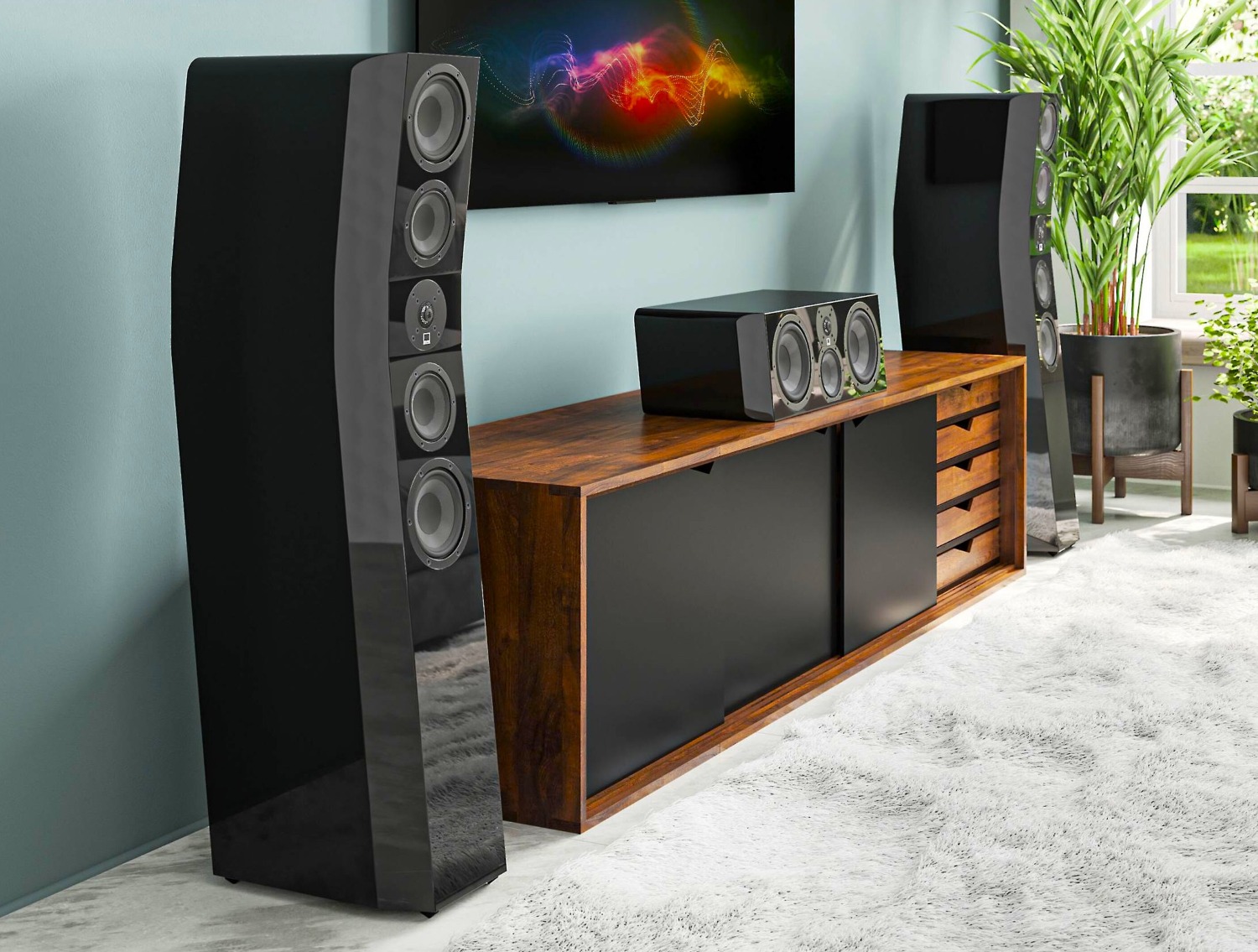
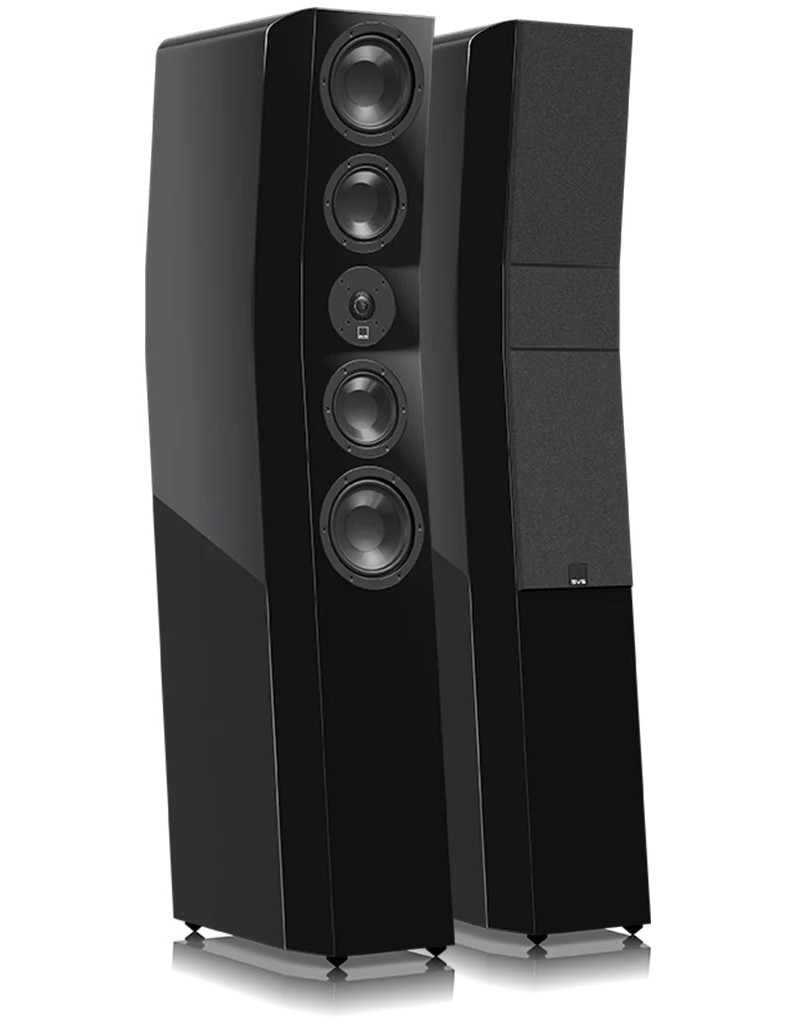
Ultra Evolution Towers are the most diminutive of three floorstanding loudspeaker models in SVS's flagship Ultra Evolution line. There's an obvious heavy focus on use in home theater installations, but the floorstanders also seem to possess the potential to excel in high-end audio setups. Even as the "baby" in the Ultra Evolution lineup, the Towers boast significant heft, weighing about 70 lbs boxed (each) and 60 lbs unboxed—Sherpaing them to my upstairs listening environment proved quite the workout! Especially considering that one of the cartons had come unbound during shipping, and needed to be re-taped (as a precaution) prior to being dragged upstairs. Unboxed, they're tallish at close to four-feet in height, are just over 8.5 inches wide, and are nearly 17 inches deep. Conical elastomer feet are attached at the factory, but substantial spikes are also provided, which was definitely the better choice in my carpeted listening environment.
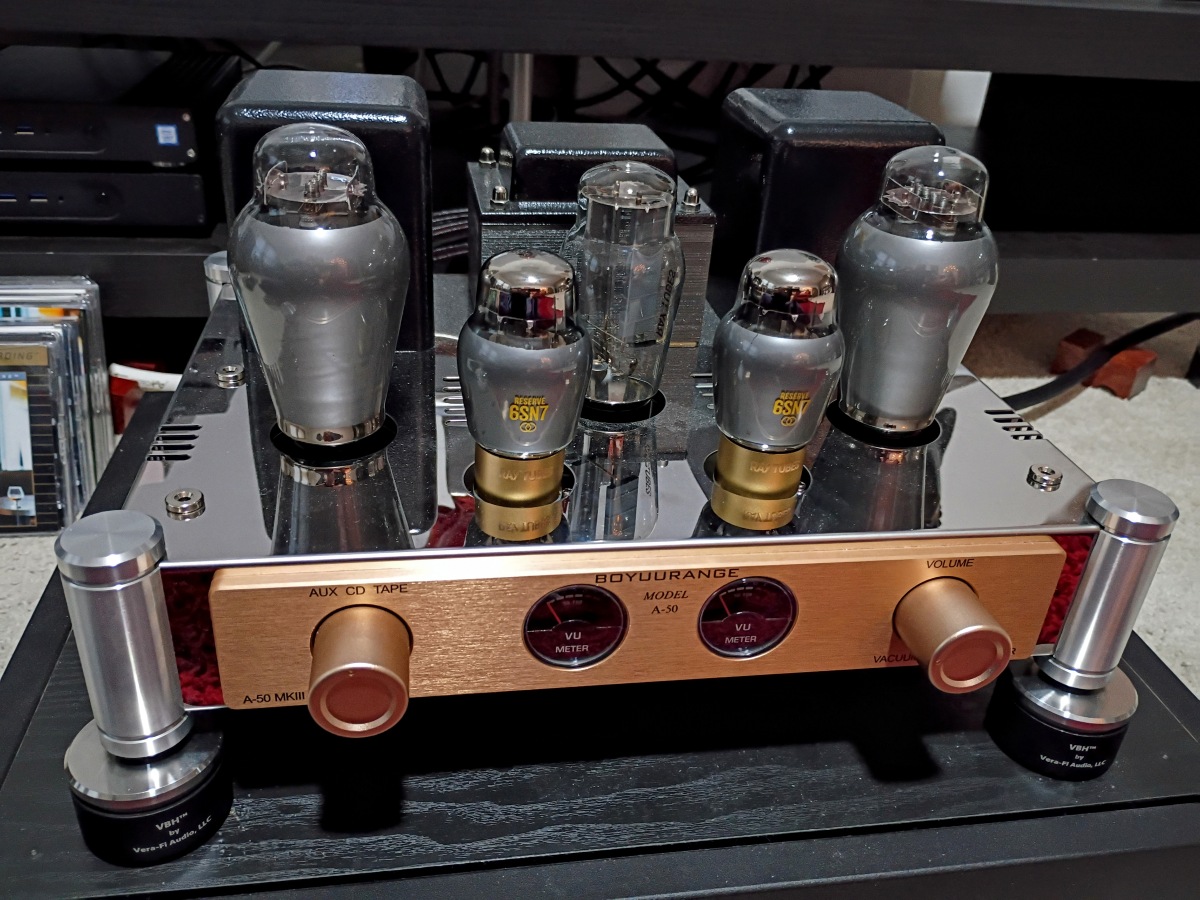
The SVS Towers feature unusually shaped cabinets designed to provide acoustically centered time alignment for the front-facing drivers. Their tallish height and relatively narrow side profile cause them to be a bit top-heavy and somewhat unwieldy, and during the initial setup, I nearly knocked one of them over. That would have been disastrous, and could easily have taken out my PrimaLuna tube amplifier, whose complement of RAY tubes cost more than each SVS Tower loudspeaker! Not to mention the potential damage to the amplifier itself, as well as likely seriously damaging the piano gloss finish of that particular Tower. Yikes! Switching to spikes from the stock elastomer feet significantly enhanced their stability and allowed me to level them perfectly.
Each SVS Tower features a complement of seven drivers; the all-important high frequencies are handled by a vapor deposited, diamond-coated, one-inch aluminum dome tweeter. A pair of 4.5-inch glass-fiber composite midrange drivers flank the tweeter from above and below; they employ vented Kapton voice coil formers for improved dynamics and transient response. A quad of high-output, 5.25-inch glass-fiber composite woofers are aligned within the cabinet in SVS's "force balanced array" configuration, which eliminates any mechanical coloration between the front and rear firing woofers. Low frequency extension is aided by a pair of 2.5-inch, wide-flare rear-firing ports; all woofer and midrange drivers employ precision cast aluminum baskets for enhanced stability and improved thermal dissipation. Overall frequency response for the SVS Towers is stated as 30Hz - 40kHz (+/- 3dB), nominal impedance is listed as 6 ohms, and sensitivity is 87dB for a 2.83V input@1 meter. The Ultra Evolution Towers are fairly unfussy with regard to amplification, and are rated for a range of 20-300 watts per channel. I alternated between my PrimaLuna EVO 300 tube integrated (50 wpc, KT88 RAY Reserve power tubes) and my German-made Naiu Labs Ella power amplifier (250 wpc/8 ohms, 500 wpc/4 ohms, 1 kwpc/2 ohms); both achieved excellent results while driving the SVS Towers.
Dual sets of jumpered five-way binding posts allow the end user to bi-wire or biamplify the Ultra Evolution Towers. Stylish magnetic grills were included for each Tower, but in my usual fashion, all my listening throughout the evaluation period was done with the grills removed. While my review pair were shipped in the piano gloss black finish, the Ultra Evolution Towers are also available in piano gloss white or real black oak veneer finish options.
Both Ultra Evolution Towers were packed well, and suffered no damage in shipping; inspecting them afterwards revealed their overall fit-and-finish to be on par with the best loudspeakers available. SVS Sound is located in Youngstown, Ohio; all research and development takes place there, but most of their product line is manufactured in China, which is not unusual in this day and age. Much of my current equipment stack (loudspeakers, subs, DAC, music server, and disc players) is also made in China or the Far East, and I have years of experience with a variety of gear—much of it with high-end pretensions—from a multitude of Far East manufacturers. That point of origin is definitely not a negative in my current world view of high end audio.
Setup and listening results
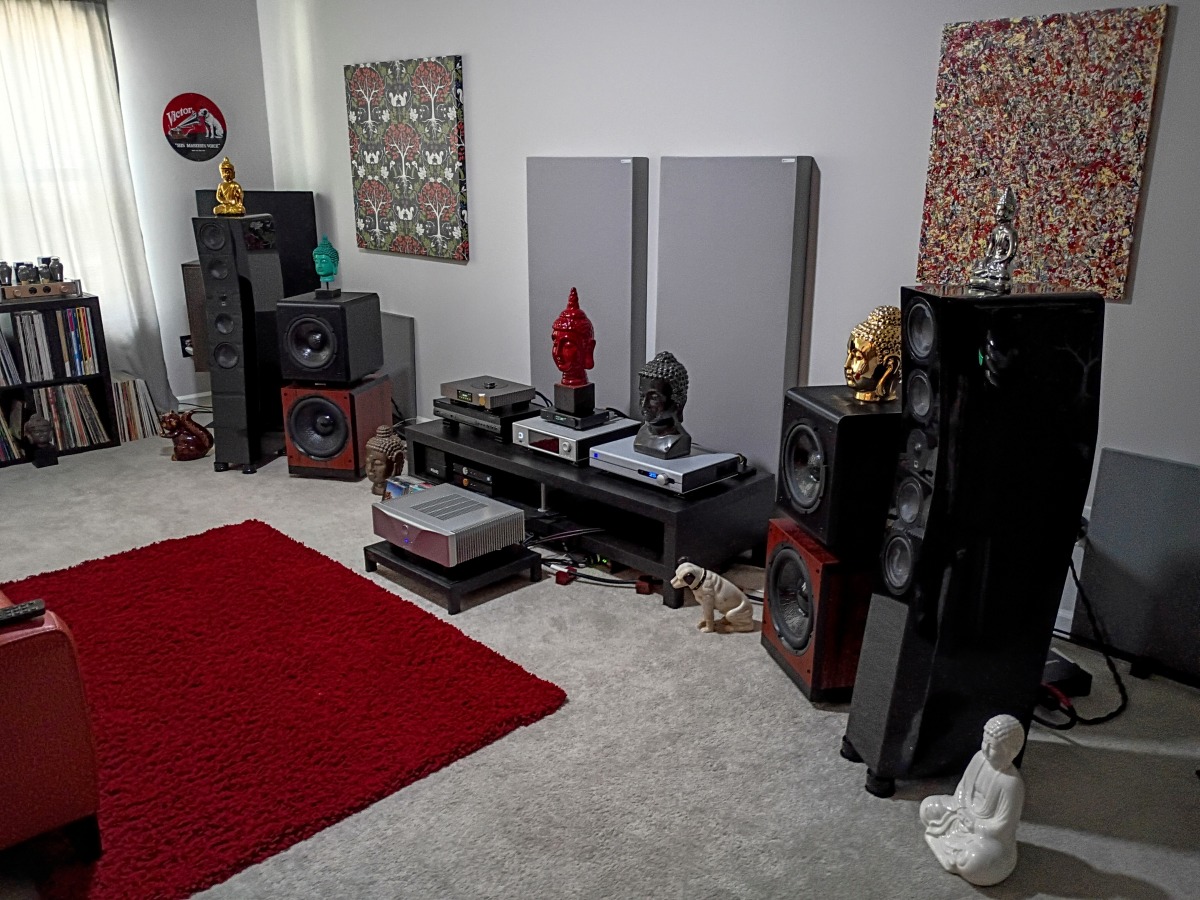
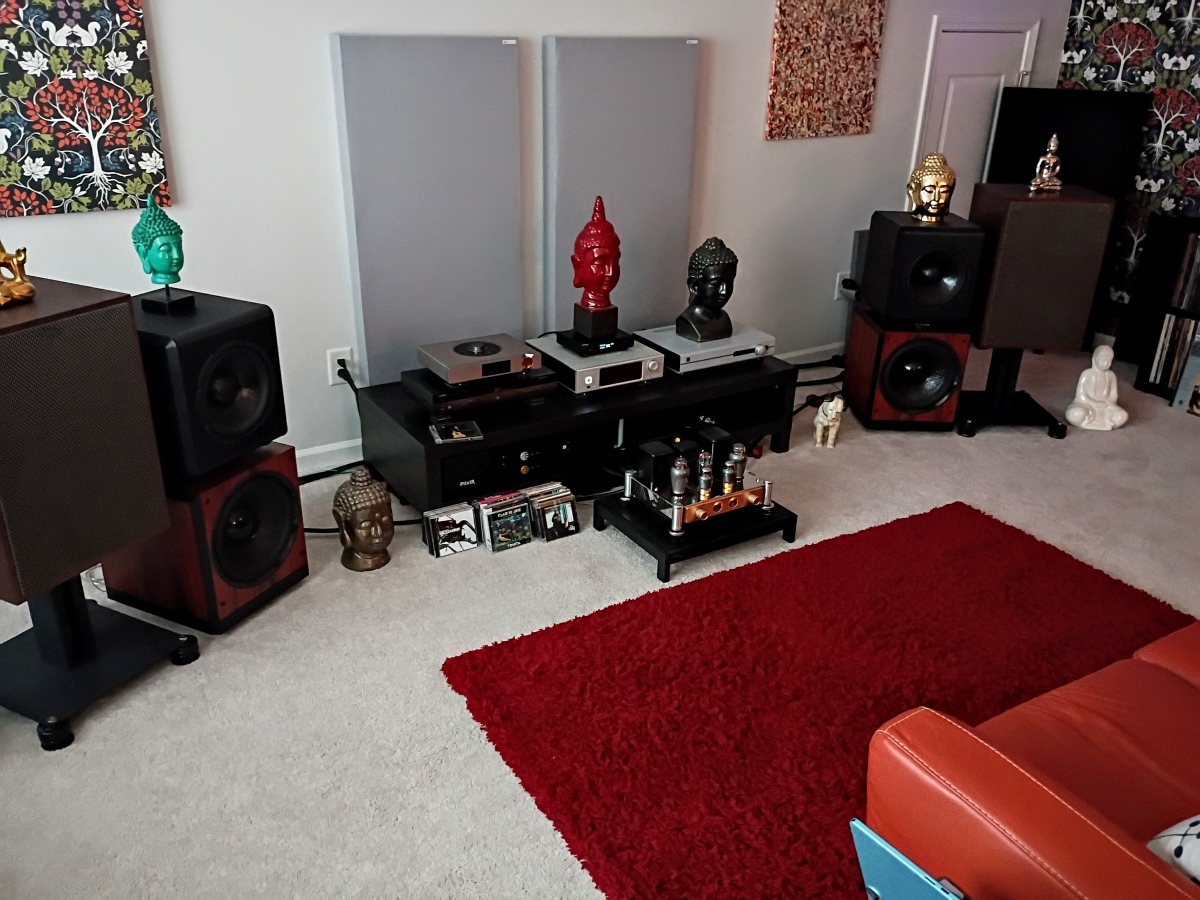
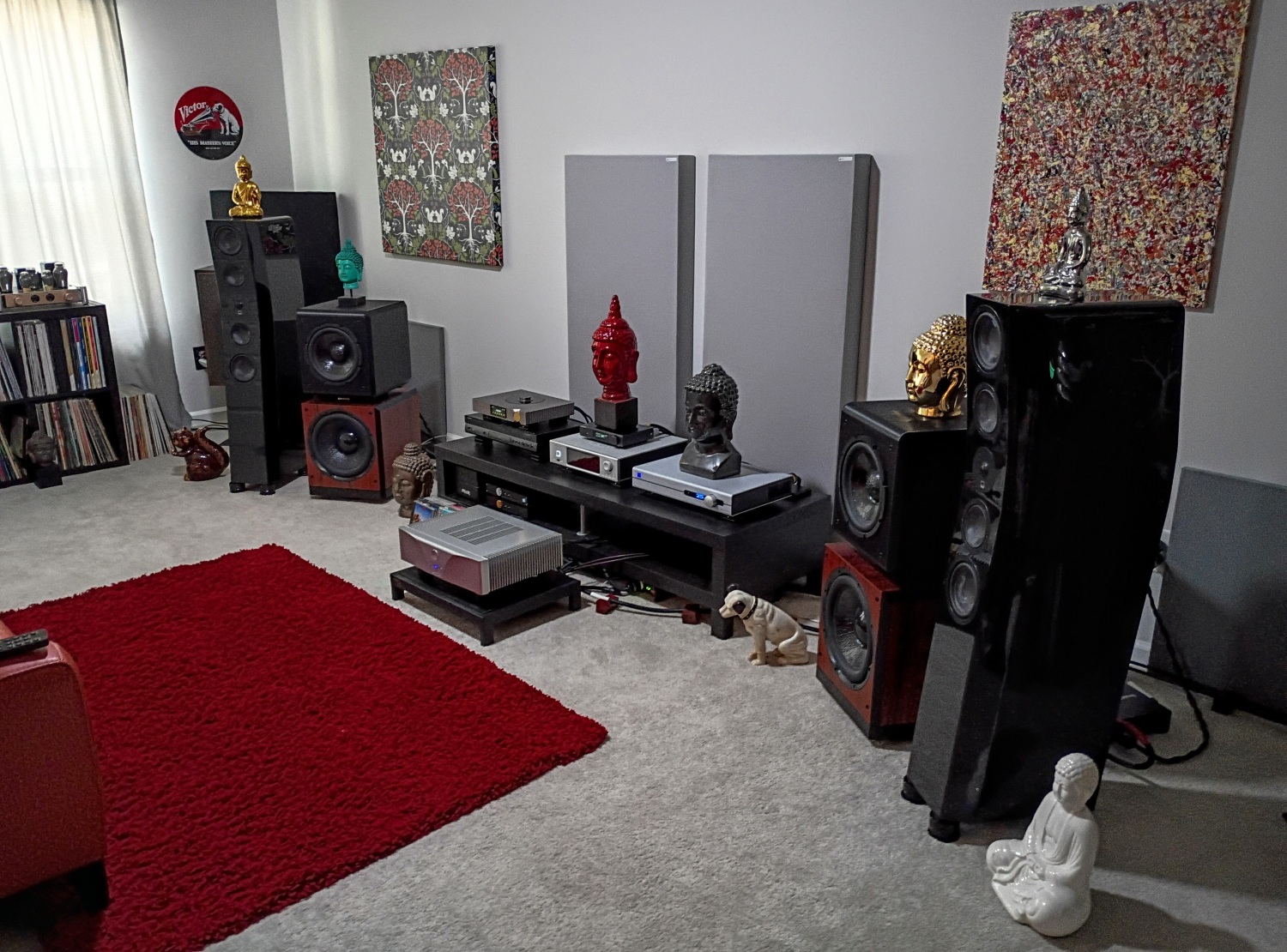
If you click on my name in the header above, you can see the full contents of my audio system. Unpacking the Ultra Evolution Towers was a bit labor-intensive due to their relative heft, and moving them about the room was a bit of a chore. I'll take heft over flyweight any day, so that was an acceptable tradeoff for me. My room is set up in a long-wall orientation, with the Towers positioned about 11 feet apart, roughly 4 feet from the wall behind them, and situated about 4.5 feet from the side walls. My listening position was triangulated to the Towers' acoustic centers, and they were toed-in, but not so much that the tweeters were pointed directly at my ears. I've been slowly tweaking this room for some time now, and have achieved a setup model that works perfectly for stereo listening. GIK acoustic panels on the wall behind and between the loudspeakers enhance the center image specificity, and GIK bass traps in the room corners behind them keep the bass more well-controlled. Corning acoustic panels are scattered at intervals around the room and are also hung in the upper corner junctures between the walls and the ceiling—the room offers probably the best acoustics I've ever experienced in my home listening environment.
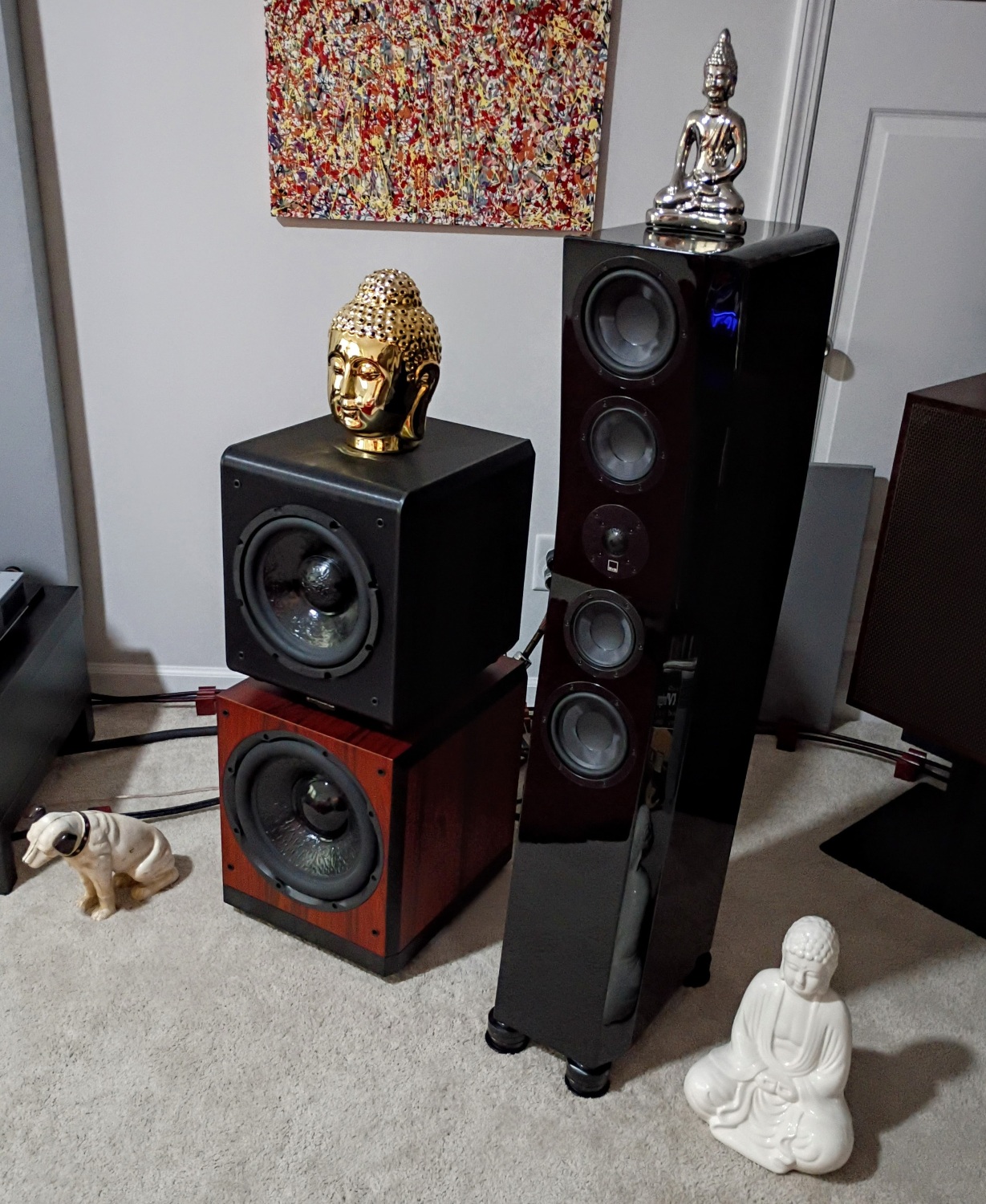
The SVS Towers ran full-range and in tandem with the stacked quad of Vera-Fi Audio Caldera subwoofers; the subs didn't affect the tonal character of the Towers, and helped push the low bass response further down into the next octave. The sound quality seemed pretty good out of the box, but lots of critical listening revealed that the SVS Towers would definitely benefit from some serious break-in. Meanwhile, a pair of Klipsch Heresy IV loudspeakers also arrived for review (within days of the SVS Towers), so I alternated regularly between the two speaker pairs, which were placed alongside each other for the next couple of months. By late October, the Towers had a couple hundred hours on them, with that time evenly split between tube and solid-state amplification. Regardless of which amp was driving them, my impression of the SVS Towers' tonal characteristics remained consistent, and were getting more in line with my expectations. But nagging issues with their sound still persisted, and pushing them with anything bass-heavy would cause the bass drivers to distort just enough to annoy me. And this was at fairly normal listening levels.
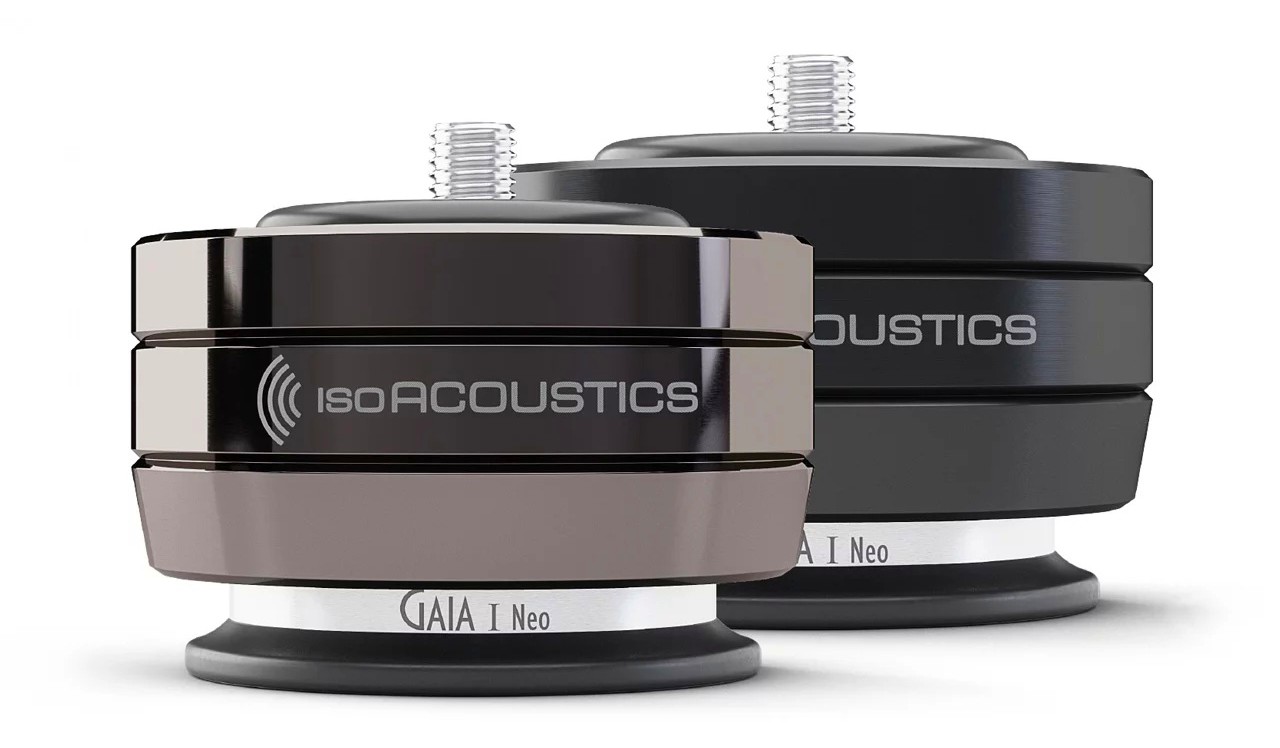
Here's when the miracle happened: while at Audio Advice Live in August, I'd also experienced an eye-opening demonstration of IsoAcoustics new GAIA Neo isolators. And the good folks at IsoAcoustics kindly agreed to send complete sets of GAIA Neos and Aperta Sub isolators to me for evaluation. The timing of the arrival of the IsoAcoustics isolators couldn't have been better! Sets of GAIA Neo II's were attached to each SVS Tower, and a pair of the Aperta Sub isolators were placed underneath each stack of subwoofers. The resulting transformation of the sound I now heard from the Towers was revelatory; you can read my full evaluation of the IsoAcoustics GAIA Neo and Aperta Sub devices HERE.¹ And the SVS Towers that were seemingly incapable of satisfying me suddenly never failed to impress, and at any volume level!
Music choices
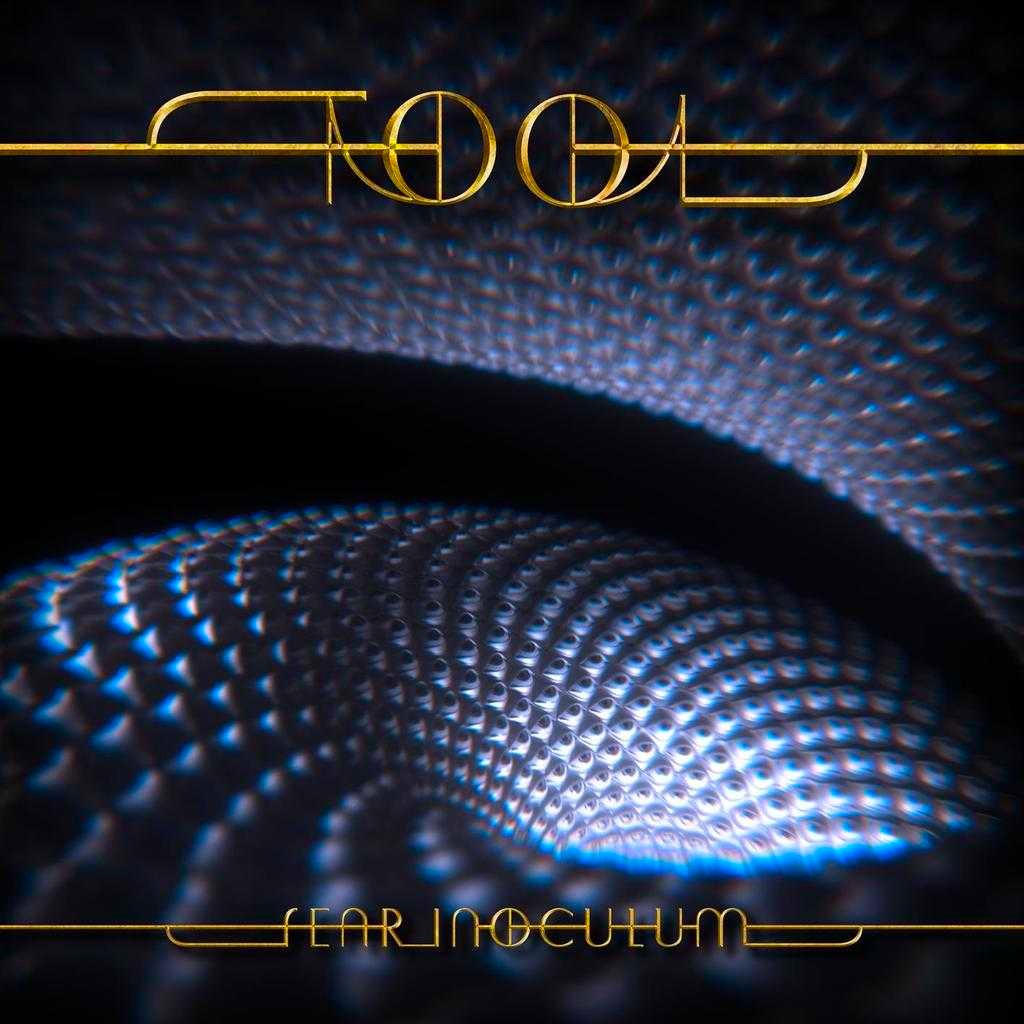
TOOL's "Chocolate Chip Trip" from their album Fear Inoculum is essentially an extended drum solo, and it's a great track to gauge any system's low-bass capabilities. Of course, you have to give credit to the quad of Vera-Fi subs for their share of the heavy lifting, but through the SVS Towers, this very dynamic track absolutely rocked the room like never before! The stereo spread was incredible, and Danny Carey's drum kit was delivered with the kind of you-are-there realism that felt as though the house was about to collapse around us! The Towers plowed through this high-octane music without so much as a hiccup—I couldn't believe their smallish complement of bass drivers were actually up to the task. A guest present for this demo sat while rhythmically shaking his head and laughing, and all he could get out at the track's conclusion was "Damn, man!"
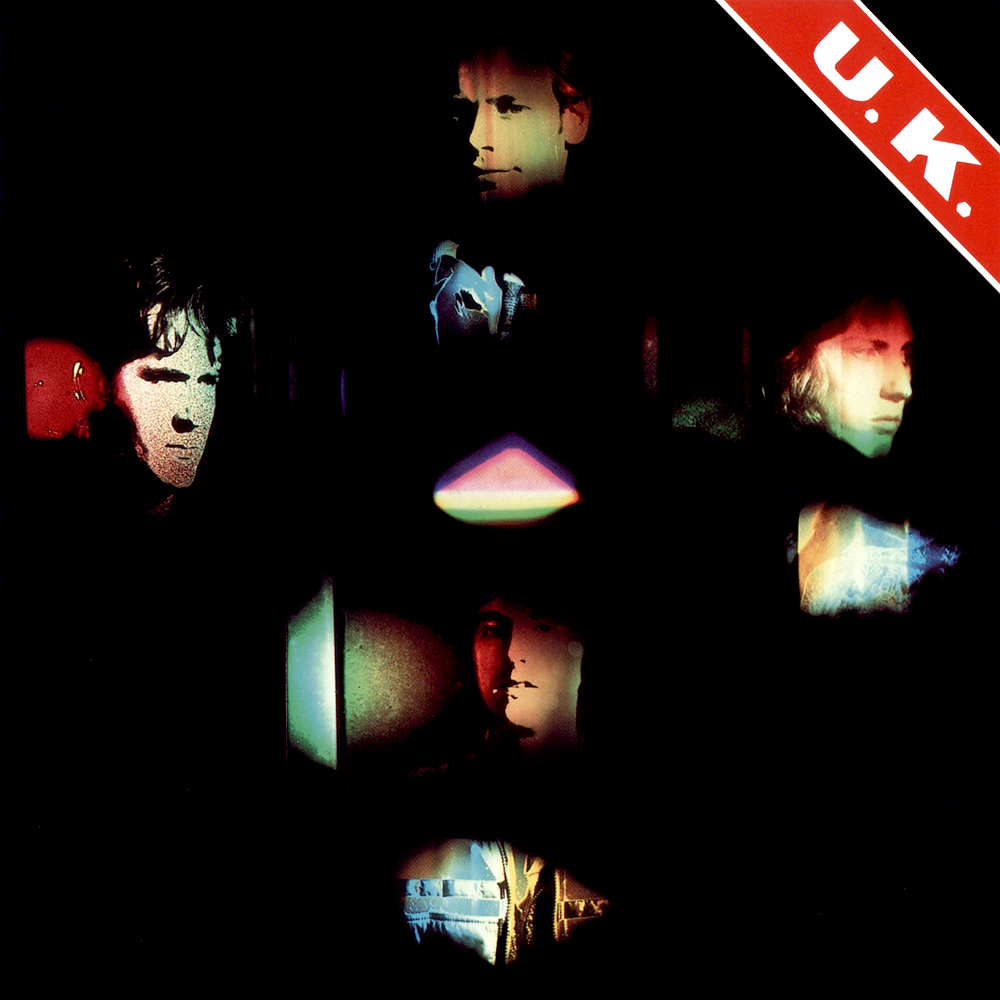
I recently picked up a Japanese SHM compact disc of prog supergroup UK's eponymous debut. UK is perhaps one of prog's finest moments, and the superb interplay between guitarist Allan Holdsworth, bassist and vocalist John Wetton, multi-instrumentalist Eddie Jobson, and drummer extraordinaire Bill Bruford captures a moment in time of unparalleled brilliance. The SHM disc presents the best digital version of this album I've ever heard, and as the tracks "Alaska" and "Time To Kill" segue into each other, they'll dynamically challenge most any high-end loudspeaker. Across the Ultra Evolution Towers, Eddie Jobson's massively layered synths propelled "Alaska" with the kind of visceral momentum that virtually transformed my room into a landing zone for an alien spacecraft! The rhythm section of Bruford and Wetton provided a pounding, driving foundation that could easily pop drywall nails out of the walls, while Allan Holdsworth's unrestrained soloing left me slack-jawed! Played at reference levels, this powerful music shook my listening room mightily, and the SVS Towers never flinched.

A surprisingly good track for system evaluation with an emphasis on low-bass output is Elton John's classic "Madman Across the Water," played here from the SACD of the same name. Through the Ultra Evolution Towers, as acoustic guitars to the left and right open the track, Elton's voice emerges from the center with perfect liquidity and powerful presence. And as the song slowly builds to a powerfully propulsive orchestral crescendo, the quad of small woofers in each Tower and the quad of subwoofers are working overtime. This is another "shake the whole house" tune; despite having heard this song countless times, I previously never fully realized its potential for system demonstration and evaluation. Across the SVS Towers, "Madman Across the Water" blew me away with dynamic transients that shook my very core.
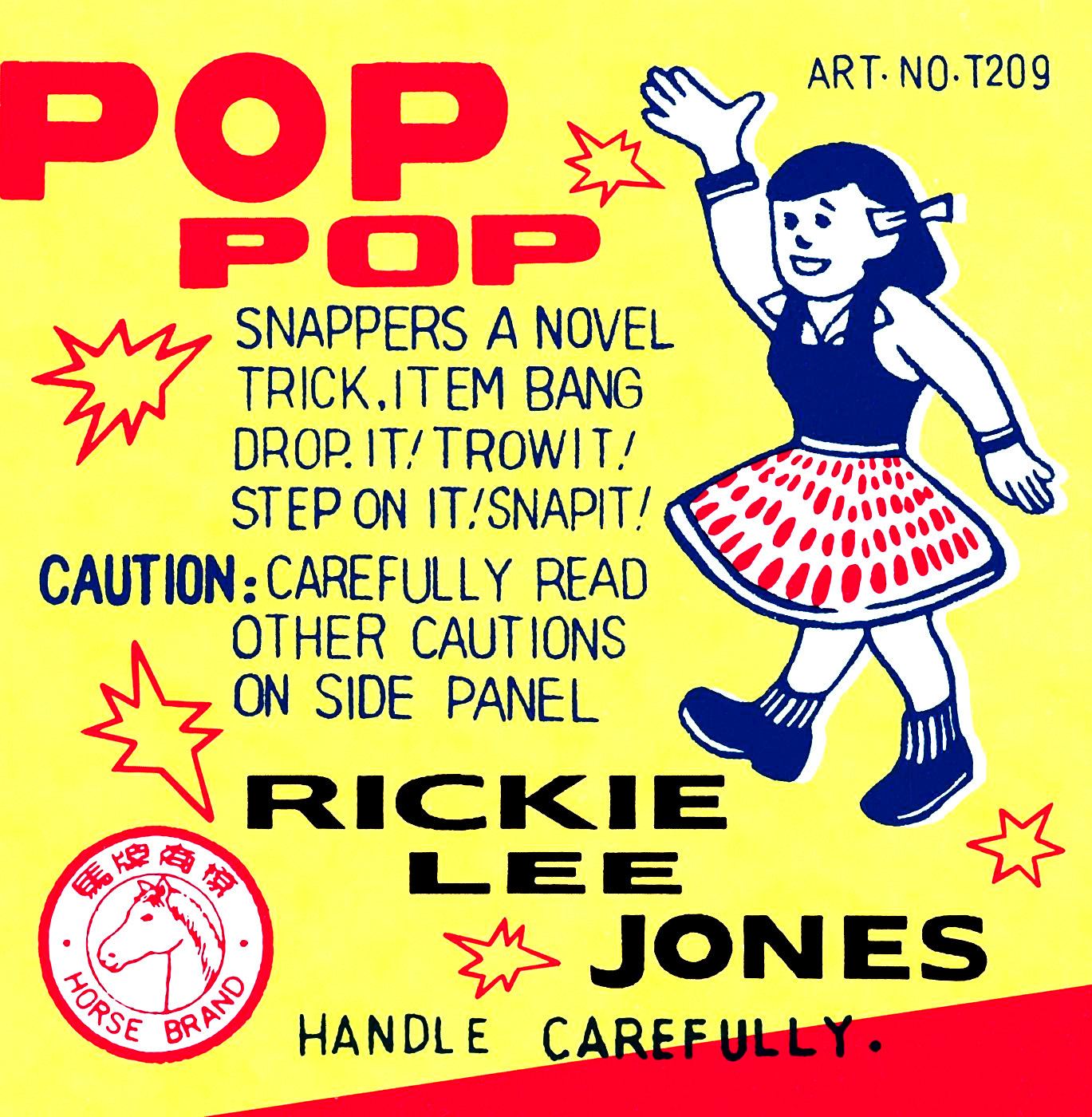
Another track that's become one of my go-to "torture tests" of sorts is "I'll Be Seeing You" from Rickie Lee Jones' hip and quirky covers album, Pop Pop. Jazz great Charlie Haden plays throughout the album, and his acoustic bass was recorded with startlingly deep realism, such that just about any loudspeaker in my personal experience will distort when playing this track. I normally listen somewhere typically around 80 decibels or so, but it's always a temptation to goose the volume, which can easily overdrive many loudspeakers. Rickie Lee's voice is perfectly captured here, and I typically set the volume such that her voice sounds as though she's live and in the room. That can be a problem for many loudspeakers, especially when Charlie Haden starts plucking his upright bass, which has a significant level of output in the upper registers. The SVS Towers sailed right through this demanding track at reference levels; I've heard this tune a zillion times, and it's always a rush when delivered sans any distortion.
I'm amazed by how acoustic instruments will cause loudspeaker distortion much more quickly than synthesized music; that impression remained consistent playing albums from Yello, Depeche Mode, and Dead Can Dance across the Ultra Evolution Towers. Yello's Stella rocked the house; the same can be said for Depeche Mode's Music for the Masses and Dead Can Dance's Spiritchaser. Whether "Vicious Games" from Stella, "Behind the Wheel" from Music for the Masses, or "Indus" from Spiritchaser, the SVS Towers in combination with the quad of subs pounded my brain into mush, and thank god my neighbors didn't call the police! The SVS Towers just kept coming, begging me to crank that volume knob another click!
I don't want to create the impression that the SVS Ultra Evolution Towers are "one-note" loudspeakers, simply designed to impress, but with any music I played across them, they delivered the truth. With superb imaging, impressive dynamics, a surprisingly liquid midrange and treble presentation, and an uncanny recreation of the recorded acoustic. Of course, as home theater loudspeakers, their ability to handle music with tremendous dynamics is built into their DNA, and I imagine they can easily reproduce the bombast and explosions of action movies with ease.

Final thoughts
After only two months with the SVS Towers, I came within an eyelash of returning them to the manufacturer and declining the evaluation. The arrival of the IsoAcoustic GAIA Neo II's changed that quickly, but I don't want to hold the Ultra Evolution Towers to account because of that situation, which could very likely be room-specific to my listening environment. My dedicated listening rooms over the years have employed construction using wood, concrete, and a variety of other materials, and each has their own unique set of acoustical problems. Control of floor, wall, ceiling, and airborne vibrations is essential to perfect performance from a range of audio equipment—especially loudspeakers and subs. Decoupling the SVS Towers and the subs from the room with the IsoAcoustics devices allowed them to perform at their maximum potential.
At their price point, the SVS Ultra Evolution Towers are shockingly good loudspeakers, and I've gotten incredibly comfortable with their capabilities throughout the evaluation period. As they've continued to get additional break-in, their sound quality and musicality has also improved exponentially. The vast majority of the music I typically listen to on any given day—which is often folk, classic acoustic jazz, vocals, or even classical or chamber music—is presented with the kind of lyricism, musicality, and you-are-there realism I definitely look for from a high-end audio loudspeaker. The SVS Towers deliver sound that satisfies all my musical tastes.
To quote from SVS's website: "Ultra Evolution is a complete reimagining of speaker design for SVS. This unprecedented marriage of acoustic design breakthroughs and passion for audio excellence has never existed and elevates the new series into the echelon of the finest loudspeakers in the world. Consisting of seven new models with advancements in driver design, cabinet architecture, and component materials, Ultra Evolution ushers in a new era of reference quality sound that transcends their class." While I might have initially considered that statement to be mostly hyperbole, having spent months with the Ultra Evolution Towers, I'm now in total agreement with the conclusion: [their] reference quality of sound transcends their class. Most definitely.
The SVS Ultra Evolution Towers blended seamlessly with the quad of Vera-Fi subwoofers, and virtually disappeared from the soundfield during playback. That's no small feat for a dynamic loudspeaker, and some of the highest praise I can give in any evaluation.² When a loudspeaker doesn't call any attention to itself, you can't really ask for much more than that, and there's nothing between you and the music. Many thanks to Gary Yacoubian, Nick Brown, and Eli Trinkle for their assistance in making this review possible. I can't recommend the SVS Ultra Evolution Towers highly enough, especially at their very attractive price point!
Ultra Evolution Tower Loudspeakers
Retail: $1499.99 (each)
SVS Sound
All images courtesy of SVS Sound and the author.
¹ For absolute clarity, there are any number of variables at play in room acoustics, including the proliferation of vibrations and microvibrations, and far be it from me to imply that the performance of the SVS Towers were substandard in any aspect. But this much is factual and clear to me from my continued listening: when the Towers and Vera-Fi subwoofers were decoupled from the room by the IsoAcoustic GAIA Neo II's and Aperta sub devices, the performance and sound quality of both very quickly snapped into complete focus. I use a variety of resonance and microvibration control devices underneath all amplifiers, preamps, and source equipment in my system, and I'm a huge believer that vibration control gets you closer to the music.
² As a longtime Magneplanar owner, having a dynamic loudspeaker disappear in my listening environment is pretty rare, but the SVS Ultra Evolution Towers managed the trick handily!