



This article is drawn from an ongoing series of public discussions on electromagnetic field theory and audio cable design, conducted on my personal Facebook page over the past several weeks. The exchanges documented here are real – quoted directly from public comments – and represent a pattern I have observed consistently across hundreds of similar debates over thirty-three years. The original discussions, along with the physics framework they reference and the community that has formed around them, can be found on my Facebook page under Theodore Walton Denney III.
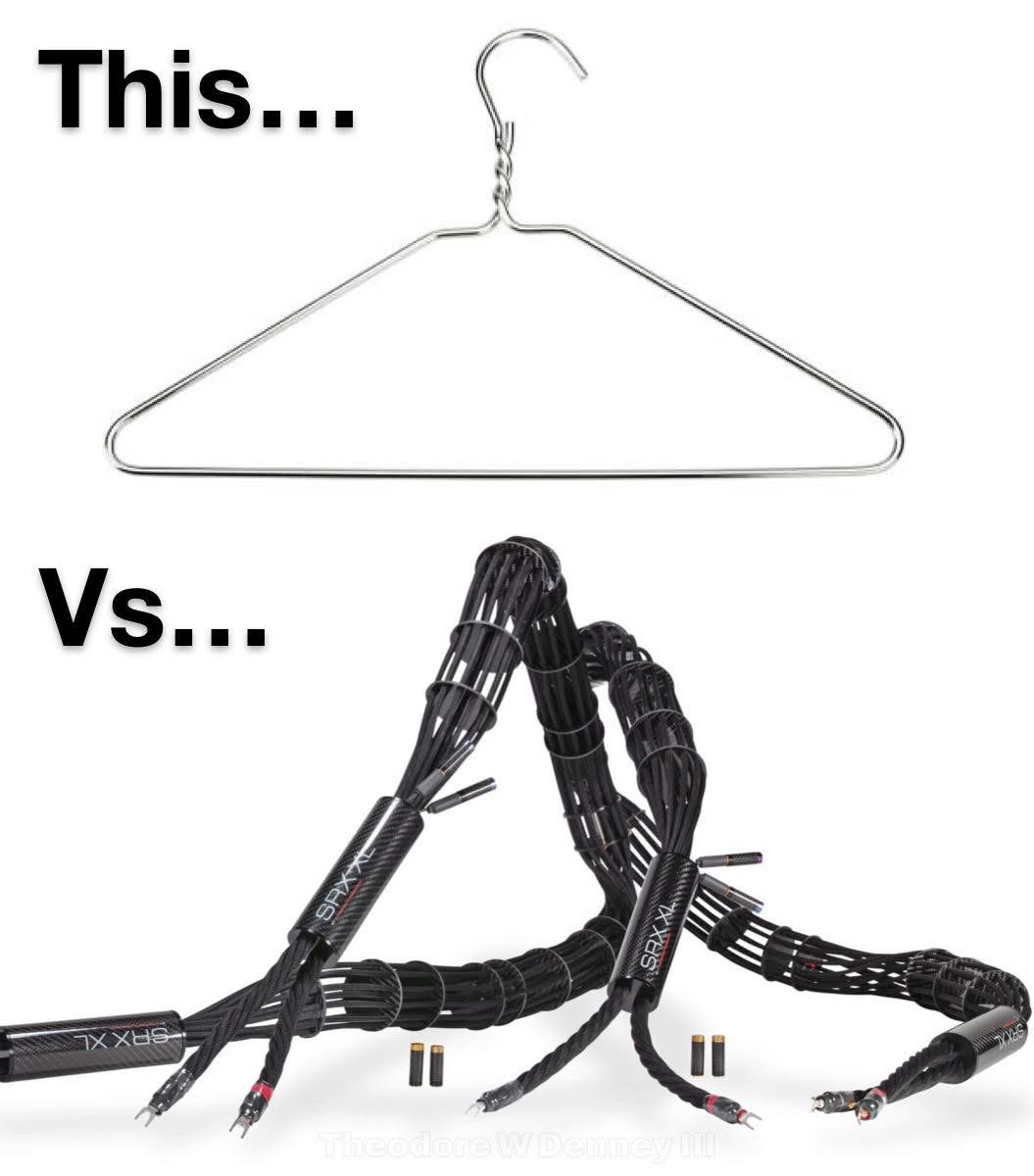
In every cable debate, on every forum, in every comment section, the coat hanger eventually arrives. It is the objectivist community's closing argument – the trump card played when the physics has been conceded, the data has been dismissed, and the only move remaining is an appeal to folklore. Someone, somewhere, once tested a coat hanger against a speaker cable, and nobody could tell the difference. Therefore cables don't matter. Case closed.
The coat hanger test has no published methodology. No documented listeners. No controlled conditions. No statistical analysis. No peer review. It is an unverified anecdote from an internet forum, repeated so many times that it has acquired the weight of established science – without ever having been science at all.
This article documents what happens when a technical skeptic engages with the actual physics of cable design, concedes the physics point by point, and then retreats to the coat hanger as his final authority. The arc is instructive. Not because the individual matters, but because the pattern repeats in every cable debate. The physics is conceded. The conclusion is refused. And the coat hanger fills the gap between what was admitted and what cannot be accepted.
The Opening: Real Questions
The exchange began with a legitimate technical challenge. The question: “Should I understand that dielectric constant for low frequencies will be affected by the induced RF signal?” This is a real question, asked by someone with enough background to formulate it precisely. It deserved a precise answer.
The answer: yes. Dielectric permittivity is frequency-dependent. When an audio signal at 20 Hz and broadband RF noise at MHz-GHz frequencies coexist on the same conductor, the dielectric's response to the combined field is not the linear sum of its response to each independently. The loss characteristics differ at each frequency. The material absorbs and dissipates energy differently at each frequency simultaneously. The impedance the audio signal sees is modulated by the RF presence – continuously, along the entire cable run. This is documented in every dielectric materials data sheet and is not in dispute by any materials scientist or electromagnetic field engineer.
The challenger pushed back. I responded with specifics. The exchange was substantive. And then the concessions began.
The Concessions
He agreed that permittivity is frequency-dependent. His words: “True. I agree.”
He agreed that 2.4 GHz suffers greater losses in the dielectric than 20 Hz – confirming that the dielectric responds differently to different frequencies simultaneously. This is the foundation of the dielectric modulation mechanism: the combined field produces a dielectric response that neither frequency would produce alone.
He agreed that a nearby conductor or body changes the RF field and couples capacitively to the cable – confirming near-field coupling as a real mechanism affecting the signal's electromagnetic environment.
Three concessions. Each one a link in the chain: the dielectric responds to frequency. The combined field produces a different response than either frequency alone. External conductors couple into the cable's field environment. Together, they establish that the electromagnetic field carrying the audio signal is shaped by the dielectric, the geometry, and the proximity of every conductor and surface in the environment – exactly the mechanism that cable engineering addresses.
Each concession was given quietly, while the argument continued as if nothing had changed.
The Binary
I asked a binary question. Five times. Either sixty-three independent listeners at CanJam NYC produced a thirty-point invariant gap across two days and two different listener populations because they heard a real electromagnetic environment difference – or they hallucinated it.
He dodged it four times. On the fifth, he answered.
His answer: the results are “100% explained by expectations, bias, courtesy and hallucinations.”
One hundred percent. Every listener. Every parameter. Every score. Including the skeptics who scored zero. Including the listeners who scored negative. Including credentialed audio press. All hallucinating. All 693 data points – explained entirely by psychology, with not one microgram attributable to the physical difference between three electromagnetic environments using identical electronics and identical headphones.
This is where a man lands when the physics has been conceded but the conclusion cannot be. The mechanism is real – he agreed. The dielectric modulation is real – he agreed. The coupling is real – he agreed. But the audible consequence of all of it? One hundred percent hallucination. The physics exists. The consequence doesn't. That is not a scientific position. It is a firewall between concession and conclusion.
The Denial of Spatial Hearing
The exchange moved to spatial perception. I described microsecond-level interaural timing differences – the primary mechanism by which the human auditory system localizes sound in three-dimensional space. This is documented in Blauert, Moore, and every auditory neuroscience textbook published in the last fifty years. The detection threshold is approximately ten microseconds.
His response: “Really? Microsecond timing between channels matters? Can you hold your head still with sub-millimeter precision?”
He told the audience that human spatial hearing doesn't work – because people move their heads. By that logic, no human has ever localized a sound source. No one has ever perceived a three-dimensional soundstage. No one has ever turned toward a voice in a crowded room. The entire field of psychoacoustics – decades of research, thousands of published studies – invalidated because humans aren't bolted to a fixed position.
The brain compensates for head movement dynamically, integrating vestibular and proprioceptive input with auditory processing. This is how spatial hearing works in the real world – where humans move constantly and still perceive dimensional sound with extraordinary precision. Every person reading this has experienced it. The claim that spatial hearing cannot function because people move their heads contradicts the lived experience of every human being with two ears.
The mechanism I described – phase smearing from broadband RF contamination degrading the timing relationships that encode spatial information – is not a fixed delay the brain can adapt to. It is a continuous, varying distortion embedded in the signal, changing with the noise environment, varying across frequency, present on every cycle. The brain cannot compensate for it because it is indistinguishable from the signal itself. The brain interprets the degraded version as the recording. The soundstage flattens. The imaging diffuses. The listener doesn't know what's missing – because his system never showed him what was there.
The Coat Hanger
After conceding frequency-dependent permittivity, capacitive coupling, and superposition – after attributing 693 data points to hallucination – after denying that human spatial hearing functions – his closing scientific citation was the coat hanger test. An unverified internet anecdote claiming that a bent piece of galvanized steel sounds identical to a purpose-engineered speaker cable.
He called the coat hanger “absolutely valid speaker cable” and said its lack of insulation is “a huge plus.”
Examine what a coat hanger actually is – as a transmission line for an electromagnetic field.
A coat hanger doesn't have “no dielectric.” Air is the dielectric, with a relative permittivity of approximately 1.0. And the moment the coat hanger touches anything – carpet, wood, the wall, another cable, the speaker cabinet – that surface becomes part of the dielectric environment, with its own permittivity. Carpet is different from wood is different from concrete is different from air. The dielectric isn't absent. It's random – changing at every contact point along the entire length, producing a different impedance characteristic at every point, a different permittivity modulating the field at every surface the wire happens to touch.
That is not “no dielectric to modulate.” That is every dielectric in the room modulating the field simultaneously, uncontrolled, at random. The “huge plus” he cited is the worst possible dielectric management – an environment determined entirely by whatever the wire is lying on.
The coat hanger is galvanized steel – a ferromagnetic conductor with a zinc oxide coating. Ferromagnetic materials exhibit hysteresis: a nonlinear relationship between the applied magnetic field and the material's magnetization. This introduces distortion at every cycle of the audio signal. The zinc oxide layer adds another uncontrolled impedance discontinuity at the surface where the field transitions between the conductor and the surrounding environment.
The geometry is random. The cross-section is not optimized for controlled field propagation. The bends introduce impedance discontinuities at every turn. The Poynting vector – S = E × H – describes energy flow through the field around the conductor, and with random geometry, that energy flow is chaotic. The field doesn't propagate in a controlled pattern. It scatters, reflects, and interacts with every surface and conductor in proximity – unmanaged.
Removing controlled dielectric management to avoid dielectric modulation is like removing the roof to avoid a leaky ceiling. You solved the leak. Now you have rain. From every direction. Uncontrolled.
The Pattern

He started with dielectric permittivity. He ended with a coat hanger from his bedroom closet. He entered sounding like an engineer – conceded frequency-dependent permittivity, conceded capacitive coupling, conceded superposition – then attributed 693 data points to 100% hallucination, told the audience that microsecond timing perception doesn't work, cited a coat hanger as scientific evidence, and left with a winking emoji asking his opponent to surrender.
This arc is not unique to him. It is the arc of every technical skeptic who engages with the physics of cable design long enough to encounter the conclusion the physics demands. They begin with real questions. They concede points – quietly, reluctantly, but specifically – because the physics is correct and they can see it. And then they reach the moment where the concessions lead to a conclusion they cannot accept: that the products work, that the customers aren't delusional, and that the position they've held publicly is wrong.
At that moment, the physics stops mattering. The data stops mattering. The concessions are forgotten. And they reach for whatever is closest – hallucination claims, spatial hearing denial, coat hangers – anything that lets them exit without saying the words they cannot bring themselves to say. The coat hanger is not a scientific argument. It is the last refuge of a man who conceded the mechanism but cannot accept the consequence. And it appears, without fail, at the end of every debate that lasts long enough to force the concession.
Why the Coat Hanger Persists
The coat hanger test persists because it is unfalsifiable by design. No published methodology to critique. No documented listeners to evaluate. No controlled conditions to examine. No data to analyze. There is only a story – and stories are immune to physics.
The same community that demands peer-reviewed, double-blind, statistically significant studies before accepting that a purpose-engineered cable might affect sound quality accepts the coat hanger test on the basis of an internet forum post with no methodology, no data, and no peer review. The standard for evidence depends entirely on which direction the conclusion points. Evidence supporting cables requires impossible rigor. Evidence dismissing cables requires a good story.
The Headphonesty article – “A Compilation of 50+ Blind Tests Reveal the Only Gear Upgrade That Actually Matters” – is the coat hanger test scaled to industrial proportions: a Head-Fi.org forum thread compiled by a single hobbyist over fourteen years, repackaged with professional formatting and presented as settled science. The same publication concluded that mud is a valid audio conductor. That is the scientific authority the objectivist community cites – and the coat hanger test is its centerpiece.
Meanwhile, actual measurement work exists. Alpha Audio – an independent Dutch publication – tested thirty-two speaker cables with calibrated instruments and found impedance variations of a factor of one thousand between commercially available cables. A single cable choice reduced a Bryston amplifier's damping factor from 500 to under 13 – a 97% loss of amplifier control over the speaker. Their earlier twelve-cable study, which included an explicit blind listening protocol, found 70% overlap between the measurement Top 3 and the blind listening Top 3. The men citing the coat hanger as definitive have not read it. They don't need to – the coat hanger story is simpler, more satisfying, and confirms what they already believe. It is not evidence. It is a membership card to a community that values the conclusion more than the process that reaches it.
What Engineering Actually Does
A purpose-engineered speaker cable addresses every failure mode the coat hanger embodies.
Where the coat hanger has random geometry, an engineered cable has controlled conductor separation and consistent cross-section – a predictable, stable impedance along the entire run, with the field propagating in a controlled pattern and energy flow following a defined path from amplifier to speaker.
Where the coat hanger has whatever surface it's touching as its dielectric, an engineered cable has a selected dielectric with known permittivity, known loss tangent, and known frequency-dependent behavior – chosen for how it interacts with the propagating field across the audio bandwidth and beyond.
Where the coat hanger has galvanized steel with ferromagnetic hysteresis, an engineered cable uses conductor materials selected for their electromagnetic properties – copper, silver, or alloys chosen for conductivity, skin-effect behavior, and the absence of magnetic nonlinearity.
Where the coat hanger has no protection from the ambient RF environment, an engineered cable can employ metamaterial barriers – semipermeable to audio frequencies, opaque to MHz-GHz contamination – filtering the broadband noise without constraining the signal's field propagation. This is the engineering advance that replaced conventional shielding, which solves RF ingress by creating a conductive boundary that reflects the signal field back on itself, trading noise rejection for field compression.
The coat hanger does none of this. It is the absence of engineering, presented as proof that engineering doesn't matter. That logical structure does not survive examination. And yet it persists – because the men who cite it are not interested in examination. They are interested in the conclusion.
The Close
The men who test the products keep them. Sub-2% return rate. Thirty-three years. Money-back guarantee. They evaluated in their own systems, with their own ears, with their own money at risk – the same way they evaluated every other component they own.
The men who argue the longest concede the most and hear the least. Because they never sit down and listen. That would cost them more than the cable ever would.
The next article in this series examines the engineering framework that addresses what the coat hanger cannot – and introduces a technology that renders the debate irrelevant.
Theodore Walton Denney III is the founder, lead designer, and CEO of Synergistic Research, Inc. His AC Master Coupler was the high-end audio industry's first commercially successful power cord – the product that spurred the entire industry to develop power cords of their own, and the best-selling high-end power cord on the market for nearly a decade. He holds nearly twenty patents in electromagnetic field management for audio applications. This is the third article in an ongoing series published at Positive Feedback.