

The Doobie Brothers' self‑titled 1971 debut barely made a ripple in the record industry. Internally, the band and producer Ted Templeman knew they needed to level- up the songwriting, arrangements, and production to become big artists. Toulouse Street became their turning point. It's the album that effectively "invented" the Doobie Brothers' signature sound.
1972's Toulouse Street marks the first appearance of bassist Tiran Porter and drummer Michael Hossack, who joined John Hartman to create the band's now‑iconic twin‑drummer lineup. This change is central to the album's rhythmic identity—a thicker, more propulsive groove that defined the band's early‑70's sound.
The album was produced by Ted Templeman, who pushed the band towards a more polished and radio-ready blend of rock, gospel harmonies, and southern influences. He also encouraged the use of banjo, recorder, and steel drums. The engineers were Stephen Barncard, Marty Cohn, and Donn Landee (who just passed away April 5, 2026). Recorded at Wally Heider Studios San Fransisco (tracks 4, 8, and 10), and Warner Bros. Studios in North Hollywood.
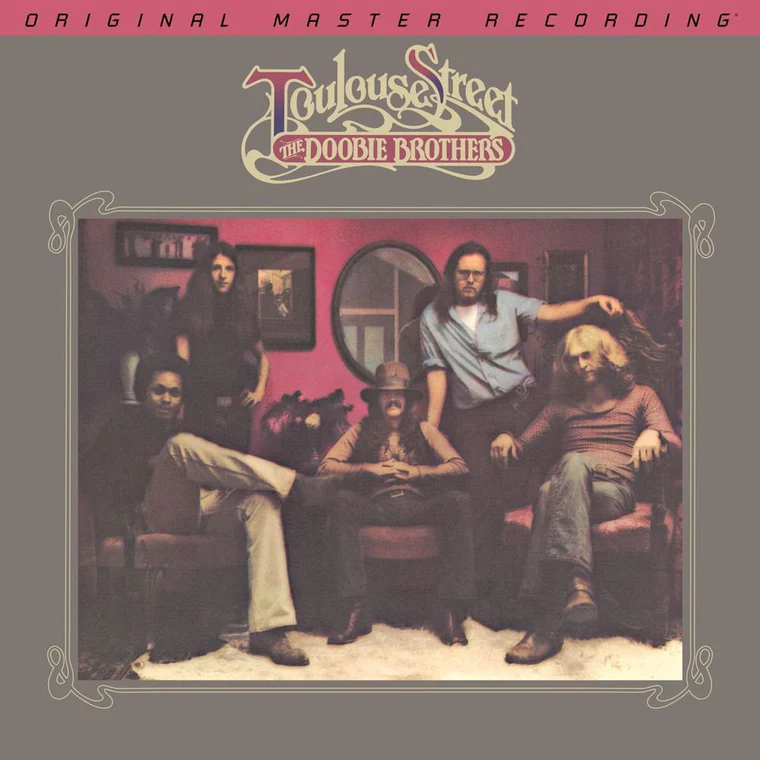
The album cover and inside gatefold photos were taken by Micheal and Jill Maggid in a former brothel on Toulouse Street in the French Quarter of New Orleans. Not sure why they did have a different back cover shot? The choice matched the band's tastes at the time for southern imagery and instrumentation, though they are from California.
Powered by two drummers, excellent producing and engineering, the band sounds more confident than on their first record. The album peaked at #21 on the Billboard Top 200.
Sonic Comparisons
My original vinyl LP is 1972 Warner Bros. copy BS 2641 (with WW2 in the deadwax, indicating Wally Heider lacquer, second cut). It is pressed well and sounds fine. These Heider cuts are typically more open and dynamic than the Columbia cut lacquers found on other early pressings. The soundstage is wider, the midrange less congested, and the transient detail cleaner, especially on tracks like "Listen to the Music" and "Rockin' Down the Highway."
But the MoFi 45 RPM. Wow! This version rocks! It slams, it hits much harder, cleaner, larger instruments and soundstage, more bottom authority, more punch, and so much more. This is what buying audiophile pressings is supposed to be. Put this on and crank it. Nostalgia has never sounded so new. This is a huge improvement!
Technical notes
- Produced by Ted Templman
- Engineered by Donn Landee, with Mary Cohn and Steve Barncard
- Mastered by Krieg Wunderlich at Mobile Fidelity Sound Lab, Sebastopol, CA using the GAIN 2™ Ultra Analog mastering chain
- Source: 1/4" / 15 IPS Dolby A analog master → DSD256 → analog console → lathe
- Plating by: RTI
- Pressed by: Fidelity Record Pressing (FRP) in California. This is MoFi's new in‑house‑adjacent plant (a joint venture with RTI)
- Packaging: Numbered, 180g, 45RPM, 2LP set, Stoughton Printing gatefold jacket
- Vinyl surface noise: Very good
- Vinyl centricity: Very good
- Vinyl warp: Very good
- Album Packaging: Very nice!