

I first met Jeff Wells over 15 years ago when he was the national sales manager for Spectron. He in turn introduced me to Class D amplification via the superb Musician III Mk. 2 amplifiers that Spectron produced at the time. Over the years I’ve come to appreciate Jeff’s no-nonsense approach to high end audio; solid design based on proven principles utilizing quality parts and excellent construction. Like many of his products, he values performance over flash.
Founded by Jeff in Northern California in 2014, Wells Audio operates as a boutique, hands-on manufacturer. Their philosophy centers on precision circuit design, thoughtful parts selection, and fully in-house fabrication—with no fluff in appearance, but intense focus on sound quality. This approach enables extensive customer customization—tweaking gain, inputs, cabling upgrades—reflecting a dedication to service rarely seen even in the boutique world of high-end audio. The Wells Audio Commander preamplifier holds fast to these principles. While no slouch in the looks department it is clearly purpose built with one intention, to allow music to shine through effortlessly, imposing as little electronic artifice as possible. And that is what it did.
The Commander is available in three tiers, each sharing the same core topology but differing somewhat in component refinement. The base model uses high quality parts and some cryogenically treated components. The Level II model adds Bybee AC purifiers and substitutes Rike capacitors and copper foil polypropylene paper-in-oil output coupling capacitors. Level III substitutes Vishay “naked Z foil” resistors in the entire signal path, adds a cryogenically treated Furutech IEC connector, Cardas input and output RCAs and cryogenically treats the tubes, all PCBs, and wire. It adds Bybee AC purifiers on all three legs and substitutes Vishay “naked Z foil” resistors for the series resistors on the shunt style Khozmo attenuator. The unit received for this review was a Level II.
The goal of the Commander is to create the classic triode sound, as pure and unadulterated as possible. It features a unique split-load triode topology using two 12BH7 tubes in the phase inverter stage and one 12BH7A triode per channel for the single gain stage delivering 16 dB of gain with remarkable linearity. A hybrid tube/solid-state buffer stage ensures plate-to-cathode balance for an ultra-clean signal. Dual multi-stage power supplies, carefully staged for a sub 90 dB noise floor virtually eliminates noise. What remains is a small amount of mainly 2nd order harmonic in the distortion spectrum. The above stages are direct coupled with one coupling cap at the output of the audio circuit.
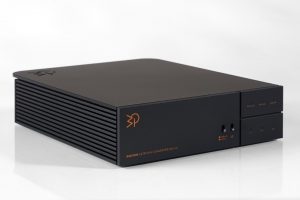
The faceplate is all business. Across the bottom left are buttons for power, mute, polarity, home theater bypass, and tape loop. Across the bottom right are buttons for RCA 3, RCA 2, XLR, volume up, and volume down. The center features volume level display. The rear panel features four pairs of RCA inputs, one pair of XLR inputs, one pair of fixed RCA outputs, two pairs of variable RCA outputs, one pair of XLR outputs, and an IEC connector for power. The XLR connectors are for convenience as the Commander is a single ended design. At roughly 17 inches wide and a bit over 6 inches tall, the Commander has a somewhat stout appearance.
Operating the Commander is a bit quirky. Pressing the power button initiates the soft start procedure and it sounds like you accidentally left your right blinker on for about 90 seconds. The power LED then changes from blinking to a solid blue, and you are good to go. Pressing the volume up or down buttons either on the front panel or the nicely machined, aluminum remote, activates the Khozmo resistor ladder attenuator providing 85 steps of ultra-accurate, low distortion volume control. The volume display on the front panel indicates precise volume settings.
All listening was done from digital files on an M1 Max MacBook Pro streaming to an Xtreme Projectors’ Apple TV-X designed and built by the brilliant Chris Stephens and reviewed elsewhere in Positive Feedback by Dr. David Robinson. Designed as a streaming video device, Chris did some of the beta testing in my system. What we discovered was that in addition to producing the best picture I had ever seen, the audio quality was breathtaking. Even feeding the very modestly priced Schitt Modi DAC, the sound was top notch. My Wilson-Benesch A.C.T. speakers were powered by a pair of Merrill Audio Veritas amplifiers.
So how did the Commander sound? In a word, superb. The quality first, no-nonsense approach was clearly borne out by the sound, or lack thereof, of the Commander Level II preamp. It had a sweetness without coloration. The sweetness was a function of the lifelike timbre of each instrument and the preamp’s transparency. The sound was detailed without any edginess or sense of etch. Instruments breathed naturally, soulfully.
Macy Gray’s performance of the Metallica classic, “Nothing Else Matters” from Stripped was soulful and lively. Her sonic image was solid, full bodied, and eerily present. The raspiness of her voice had a natural, organic quality, detailed but without any sense of artificial sharpening or etch. The recording occurred in a slightly live room, and the Commander did a superb job of conveying the size and liveness of the space, adding greatly to the realism of the performance. The standup bass, placed solidly stage left (listener right), was particularly seductive with bite and depth. The woody resonance of the body, and buzz of the strings were of a piece, transparent and tuneful in the way that gives you goosebumps. I play the drums, almost every day, and it is a sound with which I am intimately familiar. The brushes on snare sat back and slightly to the listener’s left of Gray. The micro dynamics of the brushwork added further to the sense of presence and realism. The high hat had just the right amount of “chick” and the cymbals had that familiar and realistic sizzling shimmer when struck. The tone of the jazz guitar, sitting far stage right (listener left) was round, without being lush, well defined without being edgy. Just gobs of detail you could relax and enjoy. The trumpet that comes in far stage left at 4:14 was well resolved, and in the same acoustic space as the rest of the band, brash and brassy, articulate and completely devoid of harshness.
If you ever come across a copy of Triangle’s demo disk (or the digital files), Musique – Triangle Electroacoustique, buy it. It is exquisite both for the quality of the recordings and the wonderfully diverse musical repertoire. It’s impossible to find but by luck, a friend gave me a copy years ago and its files now live on my MacBook Pro. Jonas Hellborg’s bass guitar only performance of Jimi Hendrix’s “Little Wing” was at times exquisitely sharp, and full of attack, soft and tuneful at others. It had the gut punch realism of an electric bass through an amp, percussive, immediate and dynamic, and at the same time, harmonically rich and tuneful. The Commander got out of the way and just let the music breath inviting long listening sessions.
The opening strings on “Eleanor Rigby” from Beatles Love had palpable bite and attack perfectly balanced with the woody resonance of the instrument bodies. The violins were sharp without etch, their timbre clearly distinct from the cellos. The Commander just seems to breathe, passing gobs of musical information in an immediate, musical, and transparent manner.
The Commander’s combination of detail and warmth was seductive with every album I auditioned, inviting me to listen to the next track, and the next one, and the next one. With regards to Jeff Well’s intention of neutrality, imparting as little sonic signature as possible, I can clearly say, mission accomplished. Neutral can sometimes be interpreted as sterile, lacking heart and soul. The Commander is anything but sterile. It gets out of the way and allows the life and voice encoded in the recordings to pass through it. It transmits the sense of aliveness and pace that makes you bob your head, tap your toe, and truly enjoy the music. I can highly recommend the Commander for its musicality, low noise, holographic imaging, and natural, dynamic presentation of what’s on your recordings. If you are a “music first” audiophile, the emotional engagement it provides is captivating. At $9,000, the Level II version is not inexpensive, but it delivers a level of musical satisfaction that would likely cost far more to match elsewhere. If you value performance over fluff, the Commander is a solid choice.
One last note on Wells Audio’s customer service: accommodation is not treated as an afterthought. It’s part of the company’s design philosophy, both technically and operationally. Their products are built in a way that not only permits customization but welcomes it. If your system has unusual requirements, or if you simply prefer things done a certain way, Wells Audio is prepared to work with you. They are willing to tailor a product to the specific needs of the system and the listener. That kind of flexibility is rare, and it says a great deal about how the company thinks about its customers.
Wells Audio
106 Bascom Court
Campbell, CA 95008
(408) 376.0861
wellsaudio.com
Specifications:
Gain: 16dB
Frequency response: +0/-0.1dB from 2Hz to 20kHz
Noise: -92dB, 35uv wide band
Total Harmonic Distortion: (THD): at 1k or at 20k 1.5v out = .05%
Max Output: = > 10v
Channel Separation: = 82dB at 1kHz
Input Impedance: 25k Ohms nominal
Output Impedance: = 200 Ohms
Inputs: 3 pairs RCA unbalanced, one pair XLR unbalanced, one pair Tape-in, one pair Home Theater Bypass RCAs unbalanced
Outputs: 2 pair variable RCAs unbalanced, one pair variable XLR unbalanced, one pair fixed output RCAs
Operating Voltage: 120V, 240V at 50 or 60Hz
Dimensions: 16.75” x 15” x 6.25”
Shipping weight: 20 pounds
Remote Control Functions: Volume up/ down, mute, polarity flip, H/T, aux 2, aux 3, aux 4, XLR input
Price:
Level I - $4,000
Level II - $9,000
Level III - $18,000