

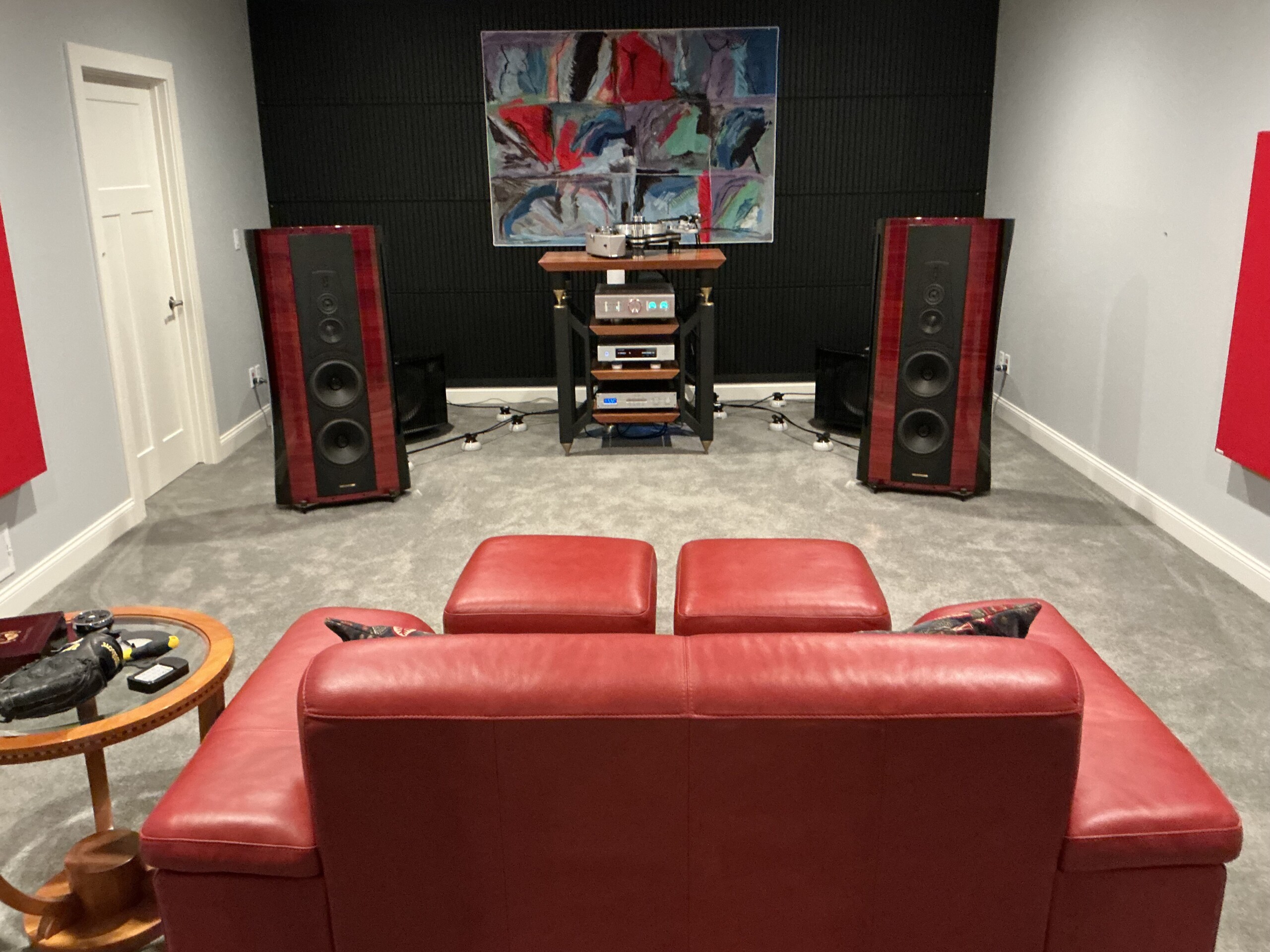
Late last year, my wife and I decided to move to a new home that was 20 minutes away, but still in the same state and still very close to friends and family. One of the many things that attracted us to this home was the potential for a new dedicated listening room. In our former home, I had my own listening room, but now there were new opportunities for both proper acoustic treatment and additional storage.
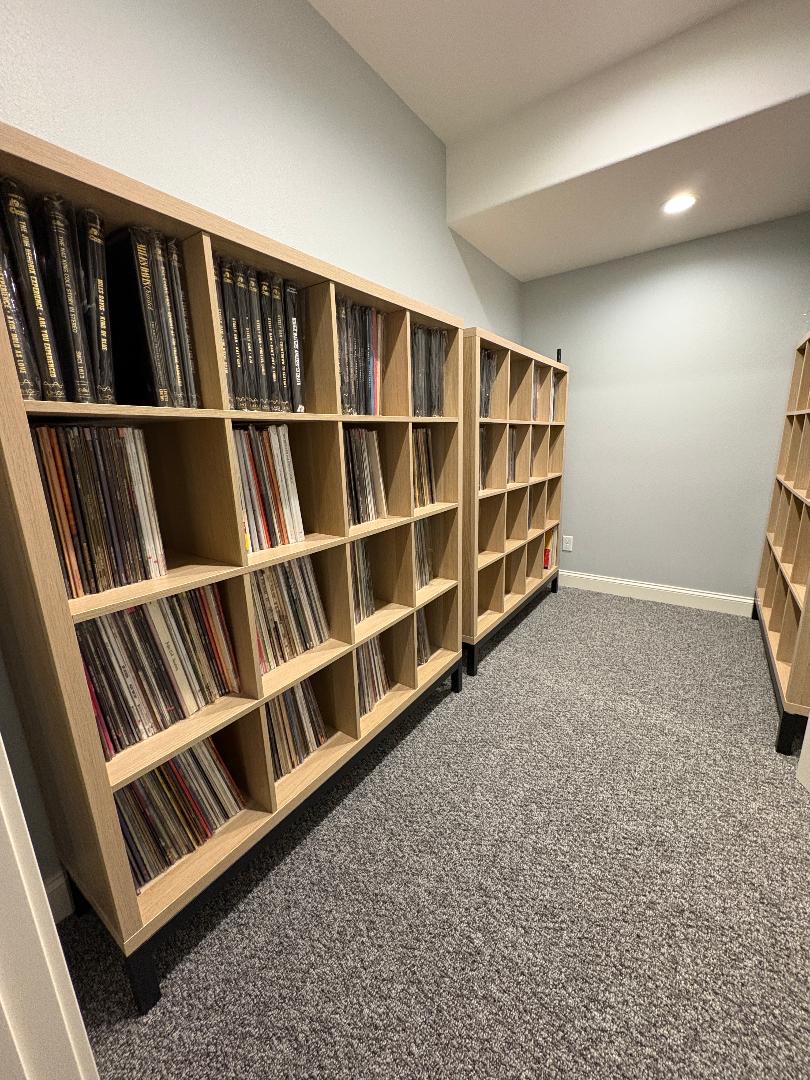
By adding a new wall and entrance door to an existing space in the finished basement of our new home, I now have a much larger main room and also an adjoining smaller room where I can store my 2000 plus record collection. In the past, I had a bunch of memorabilia for both music and sports that lined all four walls (along with the records), and virtually no acoustic room treatment. Now, with proper acoustic design, I could start from scratch and really take a big step forward on the quality of sound reproduction.
Working with GIK from the very beginning was a big decision, but the correct one. The final results were not only very successful and rewarding, it turned out to be a wonderful adventure that really helped me understand the strengths and weaknesses of my system. Compared to the cost of some of my system components, and even the price of some of the vinyl LP's that I have been purchasing lately, this decision was an absolute no brainer. Again, I should have never waited so long!
Why The Need For Room Treatment?
Room design and the resulting acoustic properties of that design can impact and sometimes even greatly distort the sound waves that are the key elements of your listening experience. This can include unwanted echoes, resonances, reverb, and flutter. As GIK states in their website, “Proper acoustic treatment absorbs, diffuses and balances frequencies to reduce reverberation and early reflections, ensuring a more natural and controlled environment.”
I am confident that most of us have experienced the impact of repositioning our speakers or subwoofers, and even the furniture in our listening room. There should be no doubt that room design is an important variable and consideration that should not be ignored. You will be amazed at how powerful and effective a proper strategy for the above issues can greatly enhance the enjoyment and satisfaction of your music! The process is somewhat both science and art, but with a little help from an expert and the proper tools, you can get some fantastic results!
Why GIK?
GIK checks all the boxes. There is not only a fantastic range of great quality acoustic products at reasonable prices, you also get the personal attention and advice from a highly respected team of experts. Just read the feedback from past customers! There are obviously many sophisticated and expensive tools available for measuring room modes, decay times and frequency response peaks and nulls, but you would be surprised how something as simple as the GIK 3D Acoustic Room Designer can help you get to the promised land.
This is a free online tool that will help guide you through the planning and implementation process. Please see the link here. GIK also provides free online access to an amazing and comprehensive series of videos and written articles that will also greatly help with your specific questions. Last but not least, GIK can provide free consultation with a real human being as you work your way through the process. Just a fantastic business model and service offering!
What Were My Objectives?
Obviously, my key objective was to maximize the sound quality of my new listening room. As stated above, this was also an opportunity to learn more about the strengths and weaknesses of my system and my specific components. Lastly, I wanted to learn more about acoustic treatment and what could and could not be done at a reasonable price. My plan from the very beginning was to start simple with some basic implementation, and then maybe follow up with a Phase 2 as I learned more and more. I have always enjoyed these kind of projects with so many variables and so many possible solutions. Patience is critical, but you will soon enjoy the process and the highly rewarding results!
Listening Room Description
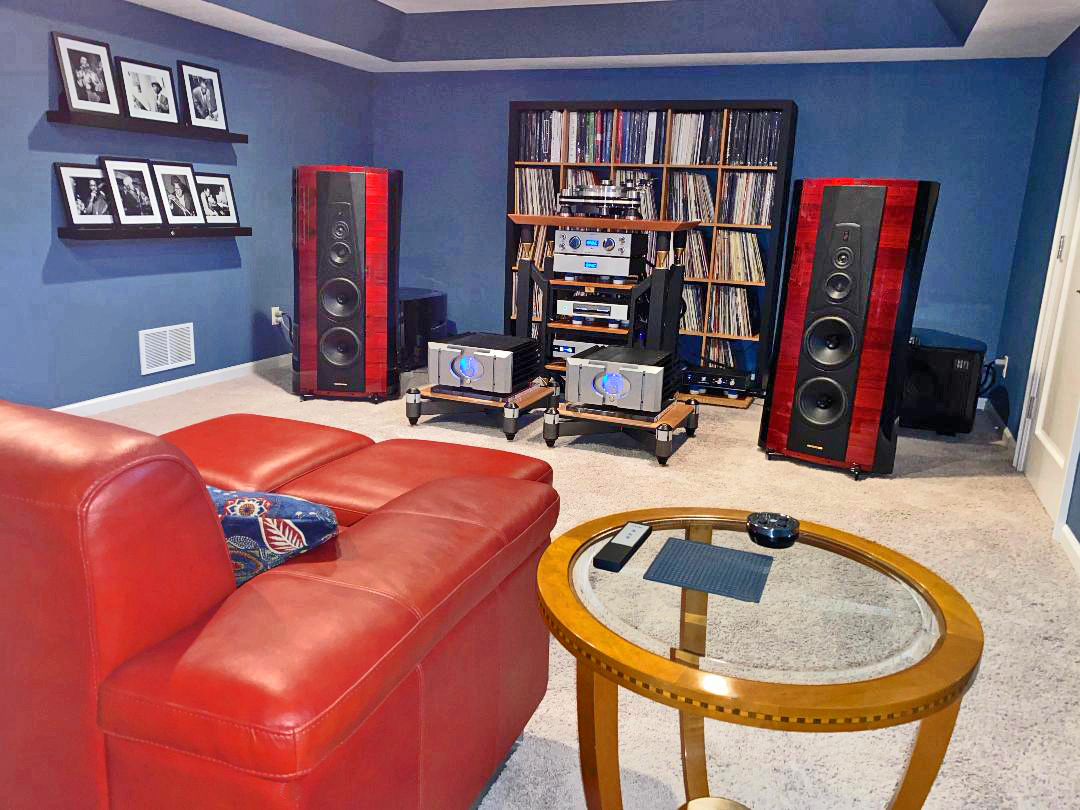
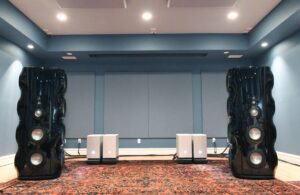
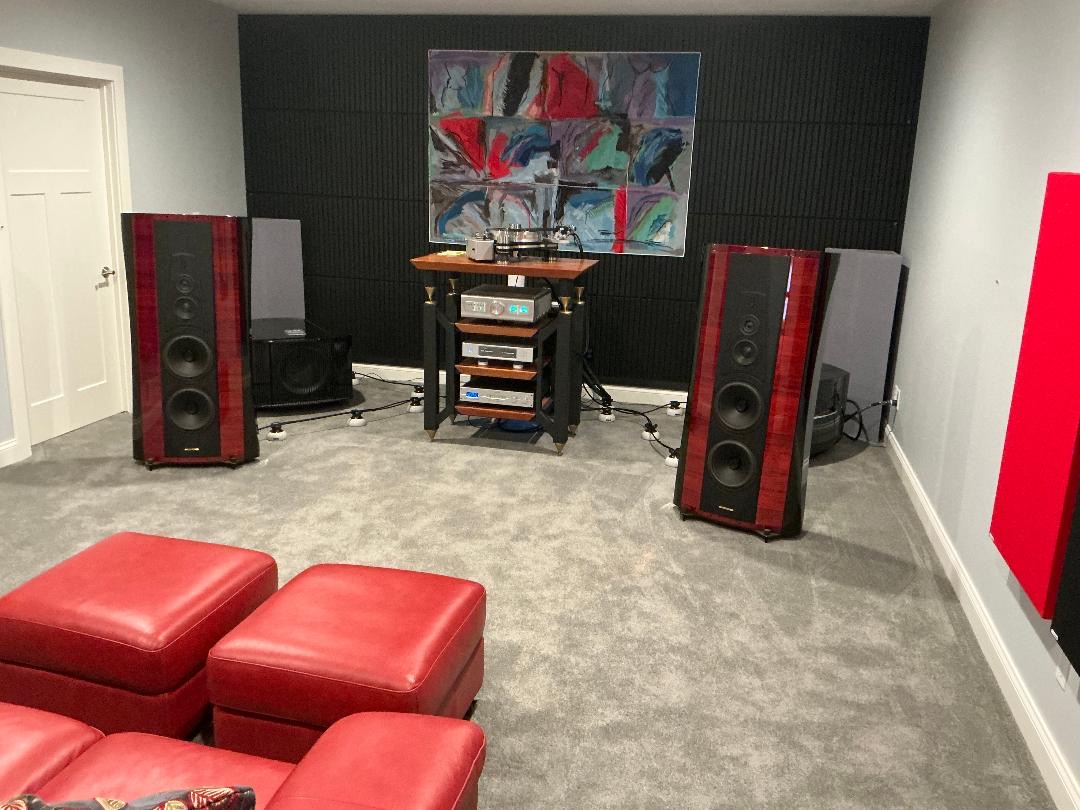
Audiophiles tend to enjoy the details on these kind of projects, so let me provide a basic description. They are also essential to the final design. The key dimensions of my new listening room are the following: 32 feet (long) x 16 feet (wide) x 9 feet (ceiling height). The front wall (behind the speakers and audio rack), and the left side wall both utilize standard ½ inch sheetrock mounted to concrete walls with 2 x 4 studs. The right wall partition utilizes ½ inch sheetrock with 2 x 4 framing. It has some additional basement storage behind it.
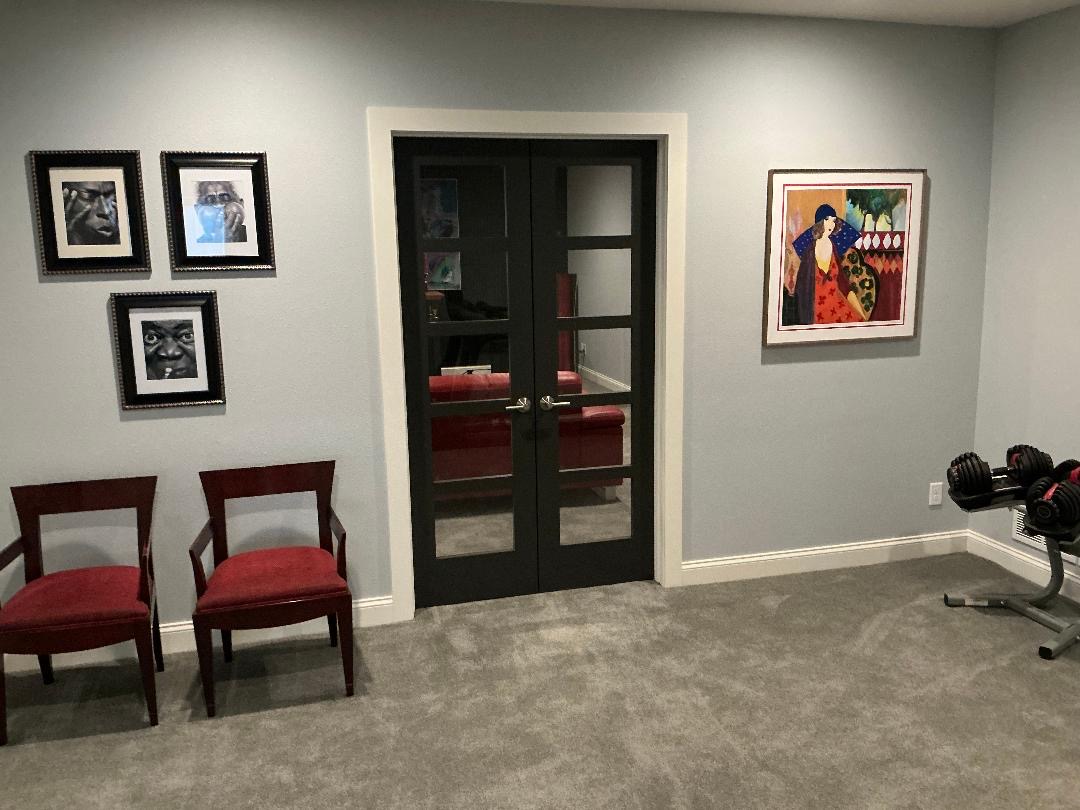
I also have an adjoining closet with a door to the main listening room that I use for record storage. The dimensions for this room are 14 feet (long) x 10 feet (wide) x 9 foot (ceiling height). You can see that door on the left wall in several of the pictures.
The new listening room entrance or rear wall partition utilizes double ½ inch sheetrock with 2 x 4 stud framing and black French doors (with glass windows). All three of the existing walls and the ceiling utilized standard fiberglass batt insulation. The new wall with entrance door utilizes mineral rock/wool for insulation and for slightly better sound proofing. The pictures above and below should help you visualize and understand this description.
Absorption vs. Diffusion
My first chance to personally discuss this project with GIK was at Axpona 2026. GIK Vice President James Lindenschmidt proved to be an excellent listener and guide as we began my adventure. One thing that became very clear in these discussions, was that there were many philosophies out there for when to use absorption and when to use diffusion. Since all of this can be about personal taste and subjectivity, you need to be cautious about moving too quickly.
The best strategy is to experiment with both treatments when you can, and to use the GIK 3D Acoustic Room Designer Tool and GIK support staff throughout the process. I experimented with both absorption and diffusion on all the walls in my room. I was often surprised when one method was more beneficial than the other. Again, please remember that much of this can be very subjective.
These are the traditional definitions:
Acoustic Absorption: Traps the sound waves inside porous, fibrous materials where air particle movement creates friction, converting acoustic energy into microscopic heat. Reduces overall sound reflections, lowers reverberation time, and eliminates flutter echoes.
Acoustic Diffusion: Redirects and disperses the sound waves uniformly in multiple directions and time intervals using uneven, geometric solid surfaces. Eliminates harsh directional reflections and comb filtering while preserving the room's natural liveliness and energy.
Front Wall
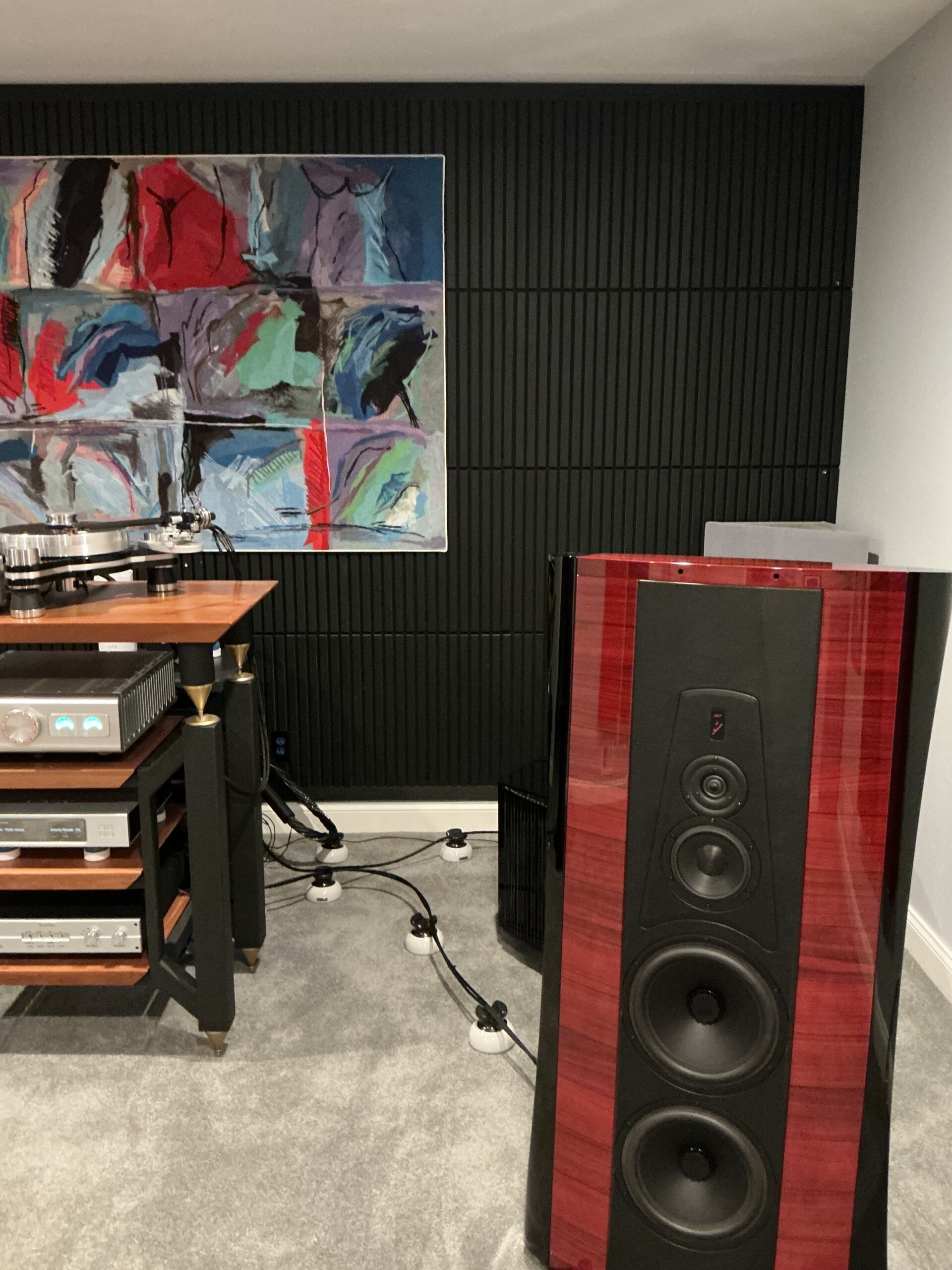
The front wall behind the speakers and audio rack is now completely covered with Artika Sonolok 23" x 23" fluted wood sound panels. We had a bunch of these left over from previous home projects and they were very effective. GIK has similar products, though we decided to use up the materials that we already had. Besides the beautiful aesthetics, one reason that we used the Sonolok panels, was because in my mind, they physically resembled the shelves of record albums that I have traditionally always placed on the front wall in my other homes. Akin to the Sonolok panels, I considered these shelves and record albums much like an acoustic diffusion product. When the albums are stored together on a shelf, they have a similar profile, though they are obviously made of different materials. In my other homes, these shelves with record albums were very effective as I experimented with and without them several times over the years.
In the end, it turned out that I was correct, as the Sonolok panels provided a very alluring diffusion effect and really added to the sound of the room. I should also note that I did experiment with GIK FlexRange full range panels on the front wall, but they seemed to take a slight bit of life and energy out of the room. To my ears, the Sonolok panels were almost a perfect compromise between absorption and diffusion on that particular wall. Having said all of that, and as GIK advised, since my speakers are primarily a forward facing driver design with a small rear port, the front wall is not as critical as the side walls and maybe even the ceiling for acoustic treatment.
Left and Right Side Walls
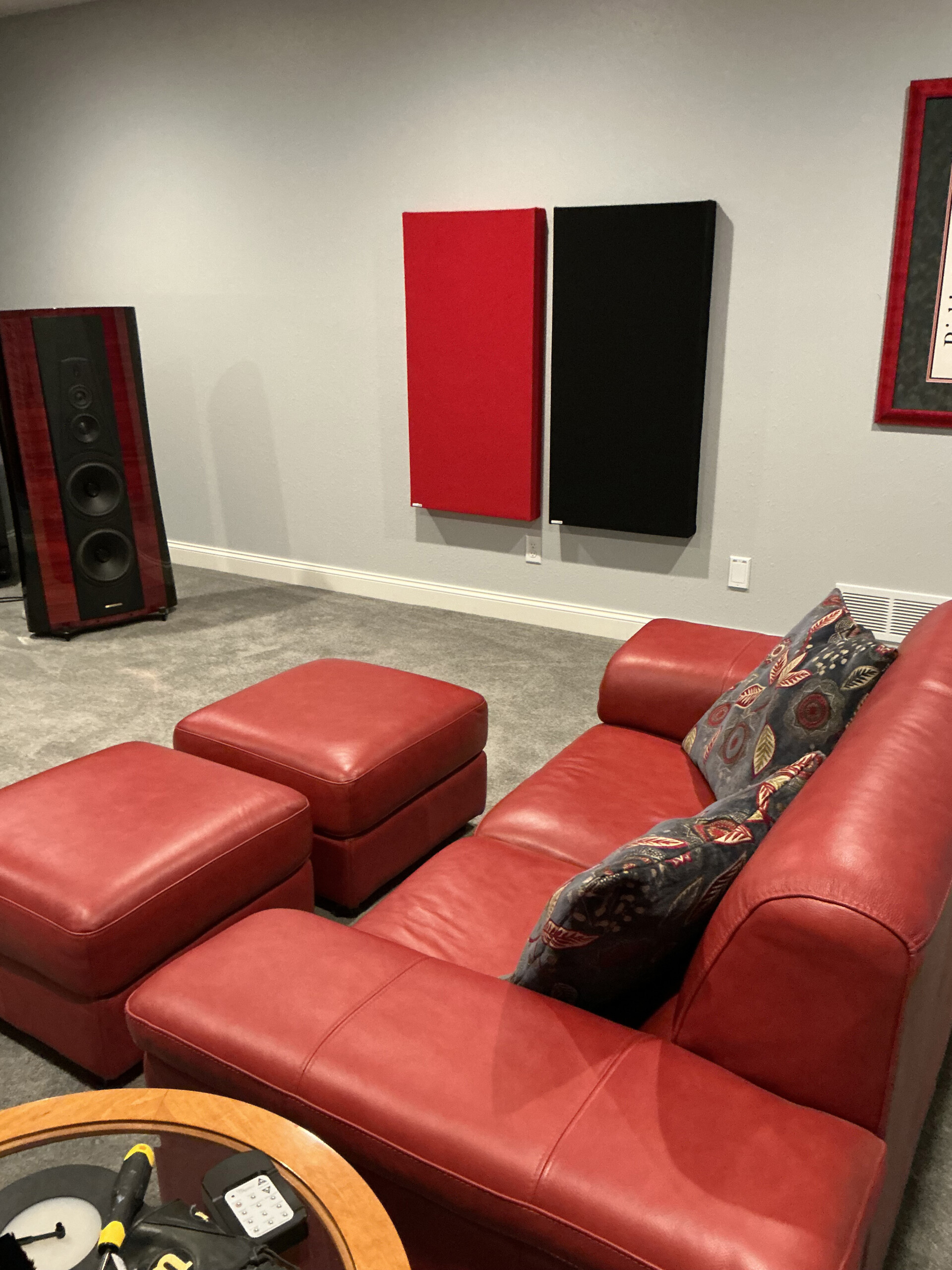
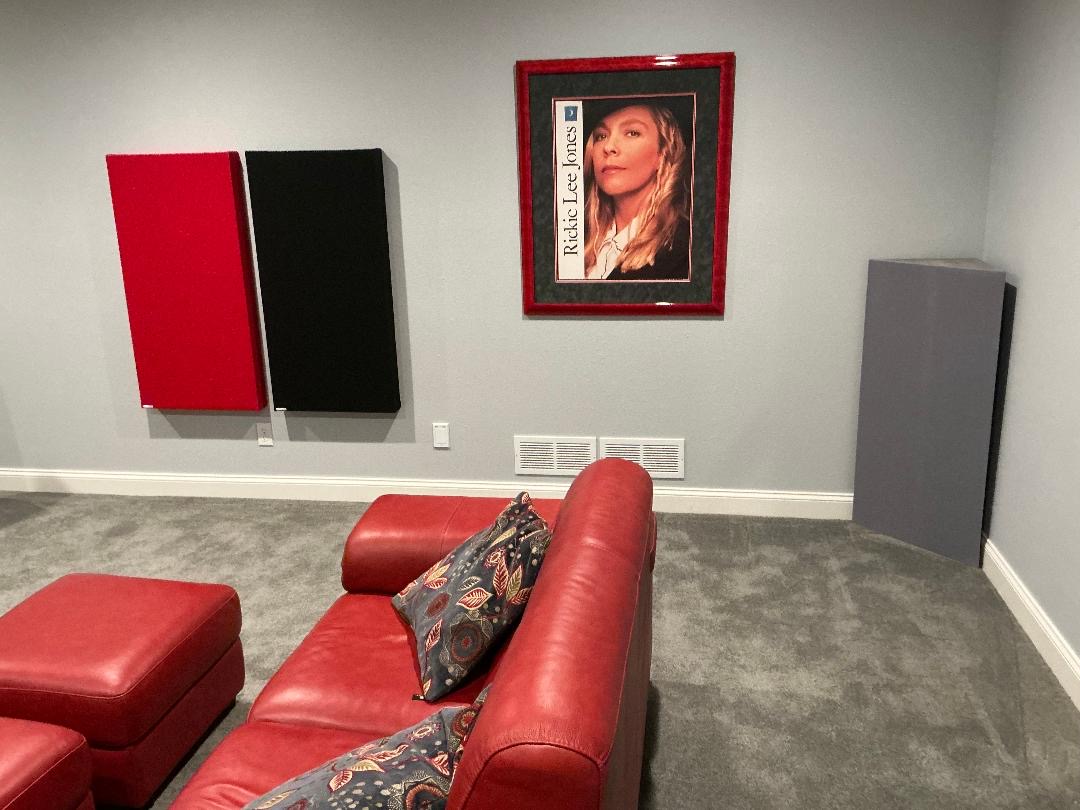
For both the left and right side walls, I ended up using two rectangular 48” x 24” x 3.5” GIK FlexRange acoustic panels which are a full range absorption design. They were mounted approximately 1.5 foot from the floor due to various HVAC vent and wall outlet location issues. I also used the standard hand mirror process (held and positioned by my wife), to locate the first reflection point from the speakers to the wall and then to the sitting position.
As advised by GIK, this first reflection thing was extremely important, so I spent a considerable amount of time and energy properly setting up the panels and listening. It did not take long to hear a clear improvement in the highs and mids. Some of my most favorite albums can sometimes have a slight edge if not an analytical flavor to the sound. Now, regardless of the recording, I was hearing a certain sweetness and timbral purity throughout these frequencies. I was now also experiencing a more detailed and clearly defined soundstage and image.
I did experiment with the Sonolok panels on these walls, both on their own and combined with the FlexRange panels. Again, the Sonolok panels are primarily a diffusion product and the FlexRange panels are primarily a full range absorbtion product. The Sonolok provided a slightly more exciting sound but with some additional forwardness. There was also a tad too much echo and flutter overall, which could become quite annoying depending on the recording.
Needless to say, I soon became enamored with the two panel FlexRange solution on both the left and right side walls. Down the road, I might also try some of GIK's diffusion products on these walls. There might be some middle ground between the results of full range absorption and diffusion. I love the looks of the GIK Amplitude panels. They are like pieces of art with many aesthetic choices. Check them out on the GIK website. You might be surprised how cool this can all be.
Corners
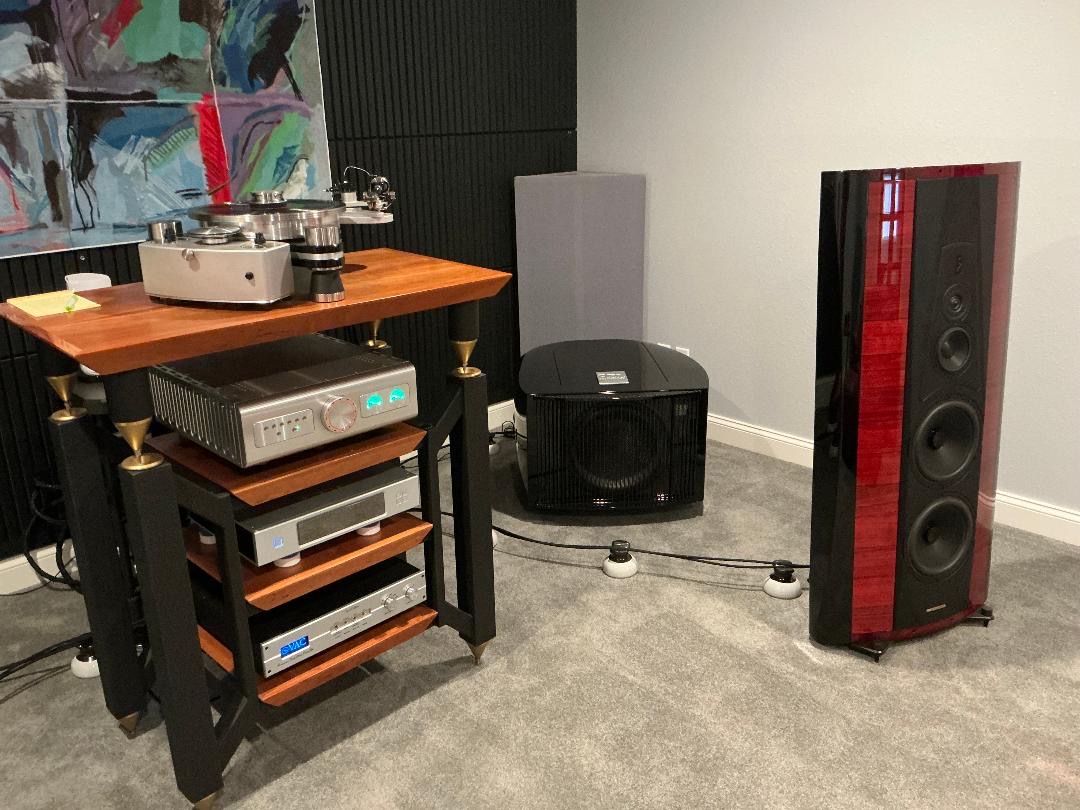
Another surprise. I bought enough of the 4 foot high GIK Tritrap corner bass traps to stack them and experiment (which is the traditional approach), yet I preferred the sound of one bass trap positioned in each of the corners – not two. Again, I found the room to be overdamped with all the stacking. Using one in each corner brought forth a wonderful combination of excitement and air to the soundstage at all frequencies. Bass and lower mids were now extremely tight and powerful with plenty of inner detail. The listening room in my former home never reached this level of physicality and slam. I had to use some creative mounting techniques to keep the art on the walls from changing positions after long nights of heavy hitting. Thank gosh I am able to keep the French doors closed when needed, as my better half does deserve a break on occasion.
Speaker and Subwoofer Positions
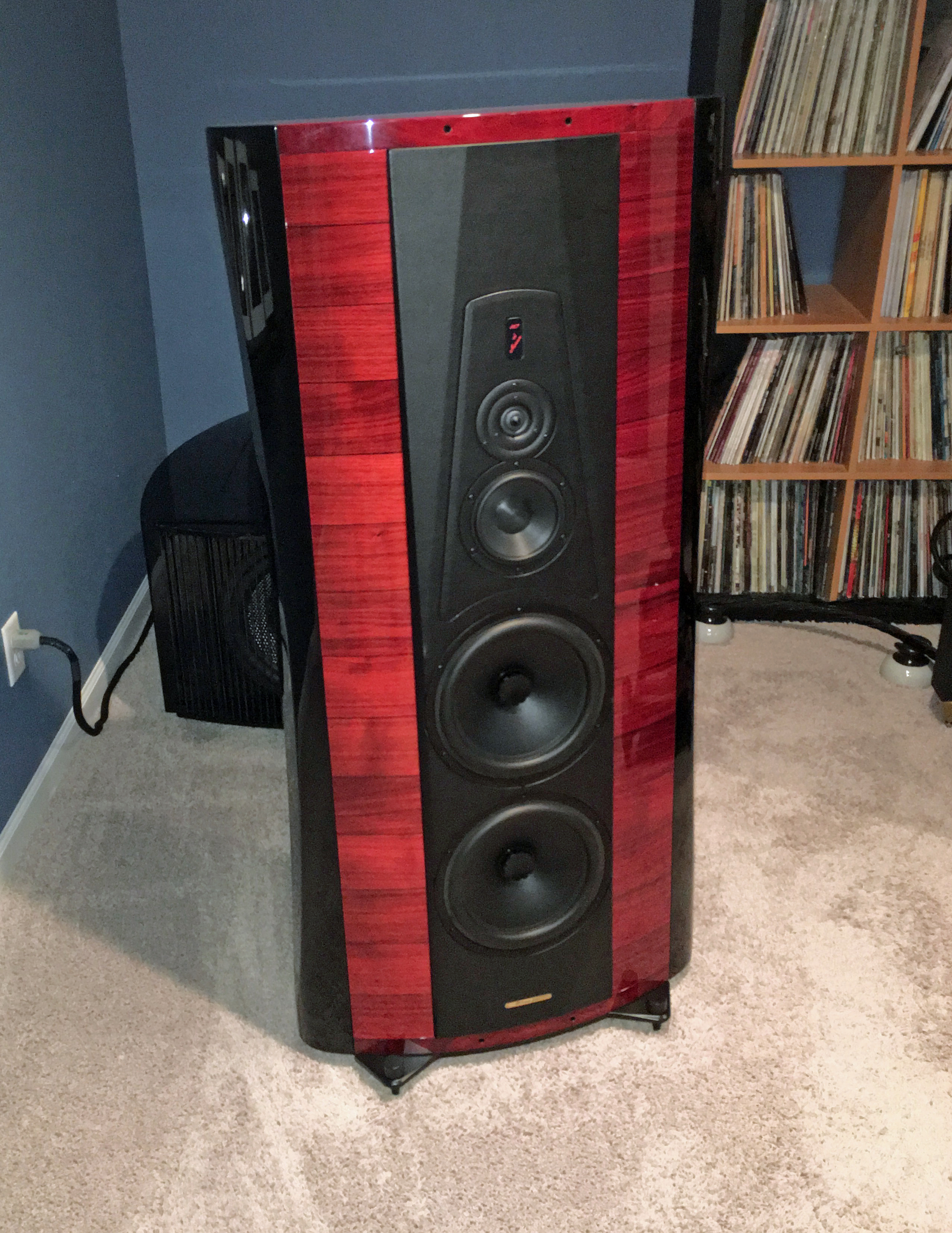
My Sonus Faber Stradivari speakers were not difficult to position. After some basic trial and error, they are now located five feet from the back wall and two feet from the side walls. Using a laser self-level, and based on past successful installs, I located the center sitting position on my couch at a point where the lazer was directed from above the tweeter location in each speaker cabinet, to behind my head and basically over each of my shoulders. This formed an equilateral triangle and greatly helped to lock in the sound stage. The Strads are not difficult to dial in and fortunately this part of the process was accomplished fairly quickly.
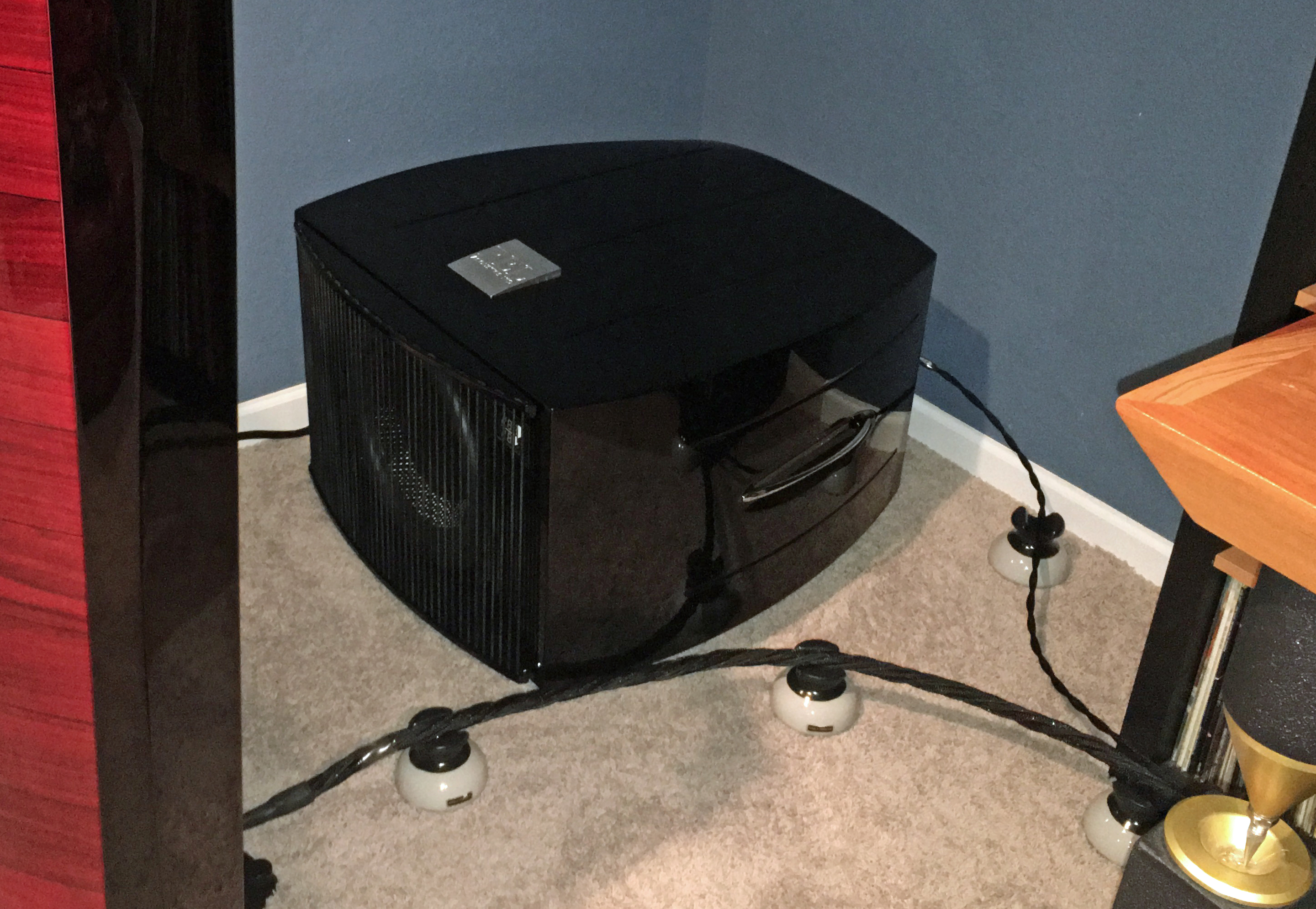
The pair of REL No. 25 Reference subwoofers were slightly more challenging. In my former listening room, the subs were located in a very snug position in each corner of the front wall and parallel to the left and right walls. This was after much experimentation with various angles and distances directly from the corners. The folks from REL actually set these up for me many years ago, and prior to my Positive Feedback review of the subs way back then. I was so pleased with the results that I bought the pair, and I was extremely satisfied with that positioning ever since.
This time around, I tried the snug corner and parallel strategy. I also tried positioning the subs inside and outside of the Strads and with the baffles for both the Strads and the RELs on the same plane. This second option was something that I was never able to try in the past, as the listening room was never large enough. Lastly, I experimented with various distances from the rear wall corners at 45 degrees until I found a sweet spot. This turned out to be my favorite position. There must have been some interesting nulls in these corners, even with the bass traps. Regardless, and as stated above, this is the finest bass performance that I have ever experienced with these components.
Rear Wall
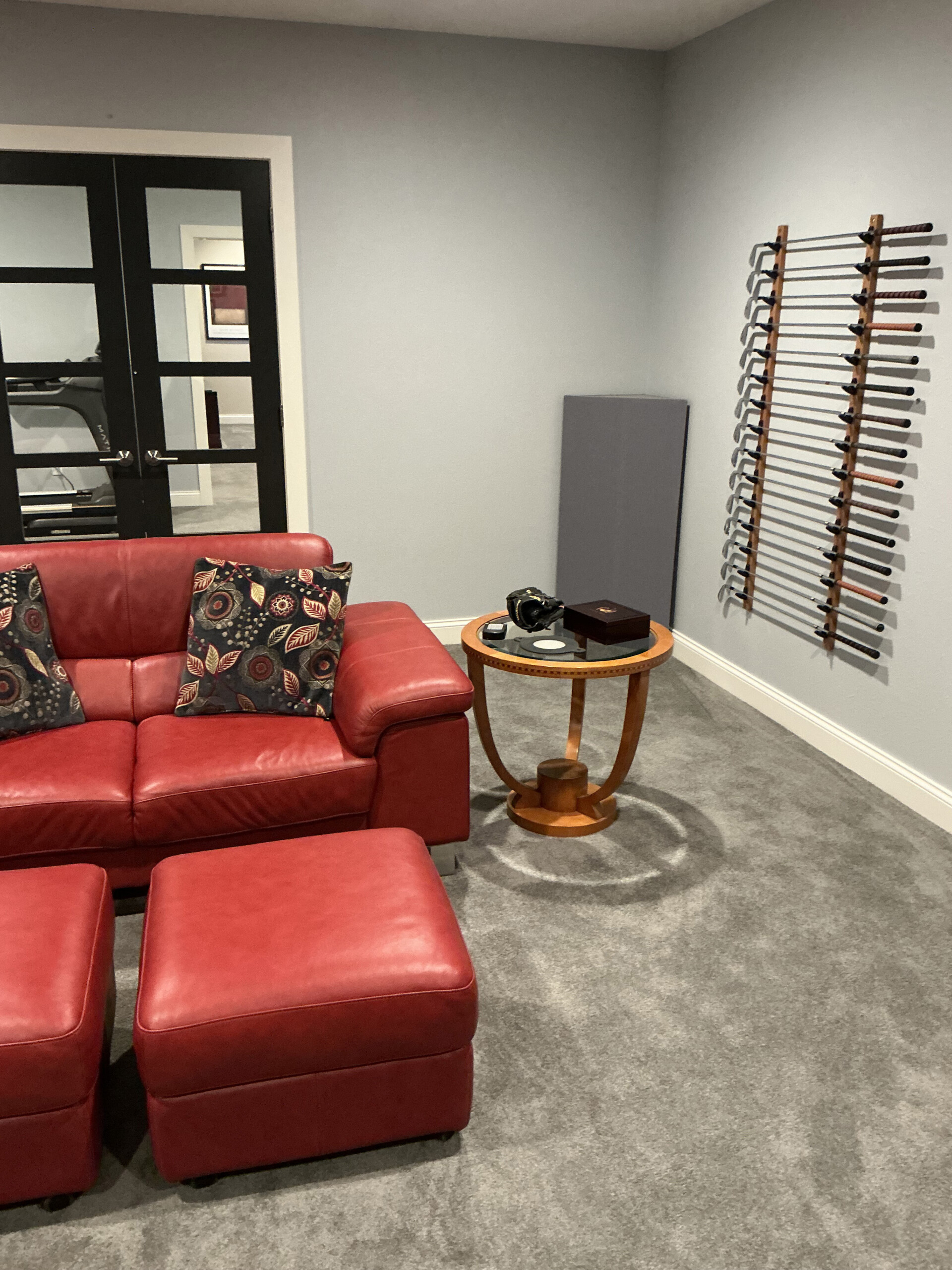
The rear wall was somewhat of a challenge, though in the end, I preferred no treatment at all. With the FlexRange panel in place, the overall sound from the listening position lacked a sense of energy and drive, almost like the room was over damped. The Sonolok panels did not help liven things up, so I left the walls bare for now. I was concerned about the potential reflections off the glass in the French doors, but they did not seem to be much of a factor either, even when I covered them with sheets. This was one of the last steps in the process for me, yet despite no treatment on this wall, I was overall very very pleased!
Dedicated 20 Amp Circuits & Record Storage Room
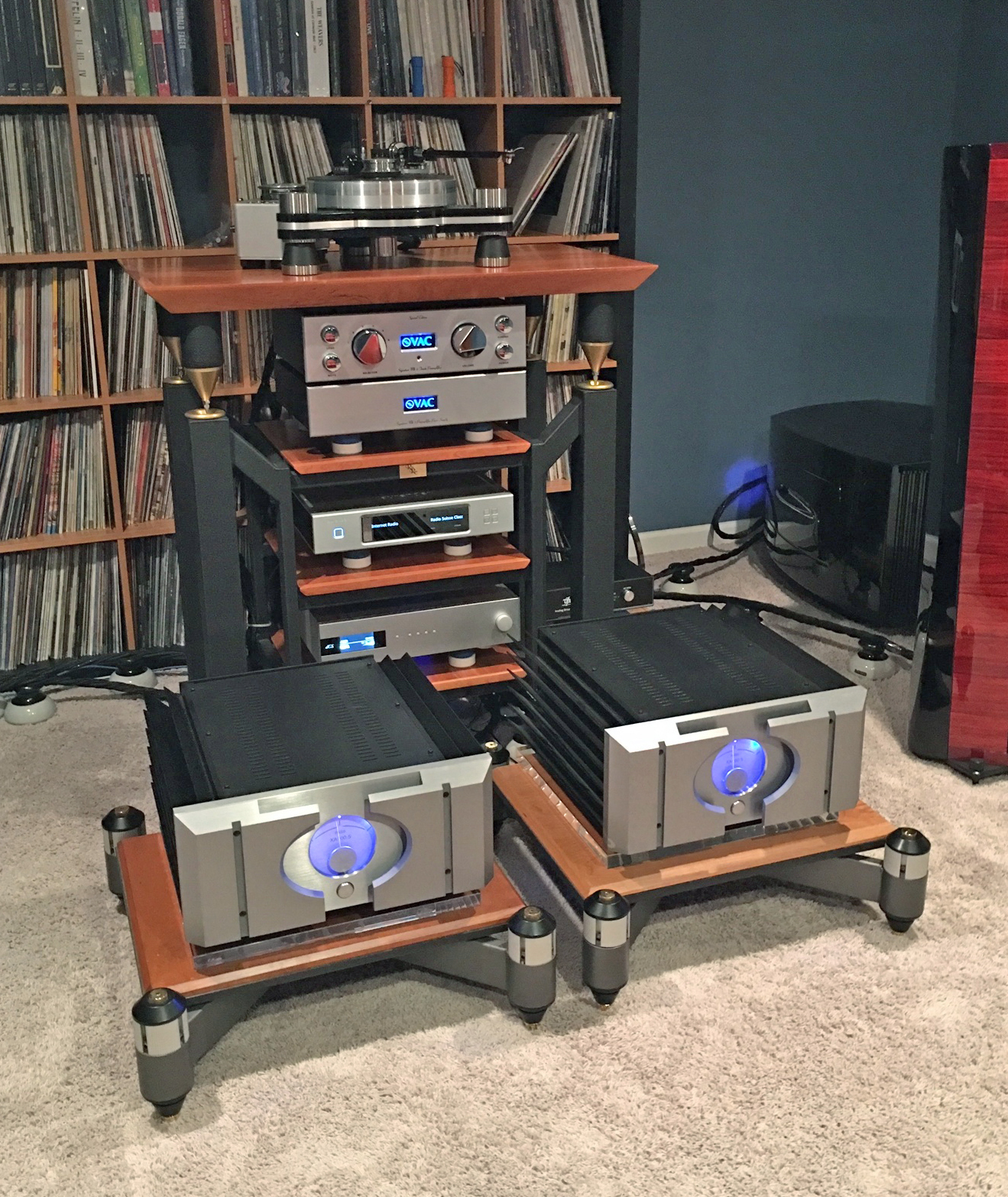
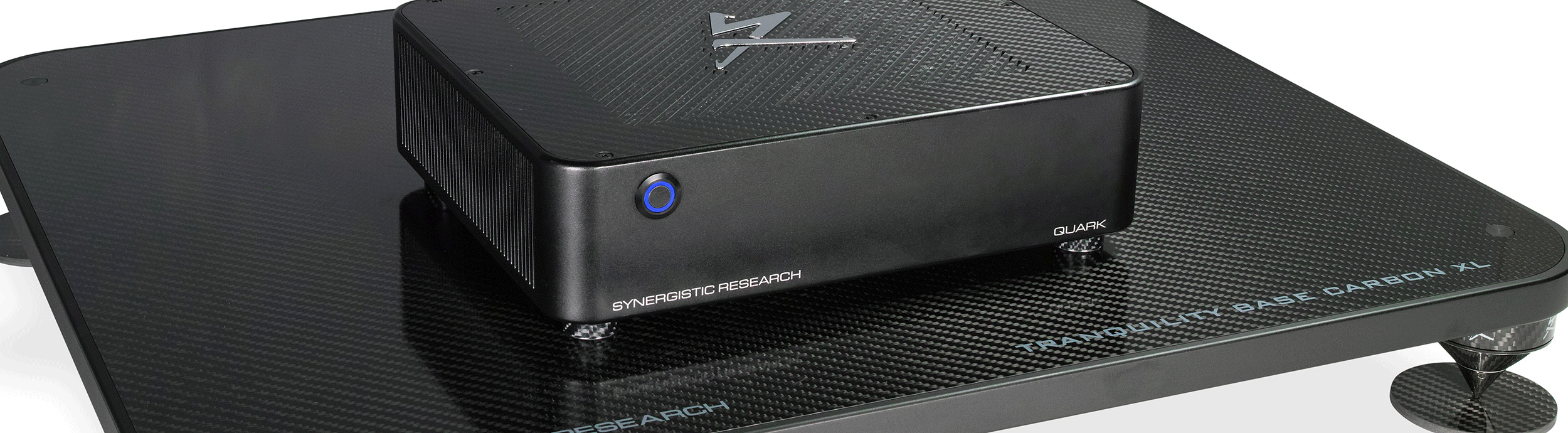
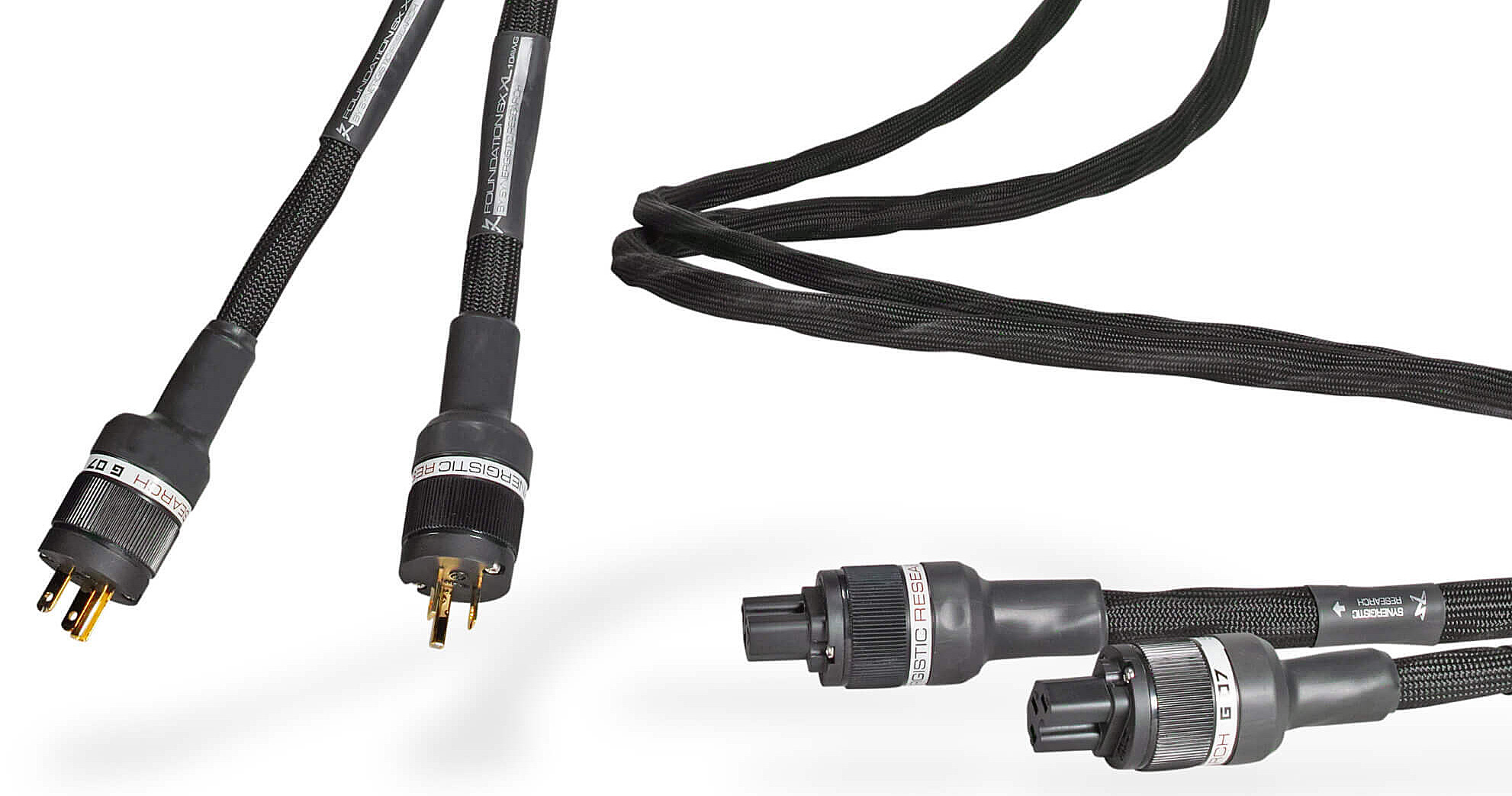
Though not directly related to the acoustic panel treatment, I want to note that I utilized a few other room implementations that were also very important. This included four new dedicated 20 amp circuits directly from my main service panel. One for each subwoofer and two for all the components. Though each of these circuits support a four-plex outlet box, I basically use only one outlet in each. Except for those two subwoofers, all of my components are plugged into a Synergistic Research PowerCell 12 UEF SE power conditioner. I also use Synergistic Research Pink UEF outlets for all mated wall connections. This strategy has served me well over the years with my other listening rooms. The improvement in sound quality is explicit and very easy to hear - well worth the time and effort!
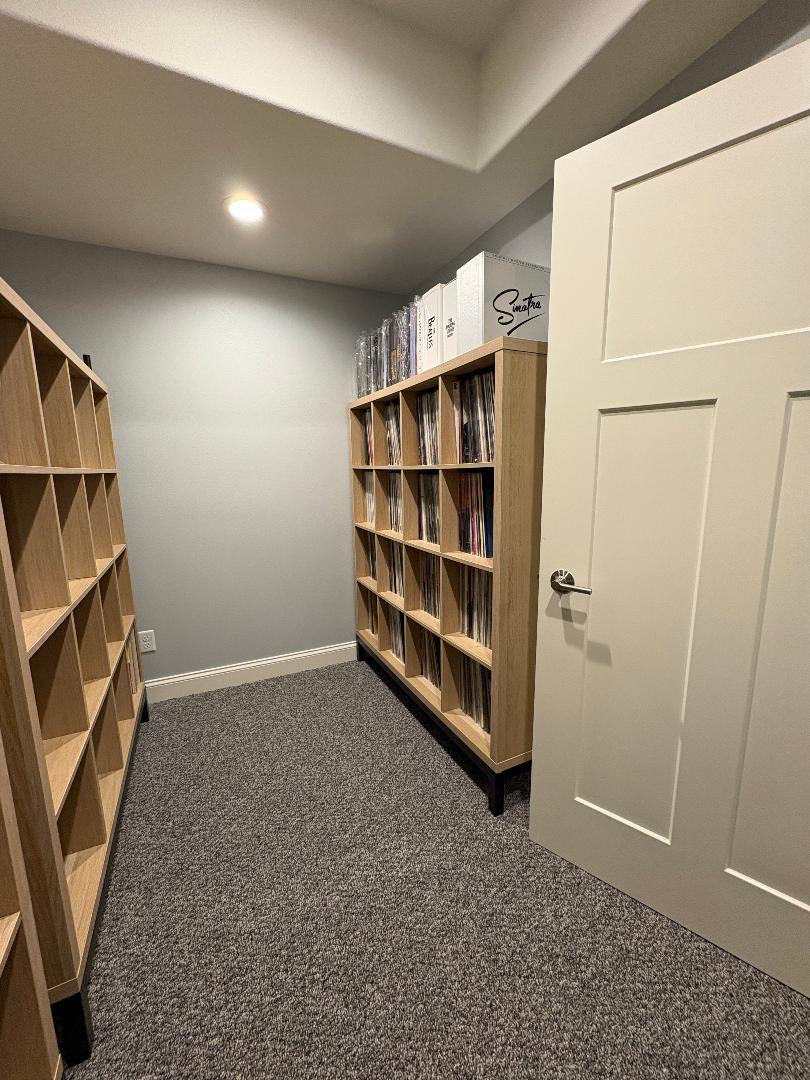
Lastly, my new adjoining room for record storage has also proven to be very important. The additional wall space in the main listening room allows me to do all the fantastic things that I have discussed above, and it has also resulted in a more tidy and comfortable listening environment. As some might relate, and over time, records can somehow end up stacked all over the floor and leaning against virtually anything in the room that can support them (and not support them). To say that everything is more organized, less busy and less cramped is an understatement.
Final Thoughts
Whenever I am on the fence for what I am hearing with a specific component or album, I call in my key consultant and the best ears in the house – my wife! There was never a doubt for me on the GIK acoustic treatments, yet once I had everything in place and fine-tuned, I invited her into the listening room for her much valued opinion. I could see her eyes light up and her posture move forward on the very first needle drop.
After an hour or two of our standard demo playlist, she did not hesitate in stating that this was the finest sound that she had ever experienced after several dedicated listening rooms and close to 50 years of marriage. She was especially impressed with the bass performance as it seemed to have more authority and visceral impact than ever before. And even with this, she commented that the bass did not shadow or veil the mids and highs - something she always listens for. She also noticed that midrange sweetness and incredible level of detail that I mentioned earlier. Images were more three dimensional and locked in than ever before. Of course with little patience, she started to rattle off her favorite albums and tracks that she now immediately wanted to hear. That says it all.
Some of the things that I am considering for Phase 2 are several GIK diffusion products for the side walls and rear wall (rather than full range absorption), and possibly something very creative for the ceiling. First reflections off the side walls and ceiling seem to be the priority of choice by both GIK and many of GIK's past customers. The success stories are fun to read on all the various Internet sites. After just buying a new home, I have to be careful with the bank account, though acoustic treatment has clearly been a big bang for the buck for our system and listening room!
I want to thank the folks at GIK for all of their support and timely communications. This includes GIK Vice President James Lindenschmidt, Acoustic Designer Ryan Grimes, and Consultant Liz Wilkinson. I cannot express how impressed I was with the level of professionalism and customer focus that each provided at every turn and for every request. This was one of my most favorite experiences with any brand or manufacturer in the past several years. Highly, highly recommended!
Proper Perspective And Caveats
It cannot be overstated that system synergy and personal taste are critical when evaluating high-end audio components and music. These reviews are based on my subjective listening priorities, my specific system configuration, and my specific listening room. This combination is only one data point of many that exist out there for my components and the music that is played. Please consider my comments and analysis appropriately.
Review System
I have included a comprehensive list of all my components and a description of my listening room. Please click on my byline name in red above if this information is needed for reference and comparison.
GIK FlexRange Acoustic 2' x 4' x 3.5" Rectangle Panels $119
GIK Tritrap Corner 4' Bass Traps $299
GIK Acoustics
3121 Presidential Drive, Suite 29
Atlanta, Georgia 30340
Phone: 404-492-8364
Email: [email protected]
Web: https://www.gikacoustics.com