
Photo credit Bricasti Design.
Bricasti Design, Ltd. was founded as a pro-audio company, specializing in reverberation units. Bricasti's principals formerly worked at Lexicon, which, at the time, was a Harmon International subsidiary. Reverbs are used not only in the recording process. Reverbs are also used in live-performance PA systems. Example, singer/guitarist John Mayer, when he performs live, has a Bricasti M7 reverb in his electric guitar's signal chain.
It also should be noted that adding reverberation via a hardware box is not just for popular music. Reverbs are often used in classical recordings. That's because orchestral vocal or instrumental soloists are usually close-mic'd, for clarity. However, that unavoidably means that the solo track has less "hall sound," so it will be "drier," at the risk of sounding discordant…so to speak.
Here's a photo of the "house" recording shack at Symphony Hall Boston, with Bricasti gear in the rack on the left.
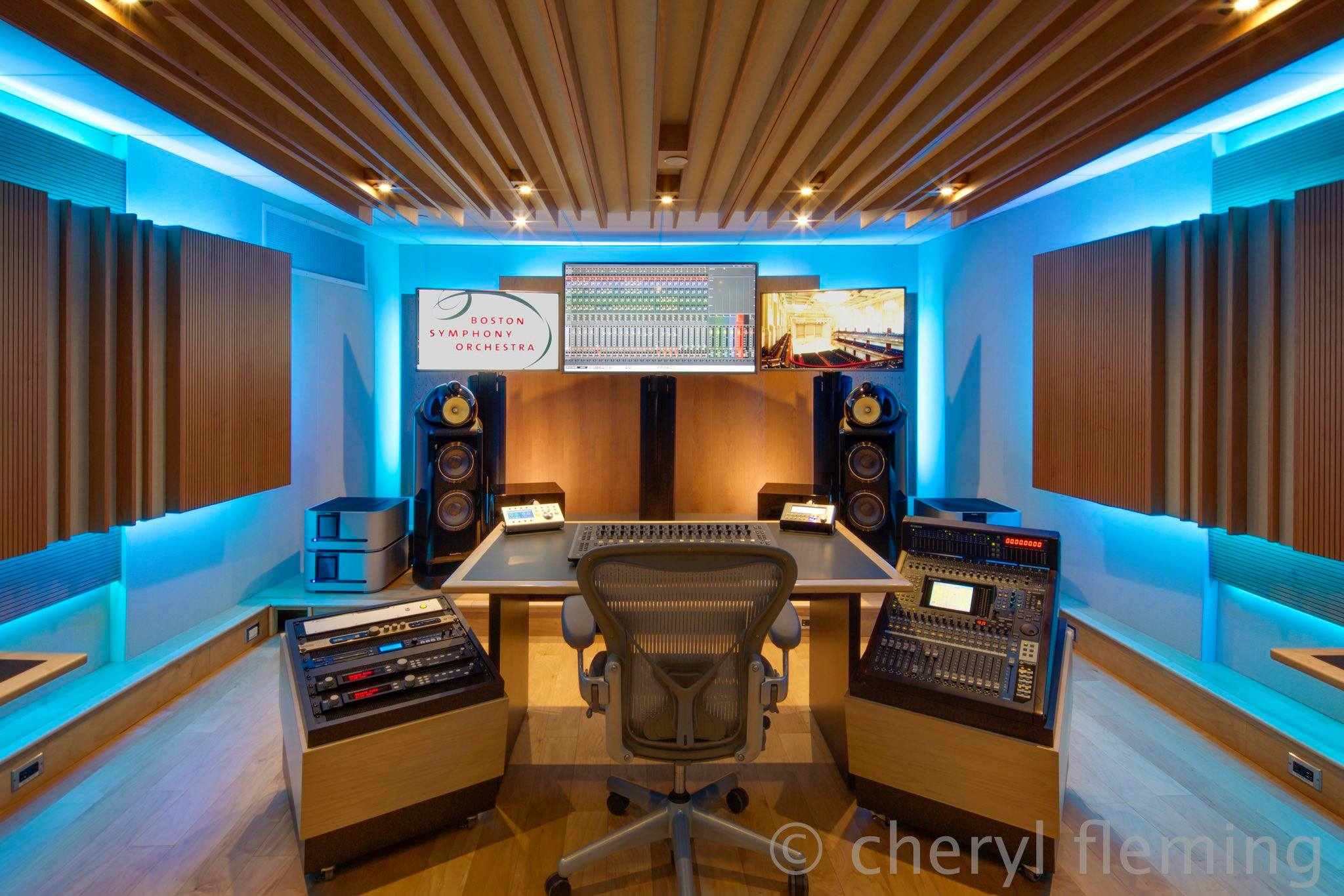
Photo credit Cheryl Fleming, for the Boston Symphony
I first heard Bricasti Design's M1 digital-to-analog converter in 2011, at a professional-audio trade fair outside of Boston. I had brought along a recordable CD of my own work-in-progress for a pipe-organ project. Brian Zolner (the "Bri" in "Bricasti") was staffing Bricasti's booth. Brian graciously let me listen (over headphones) to my own work. I was very impressed. I immediately requested a review sample of the then-new M1 DAC.
My Bricasti M1 review ran in Stereophile in August 2011. In that review, Brian stated that the design brief for the M1 was that it should sound "fast," "revealing," "open," and "spacious."
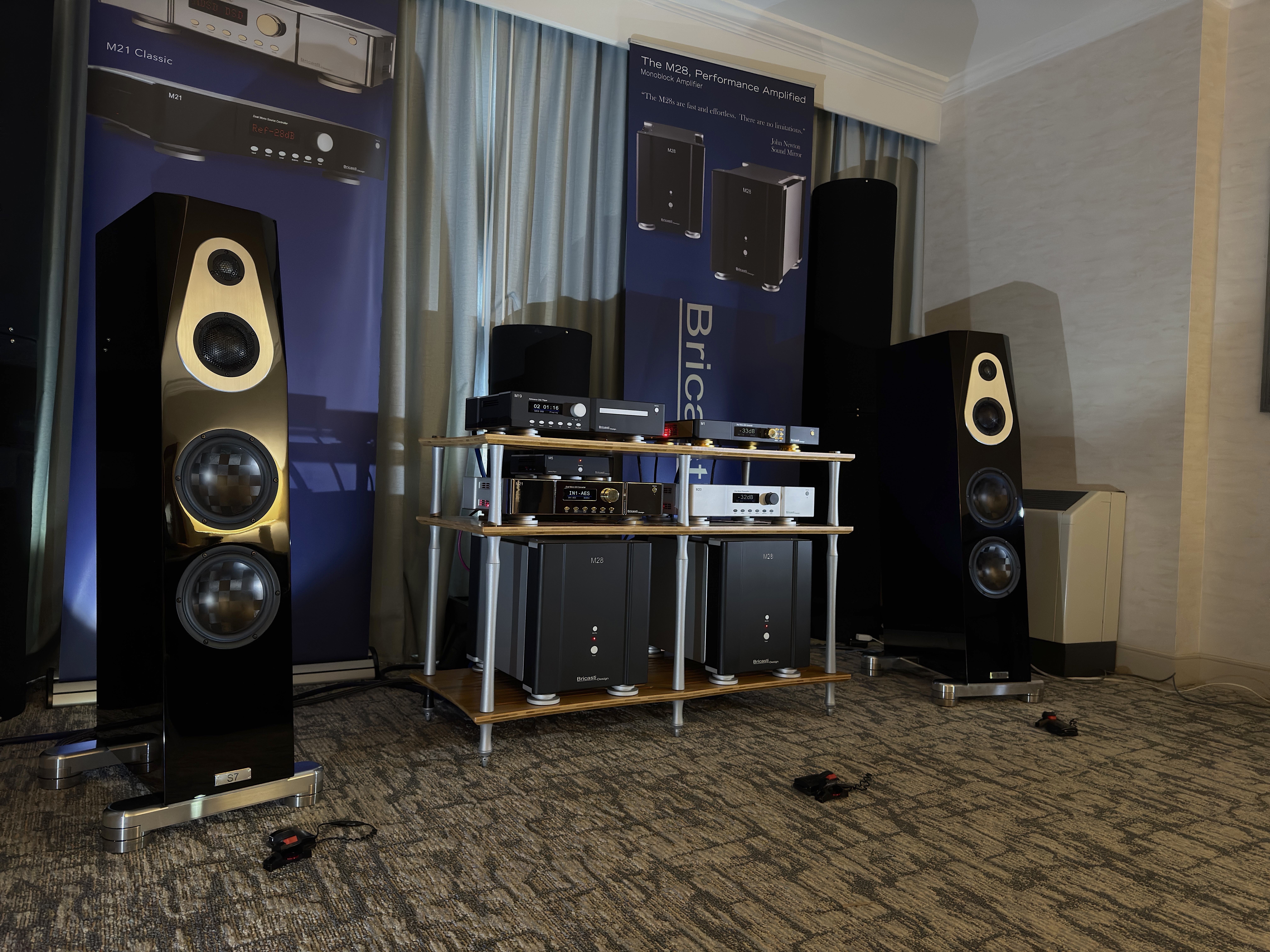
Well, because you have been reading this article, you already know that Bricasti, at Capital Audio Fest, exhibited near-final prototypes of its first loudspeaker offering, the S7. That is, "S" for "Speaker," and "7" because the S7's twin woofers are 7.5 inches in diameter. And, by all reports, Bricasti's S7, just like the M1 DAC, is "fast," "revealing," "open," and "spacious."
Here's a video of the S7s cutting loose on a cut from the film soundtrack to Rosewood.
What was shown at Capital Audio Fest was a pair of prototypes. Finished loudspeakers for retail sale should arrive in the first quarter of 2026. The anticipated US MSRP is $36,000 the pair. The S7 is assembled in Canada from components sourced from the US, Canada, Germany, Indonesia, and Sweden. There is no Chinese content.
Before I go any further, I do want to mention that I avuncularly kept abreast of the S7 (for lack of a better term) gestational progress. From time to time, I offered my opinions—usually in the guise of "helpful suggestions."
However, I am a Just-the-Big-Picture kinda guy. For example, I certainly know what Baffle-Step Compensation is; but I could not compute a Baffle-Step Compensation point to save my life. Nobody has any reason to worry or wonder whether I can no longer be relied upon to be impartial when reviewing other loudspeakers. I have always viewed advising people who have to work for a living as to how to bring music more deeply into their lives as a nearly-sacred calling.
Here's an analogy. For more than 40 years, I have labored in the vineyards, so to speak, trying to bring Arturo Delmoni's violin playing to a wider audience. I not only remain scrupulously fair in my assessments of recordings or live performances by other violinists; I delight in bringing promising young violinists to the attention of my readers. The same holds true for audio gear.
Bricasti's S7 is, in my opinion, a very ambitious entry into the ever-more-crowded loudspeaker marketplace. For Bricasti, it seems there was never any thought of starting out with a cute little "Baby Monitor" BBC-Shoebox Clone. The S7 certainly goes for The Whole Enchilada. My bottom line is that, with its large-ish cabinet, twin woofers, and a -2dB point of circa 32Hz, the S7 should be "all the loudspeaker" most people will ever need.
The S7 is circa 45 inches tall, 29 inches deep, and 9 inches wide (not including the "outriggers"). Weight is circa 120 pounds each. The design is ported. (The woofers are in a separate ported sub-enclosure, apart from the midrange and the tweeter.) The driver compliment is, for each speaker, twin 7.5-inch woofers; a 3-inch dome midrange; and a 1-inch tweeter. Crossover points are not specified. The crossover is moderately complicated, with 18 elements.
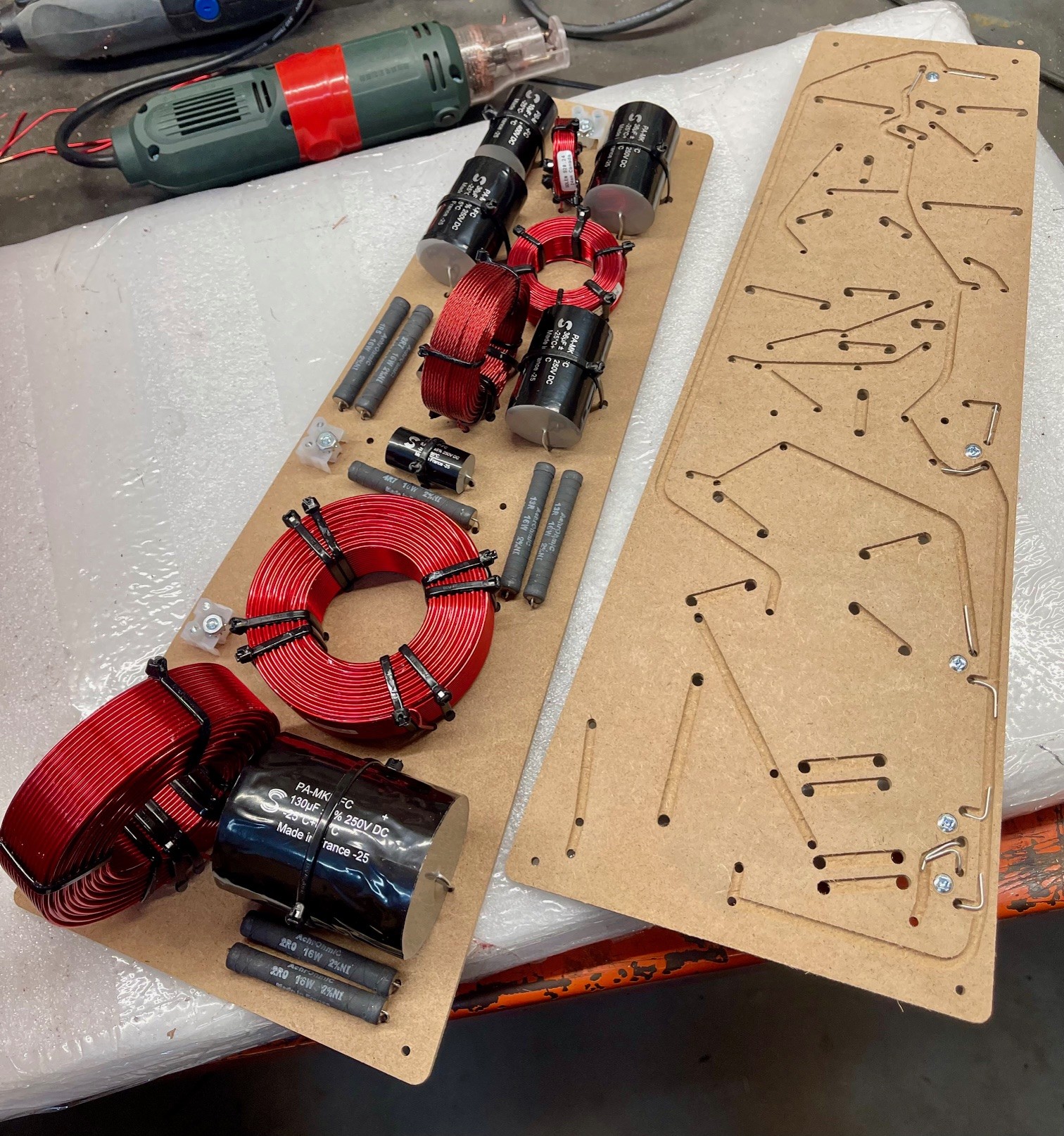
Photo credit Bricasti Design.
The woofers' cones (from SB Acoustics) and the midrange's dome (from Bliesma) are fabricated from spread-tow carbon-fiber basket-weave fabric sourced from Oxeon's "Composite Sound" subsidiary. That fabric is sold under the brand name "TeXtreme."
Oxeon is a Swedish high-tech materials company. My favorite example of their work is that the rotor blades of NASA's Ingenuity Mars-Lander Helicopter are fabricated from… the same material as the S7's woofers and midrange.
Light? "Yup."
Stiff? "Yup."
Strong? "See you on Mars!"
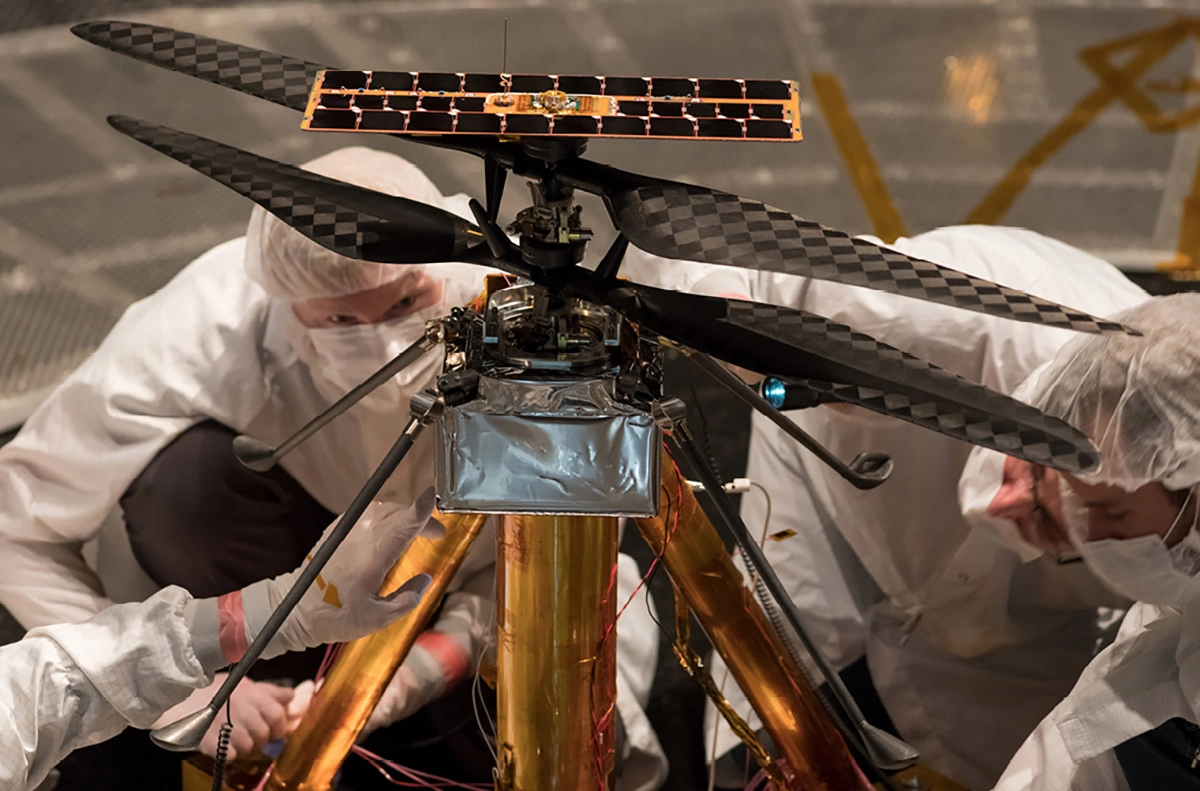
Photo credit NASA.
While the cone and dome moving parts of S7's woofers and mid are fabricated from TeXtreme; and, TeXtreme tweeters do exist, Bricasti's R&D team bit the bullet, and opted for a ($$$) Beryllium tweeter (from Bliesma).
Why? Well, Brian Zolner has never forgotten his first exposure to a Beryllium tweeter, in Rockport loudspeakers he heard at Fidelis AV in New Hampshire.
The particular Beryllium tweeter that was chosen for the S7 has a mind-bending Thiele-Small Mms parameter of 0.10 gr. That's one tenth of a gram!
By the way, the T-S abbreviation Mms, I have been told, means the "Mass of the Moving System." So therefore, that one-tenth of a gram includes not just the tweeter's dome, but also its voice coil, surround, and the air it displaces. The dome might even be the least of it all!
My colleague Jim Tuomy and I developed two proposed additions to the canon of Thiele-Small Parameters, those being Load Factor and Agility Factor. Positive Feedback graciously published our paper HERE. Predictably, the nay-sayers publicly questioned who the Hell I thought I was.
In stark contrast, the chief loudspeaker designer at Purifi told me that he thought that "Load Factor" had real value; but he also said that "Agility Factor" was cumulative. But I like seeing numbers, as a security blanket.
Be that is it may, the S7's Beryllium tweeter's Agility Factor, of 159.59 (AF is a "Quantity-Less Metric"), is the second-highest I have ever calculated. The only one higher is the S7's TeXtreme midrange, at 162.71. Not entirely in jest, I quip that the fact that the Agility Factors of the (ultimately) chosen tweeter and the chosen midrange differ by less than 2%, is the result of Divine Intervention.
Now seriously, though. The vendor of the OEM midrange and tweeter (Bliesma, based in Germany) makes a very complete range of drivers. For example, Bliesma offers 1-inch tweeters with domes of Paper, Silk, TeXtreme, Aluminum/Magnesium, and Beryllium; with Diamond domes available only factory-direct and by special order. (As they used to say about Rolls-Royce, "If you have to ask 'How much?', you can't afford it.")
It might be "Intuitive" to think that fabricating a loudspeaker's midrange and tweeter from the same material would lead to the best results. That was one of the things that impressed me about Vivid's loudspeakers way back, when I reviewed them for Stereophile, if anyone still remembers.
Therefore, a "natural" drafting-board place to start appeared to be to pair Bliesma's brandy-new TeXtreme 3-inch dome midrange with the Bliesma 1-inch TeXtreme tweeter. Except, just for fun, I ran the Agility Factor calculations of the TeXtreme, and also the Beryllium version of Bliesma's 1-inch tweeter.
Wow! The 1-inch TeXtreme tweeter had an Agility Factor of 98.79. Very impressive. Except, the TeXtreme midrange's AF was 162.71. At 98.79, the TeXtreme tweeter had an AF appx. 60% of the midrange's AF. But the Beryllium tweeter's AF (of 159.59) was nearly identical to that of the midrange.
That was one of those decisions that "made itself." The completed loudspeakers are remarkably coherent from midrange up through the treble range. I think that that is because, in the last analysis, how quickly a driver can start and stop is more important than what it is made of.
As you can tell just by looking, Bricasti's S7 has plinths, bases, or outriggers that have been fastidiously fabricated from billet aluminum. Those serve two purposes. First, to make the loudspeakers far less "tippy" in a domestic environment. Especially with young kids. (There is a United States Federal CPSC Standard for that; however, it does not apply to loudspeakers. I myself think it should apply to loudspeakers that are over a certain weight.)
Second, there is proprietary technology in there, in the realm of managing the vibrational behavior of the cabinet, and the vibrational behavior of its coupling to the floor, as the two TeXtreme woofers pound away.
I think that the video on YouTube has remarkably clean bass, for a smart-phone video of an audio-fair exhibit room. Of course, not to be ignored is the fact that, at CAF, the S7s were being driven by Bricasti's M28 mono amplifiers, which seem to be capable of pulling up large tree stumps. ($28,000 the pair.)
To date, my only little quibble about Bricasti's S7 is that I, for one, would love to see those cabinets in real wood veneers, and perhaps with a matte gold or bronze finish on the metal parts....