


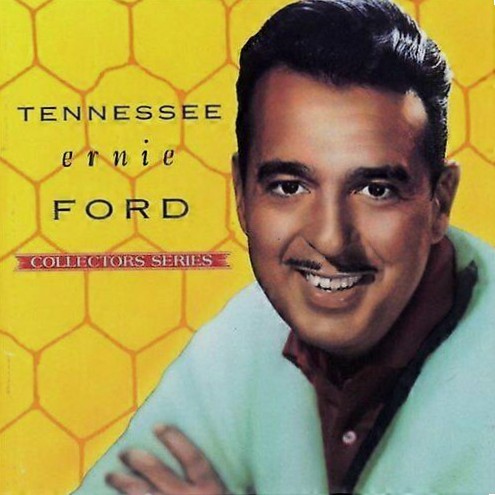
Ernest Jennings Ford (1919-1991), known professionally as Tennessee Ernie Ford, was a genuine Tennessean. Born in Bristol, he embodied the term “all-around entertainer.” The classically-trained baritone was famous for his exaggerated down-home persona. When Ford was in front of microphones, cameras, or audiences, he overflowed with southern hospitality and his unique style of country humor. Although his vocal training was operatic, his records were country, pop, and gospel. Also a comic actor, he guested on countless TV shows during the fifties, sixties, and seventies. His own show, which aired on NBC between 1956 and 1961, was The Ford Show. And, of course, the show’s sponsor was The Ford Motor Company. Today he is best remembered for his 1955 career-defining, finger-snapping, iconic record, “Sixteen Tons.” As a child of the sixties, I knew him from Kodak Instamatic commercials and from watching I Love Lucy. Due to my addiction to vinyl, I became acutely aware of Ford during the eighties and nineties from sifting through countless copies of his biggest-selling album Hymns (Capitol T756). And just in case you’re wondering if I ever bought one: I sure did, and I didn’t care for it or keep it. I’ve enjoyed a number of small-lable religious records, but Hymns is too commercial and too reverberated for my taste.
The burly man with the big voice, skinny mustache, and a dark tan, started his career in entertainment in 1937 as a radio announcer for Bristol’s WOPI. In 1938, he left radio to study music at the Cincinnati Conservatory of Music. In 1939, with his finances drained, he returned to radio and continued announcing until 1941. In 1942, he entered the US Army Air Corps and earned the rank of first lieutenant. His military service lasted until the end of WWII. After his discharge in 1945, he and his wife moved to San Bernandino, California, to be near her parents. While in San Bernardino, Ford was hired by radio station KFXM where the format was country and western. During his time at KXFM he added Tennessee to his name and perfected his trademark hayseed drawl. By 1947, he was announcing for another Southern California country and western radio station, Pasadena’s KXLA. There he met bandleader, bassist, manager, and record producer Cliffie Stone. Stone would become an important figure in Ford’s life, managing his career from 1947 to 1961. Stone’s band of virtuoso musicians also backed Ford on his earliest records. Stone, who also worked for Capitol Records as a talent scout, worked closely with artists and relations man and producer Lee Gillette. Gillette, who had recently signed Tex Ritter, Jimmy Wakely, and Merle Travis to Capitol, heard Ford on the radio singing along with the records. He liked what he heard and instructed Stone to "Bring that Tennesse Ernie fellow to me.” On 1/21/49, Ford signed with Capitol, and by April he had his first top ten single on the country and western charts: a cover of Red Foley’s 1945 single, “Tennessee Border.” I think it’s interesting that the recording was made on the same day that Ford signed the contract!
Every title in the Capitol’s Collectors Series featured an artist's name followed by the words “Collectors Series.” The content of the discs was primarily a-side of singles, but b-sides and unreleased material were occasionally added as filler. The liner notes were superbly written. Recording dates, release dates, and chart histories were also included. And best of all: Most of them sound great! Artists included Frank Sinatra, Peggy Lee, Nat King Cole, Jo Stafford, Jerry Lewis, The Kingston Trio, and Dean Martin. And that’s skimming the surface. Much to my surprise, the Ford title (CDP 595291) is the most satisfying of them all. And, of course, it’s my job to tell you why this is so, but before I do it, I need to tell you that I’m not reviewing one artist, but actually three. Between 1949 and 1953, Ford teamed up with the electrifying plugged-in guitar duo of Speedy West (1924-2003) and Jimmy Bryant (1925-1980). West played a custom-made Bigsby triple-necked pedal steel, and Bryant played a Fender Esquire, upgrading to a Telecaster in 1951. Listening to the bouncing “boogies” that Ford, West, Bryant, and Stone created makes it abundantly clear that everybody in Stone’s band was having a ball in the studio. The record-buying public couldn’t resist their hopped-up blend of country and rhythm and blues, and neither can I. It wasn’t rock ‘n’ roll, but the flavor was awfully close!
The CD opens with the above-mentioned 1/21/49 recording of "Tennessee Border.” The hillbilly-voiced DJ from KXLA had yet to think of himself as a professional singer, and it shows. Stone, a close friend of Gene Autry, used an Autry-like arrangement on this date. This means the most prominent instruments were an accordion and an acoustic rhythm guitar. The accordion was played by pianist and accordion virtuoso Billie Liebert (1925-2001). Although I love Stone's band and his barn-dance arrangements, Ford’s voice fails to move me on this cut. When I hear Red Foley’s recording, my mind floats off to another world. With Ford, I just want to press the skip button.
Cut four, “Mule Train,” recorded on 10/18/49, is disappointing. Ford takes the novelty classic too seriously. The song is supposed to be fun, like dressing-up-like-a-cowboy kind of fun. And it requires a whip. Frankie Laine, Mickey Katz, Gene Autry, and Spike Jones all made fine recordings of “Mule Train,” and they all had whips. I can’t choose a favorite, so please allow me two: They would be Laine for simply nailing it, and Katz for his Yiddish insanity. And who, by the way, doesn’t have a whip? The answer is Ford. However, his whipless record made it all the way to the number one spot on the country charts in 1949.
Cut five is “Anticipation Blues,” recorded on 10/10/49. It was penned by Ford and Stone. What was Ford anticipating? Here’s the answer: his first child, Jeffrey. In addition to becoming a daddy, something special was brewing in the studio: Ford was feeling comfortable in his new musical skin, and West and Bryant were also finding their own sound as a duo. The three musicians were becoming a singular musical force, and luckily for us an Ampex tape deck was recording the event.
“Anticipation Blues” opens with Ford doing a count-off. When he said “one,” he spoke right into the mic, but when he said “two,” he turned away from the mic so we, meaning we audio fanatics, could hear the room. The first instruments heard are a fiddle and Bryant’s electric guitar. The joint really starts to jump when Ford starts singing at eight seconds. From that point on we are transported into a jumping, swinging, time machine. At 1:22, West leaps into an incredible steel solo, and just wait until you hear Ford’s Hank Williams-like falsetto! In December of ‘49, it charted at the number three position on the country charts. It was also the b-side of the “Mule Train” single.
Cut six is “Cry Of The Wild Goose,” recorded on 12/30/49 and penned by folk singer Terry Gilkyson. Ford made his recording eleven days before Frankie Laine recorded his number one hit version. On this song, I like Ford better. An avid outdoorsman and hunter, Ford brought his love of the outdoors and the adrenaline rush of hunting to the microphone. His approach is full of color: He owned the moment! By comparison, Laine, a cityslicker from Chicago, sounds rushed.
“Cry Of The Wild Goose” opens with the great Merle Travis (1917-1983) playing flamenco licks on his acoustic guitar. Also heard is West’s crying steel guitar. At eight seconds, Ford enters. His voice is incredibly well-captured by a closely placed RCA ribbon mic and an old school tube mic preamp. For the first twenty-two seconds, all you hear is Travis’ guitar, Ford’s voice, and an off-mic organ in the background. But then the song takes off. You’d better hold onto your chair, because the music gets fast, then slow, then fast again, and while this is happening, West makes eerie sounds on his steel. Eddie Kirk played the acoustic rhythm guitar and Stone played bass. The music is inviting, colorful, and above all exciting. The sound is demo quality. It peaked at number two on the country charts and number fifteen on the pop charts, proving that there’s more than one way to sing a song, and more than one way to capture a goose.
Cut nine is “Shotgun Boogie,” recorded on 7/27/50. To my ears, it’s one of the two greatest songs Ford ever wrote and recorded. It's a high-energy country-boogie and it’ll thrill you in ways that you have never been thrilled. Imagine taking your gun-toting girlfriend out for a day of dove-hunting. OK, maybe your girlfriend doesn’t like guns, but you won’t find a tighter band on any record! It opens with some mean piano licks from Billie Liebert. For much of the song, Bryant and West are relegated to the background, allowing Ford and drummer Muddy Berry to steal the show. I love how Berry smacks his snare. His snare smacking is so affirmative! At fifty seconds, Liebert leaps into a mind-blowing boogie-woogie solo that laid the foundation for Floyd Cramer’s boogie-woogie piano work on Elvis’ “Big Hunk O’ Love,” recorded eight years later! Stone’s bass playing is visceral and inspiring, and I love how well he was recorded. Rather than today’s “high res” sound of fingers and wood, heard as separate entities, Stone’s bass blends into the music, filling the entire room with its rich resonance. At 1:50 West leaps into a mind-altering steel solo. West pioneered the “crash-bar” technique of steel playing, and this is a perfect example of it. Ford’s vocals sound a little hard due to some compression. Sometimes you have to rein in a loud singer with a little compression just to get them on tape. (If you don’t believe me, take a fresh listen to any Ronstadt or Pavarotti record.) Despite this minor flaw, the sound is fabulous! It reached number one on the country charts in December of ‘50, and it reached the number fourteen position on the pop charts the following month. This record most certainly laid some of the groundwork for the rock ‘n’ roll tidal wave that was coming right around the corner.
Are you ready for another hopped-up boogie? Of course you are! Cut fifteen, “Blackberry Boogie, recorded on 7/10/52, is my other favorite Ford record. It's another Ford original, and it’s as rockin’ and rollin’ as any rockabilly record ever recorded. It also picks up where cut nine left off. West and Leibert steal the show with their pedal steel and piano hijinks. Crank the volume up to twenty-nine and be ready to lose your mind! It reached number six on Billboard’s Most Played in Juke Boxes charts in September of ‘52, but for some reason it didn’t crossover to the pop charts. I can only surmise that somebody in Capitol’s marketing department forgot to grease the necessary palms.
Cut sixteen, “I’m Hog-Tied Over You,” recorded 7/9/52, is another Ford original. It’s a duet with labelmate Ella Mae Morse. I’m a sucker for male/female duets, but I have to admit that this one is a bit silly. However, it’s worth a listen for the incredible guitar playing, especially from West. It opens with West and Bryant sounding like they’re trying to out play each other. If you like fast guitar playing, this cut’s for you! At three seconds, the two singers arrive. Bryant, who by now was playing a Telecaster (he was the first to use one), is captured off-mic. That means he’s heard in the background for the first half of the song. West, whose mic was aimed right at his amp, will blow your brain to smithereens at fifty-five seconds with his crash-bar steel playing! At 1:47, Bryant, who finally got his mic turned on, created a storm with his incredibly fast playing. His admirers included Chet Atkins, who, according to Vintage Guitar magazine, once said: “I could never get in his league.” This cut is packed full of caffeinated energy, but according to the CD’s liner notes, this record never charted. Go figure.
Cut eighteen,“Hey, Mr. Cotton Picker,” recorded 3/19/53, is tons of fun! You can clearly hear that Ford loved making records. And then there’s West’s steel playing: In this session he was the star of the show, and his playing is completely insane. I can’t think of another steel guitarist who sounds like him. His unlimited but wacky ideas remind me of Les Paul. The fluff lyrics are nothing more than a vehicle for Ford to use his voice as a musical instrument. And then there’s Bryant: He tosses out jazz licks that would have made Barney Kessell and Johnny Smith proud. And then there’s Liebert’s piano: His solos are mesmerizing! The drummer who was keeping perfect rhythm with nothing but a rim shot was jazz great Roy Harte. The sound is vivid, it peaked at number eight in June of ‘53, and right at this very moment it’s altering my brain cells via my Sherwood-driven Sennheiser HD650 headphones.
Cut twenty-four is “His Hands,” recorded 5/4/55. Although it reached number fifteen on the country charts, it’s not country music. It’s a beautiful spiritual from the prolific pen of Stuart Hamblen. For this outing, Ford worked with Billy May. May, a band leader who conducted tons of great records for Capitol, including Sinatra’s Come Fly With Me, had a knack for bringing out the best in singers. On this song, Ford brings out his operatic pipes. His voice is huge! And what a gorgeous sound! The sound is so big, so rich, and so round, it fills the room like a Decca-London classical stereo recording. And yet, it’s mono.
Cut twenty-five made it to number one on every chart you can think of. And, of course, you know it. And, of course, if you have a pulse in your veins you’ve sung along with it. It’s the massive hit, “Sixteen Tons,” recorded on 9/20/55. We can all relate to the immortal words: “You load sixteen tons and what do you get/Another day older and deeper in debt/Saint Peter don’t you call me, ‘cause I can’t go/I owe my soul to the company store.” Ford’s close friend, Merle Travis, wrote the lyrics, and Ford took it all the way to a special place in our hearts. If only it sounded as good as it should. Yeah, I know, it’s ironic that it sounds compressed, denoised, and sloppy in the bass. Honestly, it doesn’t sound awful, but I’ve heard it sound better elsewhere.
Prior to writing this article, Cliffie Stone was just a name I saw now and then. I knew he had something to do with west coast country music, but I never gave him much thought. I would have known more about him if he had made more records. The reason for his lack of recordings was because most of his time was spent on the air as a DJ, hosting his own TV show, Hometown Jamboree, from 1949-1953, and managing musicians such as Hank Thompson, Merle Travis, and Tennesee Ernie Ford. He was also, as this CD makes clear, a great bass player. Prior to his work in country music, he played bass in big bands.
I’ve been wanting to review this CD for years, but I just kept putting it off. There are so many great songs on this disc, and I didn’t even mention all of the songs I like. If you ever thought of Ford as a one song wonder, that is so untrue.