


The incomparable Kitty Wells (1919-2012), whose real name was Ellen Murial Deason, was the first female singer to achieve a number one hit on the country charts. The year was 1952 and the song was “It Wasn’t God Who Made Honky Tonk Angels.” Many hits quickly followed, making her the first female star of country music. Raised with music in her home, she was one of six children. Her father, Charles, played guitar and banjo and her mother, Myrtle, was a gospel singer. Her husband, Johnnie Wright (1914-2011), with his partner Jack Anglin (1916-1963), were the popular duo Johnnie and Jack.
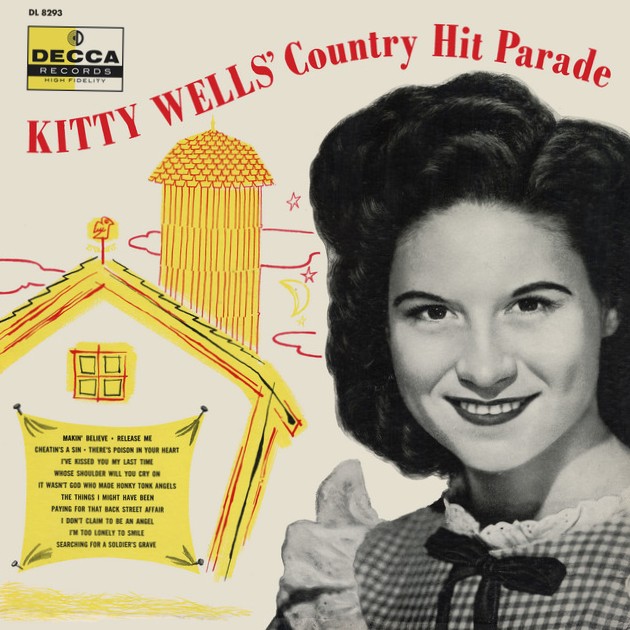
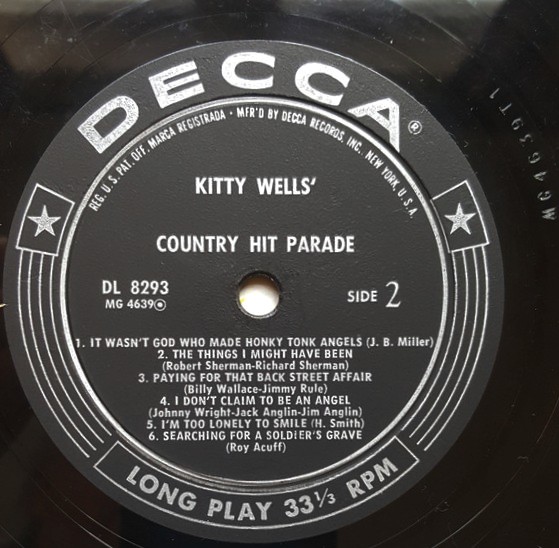
Today’s subject is Wells’ first album, Kitty Wells’ Country Hit Parade (Decca DL 8203). It was released in 1956. Although she made some singles for RCA as far back as 1949, it was her Decca singles, starting in 1952, that made her famous. 1956 was the breakout year for country and rockabilly albums, as evidenced by Elvis Presley, Johnny Cash, and Buddy Holly. For Decca, 1956 was also the year that they released their first twelve-inch albums by their country stars: Wells, Ernest Tubb, Red Foley, and Webb Pierce. These albums were created from a-sides and b-sides of singles. If filler was needed, there was always unreleased material that could be used. With this in mind, let’s see how well this twelve-inch slab of breakable Deccalite holds up as an album.
Kitty Wells’ Country Hit Parade opens with what was her latest hit single. It’s the aching love song “Making Believe,” composed by singer-songwriter Jimmy Work. (Work’s prior success came in 1949 when he wrote “Tennessee Border“ for Red Foley, which I discussed HERE.) Recorded on 1/15/1955, this heart wrenching number peaked at number two on the country charts. If you want to hear the plaintive honesty found in traditional country music, look no further! Wells’ delivery of the lyrics is spunky and sad at the same time. The song’s interpretation has, for me, never been matched, despite the many that have recorded it. It opens with Paul Warren’s (1918-1978) incomparable fiddle playing. At seven seconds he’s joined by steel guitar maven Harold “Shot” Jackson (1920-1991) playing a dobro. At ten seconds Wells starts to sing. She also plays the rhythm guitar that’s heard throughout the song. The sound on this cut gets an A-. The minus is only there because a small amount of tape-slap reverb was added to her voice. This was frequently done to make records sound appealing on low fidelity radios and phonographs.
How do you follow one of the greatest country love songs ever written? You follow it with another! Cut two is a song that we all know called “Release Me.” Up until the mid-nineties, the only version I knew was by Engelbert Humperdinck. His recording from 1967 is a bonafide countrypolitan classic, echoing the Nashville sound of the mid-sixties. But what about the earlier recordings by Ray Price and Wells? They both recorded the song in 1953. (Wells made her recording on 1/19/54, which was the day after Price’s record was released!) Both charted at number eight. Delving deeper, I discovered earlier recordings. One is by Jimmy Heap and his group the Melody Masters, recorded on 11/17/51 and issued by Capitol in 1953. My ears tell me that this is the record that Price and Wells covered. And then there’s the first recording. It’s from 1950, by the song’s composer, Eddie Miller. Kindly speaking, the song was still searching for the right messengers. Putting it bluntly: It’s a very rough demo.
Compared to Price, Wells’ “Release Me” sounds a little more spare. It opens with some deliciously played steel guitar played by Jackson. The prominent acoustic rhythm guitar was either Wells, Louis Innis, or Chet Atkins, and the high lonesome fiddler is, again, Warren. If you’ve never experienced Price’s record, you’d swear this is the definitive version. And the sound is superb! The steel and Wells’ voice are up front and vivid, while the other musicians are heard further back in the room.
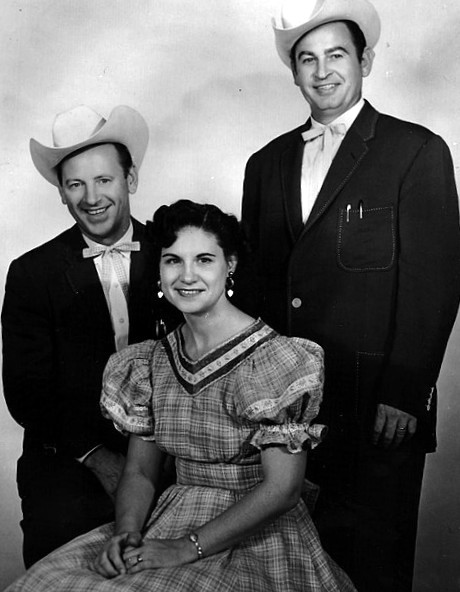
Side two opens with Well’s most famous single, and her only crossover hit. It’s her signature song, “It Wasn’t God Who Made Honky Tonk Angels.” The number one hit was recorded on 5/3/52 and released on 6/23/52. It was a so-called “answer song” to Hank Thompson’s (1925-2007) number one hit “The Wild Side of Life,” using the same melody and reusing some of the lyrics. Upon its release, NBC banned it from the radio and the Grand Ole Opry banned the controversial song from their stage! What I find most interesting is this: Wells didn't make the recording because she thought it would sell. Up until then, her singing had mostly been relegated to backing Johnny and Jack, her RCA singles tanked, and she was making plans to quit the music business so she could stay at home to raise her kids. Wright was a successful musician, so her only reason for attending the recording session was to collect $125 of union scale. Breakthroughs are rarely expected.
“It Wasn’t God Who Made Honky Tonk Angels” is a masterpiece that should be on every music lover's playlist. It opens with Jackson’s high lonesome steel guitar and Jack Anglin’s acoustic rhythm guitar. Their intro sets the mood, Wells’ voice confirms it, and the vividness of the recording is an audiophile’s thrill! At seven seconds Wells enters with the lyrics. The upright bass, played by her husband Wright, isn’t heard as much as it’s felt. And the fantastic fiddling is once again Warren. Music making doesn’t get any better! And the they-are-here sound is the icing on a delightful cake.
Side two cut four is “I Don’t Claim To Be An Angel.” This top ten single was written specifically for Wells by Wright and Anglin. Although I can’t prove it, it seems obvious that they wrote this bad-girl-gone-good song in response to “It Wasn’t God Who Made Honky Tonk Angels.” Recorded on 3/15/53, “I Don’t Claim To Be An Angel” is one of my favorite cuts on the album. It's folky, rural, twangy, authentic, and just plain awesome. It also opens with some of the best fiddling ever recorded! Warren’s magnificent tone is on full display. The mic was perfectly placed right above his instrument, so it sounds like it’s right here in my room! Following Warren’s mind-altering intro is Wells’ voice and her superb guitar playing. Meanwhile, Jackson's lonesome dobro is off mic, but easy to hear. If you're an authenticity freak, this cut’s for you.
Side two cut five is “I’m Too Lonely To Smile.” It was cut during the same 5/3/52 session that produced “It Wasn’t God Who Made Honky Tonk Angels.” Much to my surprise, it was never released as the b-side, nor was it released on any other single. It stayed in the can until this album was released. The opening words: “All my life I’ve had nothing but trouble” pretty much sums up its brokenhearted message. Earth-shattering it’s not, but it offers a powerful dose of Vitamin Twang. It also feels really good to close the album with this cut. The stars of the show are Wells and Jackson. The sound isn’t quite as vivid as the other cuts, but it’s certainly not bad.
One thing that stood out during my deep dive into this album was the great musicians. As a collector of violin records, both classical and country, I would have to rate Warren’s fiddling as some of the best ever recorded. Prior to writing about this album, I only knew him as the fiddler on the indispensably good and extremely well-recorded At Carnegie Hall by Flatt and Scruggs. I’m eager to hear more of his work.
I’m also greatly impressed by Jackson’s steel guitar and dobro work. During my research, I found sources claiming that his dobro sound on this album came from his steel guitar. I beg to differ. I’ve heard a lot of steel guitar, and while a rock ‘n’ roll guitar sound can be accomplished on a steel guitar (as evidenced by Pete Kleinow’s work with the Flying Burrito Brothers), I’ve never heard a dobro sound from an amplified instrument. Having said this, Jackson was the cofounder (with Buddy Emmons) of Sho-Bud, famous for their steel guitars, so he might have been playing a prototype amplified dobro.
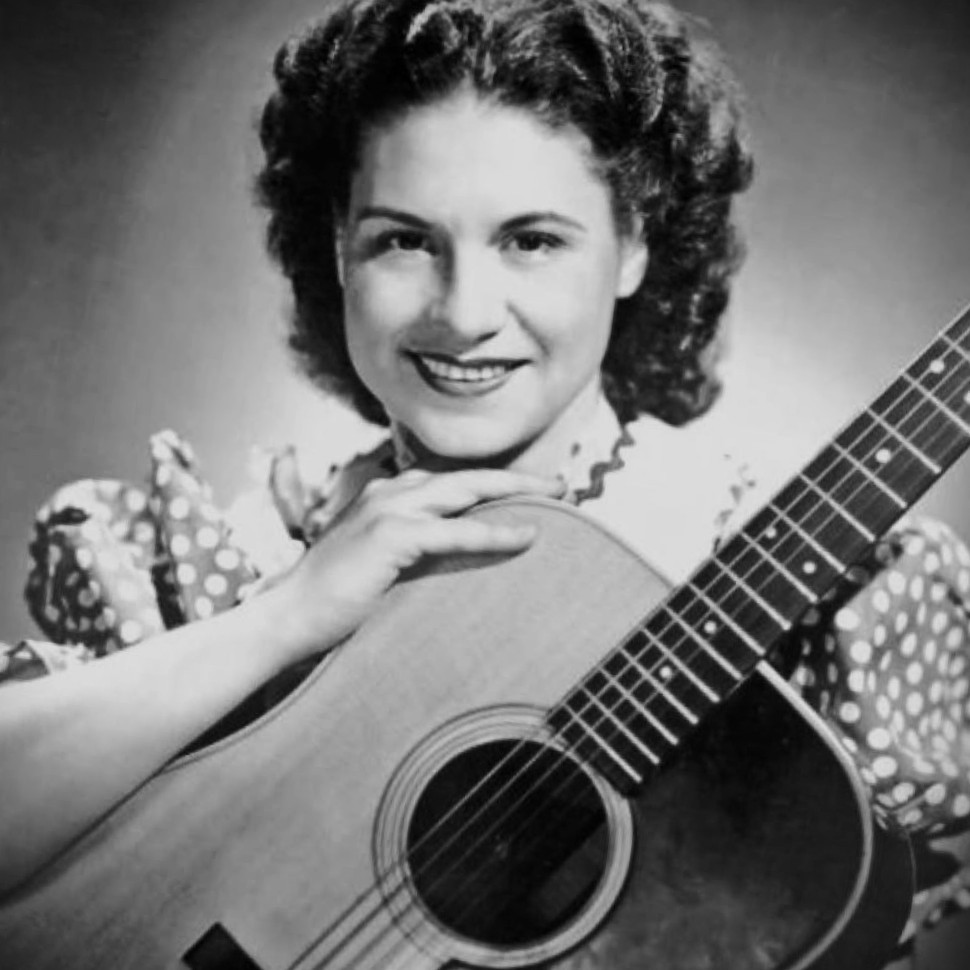
One of the best musicians on this record is Kitty Wells. I find it ironic that after all the years I’ve spent collecting her albums, listening to her music, and watching her YouTube, I never thought of her as a guitarist. And this is despite the fact that I’ve always seen her with a guitar. Eddy Arnold, Ray Price, Elvis Presley, Loretta Lynn, Jim Reeves, and George Jones did the same thing, but like Wells, I only think of them as singers. Listening to this album brought me in touch with Wells as a complete musician. I was constantly enamored with Wells’ guitar. There was nothing adventurous to her playing, but her strumming was assertive and soulful. Midway through my review, I switched from my Grado Reference to my Hana EH moving coil on my Micro Seiki DQ50 turntable. Typical of a moving coil, the Hana plays the LP with less surface noise and the bass is a little tighter. Both cartridges reproduced her voice beautifully. However, it was the Grado that placed a pleasing spotlight on her guitar playing. The Hana isn’t inherently inferior on acoustic guitar. In fact it’s excellent on guitar, but on this particular title the Grado allowed her guitar to sound more human and connected with her vocal phrasing. What would the audiophile hobby be with tradeoffs?!
I can’t speak for streamed versions of this music, but I ordered a CD. It’s on Hux Records from the UK. What clinched the deal was the opportunity to hear her second album, Winner Of Your Heart. I should have known better. The CD sounds dreadful. The top end is rolled off and reverb was added. Yuck.
What defines a perfect album? If album perfection is defined by its quantity of great songs, then Sgt. Pepper’s Lonely Hearts Club Band is one of the very few perfect albums. So perhaps because I only love half of the songs on Kitty Wells’ Country Hit Parade, I should instead call it a must-have album.