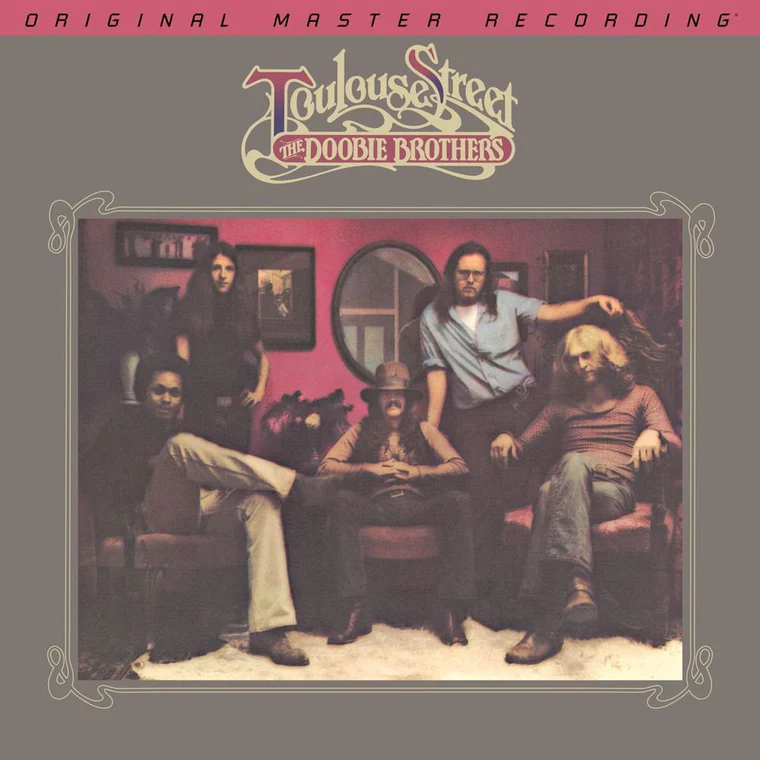



Just about six months after the release of The Doobie Brothers’ Toulouse Street, they began working on The Captain and Me, again with producer Ted Templeman and recording engineer Donn Landee. They could not book Amigo Studio solid, as the band was touring, so they had to piece-meal the project, even recording some overdubs on the road at a studio in Washington, DC.
The album has their signature sound, but also adds once again some piano and B3 work from Little Feat’s Bill Payne (Templeman and Landee had worked with Little Feat), and quite a few ARP synthesizer sounds programmed by TONTO legends Malcolm Cecil and Robert Margouleff, with some steel guitar work from Steely Dans’ Jeff “Skunk” Baxter. The string arrangements were by Nick DeCaro.
The album is mainly comprised of Tommy Johnston rockers along with some blues and country flares, and even a Chinese-influenced piano line Payne came up with for China Grove. Turns out there is a town in Texas called Chine Grove, which Templeman found in a US Atlas.
With that, Johnston wrote the lyrics in one afternoon. Johnston typically wrote the lyrics in the studio at the last minute.
The album cover and inside gatefold photos are deliberate time-warps, with a Wild West stagecoach parked under an earthquake-wrecked 1970s freeway. The location is the Newhall Pass interchange of I-5 and State Route 14, near Sylmar, California. The unfinished bridge in the shot had partially collapsed in the Feb. 9, 1971 San Fernando earthquake, about 1.5 year prior. The same section of freeway collapsed again in the 1994 Northridge earthquake. The front, back, and inside shots show the five band members plus manager Bruce Cohn, all in 19th-century costume. This answers the long-running question of who the sixth man is. Warner supplied the period clothes and the horse-drawn stagecoach from their film studio lot.
The inside gatefold carries the gag further, with the band in Victorian dress eating dinner at a table in the shadow of the collapsed overpass. The jacket photography was by Michael and Jill Maggid, and designed by John and Barbera Casado.
Note how well the MoFi Stoughton jacket reproduces the photo, since the image depends on the sharp contrast of concrete slab against sky and stagecoach. This jacket has huge variations in color and saturations depending on who printed it. MoFi does a nice job here.
The album produced several hits, including a Top Ten Hit at #8 for “Long Train Runnin’”.
Recording facts
Since the band was touring and not able to book the studio from start to finish, there were times when Landee and Templeman photographed the mixing board and put tape over the faders to prevent anyone from moving the faders and knobs during their absence.
Templeman was a drummer himself and really liked the two-drummer sound. Five tracks on the album feature it with Hartman’s drums panned hard on one channel and Hossack’s on the other.
A lot of Porter’s bass is recorded with a direct input box (D.I.), giving it a clean, articulate sound, especially on “Chine Grove,” “South City Midnight Lady,” and “The Captain and Me.”
The great distorted guitar sound on China Grove is Tommy playing through a Fender Bandmaster bottom and a Fender Bassman top.
In his book, A Platinum Producer’s Life In Music, Templeman refers to “Without You” as the Doobie’s “We Won’t Get Fooled Again,” and was often their encore tune with pyrotechnics. The track has two separate live tracks with all the members playing, and the two are joined at about the 3:15 mark.
Sonic Comparisons
This isn’t my first Positive Feedback review of the Doobie Brothers. you may want to take a look at my earlier review of Toulouse Street.
My old vinyl LP has “SP” etched in the dead wax, meaning it is most likely an early-to-mid-’80s WEA reissue pressed at Specialty in Olyphant, PA. It’s roughly a decade removed from the original 1973 Terre Haute green-label original. It’s still an analog-era pressing, likely from a later-generation lacquer. The “WW2” in the dead wax suggests a recut rather than the original 1973 lacquer.
So, this is comparing an East Coast WEA-era analog pressing against a DSD256-sourced 45 rpm. That’s a meaningful matchup, not just old versus new.
The MoFi 45 RPM. WOW AGAIN! This version asks to be cranked! This is what buying audiophile pressings is all about. Very quiet vinyl noise. Better dynamics, better details, fuller sound. The acoustic guitars are clean with realistic image size and presence, although the strings are a bit vague in the recording. Great reverb use throughout. Vocals were recorded present, but a bit thin in the midrange. Nice depth found in the back ground vocals. Nicely packaged gatefold, and their especially nice feeling rounded LP edges on the discs.
My old LP has much less weight and size, not as much bottom end, doesn’t have the heft or attack, yet it still sounds clean. The vinyl noise is poor even though it is in “like-new” condition.
“Natural Thing”: A highlight track. Smooth, nice details.
“Long Train Runnin’”: Articulate bass. I hear some print through on the MFSL before the track starts, but not on my old pressing!?
“China Grove”: A highlight track. Crank it! Nice high hats, great guitar distortion, cool rounded tone on the guitar solo. D.I. bass.
“Dark Eyed Cajun Woman”: A highlight track. More of a concert bass sound. Always sounded to me like B.B. King playing in the beginning of the track. The string sound is better here.
“Clear as the Driven Snow”: Nice synth work. The background vocals sound back in the soundstage.
“Without You”: Concert bass again.
“South City Midnight Lady”: The “Skink” on Steel. Articulate Bass.
“Evil Woman”: The worst sound on the album. It sounds congested, probably from overdoing the effects to get a vibe.
“Ukiah”: great synths.
“The Captain and Me”: A highlight track. Great bass and drum sound, separation, balance, and dynamics.
This recording/playback in general
Dynamics- good
Imaging — Good+
Soundstage — Solid with good layering
Tonal Balance — Good
Bass Extension — a bit more than typical for the era
Bass Articulation — hit and miss
Detail Retrieval — very good
Musicality — makes you want to crank it.
Technical notes
Produced by Ted Templman
Engineered by Donn Landee
Mastered by Krieg Wunderlich at Mobile Fidelity Sound Lab, Sebastopol, CA using the GAIN 2™ Ultra Analog mastering chain
Source: 1/4" / 15 IPS Dolby A analog master → DSD256 → analog console → lathe
Plating by: RTI
Pressed by: Fidelity Record Pressing (FRP) in California. This is MoFi’s new in‑house‑adjacent plant (a joint venture with RTI)
Packaging: Numbered, 180g, 45RPM, 2LP set, Stoughton Printing gatefold jacket
Vinyl surface noise: Very good
Vinyl centricity: Very good
Vinyl warp: Very good
Album Packaging: Good quality
Cover photo courtesy of Mobile Fidelity; drawing by Bruce Walker