

This was the line-up who was the first to play "electric" at the Newport Folk Festival in 1965. This caused quite a disturbance from the folk-purists in the crowd. Especially when members then backed up Dylan for his first electric performance.
The Butterfield Blues Band album "East West" of 1966 is one of the earliest recordings to fuse Chicago electric blues, jazz improvisation, and rock rhythmic drive (and even Indian classical modality) into the American culture. Paul Bloomfield had been studying raga structures and wanted to create a piece built on sustained modal vamping rather than chord changes. This is particularly evident in the 13-minute title track, and is years before the San Francisco scene adopted similar ideas by bands such as The Grateful Dead, Quicksilver Messenger Service, etc.
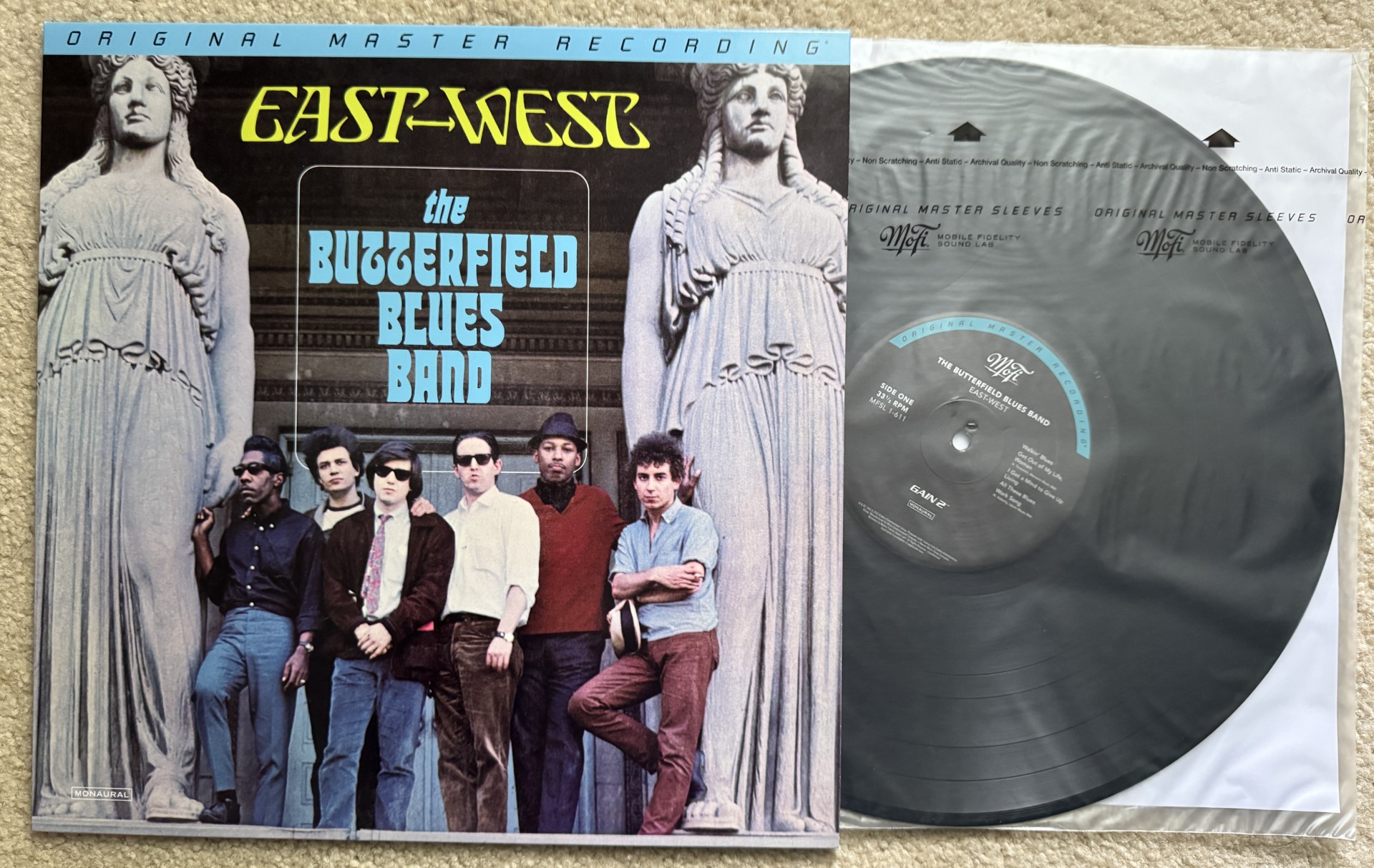
This is a MoFi 33 1/3 monaural LP. There are mono and stereo versions of this recording on other labels. Between the two, the mono version is more cohesive and where producer Paul Rothchild and recording engineer Ron Malo focused most of their efforts. The mono is considered the "real" mix. It is more punchy, and was optimized for AM radio and club jukebox playback, popular at the time. The instruments sit in more of a single acoustic space, which is accurate to the way the music was actually recorded.
The Band Members
Vocals/Harmonica- Paul Butterfield grew up in the South Side in Chicago. He was mentored by Muddy Waters and Howlin' Wolf and one of the first white musicians fully accepted into the Chicago blues scene. The Butterfield Blues Band bridged electric Chicago blues with the rock audiences.
Guitar- Mike Bloomfield studied blues guitar, Indian classical and modal improvisation.
Guitar- Elvin Bishop probably ended up being the most successful member of the band.
Electric Bass- Jerome Arnold was a former bassist for Howlin' Wolf.
Drums- Billy Davenport was primarily jazz trained.
Organ/piano- Mark Naftalin rounds up the band, all from the Chicago Blues circuit.
Album Recording
Ron Malo was Chess Studio's Chief Engineer. He is known for unfussy engineering, and instrument and mic placement that allows the band to play off one another, and to capture the live energy and interplay of the music, rather than constructing tracks to build the composition. The result is an album that feels like you are witnessing a spontaneous performance. An album that is fun, comfortable and relaxing to listen to.
The album was recorded live in the main Chess room in Chicago, where Muddy Waters, Howlin' Wolf. Etta James, etc. recorded. Because of these records, the Rolling Stones wanted to capture the same focused, midrange-forward, performance-driven sound. They recorded there several times in 1964-65. And so, East West includes the same DNA, with the same engineer and equipment chain. In the mid 60's Chess had Ampex 2, 3, and 4 track tape machines, RCA 77-DX ribbon mics, Shure 545 and Electro-Voice 664 and 666 dynamic mics, custom Chess tube preamps, and a rather dry approximately 30 by 20 by only 10 foot live room. No iso booths. This offers great communication between the musicians but requires careful mic placement to allow controlled detail and bleed. Malo relied on physical distance, not EQ, to create clarity, and long and continuous takes to create the desired emotion.
The Chess scene of 1966 was a minimalist, high-discipline environment. Malo's philosophy was "Get the band right in the room, then get out of the way." The album likely only has a couple of vocal fixes, with all else live. This was the primary approach found at Chess, and serves the Butterfield Blues Band perfectly.
Recording Chain Reconstruction
The likely set up was:
Mics → custom Chess tube preamps → Ampex 300 or 440 4-track at 15 ips. Then mixed and mastered on an Ampex 351 with Ampex 201 polyester tape. No noise reduction circuits.
Billy Davenport on drums in the back corner of the room.
Drums Overhead: RCA 77‑DX (figure‑8) or Shure 545. Captured the entire kit with natural room tone. Positioned 3–4 feet above snare, angled to balance cymbals.
Kick drum: Electro‑Voice 666 or AKG D12. Placed just outside the resonant head. Malo preferred tight, dry kick with no added EQ.
Jerome Arnold on Bass near drums. Shure 545 or Electro‑Voice 664 on Fender Bassman or Ampeg B‑15 (both documented in Chess sessions of the era).
Mike Bloomfield on guitar opposite side of room from Bishop. Guitar: Fender Telecaster. Amp: Fender Twin Reverb. Mic: Shure 545 or Sennheiser MD‑409 (Chess occasionally used these) placed 6–12 inches off‑axis, slightly above cone center.
Tone: Bright upper mids, fast transient attack, zero compression—pure amp dynamics.
Elvin Bishop on guitar opposite side of room from Bloomfield. Guitar: Gibson ES‑335. Amp: Fender amp (likely a Twin or Bassman). Mic: Likely same as Bloomfield but placed further off‑axis for warmth.
Tone: Rounder, thicker midrange to provide harmonic bed for Bloomfield's modal lines.
Paul Butterfield on Harmonica near front center of the room. Mic: Astatic JT‑30 or Shure Green Bullet to feed a small Fender tube amp (Champ or Bassman) and then picked up with a Shure and/or EV 664 room mic to capture the air. Harmonica sits forward without harshness.
Paul Butterfield on Vocals near front center. Mic: RCA 77‑DX or Shure SM56. Malo favored ribbons for blues vocals because they softened harshness. Vocal is intimate, slightly compressed by tape saturation.
Mark Naftalin on keys against the wall. Hammond organ or piano depending on track. Mic: Organ Leslie: Shure 545 on horn + EV 664 on drum. Organ adds harmonic glue. Piano: Single RCA 77‑DX or Shure 545 inside lid. Piano is percussive but not overly bright.
The Sound
The band's second album comes off as a well-executed, tight band, and offers a cohesive, yet varied collection of nine tunes. Recorded sixty years ago, it is definitely nostalgic, both as far as musical content, and recording style of the Chicago blues at the time. There is nothing here to show your audio system off with, just a better way to enjoy the music. And MoFi does a great job here. You can hear all the different changes in mic levels and positions for each track. You can hear many different kinds of distortions that were made during the recording, not the playback medium. An important and historic recording presented here with the best version available.
The Technical notes
- Produced by Mark Abramson and Paul Rothchild
- Engineered by Ron Malo at Chess Studios, Chicago, Il
- Production Supervisor: Jac Holzman
- Mastered by Krieg Wunderlich at Mobile Fidelity Sound Lab, Sebastopol, CA using the GAIN 2™ Ultra Analog mastering chain
- Source: 1/4" / 15 IPS monaural analog master → DSD256 → analog console → lathe
- Plating by: RTI
- Pressed by: Fidelity Record Pressing (FRP) in California.
- Packaging: 180g, 331/3RPM LP, Stoughton Printing jacket
(MoFi also offers a monaural Hybrid SACD version) - Vinyl surface noise: Very good/excellent
- Vinyl centricity: Excellent
- Vinyl warp: Very good; some ripple, tiny dish warp
- Album Packaging: Very good