On a recent, really late evening, my phone chimed nearly nonstop as good friend and fellow high-end audio enthusiast Finnbogi Sigurdur Marinosson urgently slid into my DMs. Finnbogi and I are fairly obsessive hardware geeks, and he’d just descended into an inexplicable, almost incomprehensible journey from which there was seemingly no possibility of return. And he desperately needed a sounding board.
His near-madness was brought on by the installation of a new tweak he claimed had transformed his audio playback like nothing before – surpassing even the effects of his recently acquired Shunyata Research Altaira¹ grounding hub. Finnbo’s steady stream of direct messages continued well beyond midnight, resuming again shortly after 6 am the following morning. His manic, sleep-deprived expressions of absolute incredulity carried an unambiguous undercurrent: “You have to hear this in your own system, or you won’t believe it!” The device he was lunatic-raging about was the Nirvana Audio Chronos Optimizer.
 Finnbogi Sigurdur Marinosson shares his world view of the high end over Cuban sandwiches at Rhumba in Aiken, South Carolina.
This kind of encounter with a fellow audiophile typically just sails right over my head <whoosh!>, but Finnbo’s earnest, nearly maniacal insistence wore me down to the point where further resistance was futile. I reached out to Michael Garner of Tweek Geek, Nirvana Audio’s North American distributor, concerning the possibility of getting a Chronos for review. His response was swift and without hesitation, and within an hour, he had one enroute to me via UPS second day air. Upon messaging Finnbo that Chronos was on its way, my direct message line continued to buzz for days in anticipation of my first impressions. Unfortunately, Chronos arrived late on a Friday when I had just picked up my grandkids for the weekend; shortly after putting them to bed that evening, I inadvertently kicked a subwoofer with my bare left foot (ouch!), breaking the middle toe and badly bruising the entire upper portion of said foot. Needless to say, the initial phase of the Chronos audition got delayed by 48 hours of chasing (actually, more like hobbling!) around after 4-and 8-year-old crumbsnatchers all weekend.
Chronos arrives
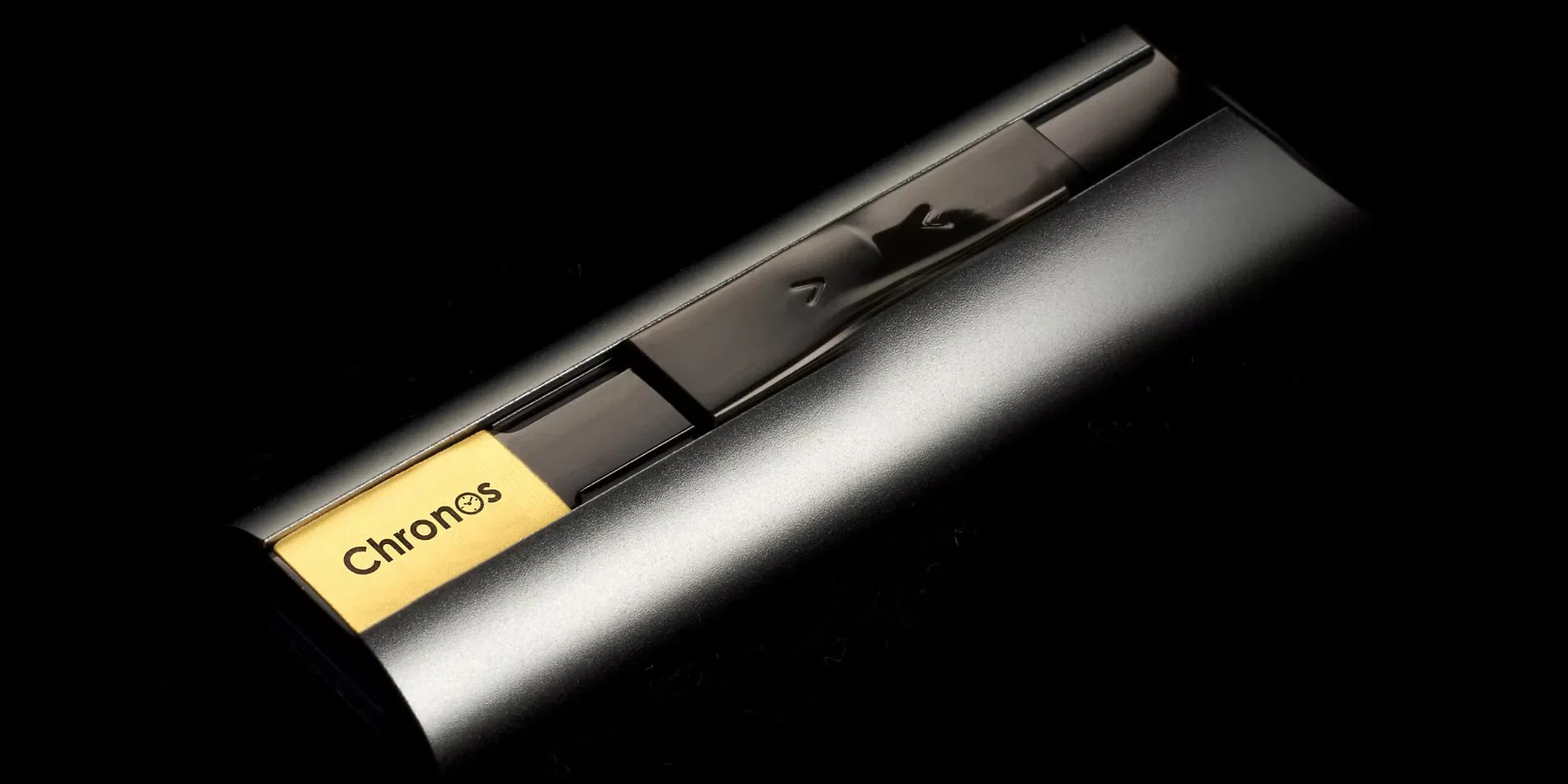
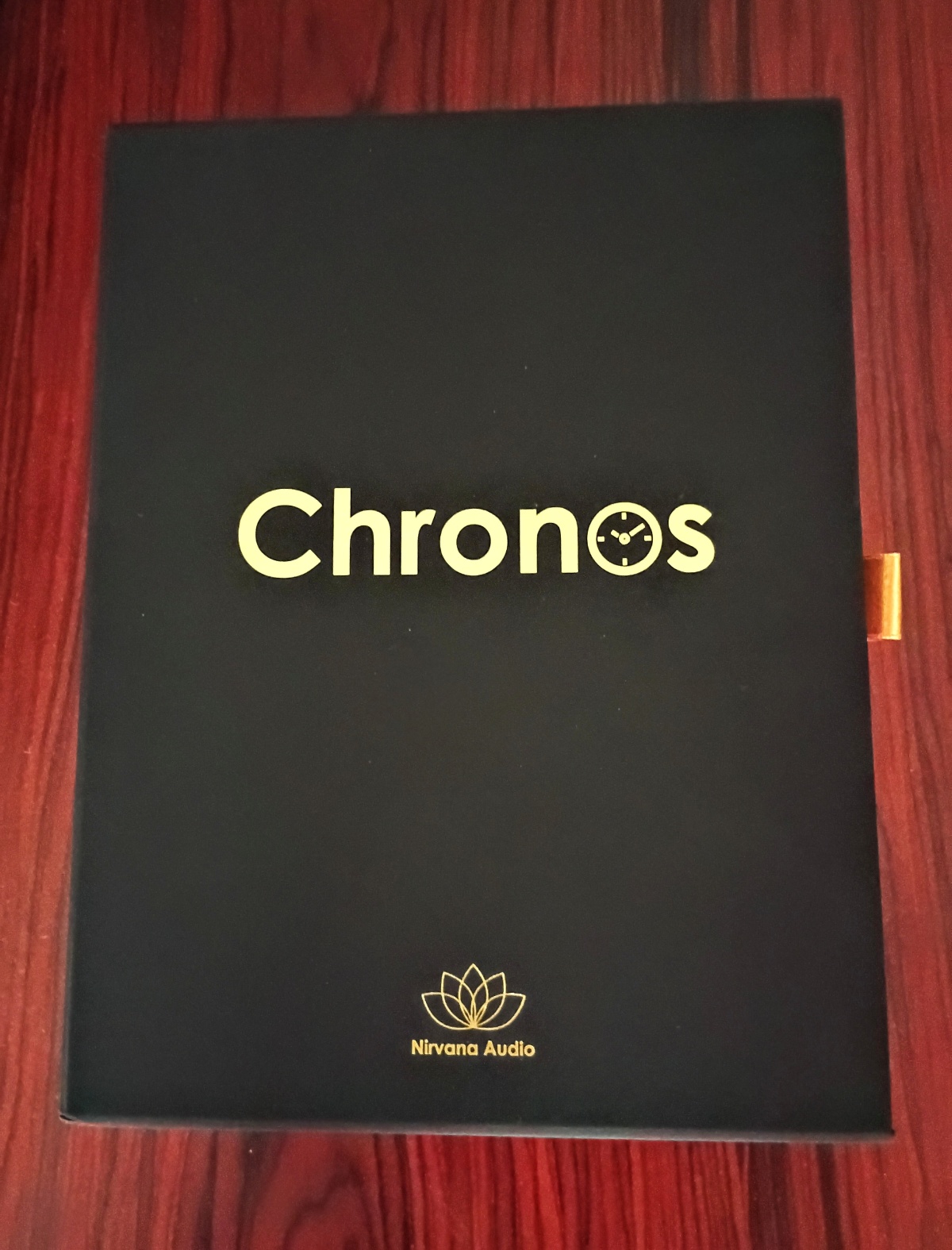
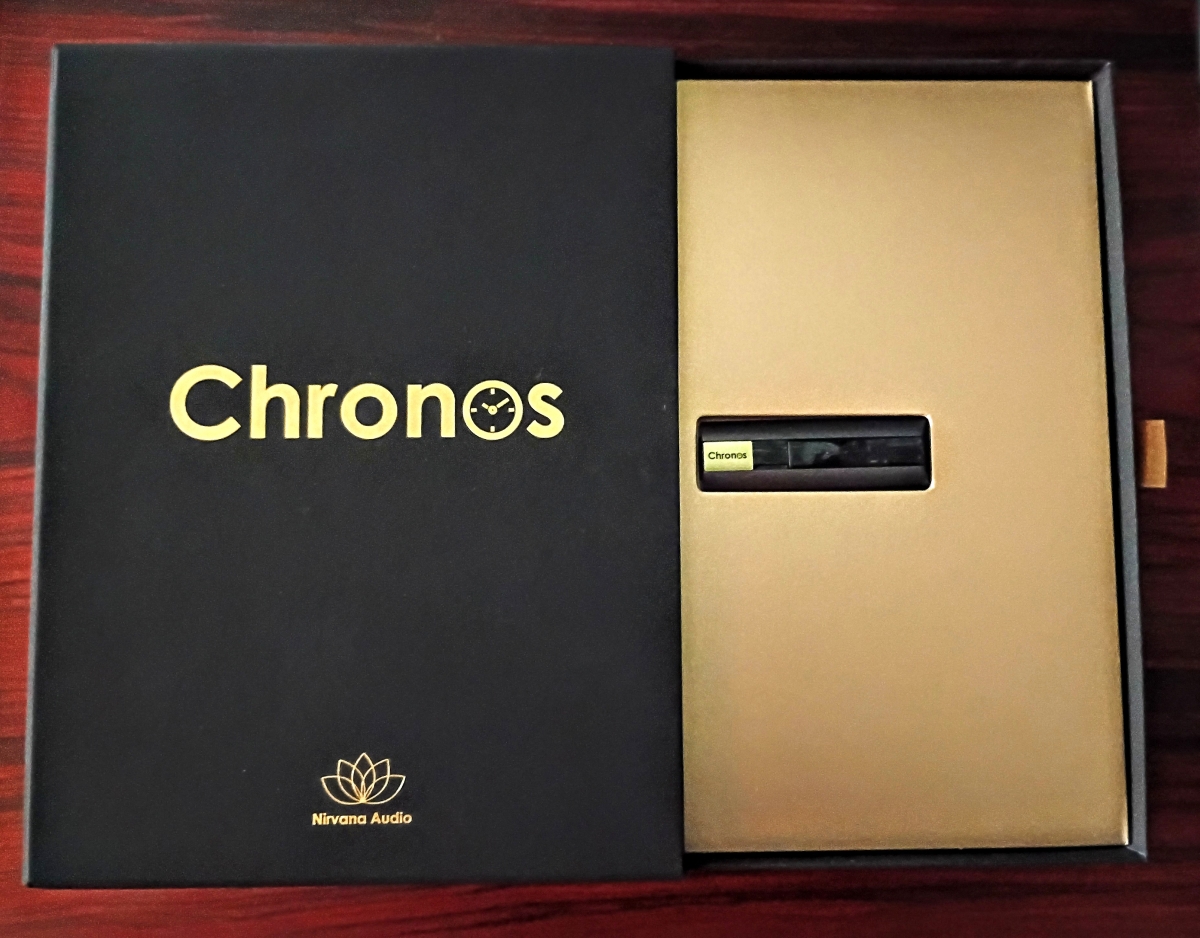
The UPS box containing the Nirvana Audio Chronos was surprisingly large, especially since I already knew its form factor was that of a USB dongle of sorts. Inside the outer box was what the Chinese refer to as a “beauty box” that contained Chronos – and nothing else other than a warranty card – but the gold foil-stamped and golden foil-lined packaging made quite the visual impression! Following Chronos’ arrival, I’d spent every available moment (while not engaging with or hobbling after my grandkids) in reading every published review of the device (all from the Far East, with the exception of Rick Becker’s piece for Enjoy the Music). In a vain attempt to try and ascertain the science behind Chronos, which was pretty much an exercise in futility, as the magic behind the curtain is proprietary and heavily guarded. Most of the online evaluations pointed towards a common hypothesis: Chronos' unusual behavior can very likely be explained by the effects of particle physics. Once again, <whoosh!> and right over my head², but I’ve always been more of a “what my ears tell me” kind of audiophile than one who relies upon “what the empirical and statistical evidence” tells me.
Here’s the part that runs counter to most of my beliefs regarding high-end audio and how it typically operates: Chonos isn’t a thru-put device that conditions the signal or alters the function of the connected equipment in a traditional manner. Chronos requires power, which involves either plugging it into a USB charger or simply placing it in the room where your system resides, where it will be energized by music as it plays. Michael Garner strongly suggested using Chronos without a USB charger, but any colour you like will work with regard to powering the device to create the desired effect.
I alternately proceeded with Chronos by employing the obvious options. Including: powered by a good quality USB charger I had on hand and plugged into a wall outlet; powered by the same USB charger and plugged into an outlet on one of my Vera-Fi Audio Snub Station Zero power conditioner units; and also powered passively by placing the unconnected Chronos on the equipment rack. One of the Asian reviews suggested that powering Chronos with a USB charger would help to initially jumpstart the effect, and I ultimately chose to do exactly that in my early explorations. To my great surprise, Chronos’ effect was impactful and immediately obvious, which struck me as very odd indeed in a world where newly inserted equipment often requires hours, days, or even months of run-in to achieve optimal performance.
Some background on Nirvana Audio and Chronos
Nirvana Audio is owned by one Mr. William Su, a successful entrepreneur and major player in Taiwan’s prepackaged commercial foods industry. His principal business, Snow Factory, was founded in 2007, and has gone on to become a market leader in branded yogurt products with annual sales in excess of $30 million USD. Of particular relevance to audiophiles everywhere is that Su's impressive level of financial success has provided him with the resources to pursue his lifelong passion for audio and music to the fullest extent possible. In 2021, he became the owner of Nirvana Audio Co., Ltd., which is now a wholly-owned subsidiary of Snow Factory.
While still a college student, William Su became an early adopter of the nascent (and rapidly evolving) computer-based audio technology. And he shared his enthusiasm for digital music with his contemporaries, some of whom happened to be physics majors at the university. As his core studies progressed – along with his fascination for computer audio – Su was enlightened by one of his peers to a particular phenomenon he’d observed regarding digital audio playback. One that wasn’t hardwired to digital circuitry or data, but nonetheless had a definite effect on the sound of the resulting music. Intrigued by this, William Su continued his explorations into the phenomena for well over a decade. Eventually, the unprecedented success of his core business allowed him to direct significant resources into research and development of his audio obsessions, which culminated in 2021 with the introduction of the earliest iteration of Chronos.
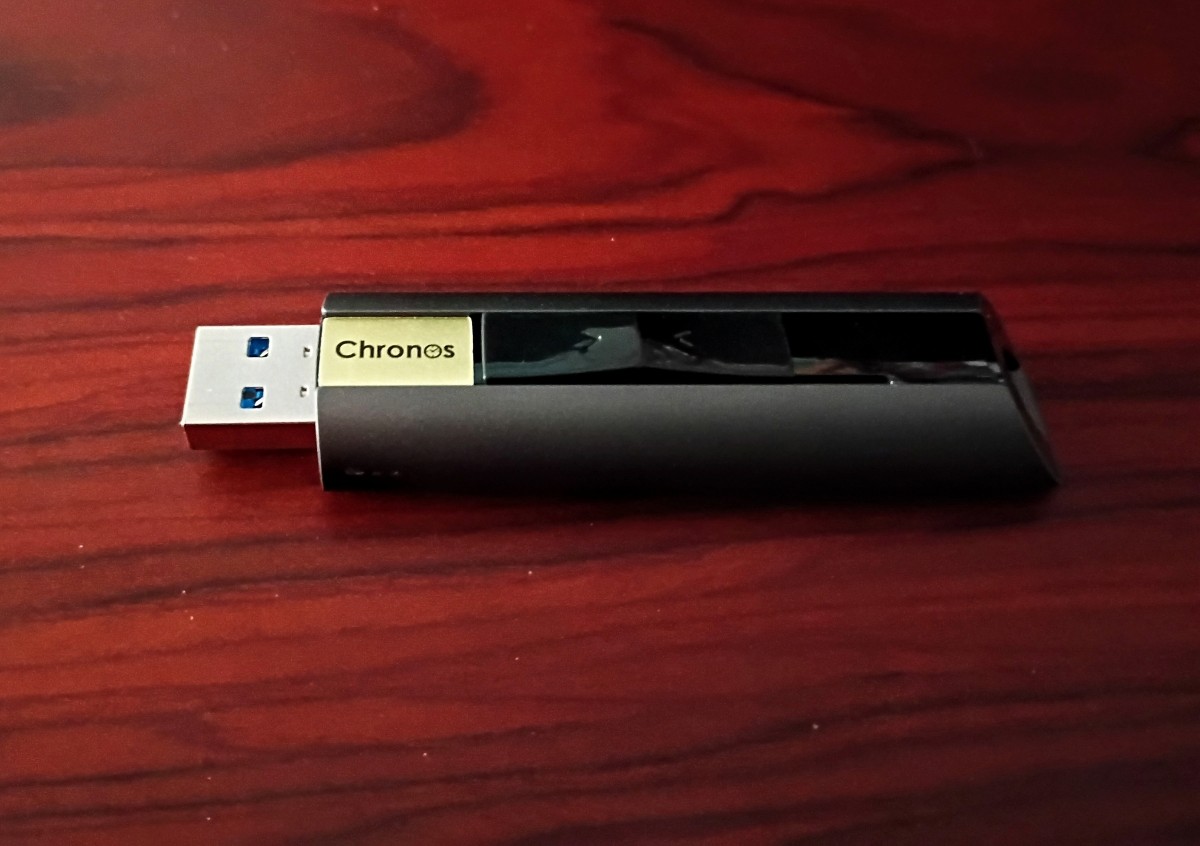
Chronos’ initial appearance came in the form of a USB stick, or dongle if you prefer. That appears to have been something of a “happy accident” of sorts, but the USB stick was soon determined to be entirely appropriate for the delivery of the Chronos effect to audio systems. While technical information concerning the actual function of Chronos is proprietary, Nirvana Audio makes clear certain considerations regarding its implementation in an audio system.
Firstly, Chronos achieves optimal impact on audio systems that are located in an enclosed space; that can be a dedicated listening room or other similar environment, or even a large exhibition hall. A pair of Chronos devices are typically employed for use in very large spaces, but a single device is more than sufficient for most home listening environments.
Additionally, Chronos requires a miniscule amount of power to produce its effect on the listening environment and the equipment contained within. Even when plugged into a USB charger connected to an AC power source, Chronos doesn’t draw a significant level of power, although it does get warm to the touch. Chronos' effect on an audio system is cumulative, and even without connection to an AC power source, the device will eventually reach its maximum effect. Listeners with accelerated timetables may choose to plug in the device to more quickly achieve the full Chronos effect. But removing the device from the power supply and simply placing it in the room or near the equipment stack will allow Chronos to be energized by airborne musical signals and their ensuing acoustic wave vibrations. As with anything, experimentation by the end user is the key to finding the best power or placement configuration for their particular implementation.
Finally, Chronos is not strictly intended solely for digital music playback, and its effect works in combination with both analog and digital equipment alike. In William Su’s earliest experimentations with what would eventually become known as Chronos, he quickly realized that despite the conceptual nature of the USB carrier as a digital device, the power of its effect wasn’t limited to only digital equipment.
As I mentioned earlier, there’s a great deal of conjecture among reviewers and listeners as to how Chronos actually achieves its stunning effect. Most of those lean towards some influence of particle physics as the most probable explanation, and that Chronos likely generates a field in the listening environment that affects everything within it. That field seems to eliminate any type of noise that might otherwise mask critical spatial cues of the music source, allowing the associated equipment to offer music playback that’s unhindered and unrestrained. And the effect can even extend to car stereo environments; one of the reviews I read relayed an anecdote about how William Su, early on in the Chronos experience, approached one of the Asian audio publications for a potential review. The principals at the publication were initially hesitant, especially considering that Su’s known background was in commercial foods, but eventually agreed to hear Chronos. When he arrived, he convinced the magazine’s point person to come to the parking lot to hear a demonstration of Chronos in combination with his car stereo. That demo apparently made such a positive impression that they agreed to evaluate the device in a more suitable audio environment.
Again, while Nirvana Audio doesn’t share much in terms of the technology employed by Chronos, they do make fairly adamant claims about its effect on your system playback. Those include a significant reduction of EMI, RF, and other sources of noise; a noticeable increase in the overall clarity, dynamics, and musicality of your system; a significant increase in your system’s operational stability; a marked increase in system headroom, allowing your music to play at much louder levels without any accompanying increase in strain or distortion; and an extraordinary increase in both stereo imaging and soundstage realism and believability.
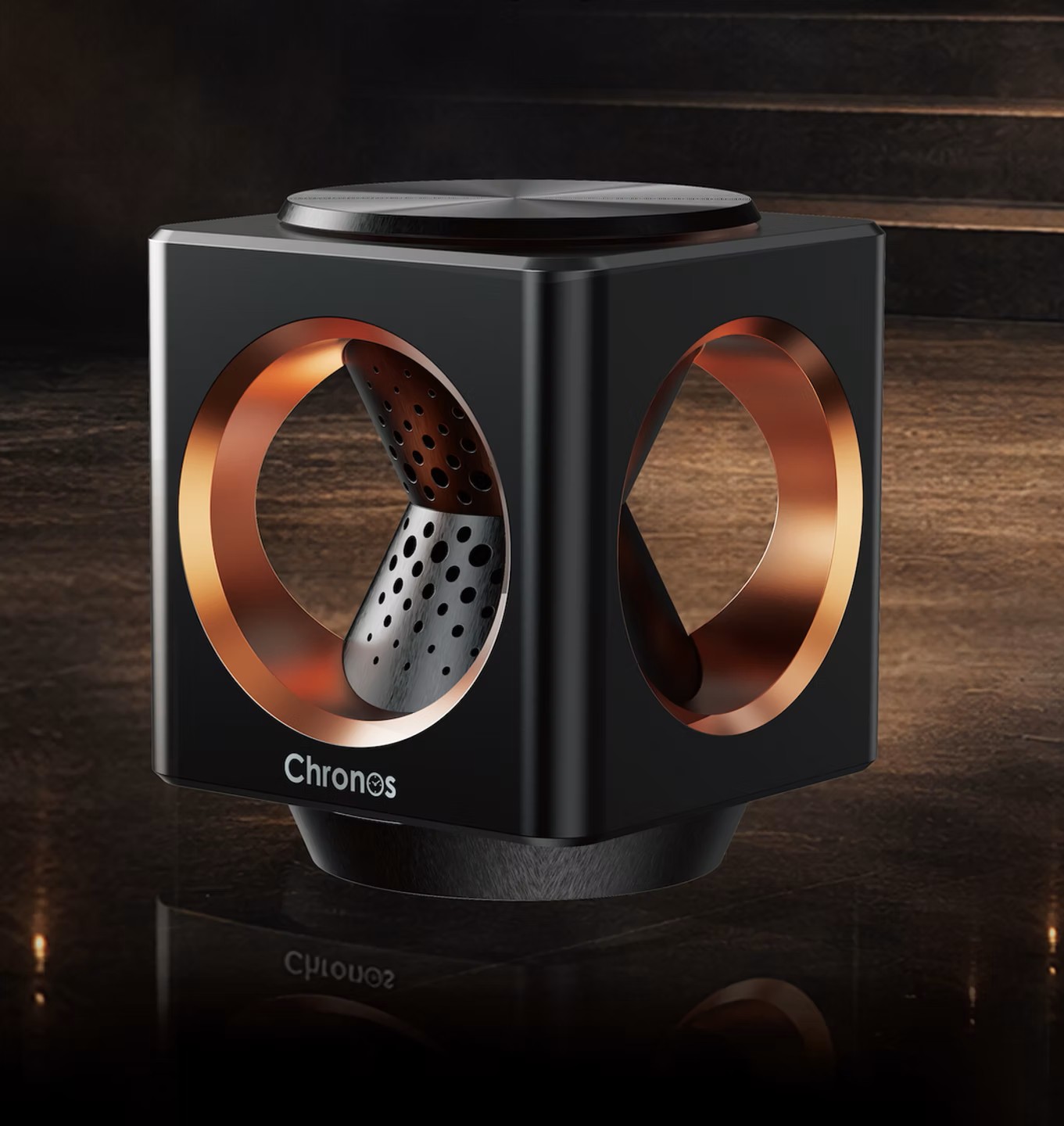 The newest iteration of Chronos is just around the corner!
Nirvana Audio stresses only one absolute rule with regard to the use of Chronos in your system: the device can never be plugged into a computer of any kind. That includes streamers or servers that have onboard Linux systems that read the contents of inserted USB devices or drives. If you're plugging Chronos into anything other than a USB charger, you'd better be darn certain that USB receptacle is simply an accessory port designed to provide power to USB devices. Plugging Chronos into a computer or any device that attempts to read its contents will effectively destroy its ability to create the effect; while that’s a definite area of concern with the current USB iteration, the newest Chronos version appears to eschew the USB connection completely. That actually appears to be Nirvana Audio’s preferred method for the end user to experience Chronos.
Chronos setup and listening tests
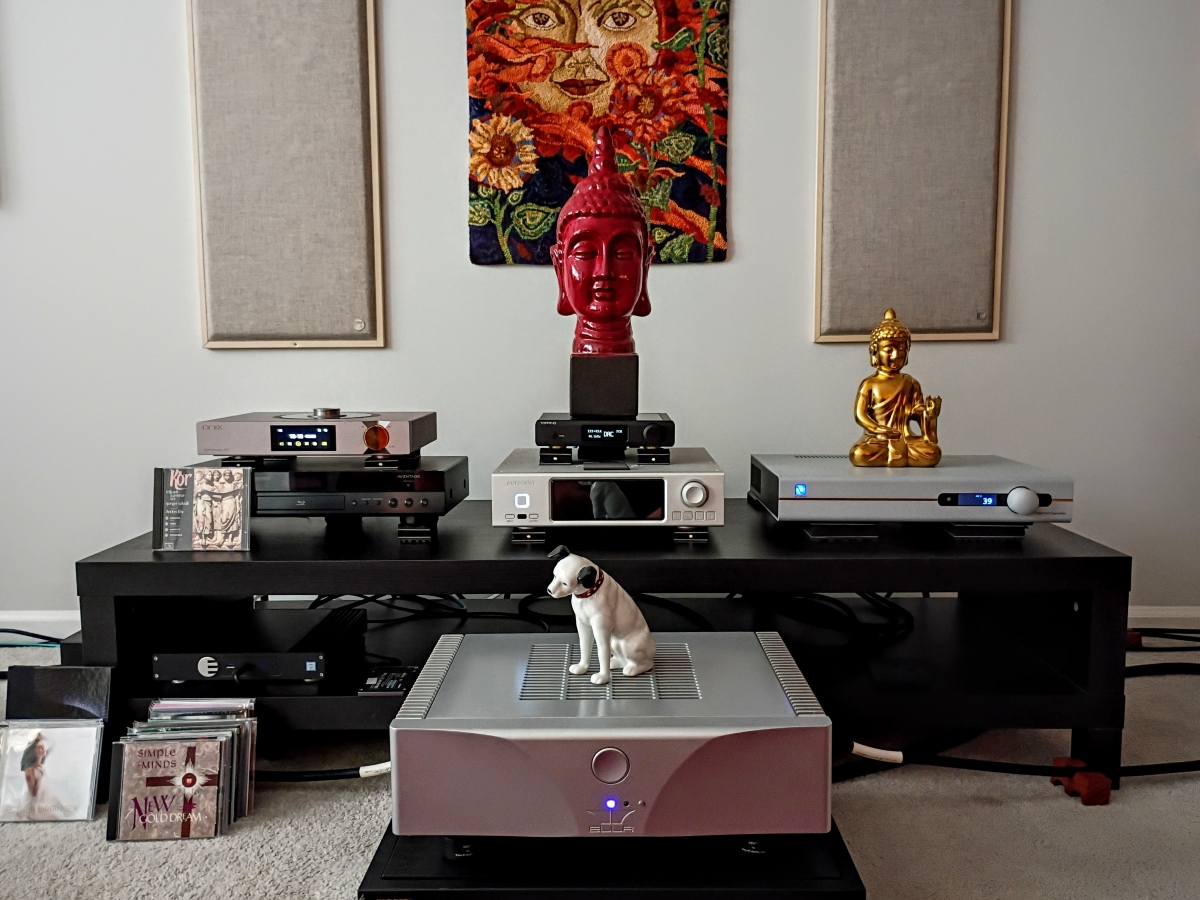
Clicking on my name in the header above will reveal the components currently in use in my system for this evaluation. Chronos’ effect was clear and immediate regardless of how it was configured, but I nonetheless explored the available connection options. I finally settled on inserting it into the USB-A port of a good charger I had on hand; the charger was then inserted into an available AC outlet on one of the Vera-Fi Audio Snub Station Zero power conditioners in my system. And that produced the most prominent effect for me. Nirvana Audio suggests the use of a specific USB charger, the Anker GaN Prime, which is commonly available online and even at brick and mortar locations. That said, the Anker GaN Prime has models scattered across a broad range of wattage and price points (some of them are insanely expensive!), and getting anyone to nail down a specific model appropriate for use with Chronos proved impossible. I went with what I had on hand, and while I was less than impressed with it plugged directly into an AC wall outlet, it achieved a closer version of perfection plugged into the Snub Station Zero.
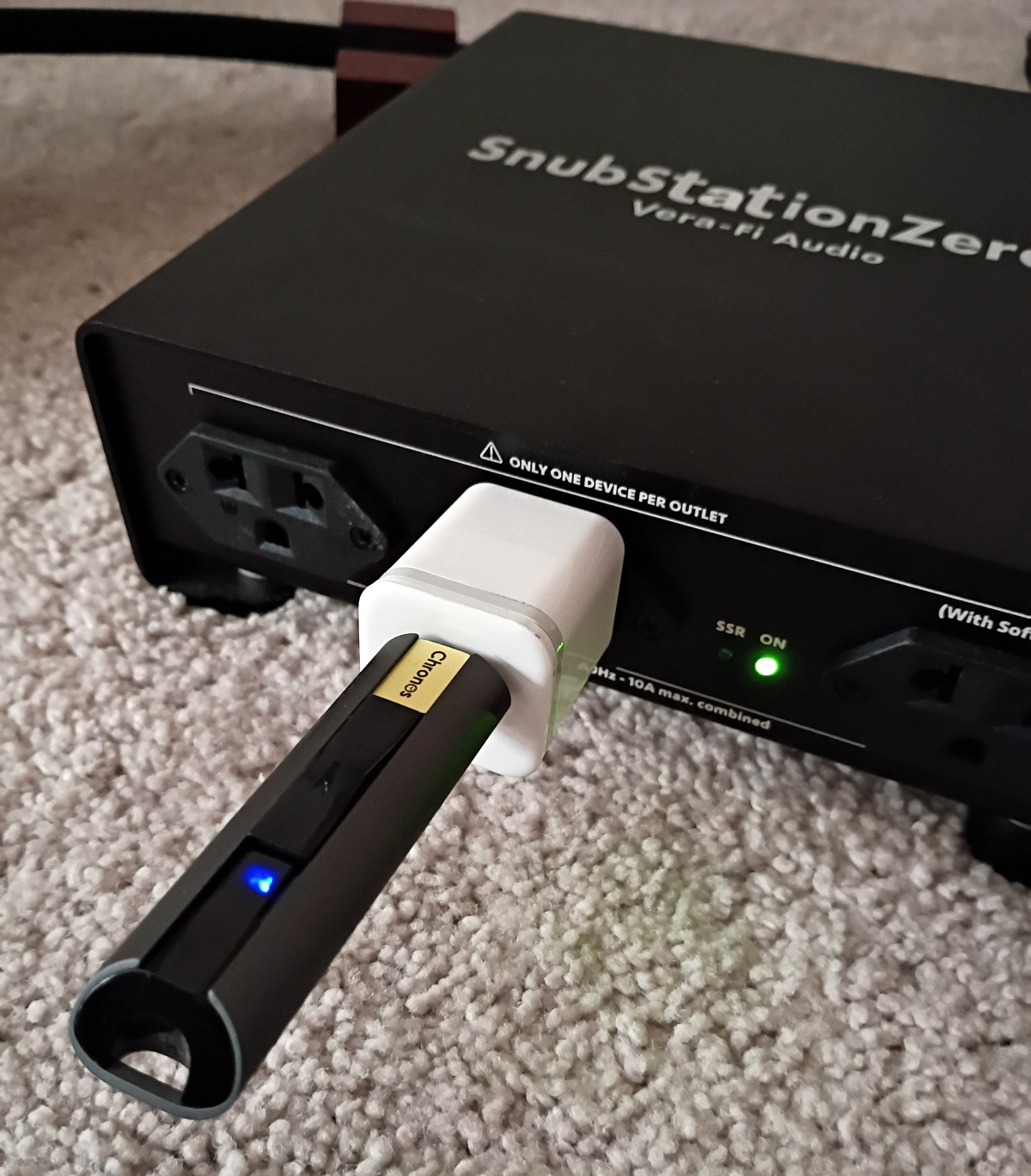
Certain reviewers noted that Chronos’ effect when plugged into a charger could be overwhelming, but that wasn't my experience. But after four days of being continuously powered on, I decided to unplug the charger, remove Chronos, and then simply place the device horizontally on my equipment rack. 24 hours later, there was no discernable reduction of Chronos’ effect on any of my music selections. This setup is how I proceeded for the remainder of the evaluation, so here’s the burning question: how does Chronos affect the system sound?
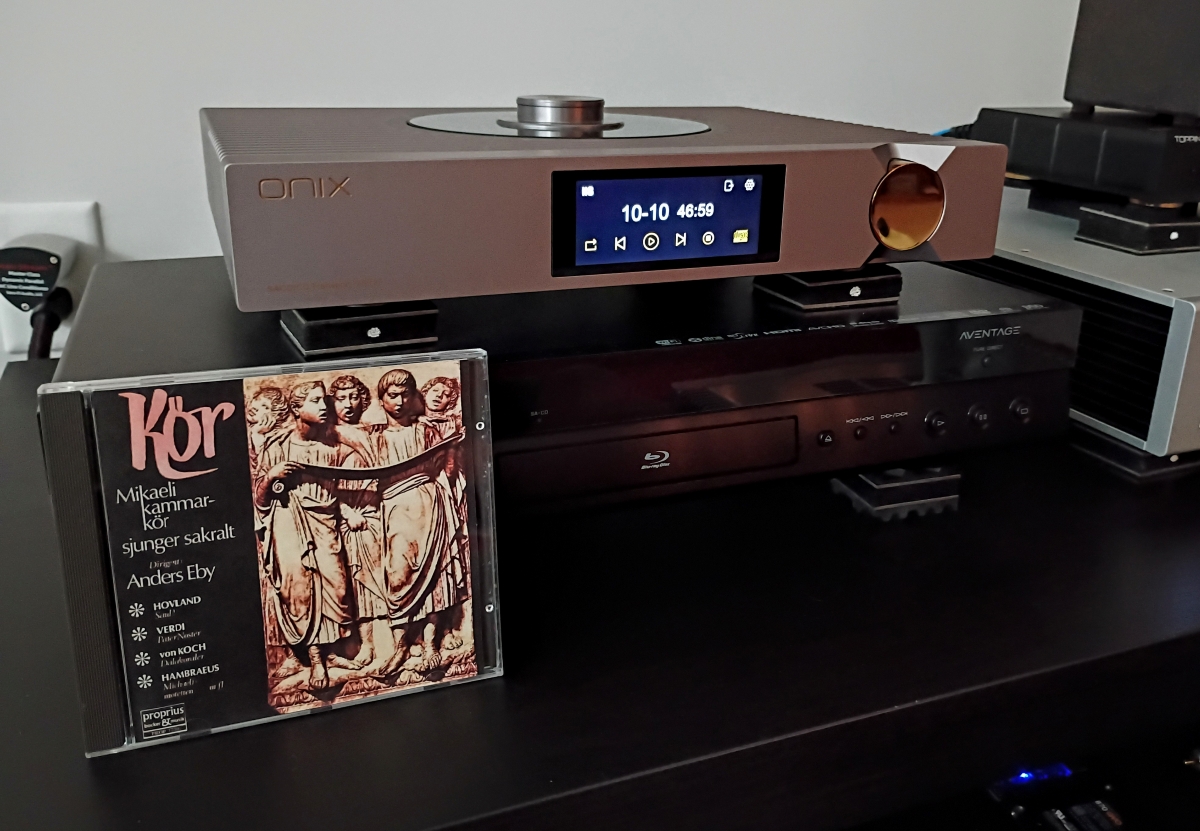
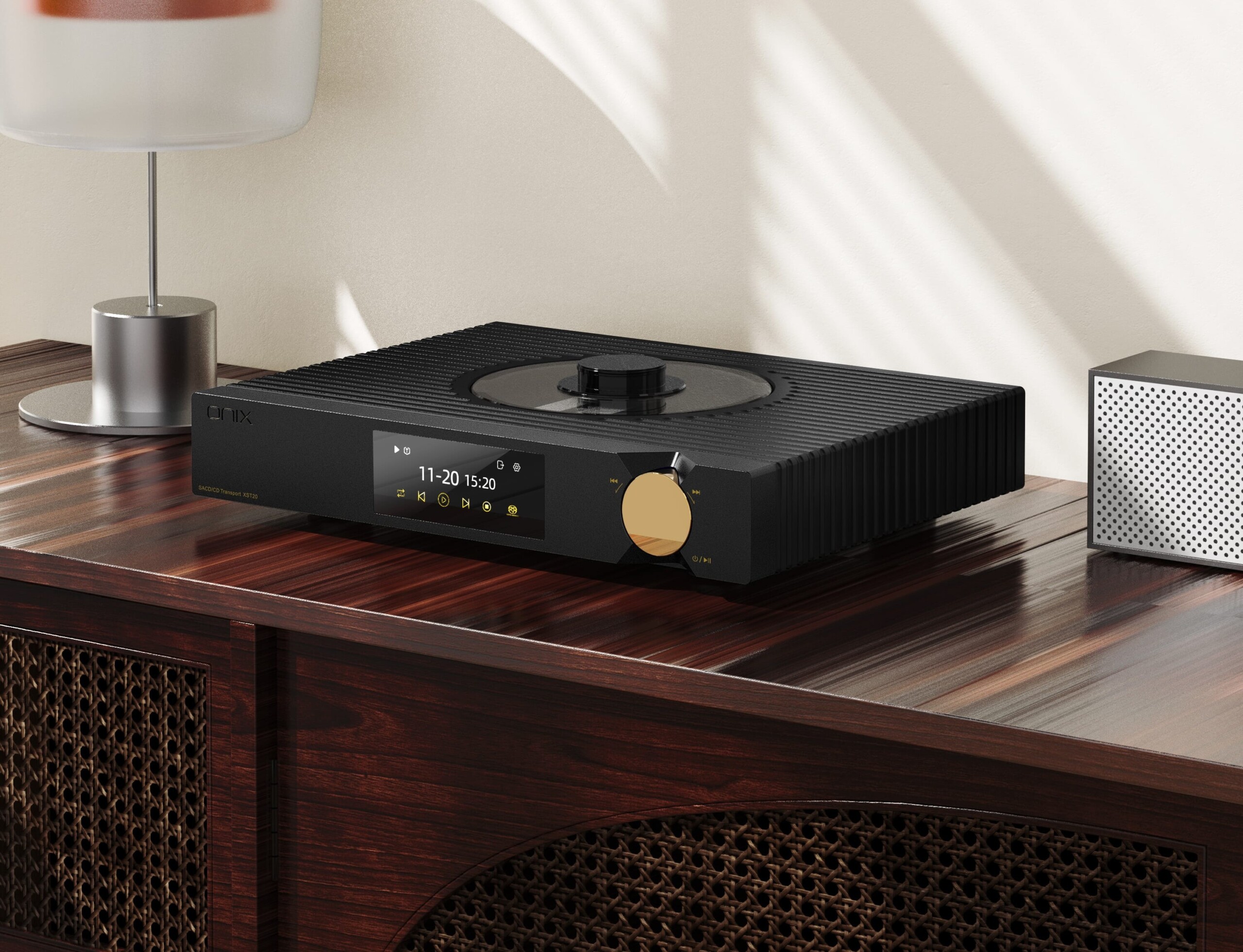
I'm currently in a very strange place in my audiophile journey; I have a new Onix Zenith XST20 disc transport in my system, and have been spinning physical digital discs like there's no tomorrow for several months now. I embraced both CD and SACD at their respective outsets eons ago, but until the arrival of the XST20 in combination with my Topping D90III Discrete DAC, I’ve never really fully appreciated the potential of either for truly superlative sound. Especially Red Book compact discs, which across this system sound as I imagined CDs might (but never did) back in 1983, and even forward into the future. I’ve been over the moon with the sound quality of this combo, but the addition of Chronos has taken my playback to another level of goodness!
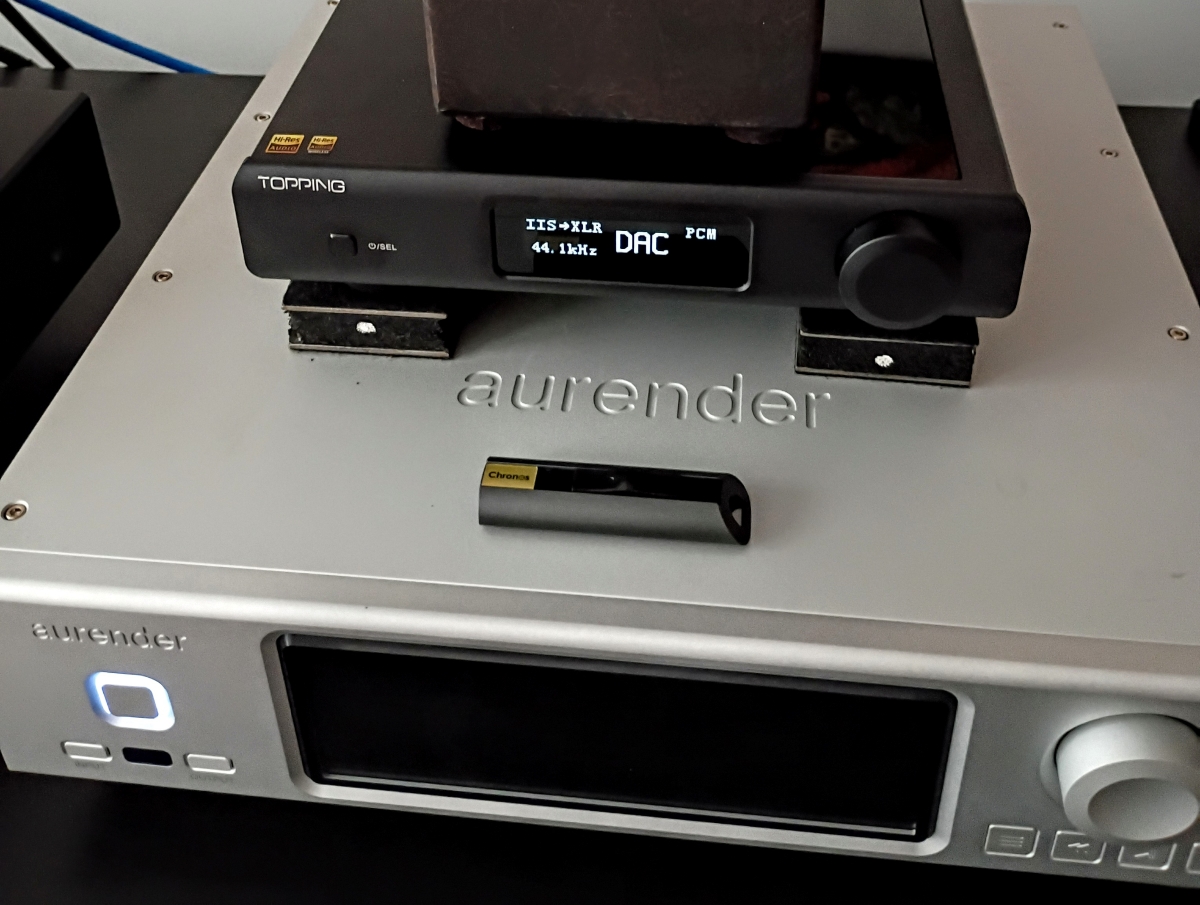
I typically use a core group of albums scattered across a variety of genres for evaluations of systems or individual equipment. While the music and performances on most of the discs have always thrilled me (even more so with physical disc playback via the Onix Zenith/Topping combo), some nonetheless leave something to be desired in terms of ultimate fidelity in their presentation. That's true regardless of the music source, whether physical disc playback or rips of those discs on my Aurender and Euphony digital streamers. I’m noting only a mere handful that awakened me to the power of Chronos, but my listening throughout covered too vast a selection to document here.
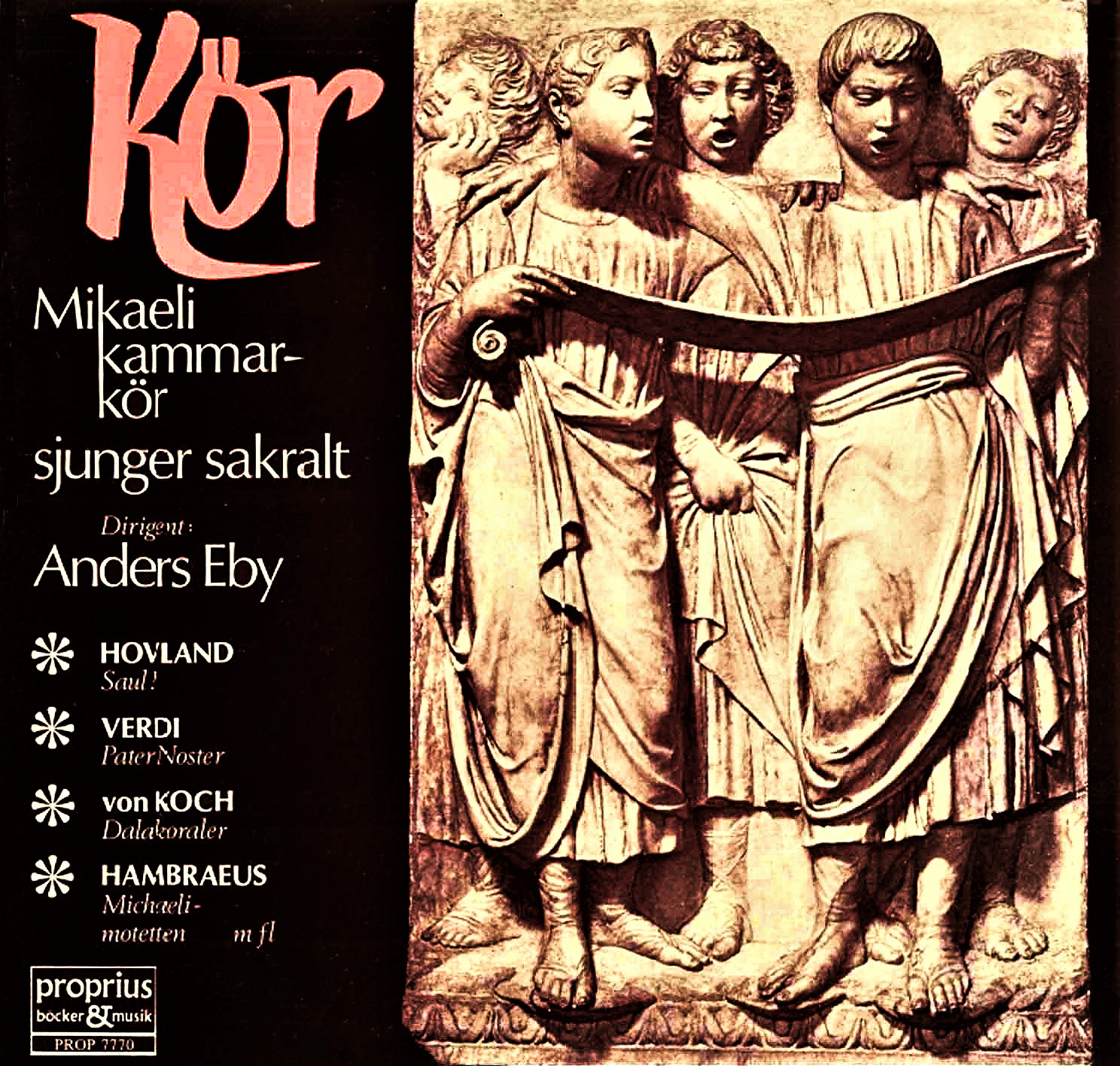
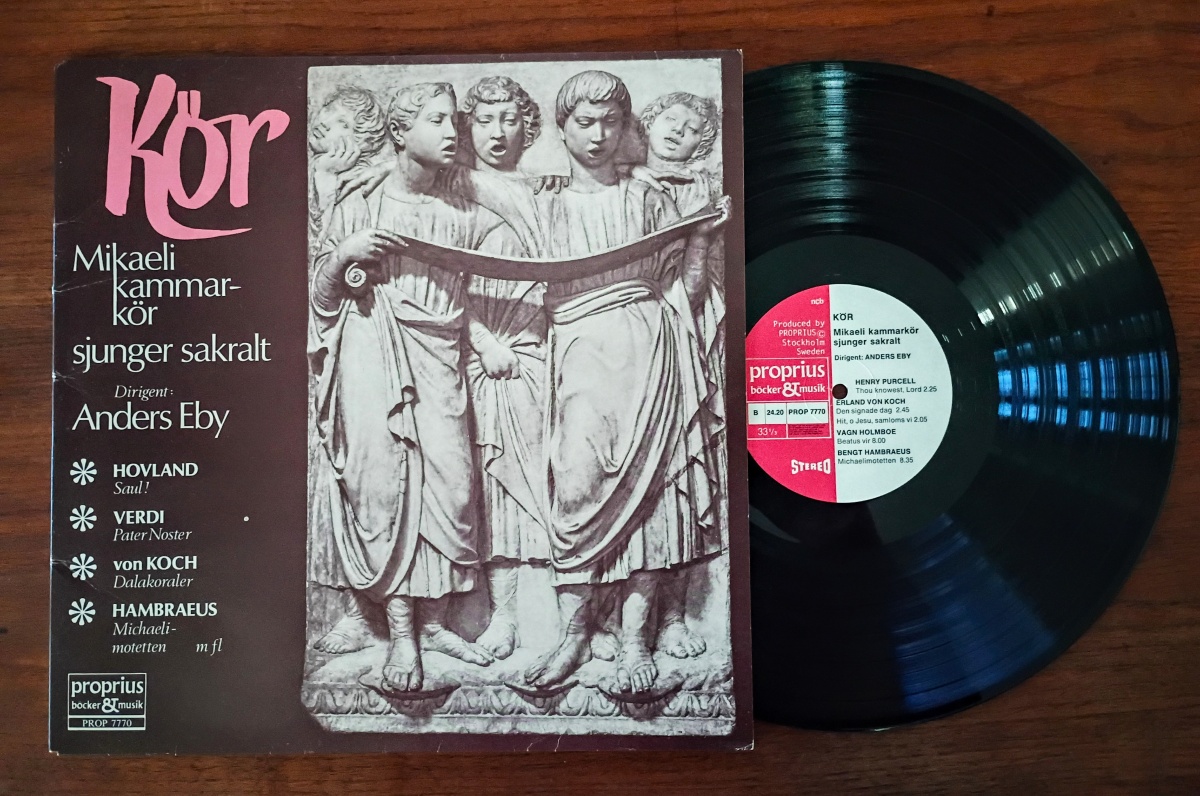
Kör: Anders Eby, Mikaeli Kammarkör (Proprius 7770). This classic 1975 Swedish choral album has until recently (it's available for streaming on some services) only ever been available as an LP, and has never been released on CD. I’m listening to the original WAV files supplied to me from Naxos Music 15 years ago that I burned to a CDR for playback. I’ve always felt Kör is the absolute pinnacle of recorded choral singing, and the astonishing realism provided by my original LP shocked me back in the late 1970s. The WAV files better the LP in every possible way, and with Chronos in the system, the choir sings with a level of realism far beyond LP playback or that of the WAV files on my music server. As Verdi’s “Pater Noster” opens the album, it immerses you in the recorded acoustic of Oscar’s Church in Stockholm, Sweden. There’s an astonishing stereo spread across the soundstage that clearly identifies the positions of the male and female ranks of the Mikaeli Kammarkör, and the locations of the soprano and tenor soloists are portrayed with perfect clarity. The organ that accompanies a number of the tracks has power and dynamics to spare, but the combined voices of the choir alone are enough to send your amp into clipping! With Chronos, I found I could crank the volume significantly with no increase of system strain, which allowed me to get a greater sense of absolute realism. Kör is one of my favorite albums of all-time, has never sounded so very good as now, and has been in constant rotation since Chronos arrived!
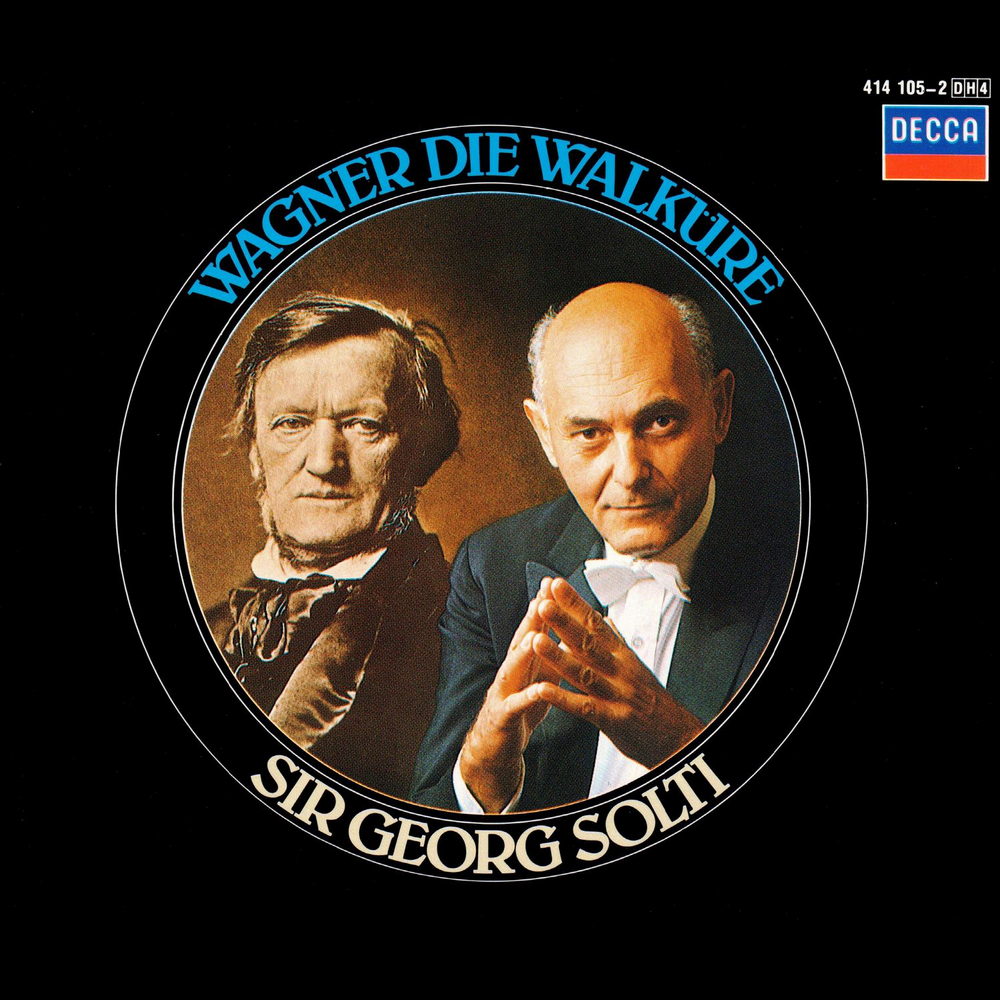
Wagner: Die Walküre: Sir Georg Solti, Vienna Philharmonic (Decca CD 414 105-2). I’ve been listening to Solti’s Wagner Ring cycle for eons, but with Chronos in the system, the performances take on a dynamic realism unlike anything I’ve ever heard before. Playback was from the original 1984 European Decca compact disc release made by Polygram in West Germany that was transferred without compression from the original 1965 master tapes. The track I’m focusing on is the Act III opener, the classic warhorse “Ride of the Valkyries," where Solti and the Vienna Philharmonic play with unrestrained orchestral dynamics, and legendary soprano Birgit Nilsson literally screams as Brünnhilde. From the opening notes of the “Valkyrie” motif, there’s an orchestral spread across the soundstage that clearly places you in Vienna’s Sofiensaal orchestral hall, with brass, strings, and tympani that set the stage for Nilsson’s entrance. At the 4:00 minute mark, when the full orchestra joins in, it’s a true lease-breaking moment that is portrayed with the kind of power I’d never have believed possible over my system. “Hojotoho!” indeed!
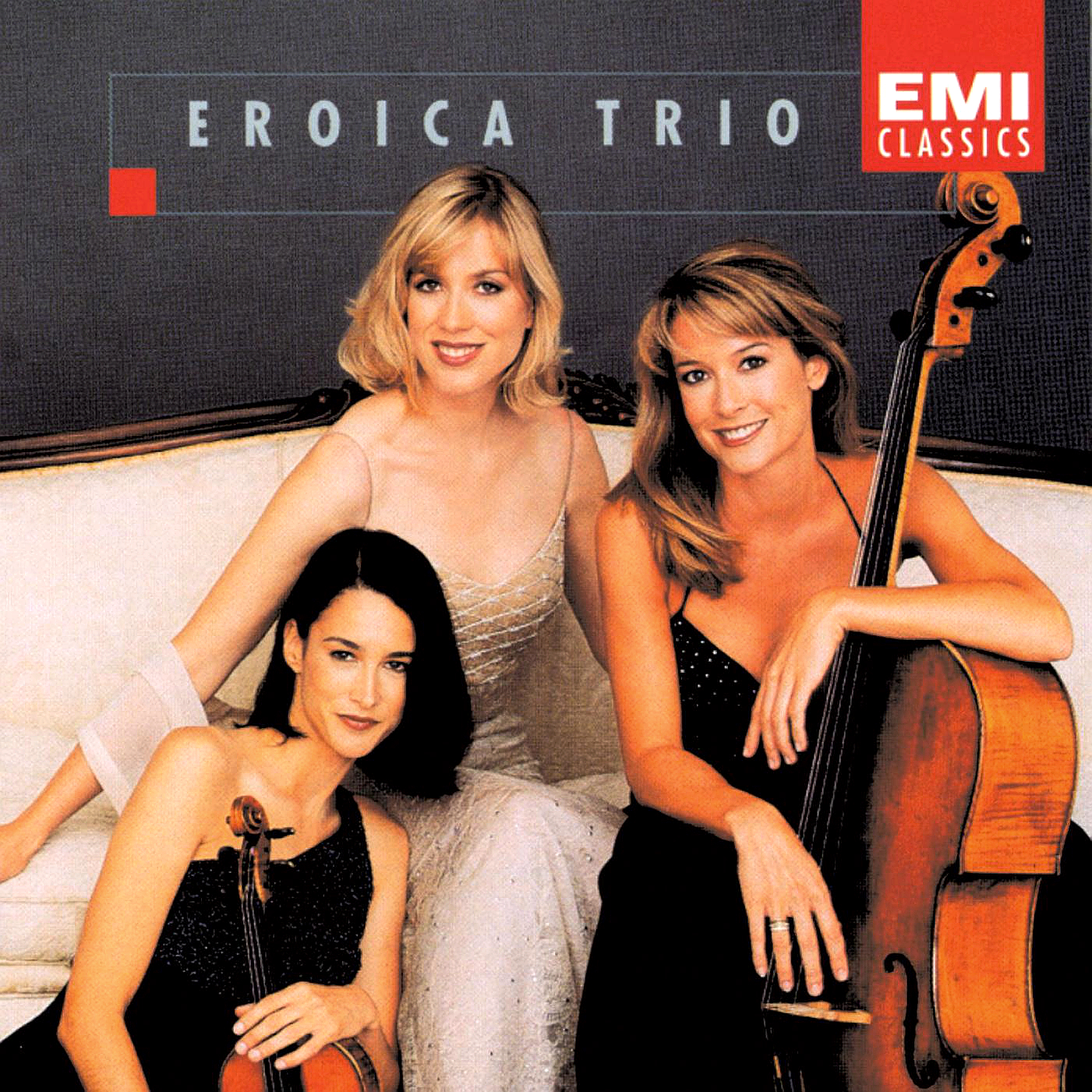
Eroica Trio: Eroica Trio (EMI CD 56482). I bought this CD on the day of release in 1997; it was recorded by Joanna Nickrenz (the pianist’s mother), who was one of the most celebrated classical recording engineers of the era. That said, while the trio performances of Gershwin, Ravel, Goddard, and Schoenfield are definitive, I’ve always felt the recordings' seemingly diffuse stereo image lacked clarity, and found it nearly impossible to clearly identify the piano, cello, and violin in the soundstage. To my great astonishment, with Chronos in the system, Erica Nickrenz’ piano has a bit of a wide spread, but it’s front and center, Adela Pena’s violin is left center, and Sara Sant’ Ambrogio’s cello is on the right. I literally know the music on Eroica Trio by heart, but hearing it now with Chronos is like hearing it for the first time ever. Color me astonished!
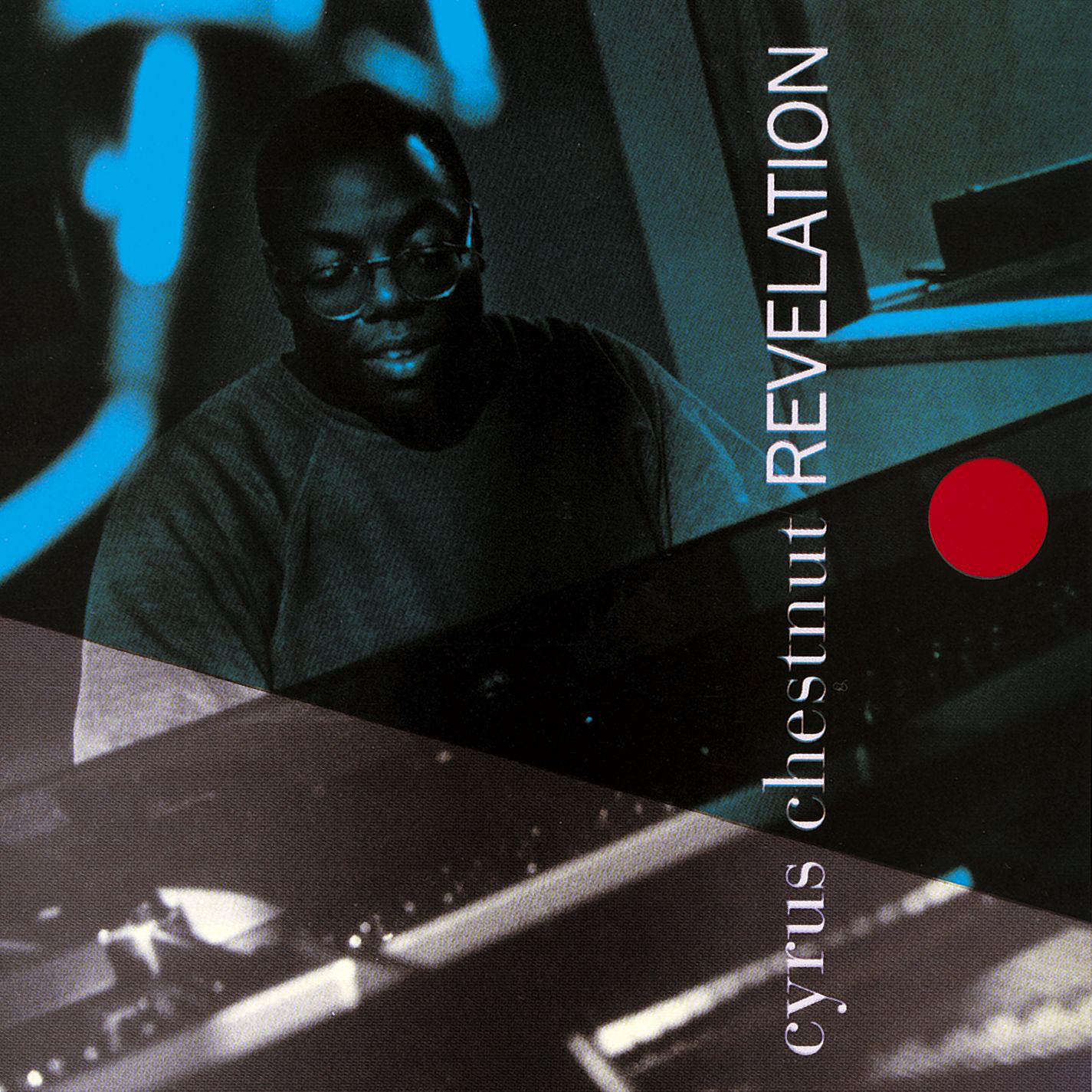
Cyrus Chestnut: Revelation (Atlantic Jazz CD 82518-2). Another record I bought at the time of its 1994 release; this Jim Anderson engineered album is a clinic in good recorded sound, and one that I use frequently to establish subwoofer settings and positioning. I didn’t think Revelation could possibly sound any better than it already did, but with Chronos in the system, the individual players occupied more clearly focused positions in the soundstage. Cyrus Chestnut’s piano, Clarence Penn’s drumkit, and especially Christopher Thomas’ upright bass showed an astonishing increase in realism that completely shocked me. One song in particular, “Lord, Lord, Lord,” features bassist Thomas in an extended solo; with Chronos, his instrument had a much more “woody” sound that plumbed the depths and dominated the soundstage in a way I’d never experienced before. After hearing Revelation with Chronos, there’s definitely no going back for me!
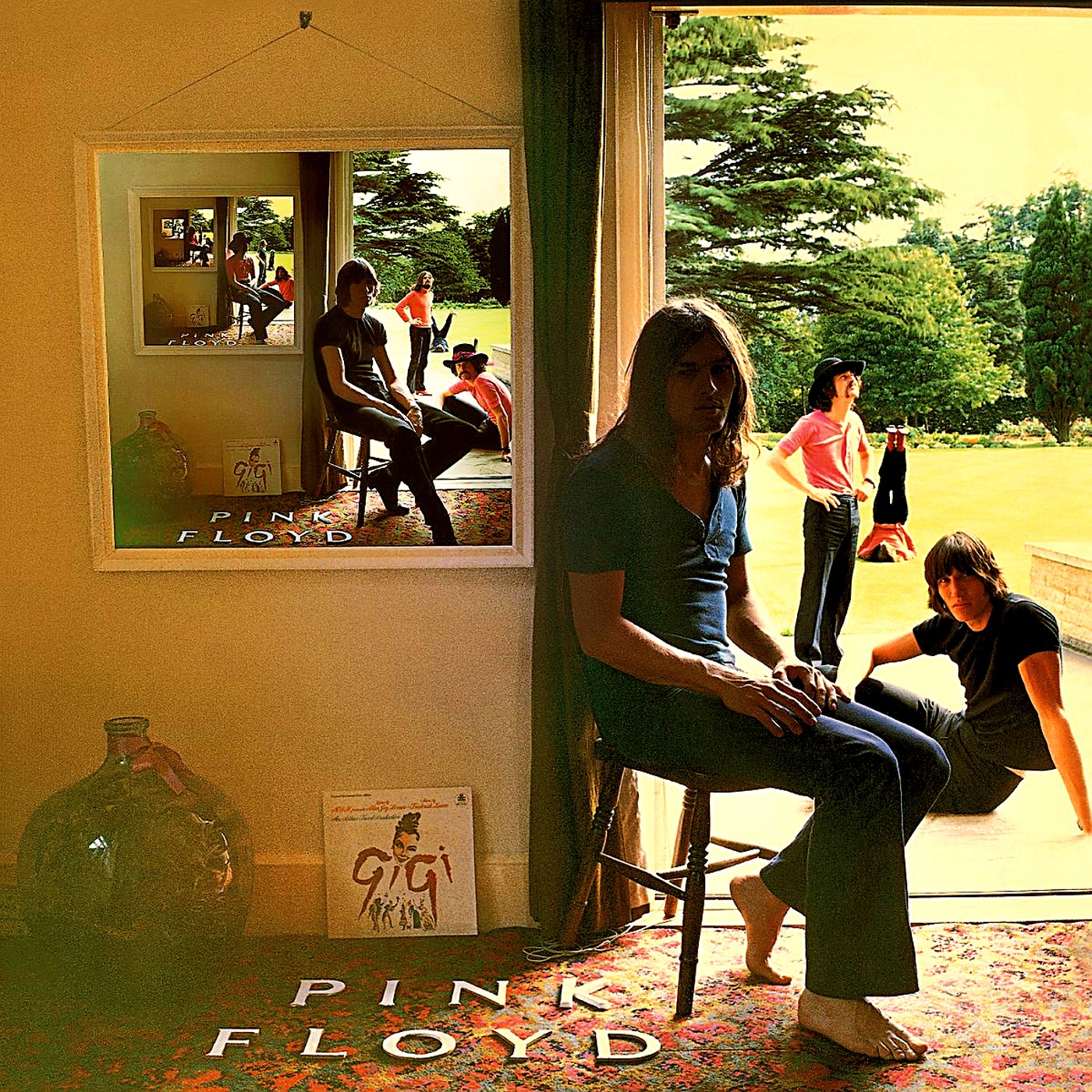
Pink Floyd: Ummagumma (Sony CD 50999 028937 2 3). I fell in love with this 1969 release in my early teens; the CDs here are from the 2011 Ummagumma Discovery box set. The disc one live tracks substantially enhance and expand the performances from the catalog originals (Careful with that axe, Eugene!), and the second disc of solo submissions from Waters, Gilmour, Wright, and Mason are incredibly entertaining. With Chronos, the live tracks have an enhanced level of warmth and realism that imbues them with a more involving sound; the individual group member contributions also are given a remarkable lift, especially Roger Waters’ “Grantchester Meadows,” which sounds much less gimmicked than it does without Chronos. The real star is Nick Mason’s “The Grand Vizier’s Garden Party”; its soundstage with Chronos wraps around the sides of the listening position, and Mason’s drum solo in the middle section has a newfound weight and heft like never before – the difference was beyond belief!

Judy Collins: Colors Of The Day - The Best of Judy Collins (Warner Japan CD WPCR 613). I bought this Japanese issue CD because I wanted an improvement over my lackluster US-issued catalog version, and this one got high marks from a number of sources. I wasn’t particularly overwhelmed when it arrived – it had better clarity than the original, but it didn’t quite blow me away either. Enter Chronos, and Colors Of The Day now sounds even better than I’d hoped it might! Judy Collins’ voice has taken on a level of warmth and physical realism I never heard on the original CD, and all the tracks exhibited an enhanced soundstage presentation, especially the closer, her classic rendition of “Amazing Grace.” When the choir kicks in, they’re spread across, behind, and above the soundstage like never before. Absolutely remarkable!
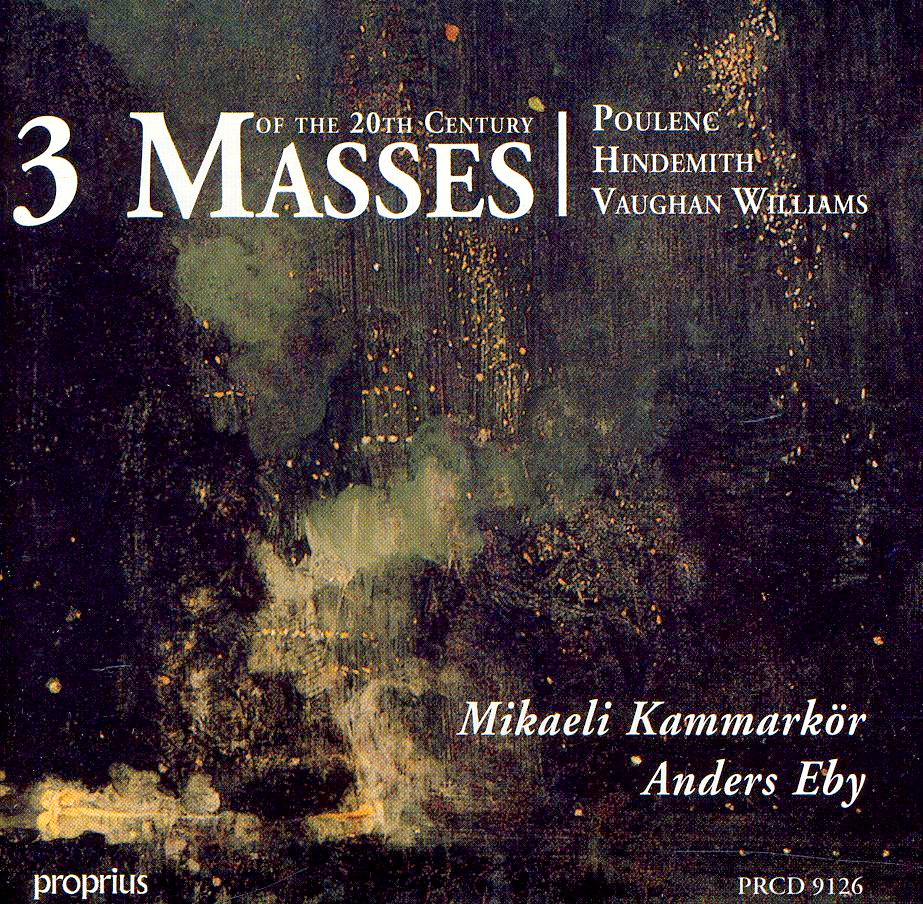
3 Masses of the 20th Century: Anders Eby, Mikaeli Kammarkör (Proprius CD PRCD 9126). This amazing CD collects choral masses from composers Poulenc, Hindemith, and Vaughan Williams, and features the Mikaeli Kammarkör that I so loved on the disc Kör from above. While all the performances are superlative, I most frequently use a single track for demonstrations, the final movement from Francis Poulenc’s Mass In G Major, the “Agnus Dei.” Where the soprano soloist offers a mellifluous vocal turn filled with mystery and emotion – I can set this track to repeat and listen endlessly, it’s literally ear candy, and that’s even without Chronos. Add Chronos into the mix, and the soloist takes on impressive gains in realism, liquidity, and physical presence in the soundstage. The soprano’s voice is sooooo much better than before (how is this even possible?), and the choir is clearly delineated into identifiable ranks that layer eerily in the recorded acoustic. 3 Masses of the 20th Century is another Proprius miracle made even more miraculous by Chronos.
As previously noted, I have a fairly long history with the albums I used for the evaluation, and I've developed strong opinions about aspects of their sound quality and certain deficiencies I’ve identified with many of them. In terms of A/B’ing with and without Chronos, I had limited success performing that kind of evaluation. Finnbogi invited a friend to his home for a listen; he hadn't yet USB powered his Chronos, and was able to effectively perform a Chronos out/Chronos in/Chronos out demonstration. When Chronos was out, he placed the device in a metal box and removed it from the room, but his friend was unable to detect any differences in the sound with or without Chronos present. Minus Chronos, Finnbo said the music completely collapsed for him.
Because I USB powered Chronos from the beginning, simply removing the device and placing it in a metal canister didn't diminish the effect. I’m certain that Chronos generates a field that affects everything in the room, and when it's disconnected or removed from the room, that field and its effect doesn't quickly fade. I had a late afternoon thunderstorm roll through recently that continued into the wee hours; as is my practice, I shut down and disconnected everything from AC power, and at the same time I decided to remove Chronos and placed it in the metal box far away from the room. Midday the following day, I reconnected and repowered the system; without Chronos in the room, I couldn't hear the effect, and playback of my evaluation discs returned to their boring, usual, but still quite good but normal state. After reinserting Chronos with the USB connection for part of the day, I detached it and placed it on the equipment rack; that restored the status quo for me. I find it almost inconceivable that anyone couldn’t hear the effects of Chronos, which is impossible for me to ignore. And no, I have not been drinking the Koolaid!
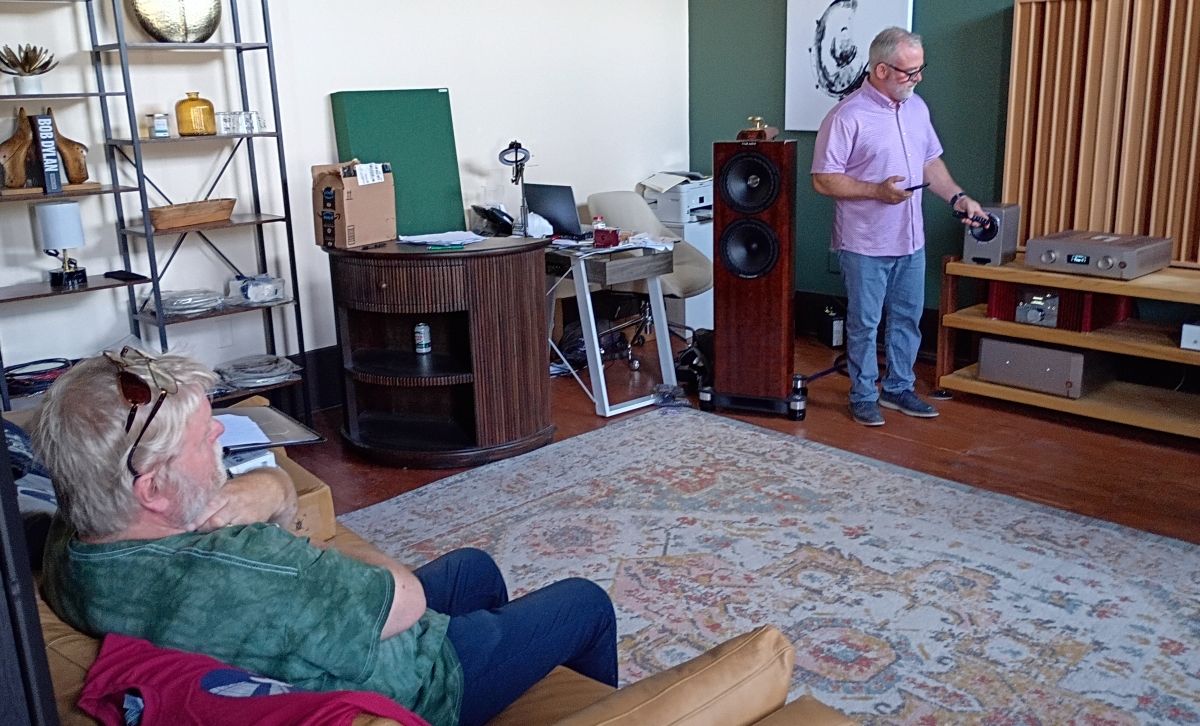
South Carolina’s only true high-end audio dealer takes a listen to Chronos!
About a week or so ago, I made a road trip to Aiken, South Carolina, where audio good-guy Shayne Tenace has opened the only true high-end audio dealership in the state, Absoulute Audio plus Video. He’s enlarging his space there to 5000+ square feet, with a total of twelve system rooms, a selection of high-end brands that few dealers on the East coast can boast, and he’ll even have dedicated spaces for home cinema and record sales! Finnbogi Sigurdur Marinosson and I met up there to check out the new construction progress and talk shop with Shayne about all things audio. And also spend some time listening to some of the finest high-end audio systems in the Southeast. Unbeknownst to me, Finnbo had brought his Chronos along for the ride, with hopes that Shayne might be amenable to having a listen!
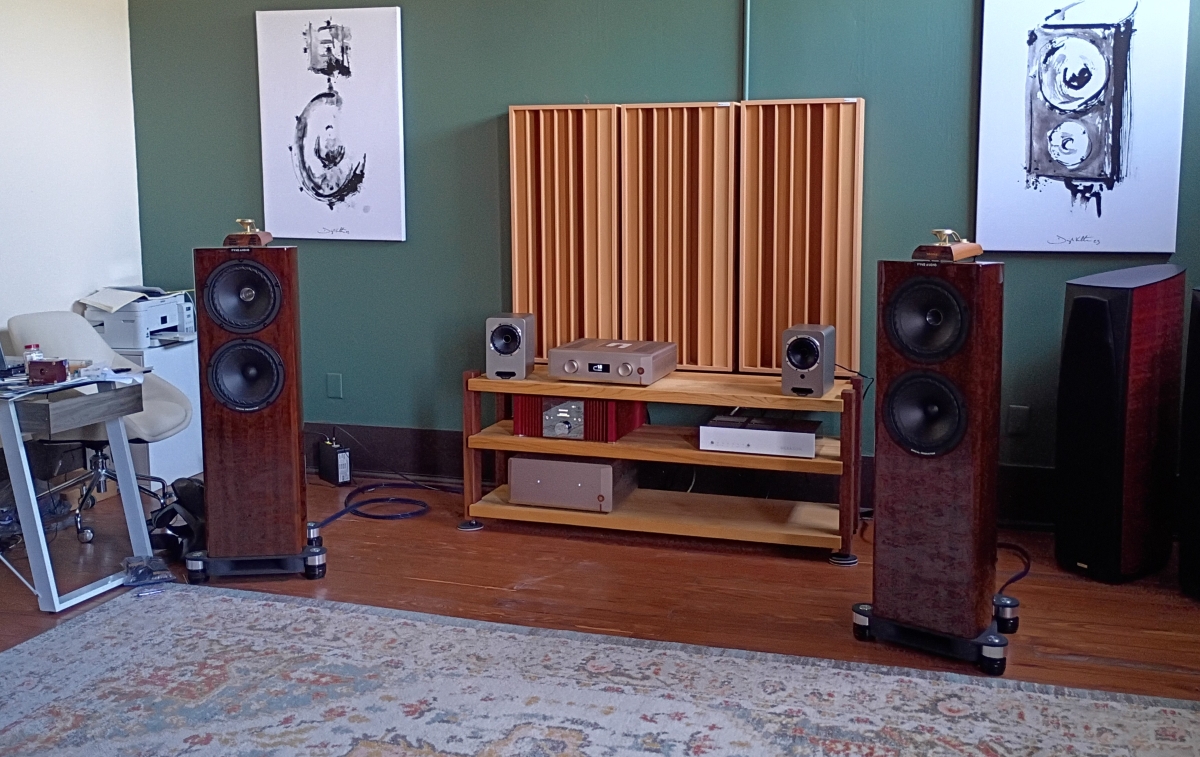
When we arrived at Absoulute Audio plus Video that morning, we toured the improvements and eventually walked into the biggest room in the original section of Shane's shop. He played some music on a large floorstanding pair of Fyne Audio loudspeakers set up at one end; they played with an enormous scale of sound, pinpoint imaging, and impressive musicality. He played a number of selections, each rendered beautifully by the system, and I was beyond impressed with the sound quality. Due to the ongoing construction, we were unable to audition any other systems that day, and after grabbing some lunch, we returned for further conversation and another listen to the Fyne system. The sound was completely compelling, and Shayne remarked "Can you believe these speakers are only $900 for the pair? All you need is a source, they're self-powered!" I did a double-take, stared at him in total disbelief, then realized it wasn't the large loudspeakers we were hearing. Playback was provided by the smallish speakers sitting on the credenza behind them, the new Fyne Audio Cubitt system, which rocked the cavernous large room with incredibly low bass for such a small form factor! A "d'oh" moment for me for sure, but the sound was beyond belief!
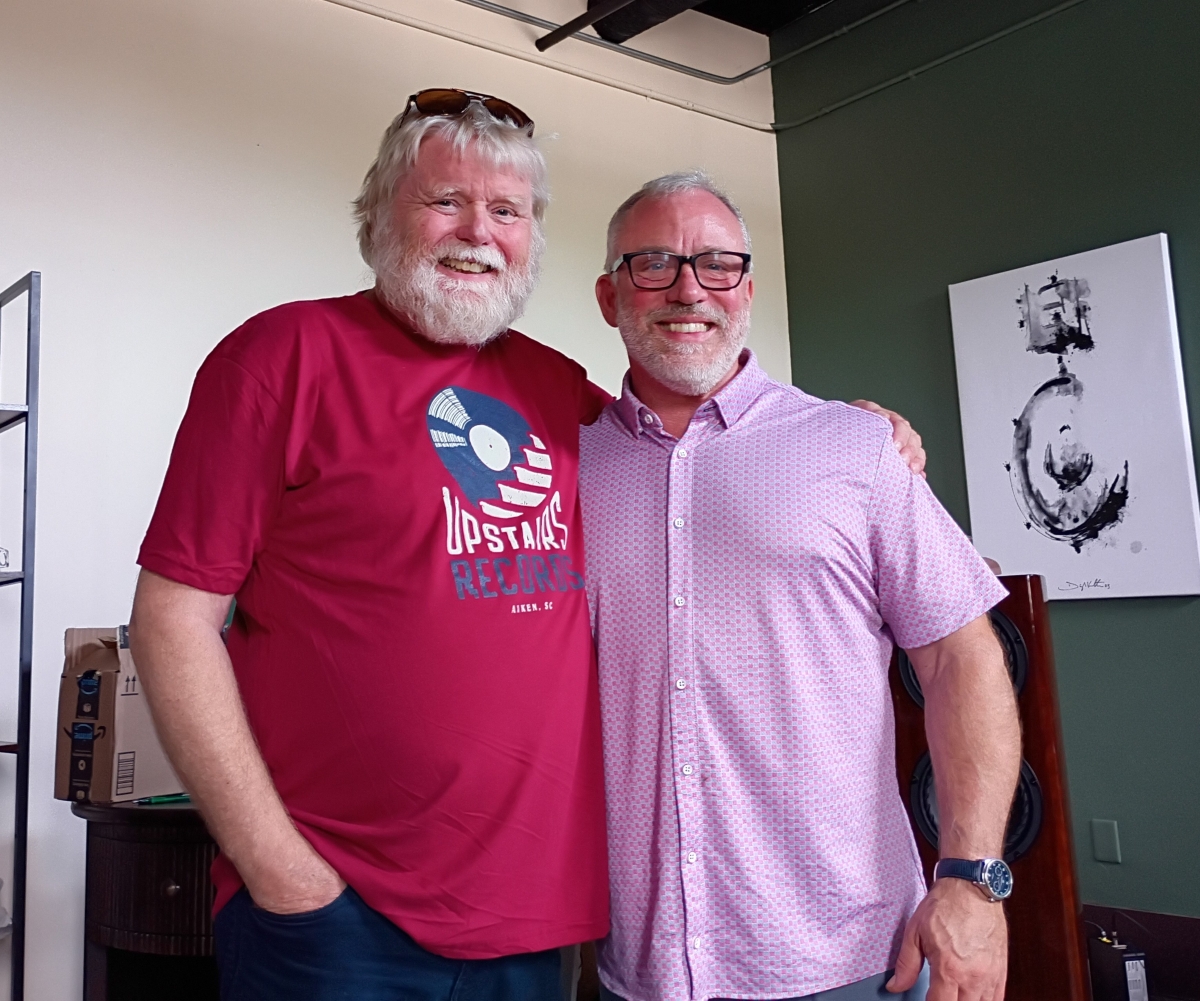 Finnbogi Sigurdur Marinosson with Shayne Tenace at Absoulute Audio plus Video.
At this point, Finnbo pulled out his Chronos unit, which had been concealed in a small metal box³ to prevent its effect from ambushing any listening sessions before its presence had been made known. We both attempted to explain to Shayne our relatively narrow understanding of how Chronos produced its effect and enhanced the performance of our respective systems. Mostly in an attempt to gauge his interest in hearing Chronos, if only on the small but impressively good sounding Fyne Cubitt system. Shayne’s curiosity was piqued, and he replayed the same selection of tracks we listened to during our earlier audition. Even though our exposure to the system was fairly brief, we all agreed that having Chronos in the system was a next-level improvement. Backgrounds were blacker, the already enormous soundstage and image height were more pronounced, and there was more air and space around the vocalists and musicians. The shockingly good Fyne Audio Cubitt system was even more impressive with the unpowered Chronos simply sitting on the credenza between the pair of loudspeakers!
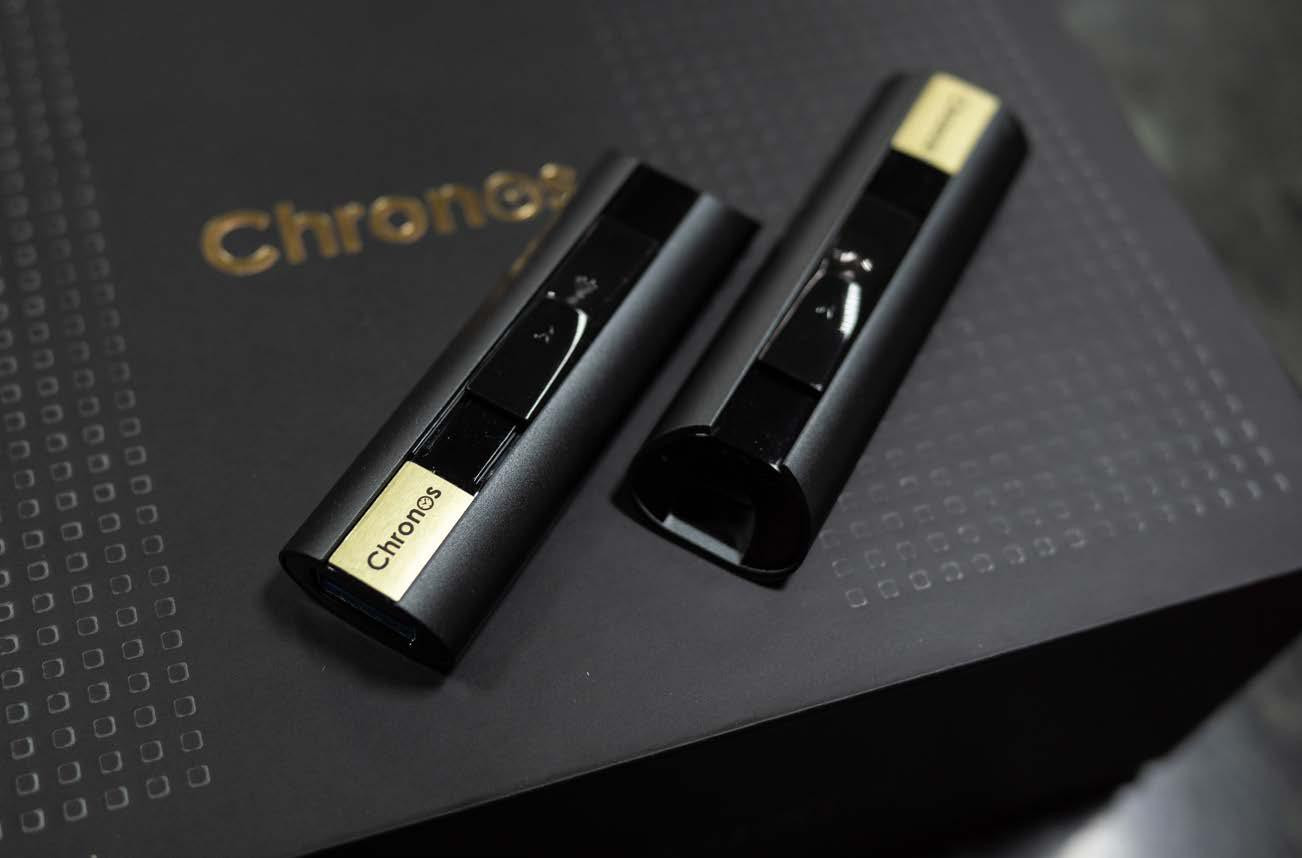
Chronos for the win!
I’m a fairly level-headed, music-first listener, and in my forty-plus years as an audiophile and quarter-century as an audio and music journalist, I can probably count on both hands the number of demos of audio systems or devices that have truly impressed the hell out of me. Even fewer, the number that have shaken my core beliefs about high-end audio and its reproduction. The Nirvana Audio Chronos Optimizer now sits squarely at the number one position on that list, and what makes the situation almost untenable for me is that I’ve been constantly scouring my library for additional albums or music selections to audition with Chronos. Whereas my typical listening sessions might last 30 minutes to an hour, they’re now running an hour, two, maybe three – oh, wow, let’s listen to this one! Listening to discs I thought I knew intimately is now like hearing them for the first time!
It’s gotten even more convoluted; at the point when the Onix Zenith XST20 transport arrived, I re-engaged with physical digital discs in a way that hadn’t happened in decades. Listening with the XST20 also prompted me to do some comparison listening to ripped files from those same physical discs across my music servers, and all those rips had been verified by dBPoweramp as bit perfect. That said (and pre-Chronos), they typically sounded dull and lifeless when compared to the sound I was hearing from physical disc playback on the XST20. My brain at first told me it was probably some kind of new-equipment bias going on, but extended listening and comparisons made me start thinking about my countless thousands of disc rips. Which were made across a couple of decades, typically on low-cost, less-than-audiophile quality computer drives that might have injected jitter into the stream, possibly affecting their overall sound quality. With Chronos in the system, those same rips across the server sound on par with identical physical disc playback, so the Chronos experience has become even more maddening! While my experience with Chronos covered digital disc and streaming playback this go-around, I'll follup with my impressions of the device on the sound of LPs very soon!
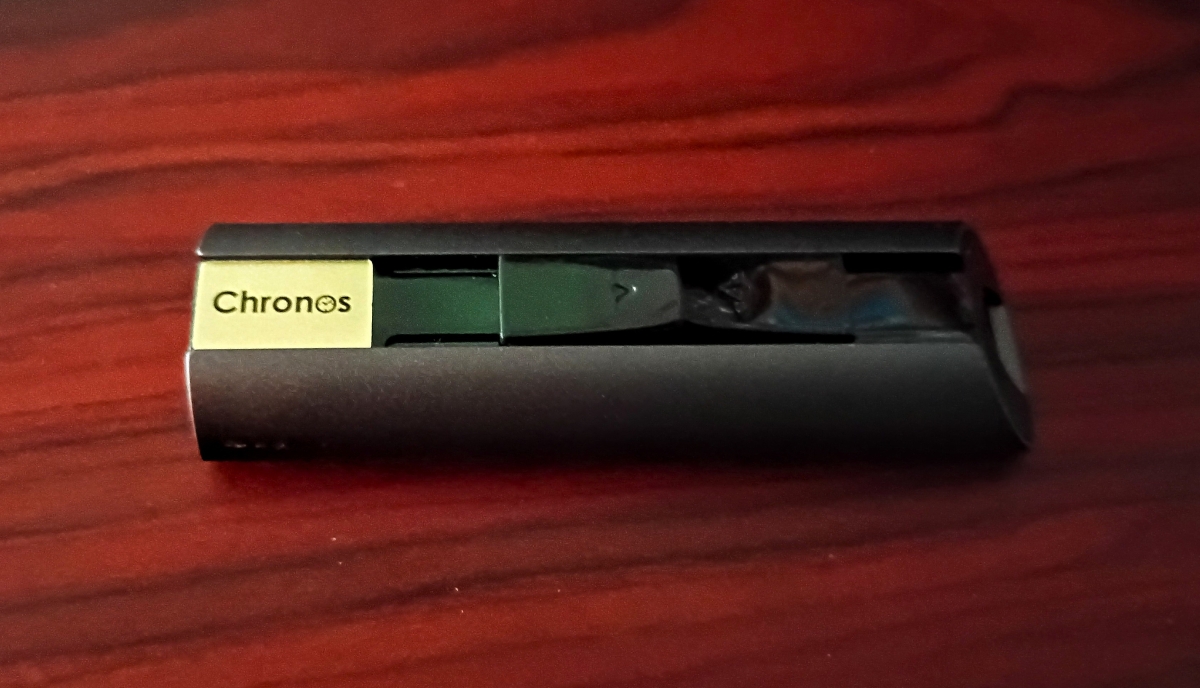
My lifelong philosophy has been that I can glean everything I need to know about anyone or anything in the first five minutes of the experience. That’s been proven to be fairly misdirected over the years, and having had Chronos in my system has me rethinking that with regards to audio and music. I obviously don’t even really know what I’ve been listening to all these years! Here's the upside: in the first five minutes of my Chronos experience, I realized it’s indispensable to my music playback. Otherwise, I’m definitely not getting the whole picture. Chonos has impacted every aspect of playback in my system, offering glorious music that’s free from noise, has a more organic and natural presentation, produces nearly holographic imaging across a hyper-realistic soundstage, and plays with power and dynamics that strain credibility at any volume level. The effect of Chronos on my system has been about as subtle as a sledgehammer!
At $2500, the Nirvana Audio Chronos Optimizer isn’t inexpensive, but considering how it single handedly reenergized my enjoyment of music, it’s beyond priceless. And when you consider its price point in comparison to the other equipment in my current system, it seems entirely within reason. Thanks to Finnbogi Sigurdur Marinosson for his nearly non-stop campaign of sheer terror in bringing Chronos to my attention, and thanks to Michael Garner of Tweek Geek for making this evaluation possible. The Nirvana Audio Chronos Optimizer comes very highly recommended!
Nirvana Audio Chronos Optimizer
Retail: $2500
Nirvana Audio
Tweek Geek
All images courtesy of Nirvana Audio, Tweek Geek, Finnbogi Sigurdur Marinosson, and the author.
¹ I was present for a pre-release demo of the Altaira ground system at the Florida Audio Expo in 2024. To this day, it was beyond doubt the single most impressive before/after demonstration I’d ever witnessed at any audio show, bar none. The attendees in the room literally gasped in disbelief at the difference when the Altaira was inserted then subsequently removed from the system. A near-riot ensued in the demonstration’s aftermath, with one attendee screaming "What the hell am I supposed to do with the Nordost QCORE grounding system I just bought?"!
² As a journalism major in college, I was required to take certain core courses as prerequisites, including a semester of Physics, for which I was awarded a “C” grade for my less-than-stellar academic efforts. I blame my scientific failures on my youthful impetuousness, where at the time I was much more focused on billiards, bowling, chasing skirts, and drinking beer than gaining a firm grasp of Vulcan-like theory.
³ In one of the Asian magazines, the reviewer also A/B’d between selections by placing his Chronos in a metal box he referred to as an “iron casket”!