I’d already chosen my next review subject: a rock band from Chicago who thrived from the mid-sixties to the early seventies, but I got distracted by two new additions to my collection. So what could possibly distract me from great rock ‘n’ roll? Here’s the answer: Two Eddy Arnold (1918-2008) EPs from the early fifties! They had just been acquired by Las Vegas’ Wax Trax Records, and I just happened to walk into the store when owner Rich Rosen was sorting through two boxes stuffed with pristine condition EP records. I asked him if I could have a look, saw the two Arnold titles, and the rest, as we say, is history.
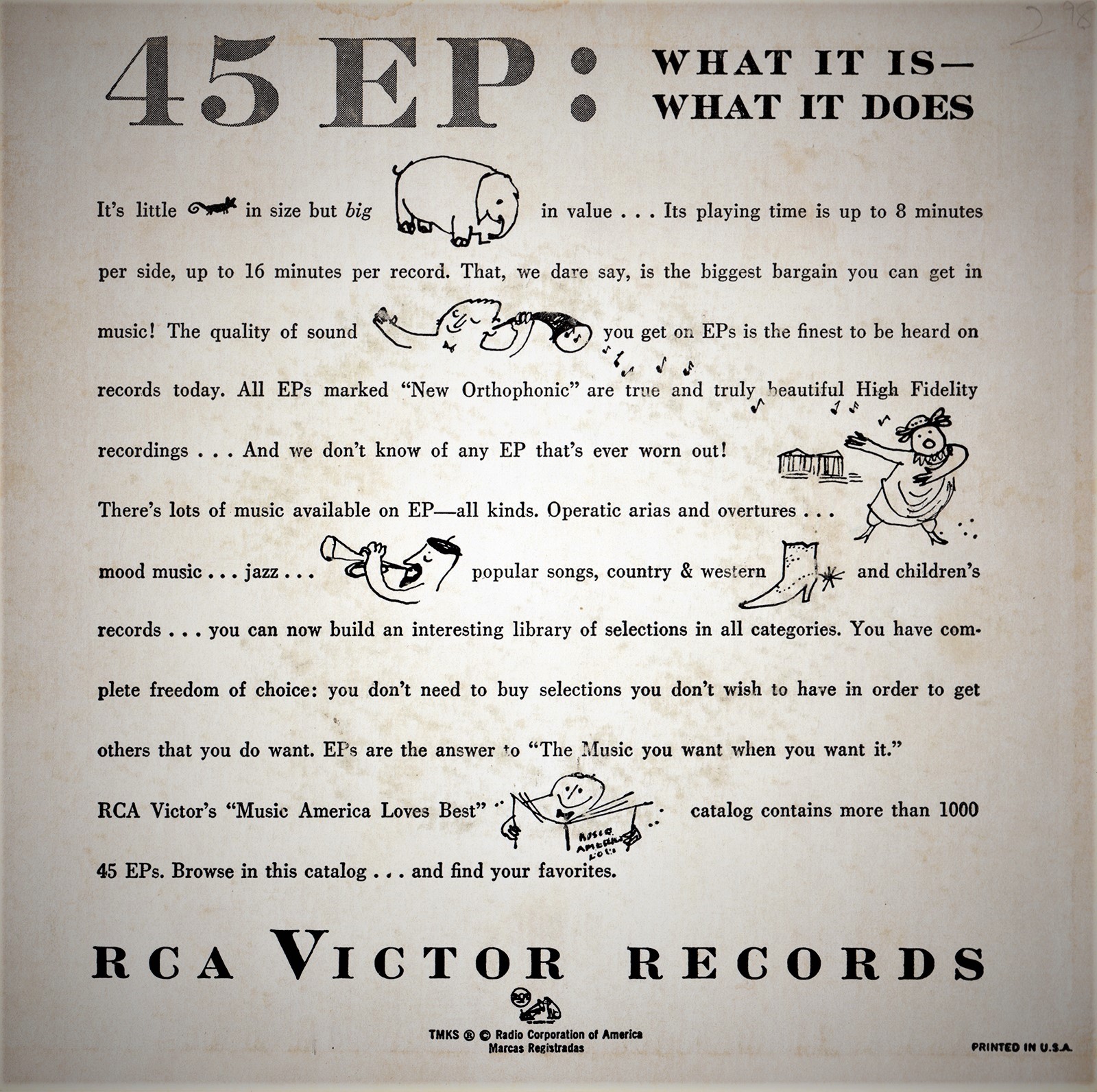
Just in case you’re unfamiliar with the EP format, EP stands for extended play. They are seven-inch 45RPM mono records with two songs on each side. At a glance, they look just like ordinary one-song-per-side singles. They even have the large spindle holes. But unlike singles, they came in cardboard outer jackets with artwork. Some EPs even had gatefold jackets containing two discs. Gatefold EPs were actual albums, containing the same number of cuts (as in eight) that most 33RPM fen-inch pop albums have. The sound of EPs, based on the samples I own, is all over the map. The faster playback speed usually offers the same benefits as a 45RPM audiophile LP: greater dynamic range, tighter bass, and more of an effortless sound. But the longer playing times on each side can also cause them to suffer dynamically. Paying Rich eight dollars each for the two EPs felt a bit steep, but at this point in my life I don’t care. They’re in insanely good condition, I love Arnold’s early recordings, and adding them to my collection was a no-brainer.
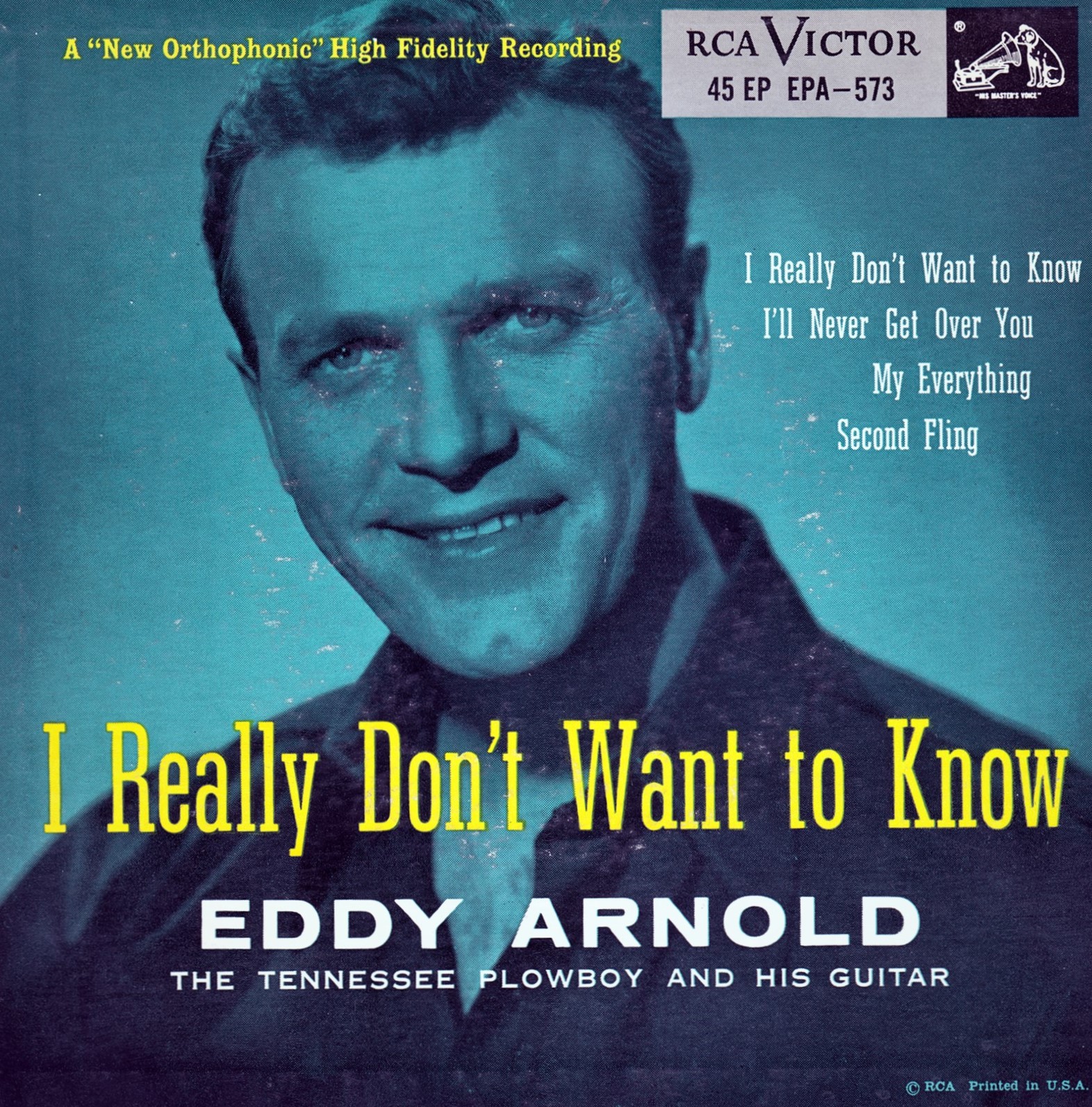
I Really Don’t Want To Know (RCA EPA-573) was released in 1954. It was a showcase for Arnold’s latest singles. All four of the cuts came from 1953 sessions recorded within weeks of each other. This single-disc EP opens with the song “I Really Don’t Want To Know,” recorded on 10/23/53. It's my first exposure to the chart-topping recording and I was surprised how much I didn’t like it. The version of the song that I know and have enjoyed for decades is his recorded-for-stereo version found on the Living Stereo LP Eddy Arnold Sings Them Again (RCA LSP 2185), released in 1960. His voice sounds exactly the same on both recordings, but on the later recording the studio musicians brought the song to life. The mono performance honestly sucks. Also, the sound of the 1953 recording is awful. It sounds like the recording engineer found a new toy, a broadcast limiter, and haphazardly used the relic to slam the music onto the tape. Perhaps he wanted to enjoy a cigarette without worrying about the recording level. In addition to the compression, it’s distorted. Blech.
Cut two is a magnificent recording of a Floyd Tillman song. It’s called “I’ll Never Get Over You.” It was recorded on 9/26/1953. It's a head-turner both musically and sonically. It’s a gentle country blues that opens with a deliciously played lap steel guitar. The steel was provided by Arnold’s longtime sidekick, Roy Wiggins (1926-1999). Ten seconds into the song Arnold starts singing. His sparse backing, outside of Wiggins, is an acoustic rhythm guitar and a string bass. Right before the last verse is sung, Wiggins returns with some beautiful Hawaiian playing. The sound is remarkable in its simplicity. Despite some innocuous preamp overload on the vocal, you can actually hear the recording space! I’m guessing only three mics were used. One for Wiggins, one for Arnold, and one placed high enough to capture both the acoustic guitar and the string bass. I could listen to this kind of sound all day.
Cut three blows my audiophile mind. It’s called “My Everything.” It was recorded on 11/13/53. This is a textbook example of the less-is-more school of recording music. They-are-here sound is what I’m hearing via my Sherwood S-7650-driven Sennheiser HD650s. Every musical instrument is right freaking there! And then there’s the music: Holy smothered pork chops, Batman, old school country music sounds so good! The star of the show is Wiggins and his Gibson Console Grande Electric Hawaiian Guitar. If you're feeling sluggish, maybe it’s because you need Vitamin Twang in your diet. Wiggins and the awesome sound of his Gibson will boost your metabolism and provide your body with a forty eight hour dose of Hawaiian guitar euphoria. In addition to the insanely fine steel playing is Arnold’s soothing voice, and some very sweet acoustic rhythm guitar playing. When you hear it, don't be surprised if you feel a tropical breeze.
Cut four is a silly but fun song called “Second Fling,” recorded on 3/31/53. Its only purpose was to get people dancing. It was composed by Joan Javitz and Steve Nelson. And who the heck are Javitz and Nelson? Even after googling them, I still can’t tell you how the two came together to compose this song. Javitz, who’s still alive at 97, was a staff writer in New York’s Brill Building. She also wrote the Christmas classic “Santa Baby.” Nelson was a Nashville-based writer whose credits include “Frosty The Snowman” and two of Arnold’s biggest hits, “A Heart Full Of Love” and “A Bouquet Of Roses.” This lightweight dance record reminds me a lot of Spade Cooley’s west-coast western swing sound. “Tonally perfect and dynamic” are the first words I jotted down when I heard it. It was also the b-side of “My Everything” on the original single.
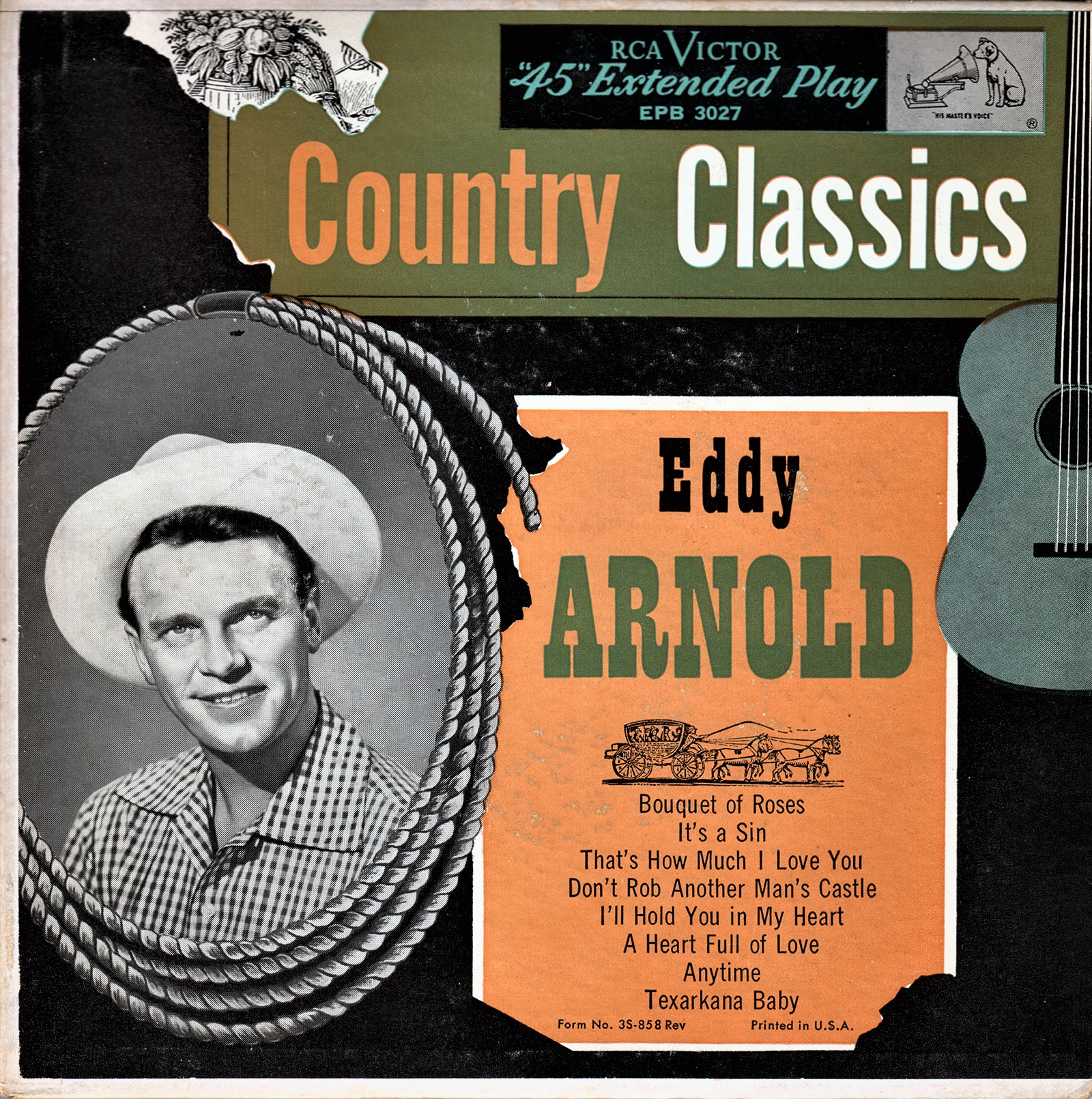
The other EP is Country Classics (RCA EPB 3027). It’s a genuine album, released in 1952. It was derived from singles recorded in 1947 and 1948. It was also issued as a ten-inch 33RPM record (RCA LPM 3027). I would have loved to find the ten-inch version, but fate wants me to own the EP first. Actually, I already own every cut on this title. They’re on the twelve-inch LP Anytime (RCA LPM 1224), released in 1956. The sound on the 1956 LP is off-the-charts perfect on every cut, or so I thought. Actually, I’m still very much in love with the sound of Anytime. By comparison, the EP’s sound is mostly mediocre, but one cut makes owning it worthwhile. And that cut is the above-mentioned “A Heart Full Of Love.” It was recorded on 12/14/47 in New York City, at RCA’s Studio One. As good as it sounds on Anytime, on the EP it sounds one step closer to what I believe is on the master disc. It’s slightly more dynamic, and Arnold’s voice is even clearer. Think of the improvements that a superior pair of interconnects make. That’s what I heard when I compared the sound of the two different sources of this song.
“A Heart Full Of Love” is the second cut on side three of the double EP. It opens with some of the finest Hawaiian lap steel playing ever committed to a country record. Way in the background is a fiddle, but in the foreground, coming in at the ten-second mark, is Arnold’s magnificent voice. Simply put, this is a perfect record, and a perfect example of just how close Hawaiian music once was to country music. Remove the singer and the fiddle, and it becomes a Hawaiian record!
If you were to judge Arnold by his easy-to-find albums from the early sixties onward, you’d probably think he’s pretty boring. He recorded tons of easy-listening schlock. His RCA stereo albums are not only abundant, they live in their rightful place: the 99-cent bins. Arnold, one of the most successful country artists of them all, recorded many cool records in the forties and fifties, and even a few in the early sixties. These records aren’t exactly rare, but finding them in good condition can be challenging.
I was so taken by Wiggins as a guitarist, I had to learn a little more about him. Wiggins, who often went by Little Roy Wiggins, is one of the few Nashville studio musicians who was actually born in Nashville. Best remembered as Arnold’s steel guitarist, he, along with Jerry Byrd, is famous for infusing the Hawaiian lap steel sound into country music. For years, I thought the steel player on Arnold’s early records was Byrd. I’m glad to be corrected. However, I could not find out how tall he was. Considering that Arnold was a burly man who stood more than six feet, Wiggins’ must have looked short by comparison. I also looked into whether he recorded an album of Hawaiian music. He did. It was on Starday Records.
Last, but not least, is the audio system I used while writing this review. For this outing, I used my office system. I often prefer my direct drive Micro Seiki turntable over my belt drive Luxman on early mono recordings. The cartridge I chose was the Grado Reference, Grado’s former top-of-the-line model, which is also their first wood-bodied model. Perfect it’s far from. Sometimes it sounds so slow it can’t get out of its own way, but at other times it sounds more natural and engaging than my Denon and Hana moving coils. This dualfaced performance has been a part of the high end Grado sound for as long as I’ve known the brand. (The lower-priced models tend to sound more neutral.) As I’ve owned countless Grados since the mid-eighties, I doubt that this quality has changed. Every few years somebody in the high end press makes the claim that the infamous Grado jiggle on invisible warps has been fixed, and the occasional bass-heaviness has all but vanished. I doubt that either is true. However, the belief among my vinyl-addicted friends that there’s nothing quite like the Grado midrange is still very true. The Grado Reference, my Micro Seiki DQ50 turntable, my Sherwood S-7650 receiver, and my ever-trusty Sennheiser HD650 headphones worked as a proverbial time machine during the time I worked on this article. It felt awesome to just sit back and relish Arnold’s incredible baritone voice, and Wiggins’ awesome played-without-pedals steel guitar. Friends, recorded music doesn’t get any better.