Toronto Audio Fest (TAF) 2025 – Show Coverage, Part 2
October, 2025 Friday 17 – Sunday 19
As I was driving towards the Toronto Airport Westin hotel on Saturday 18 October morning, my mind was wandering and I was thinking that mid-October 2025 feels like a surreal time in history. Everyone is venomously angry about anything and everything. Reasonable and rational discourse has been completely abandoned in favour of lunatic outrage, breathtaking narcissism, and utterly delusional thinking. As a friend of mine recently commented: "It is f**k-aroundest of times, and it is the find-outest of times."
It's like everything is collapsing at a dizzying speed, and all we can do is to try to hang on to what little is warm, familiar, and still makes sense. For audiophiles and videophiles, this means focusing more intently than ever on live music, recorded music, movies, TV shows, and a plethora of on-line streamed content. Music is the food of life. It is nourishing, satisfying, fulfilling, and that which makes our lives more worth living.
The annual pilgrimage to the Toronto Audio Fest (TAF 2025) consumer electronics extravaganza is something that I sincerely look forward to experiencing every year. Why…? Stated succinctly, because the annual show is familiar—even calming and reassuring—in its familiarity.
On Saturday morning, I arrived at the Toronto Airport Westin early. I ran into James Tanner—one of Bryston's founding members—in the parking lot. As I walked into the hotel with him, we chatted about the state of the North American high-end audio industry.
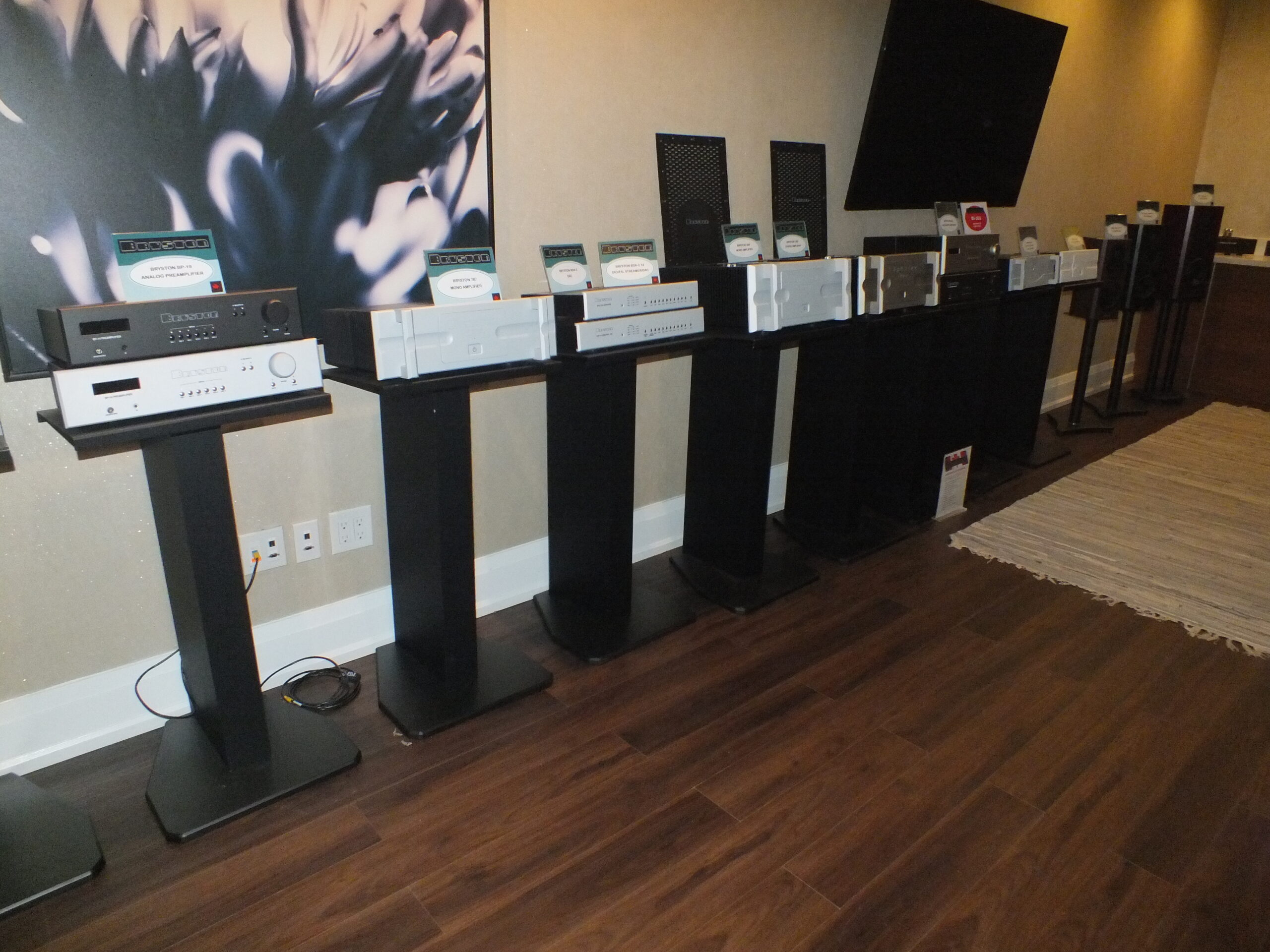
Bryston had a plethora of their awesome sounding gear set-up inside the Atmosphere North room on the ground floor. As busy as he assuredly was that morning, James was kind enough to take the time to chat with me—at great length—about some of the speakers and components that Bryston had brought to TAF 2025.
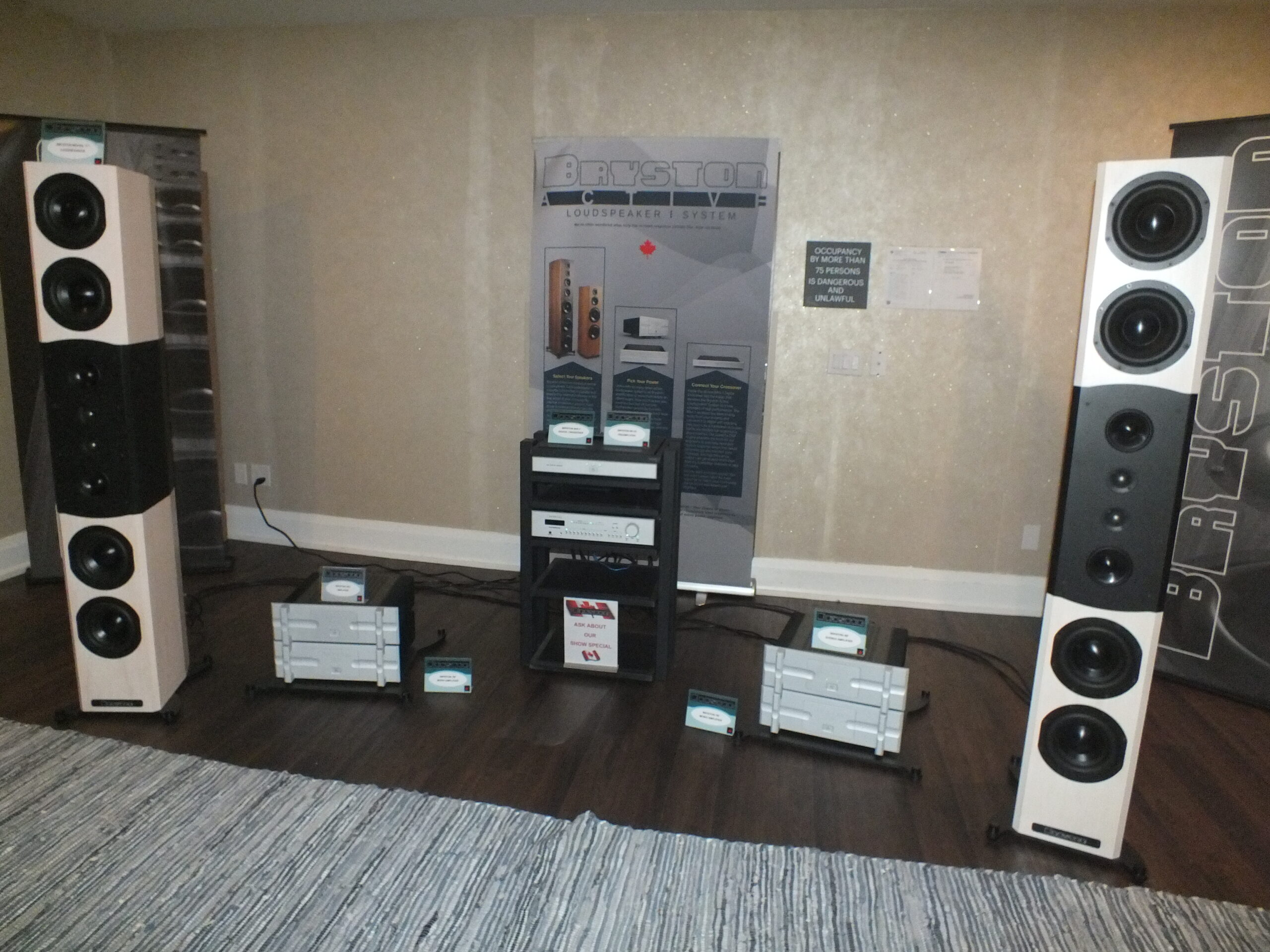
Bryston 2-channel system
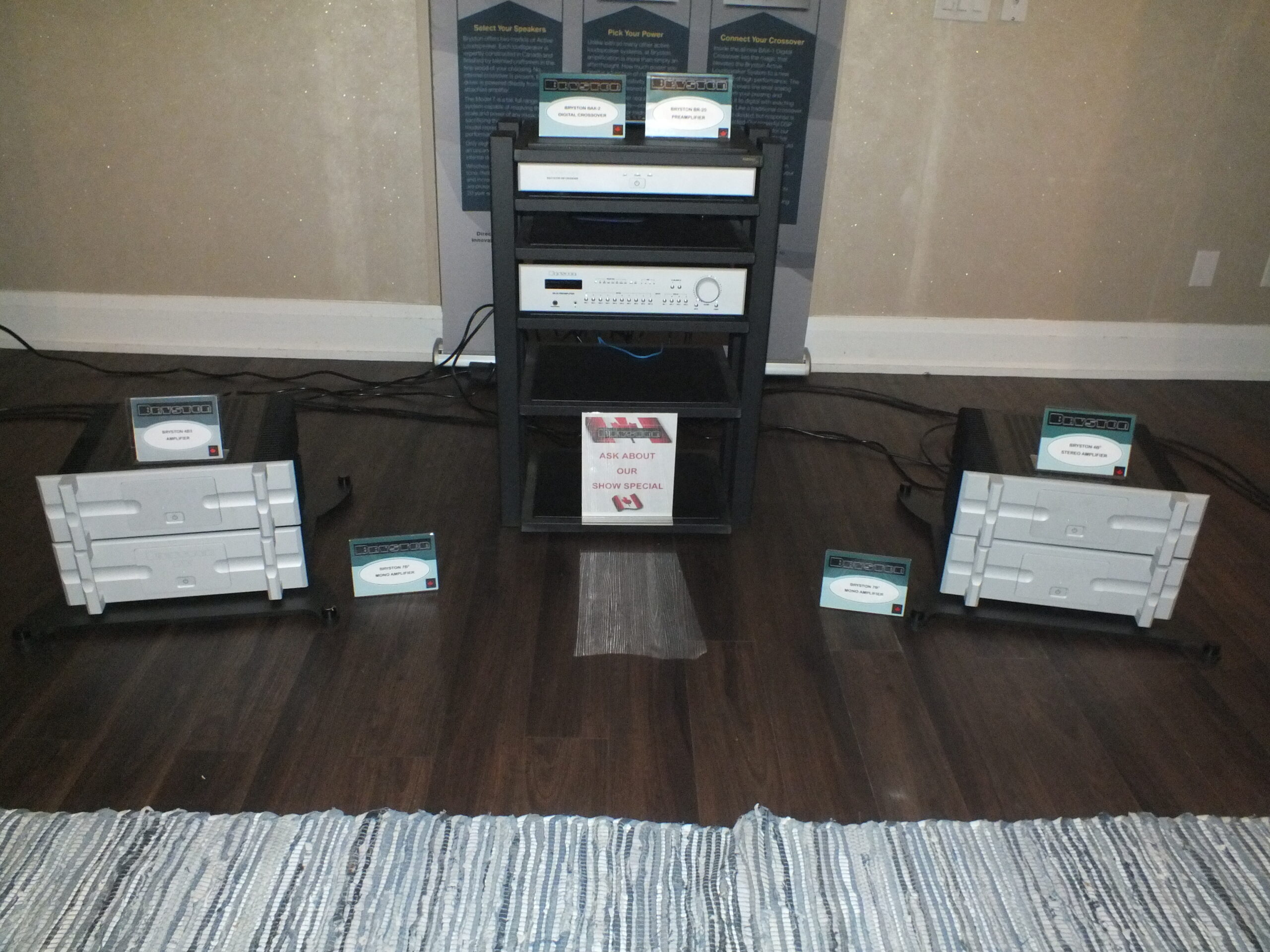
Bryston 2-channel gear close up
Showcasing the new BR-20 all-in-one streamer/DAC/preamplifier ($7495 CAD) as a tablet-controlled source, Bryston's main 2-channel system fed signal to a pair of Bryston's 4B³ solid-state mono-block amplifiers ($16,600 CAD for a pair of mono amps). If desired, these single-channel amplifiers can be bought individually for $8200 CAD + taxes for Home Theatre (H/T) applications.
Bryston Room, various components
The floorstanders were a pair of Bryston's majestic T-10 loudspeakers ($10,995 CAD per each speaker) in a gorgeous 'white wash maple' wood veneer cabinet finish. Bryston's new BAX-2 active cross-over ($4395 CAD) features 2-inputs and 8-outputs to dial-in the highs, mids, and bass of speakers. The BAX-2 also has outputs to control the impact and intensity of two subwoofers.
Bryston also brought their new TS-10 tower subwoofer in the same stunning 'white wash maple' wood veneer finish ($18,000 CAD per pair). The TS-10 subwoofer is not powered. As such, it needs an outboard 2-channel amp to drive a pair of them.
Bryston's floor standing TS-10 subwoofer
Bryston's TS-10 floorstanding subwoofer
A few years ago, Bryston had been developing a custom 4-tower speakers + subwoofers array that was (potentially) going to be called the T-Rex system. Similar in approach to the monolithic 4-tower Genesis Infinity Reference IRS-V loudspeaker system that Arnie Nudell had once unleashed upon the audio world, the T-Rex had similar aspirations of bringing Titanic depth and Godzilla-level impact to the mid-bass and low bass frequency registers.
Although Bryston's T-Rex four-tower system never went into production, today in Oct 2025, the 2 x tower T-10 floorstanding speakers plus 2 x TS-10 tower subwoofers is the 4-tower system that resulted from all of the research that went into the original T-Rex system.
TAF 2025 was the North American premiere for the TS-10 subwoofers. According to James Tanner: "The whole idea behind the TS-10 subwoofer Towers is that they must be used in concert with the Main T-10 Towers as acoustically the Main and the Sub is now one speaker[;] not a main and a sub."
Bryston- 4 x various loudspeakers
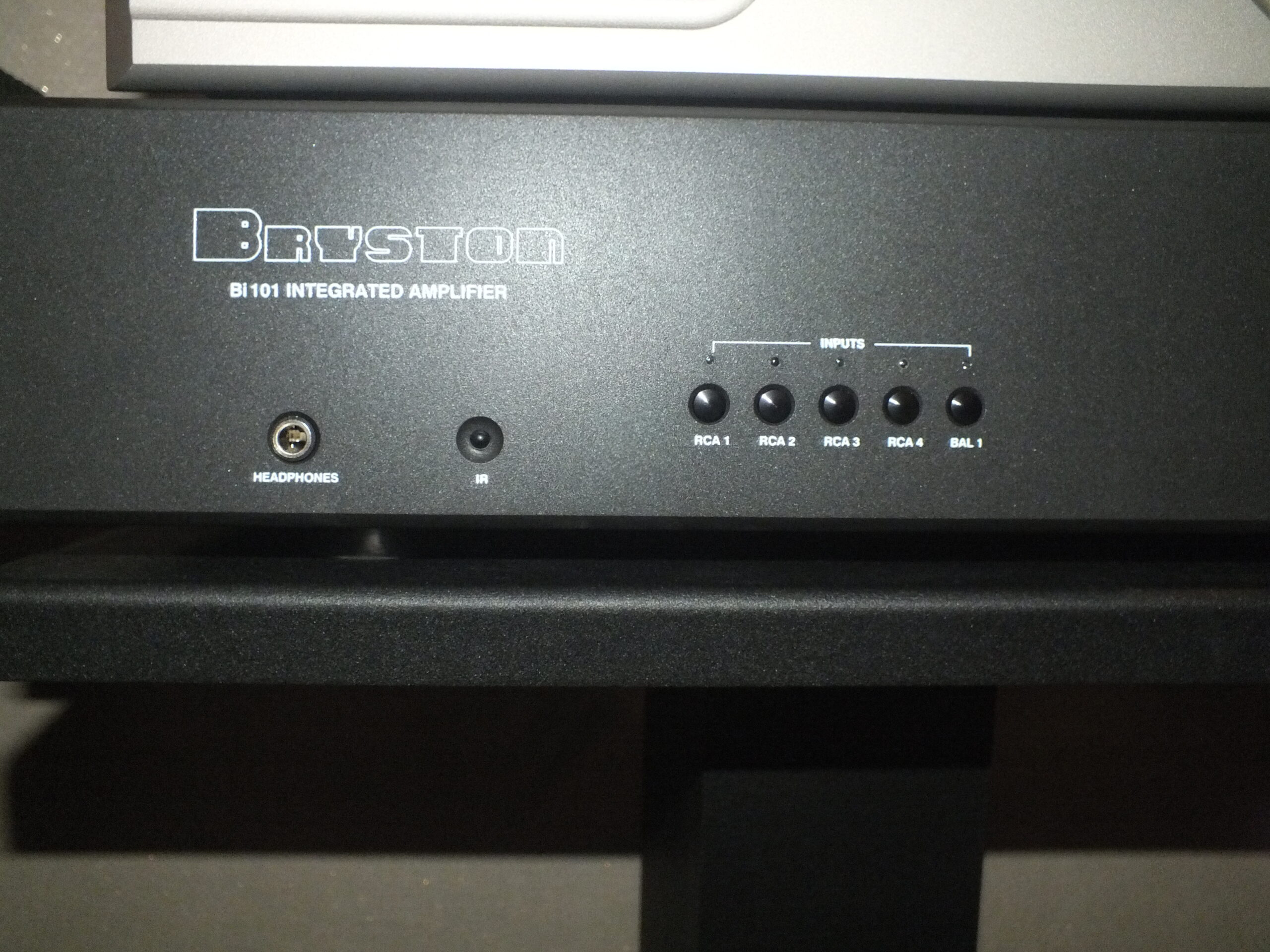
Bryston also premiered their brand new Bi-101 solid-state 2-channelintegrated amplifier (projected MSRP $5000 CAD) at TAF 2025. Delivering 100 watts per channel into 8 Ohms, the Bi-101 combines Bryston's BP-19 preamplifier with two class 'D' solid-state amps in one box.
Bryston's Bi-101 integrated amplifier
Bryston's Bi-101 integrated amp
If an end-user chooses to mate the Bi-101 in a pre/power combo with two outboard mono-block amplifiers, the Bi-101 can bypass its own class 'D' amplifiers and be used exclusively as a high-end preamplifier.
Later on that Saturday afternoon, I returned to the Bryston room with a couple of audiophile friends to listen to the main 2-channel system again. At that time, I wrote down in my notes: "Impressive dynamics with a fluid, non-fatiguing, and tube-like warmth. Deep resolution with superb bass extension and palpable instrumental textures—especially in the lower mid-range, upper bass, and mid-bass registers."
A lot of the larger rooms at TAF 2025 sounded painfully harsh in the high frequency registers. This wasn't just because those poorer sounding rooms were playing the music at ear-splitting volume levels. Some of the rooms sounded so bad that I thought I should turn the stereos off, sit on top of the equipment, and listen to the hotel's HVAC system.
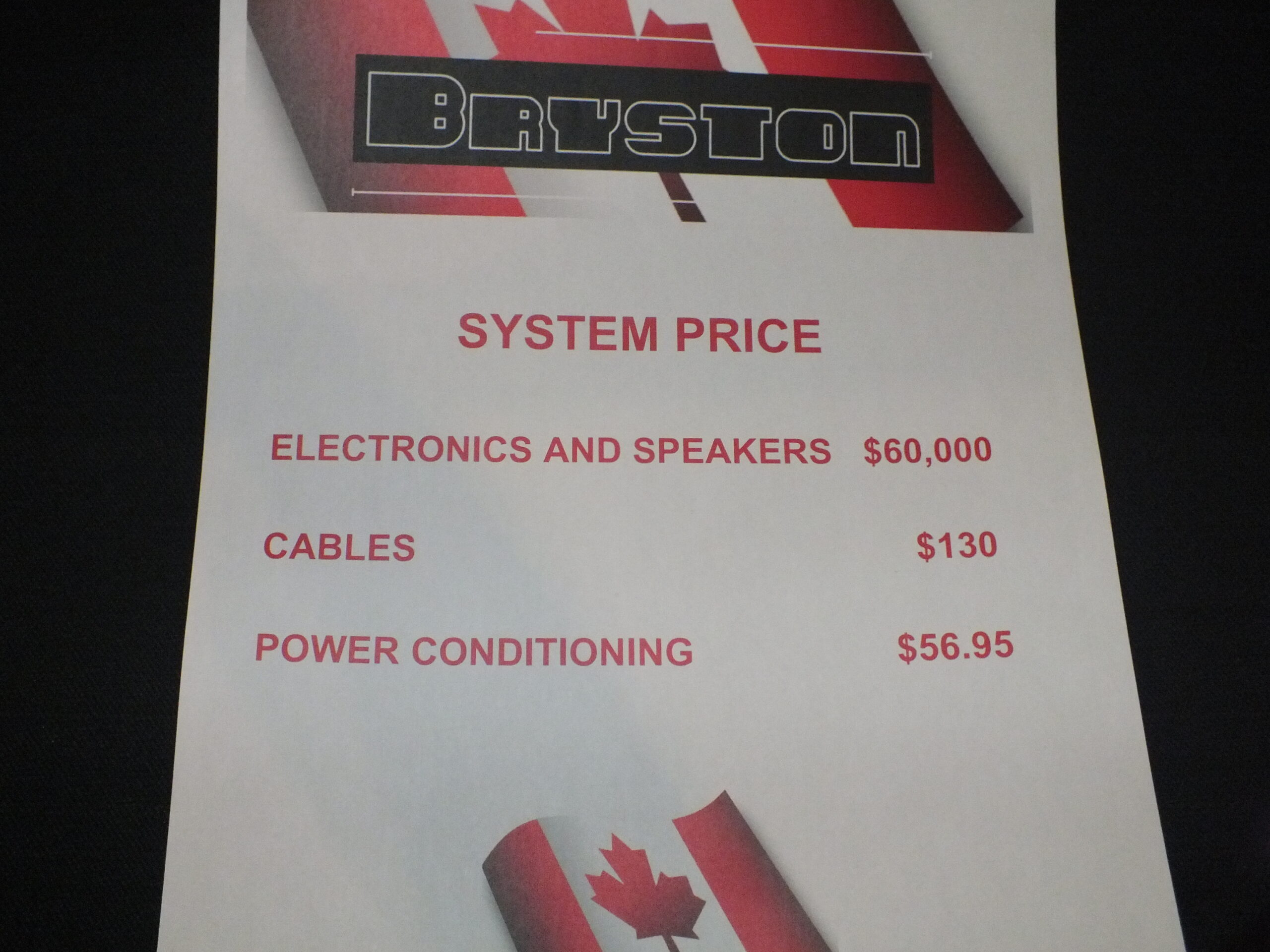
Bryston always manages to bring superb sound to audio trade shows. By mid Saturday afternoon, Bryston's 2-channel system was solidly ranked in my annual 'Top 3 Best Sounding Rooms at TAF'. Much to the surprise of many, Bryston were proudly using no-name cabling and a Home Depot power bar. They even had a comical plaque with the overall pricing for their system:
Bryston
I can only imagine how much better Bryston's gear and speakers might potentially sound with a 5-figure cable loom, a plethora of anti-resonance devices, and acoustical room treatments.
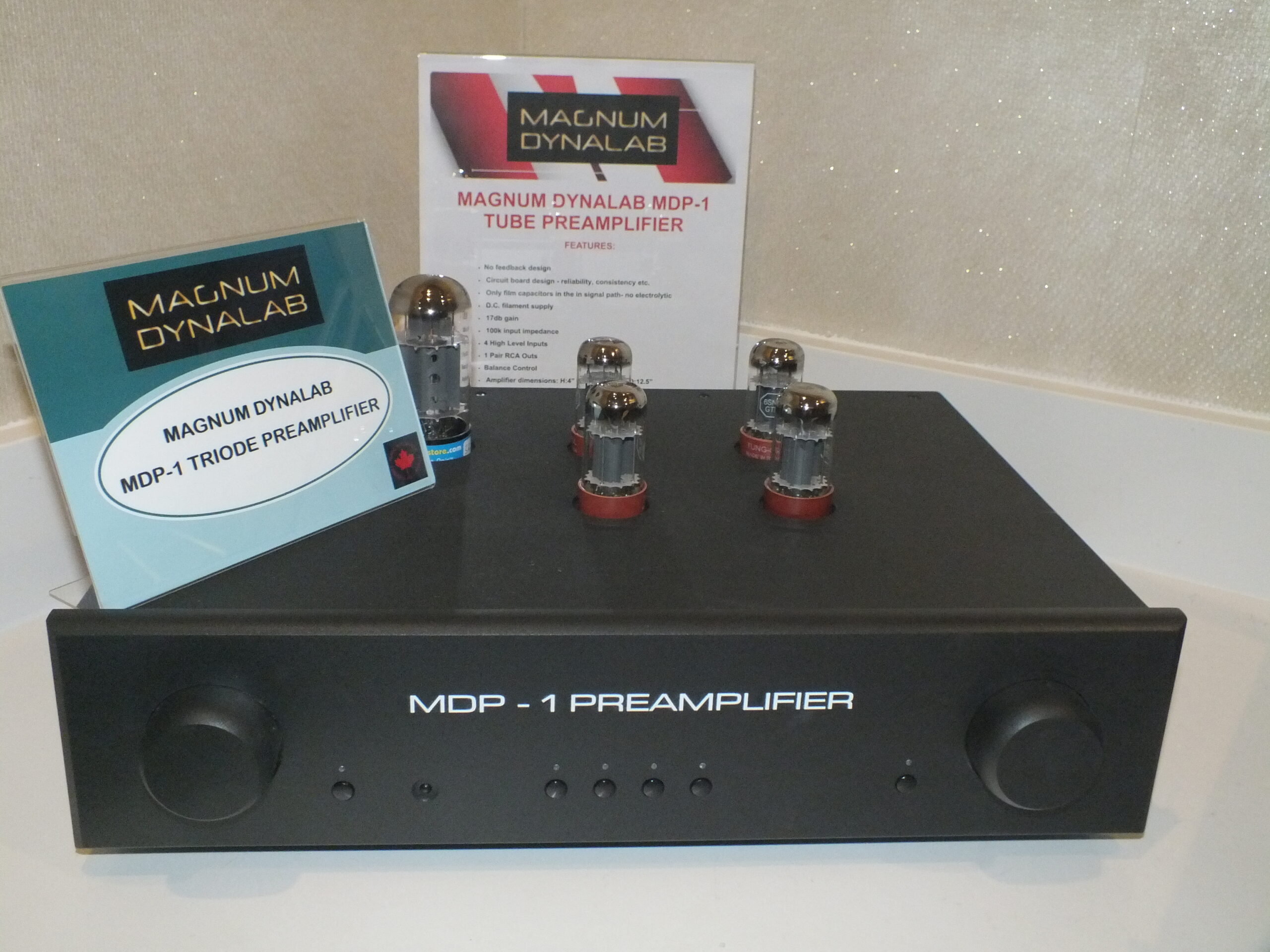
Lastly, Bryston recently bought the intellectual property (IP) rights to Magnum Dynalab's designs. Bryston had a prototype of a new vacuum tube triode MD-inspired tube preamplifier on display.
Bryston's Magnum Dynalab MDP-1 vacuum tube triode preamplifier
Bryston's MD-105T radio tuner
I'm curious to hear what Bryston's take on a tube preamp that was originally designed by Magnum Dynalab will sound like. For more information, please visit Bryston's website HERE.
Audio Note
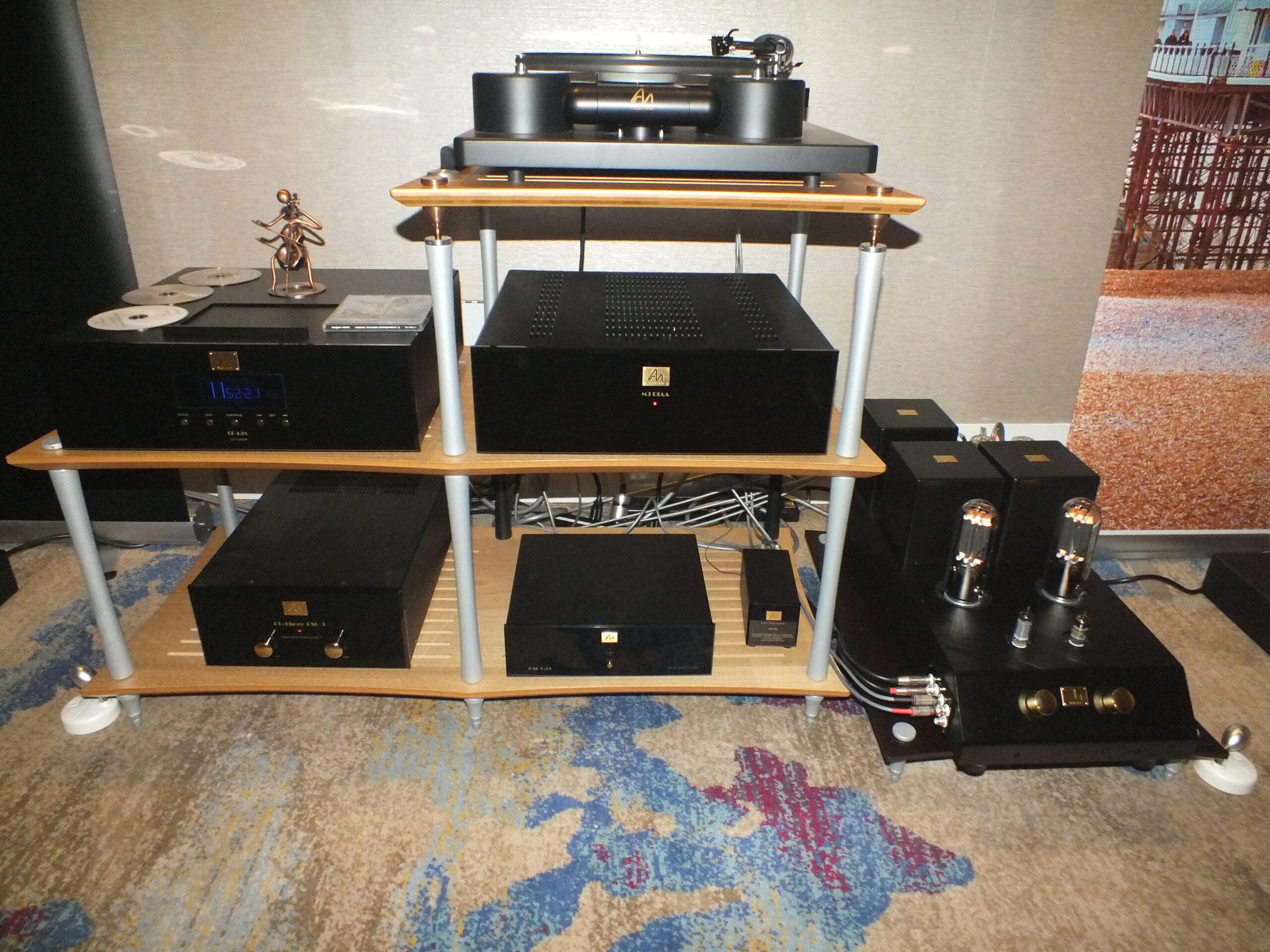
For TAF 2025, Audio Note UK proudly showed their gear in the Dixon Room on the ground floor. Audio Note custom fabricates ALL of their goods—including their speakers and cable lines—in house. The result of designing and building everything under one roof is a sonic synergy with Audio Note's stereo systems that few (if any) other companies in the high-end audio CE industry can match; let alone beat.
Audio Note UK
Source components were an Audio Note CD 4.1x Red Book integrated CD-player ($30,800 CAD), an Audio Note TT-3 Reference turntable ($27,500 CAD), ARM-3 tonearm ($5250 CAD), and IO2 M/C cartridge ($1500 CAD). Phono signal amplification was via an Audio Note M3 RIAA phono stage ($18,700 CAD). The vacuum-tube power amp was a Jinro 211 SET line integrated amplifier ($53,800 CAD).
Playing a classical track, a lovely pair of Makassa ebony wood finish AN-E/SPx Ltd field coil floorstanding loudspeakers ($97,000 CAD) sounded amazingly lifelike, coherent, and tactile.
Audio Note components
The system was cabled-up with Audio Note's AN-SPe speaker cables (1.5m length - $3800 CAD) and AN-Vx interconnects (1.0m length- $2800 CAD).
TAF 2025 was the first time that the brand new AN-E/SPx LTD Field Coil speakers have been played at a Canadian CE trade show. While other field-coil speaker designs do exist, AN's beast is unique is that both the tweeters and the woofers use field-coils that are built by hand in their factory in the UK.
As a softer song played, I chatted with Audio Note's Daniel Qvortrup for a few minutes about Triptykon, Goatsnake, Cathedral, Electric Wizard, and Celtic Frost. Sensing that I'd appreciate hearing something heavier, Daniel decided to play Slayer's blistering track "Raining Blood" of off their seminal 1986 Reign in Blood album. Way-back-when in the mid-1980s, Slayer pushed the boundaries of what was musically possible with heavier music. In terms of ferocious speed, dynamic energy, technical precision, and overall heaviness, no one—repeat, no one—has ever equaled Slayer's rampaging 1980's era sound.
Last year at TAF 2024, I wrote: "If you think that Audio Note's speakers are only designed to play delicate female vocals or gentle acoustic guitar lines, think again. Had I not heard this system, I never would've believed that AN's speakers could play that loud with soooooh much gosh-darned bass while still maintaining the music's blistering PRaT (pace, rhythm, and timing), textures, and overall musicality."
Audio Note TT
Listening to the cement-mixer heavy and blitzkrieg speed of Slayer's music being reproduced so accurately by Audio Note's 2-channel system was, once again, a joyous experience. The sound put a gloriously twisted smile on my face. Oh my Heavens is there a lot of sonic information in that recording. And hearing the Mariana's Trench deep resolution of AN's stereo system gave me goosebumps. In particular, Dave Lombardo's thundering percussive assaults were rendered clearer—and more meaningful—by Audio Note's gear than I've (arguably) ever heard them before. Yep…this is how Slayer is supposed to sound.
Switching things up a bit, Daniel also played a much softer track by Saarth Effrikan… er… South African singer Lette Mbulu. What impressed me to no end was how effortlessly the AN 2-channel system made both of these recordings sound so darned good. Hot damn… what a memorable moment that was for me!
For more info, please visit Audio Note's website HERE.
Audio Sensibility
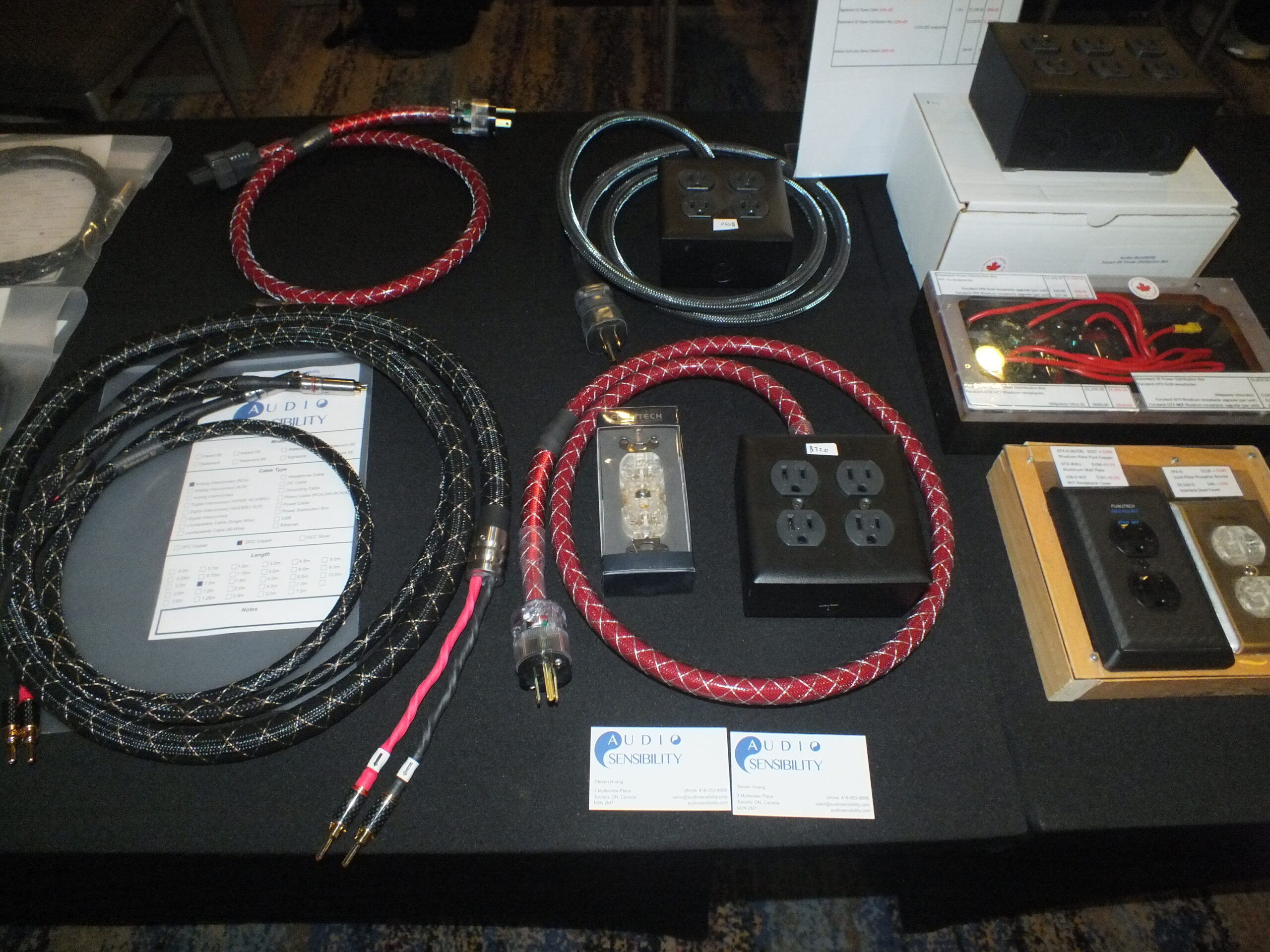
Located in central Toronto, custom cable fabricator Audio Sensibility was selling a wide range of audiophile cables and tweaks. CEO Steven Huang has invested heavily in 3D printers to custom-fabricate specialty cables, odd connectors, and unique power supply tweaks for audiophiles. If no-one else can figure out how to build a one-off cable or a connector for you, AS is the company to go to.
Audio Sensibility cable display board
Audio Sensibility finished cables
I wrote a review about AS' top-of-the-line Signature 'Special Edition' (SE) A/C power cord for Positive FeedbackHERE.
For more info, please visit Audio Sensibility's website HERE.
Wynn Audio
Located in Richmond Hill (north Toronto) Ontario, Wynn Audio was swinging for the fences with a 'State of the Art' 2-channel stereo. For source components, this system showcased a German-made Thiele TT-01 turntable ($45,000 CAD) and a Thiele TA-01 Zero Tracking Error tone arm ($20,800 CAD).
Wynn Room entire system
Centered around Japanese Kondo Audio Note components, this 2-channel system featured a Kondo SFz MC step-up transformer ($20,000 CAD), a Kondo M7 Heritage preamplifier with phono stage ($90,000 CAD), and a Kondo Ongaku Integrated Amplifier ($158,000 CAD).
Wynn Audio components
Wynn's loudspeakers were a pair of German-made Tidal Contriva G3 floorstanders ($150,000 CAD). Combined with a Critical Mass Systems' Olympus V12 equipment rack, an Entreq Olympus Hero grounding box ($36,300 CAD), and a full loom of Crystal Cables, this 2-channel system created holographic 3-dimensional sound.
Wynn's sonic gurus are experts at tuning rooms. Even in a large, open-concept, basement room with assuredly challenging acoustics, their 2-channel system had a relaxed, organic, and natural sound that was a pleasure to listen to. I spent far longer than I should have enjoying music that was being played through this stereo.
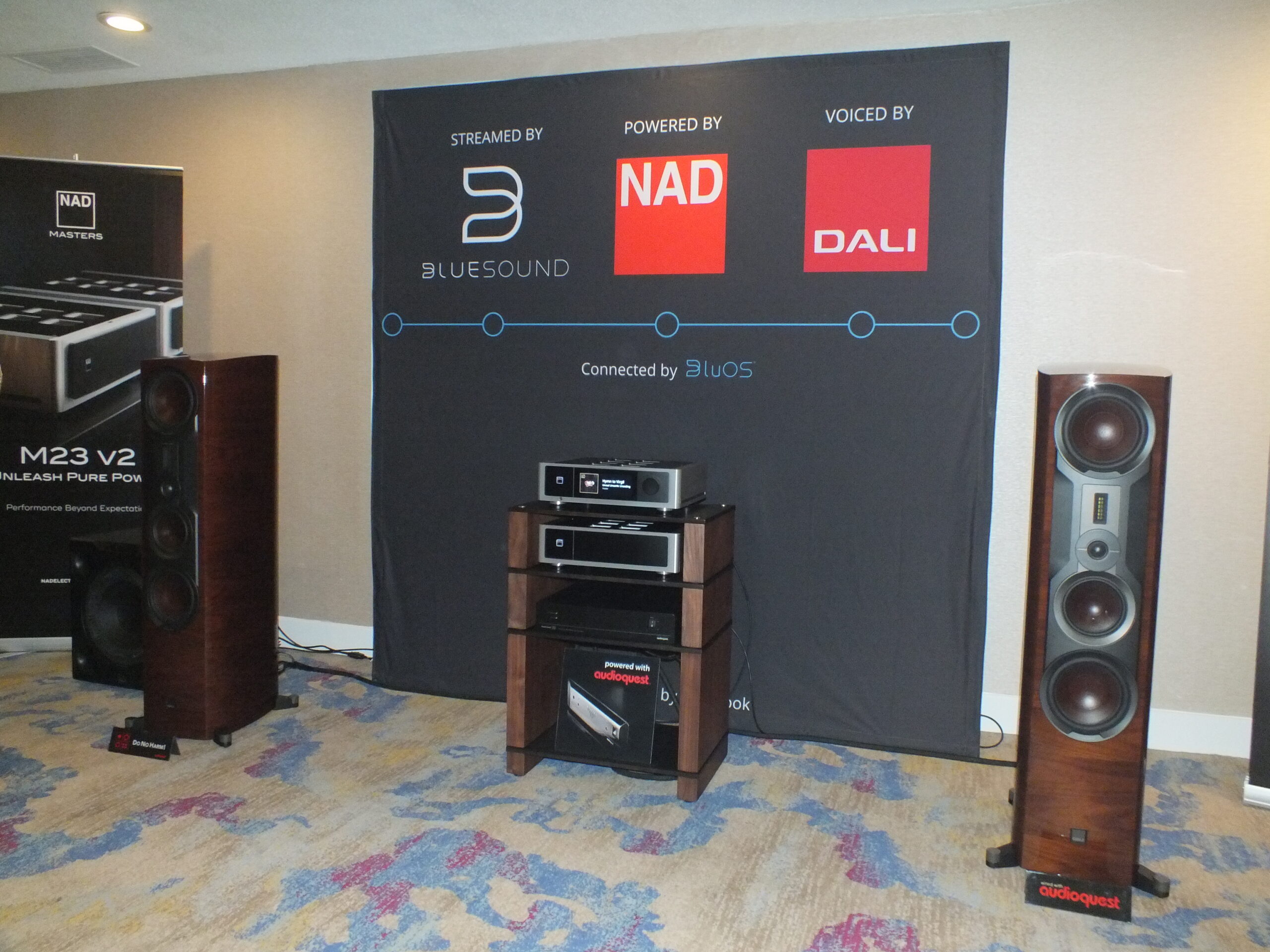
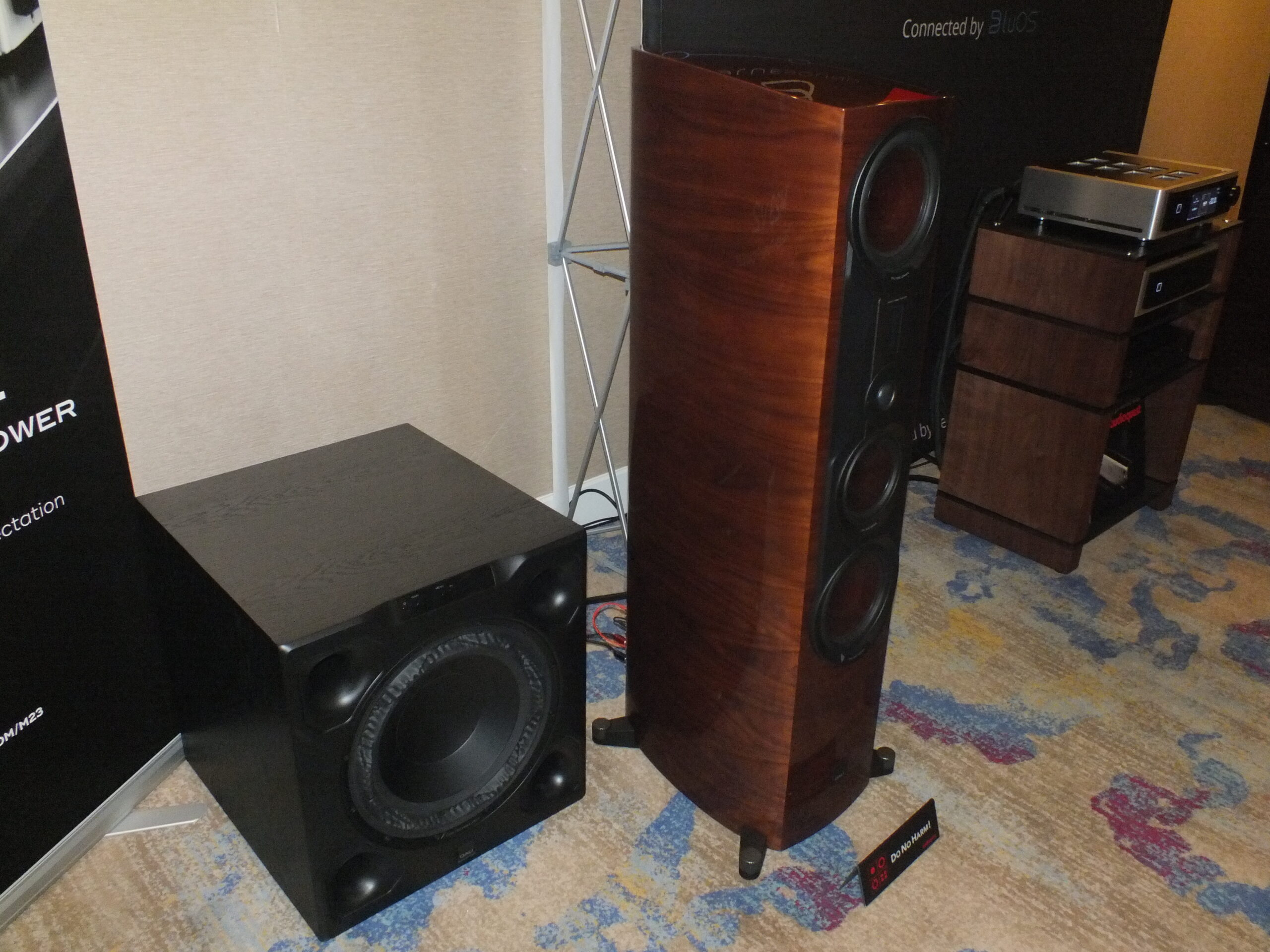
Located in the Windsor Room of the Westin hotel, Lenbrook used TAF 2025 for the North American premier of the new NAD M33 V3 integrated Blu-Sound streaming system ($8599 CAD). Partnered-up with NAD's M23 power amplifier ($5699 CAD), this striking NAD pre/power combo drove a pair of Dali Epicore-9 floorstanding speakers ($50,000 CAD).
Lenbrook room
This 2-channel system also incorporated a colossal 140Lb Dali VF-16 subwoofer ($10,000 CAD).
Lebrook Dali tower and VF-16 subwoofer
Listening to Chris Stapleton's song 'Bad As I Used to Be' that was used to great effect in Brad Pitt's F1 movie, the overall sound quality in an acoustically difficult larger room gave me shivers. In my notes, I wrote: "Incisive resolution, palpable texturing, bass to die for, and a thoroughly immersive 3-dimensional soundstage." Looking back, this now remembers as one of my favourite moments of the entire TAF weekend.
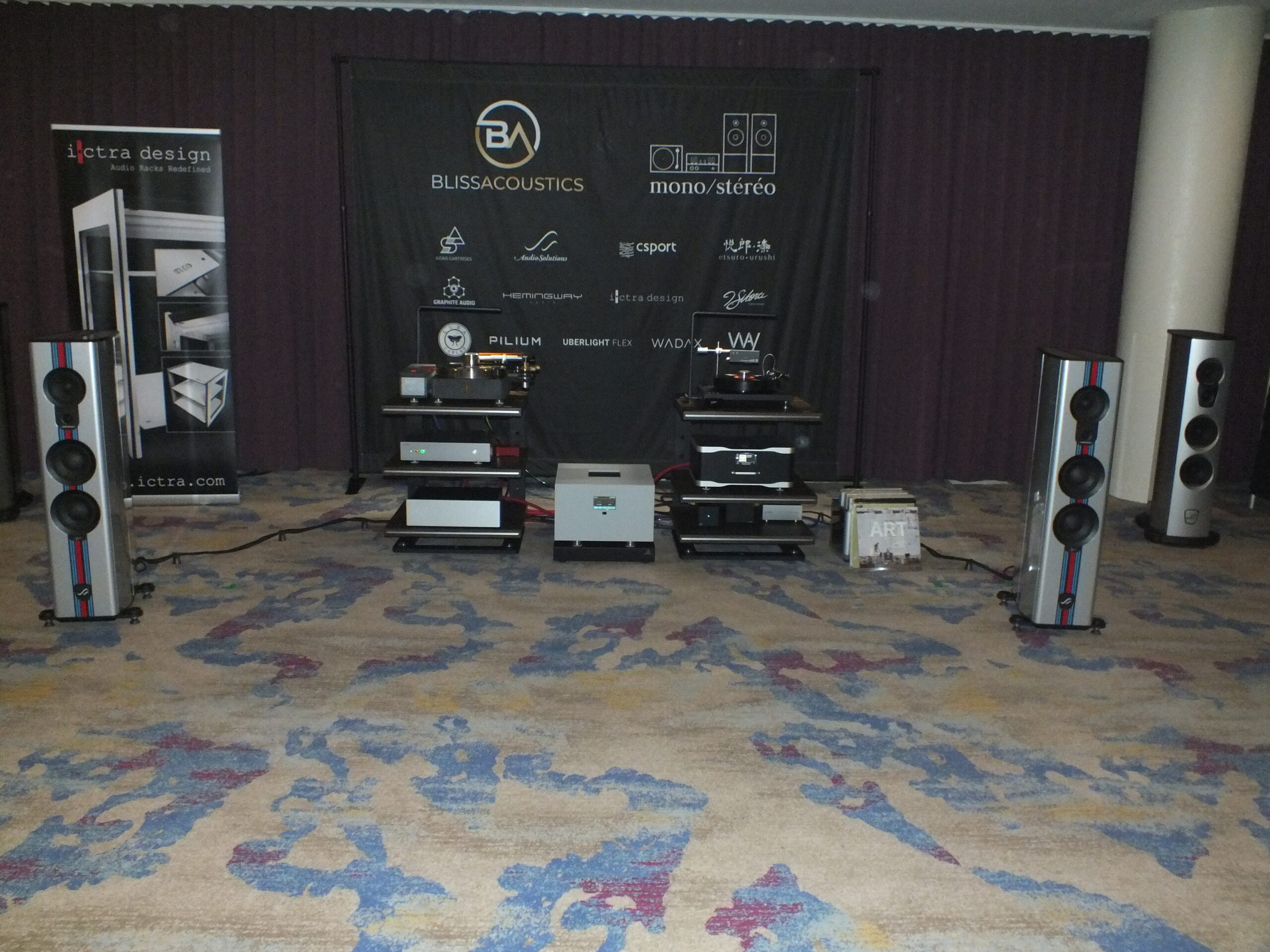
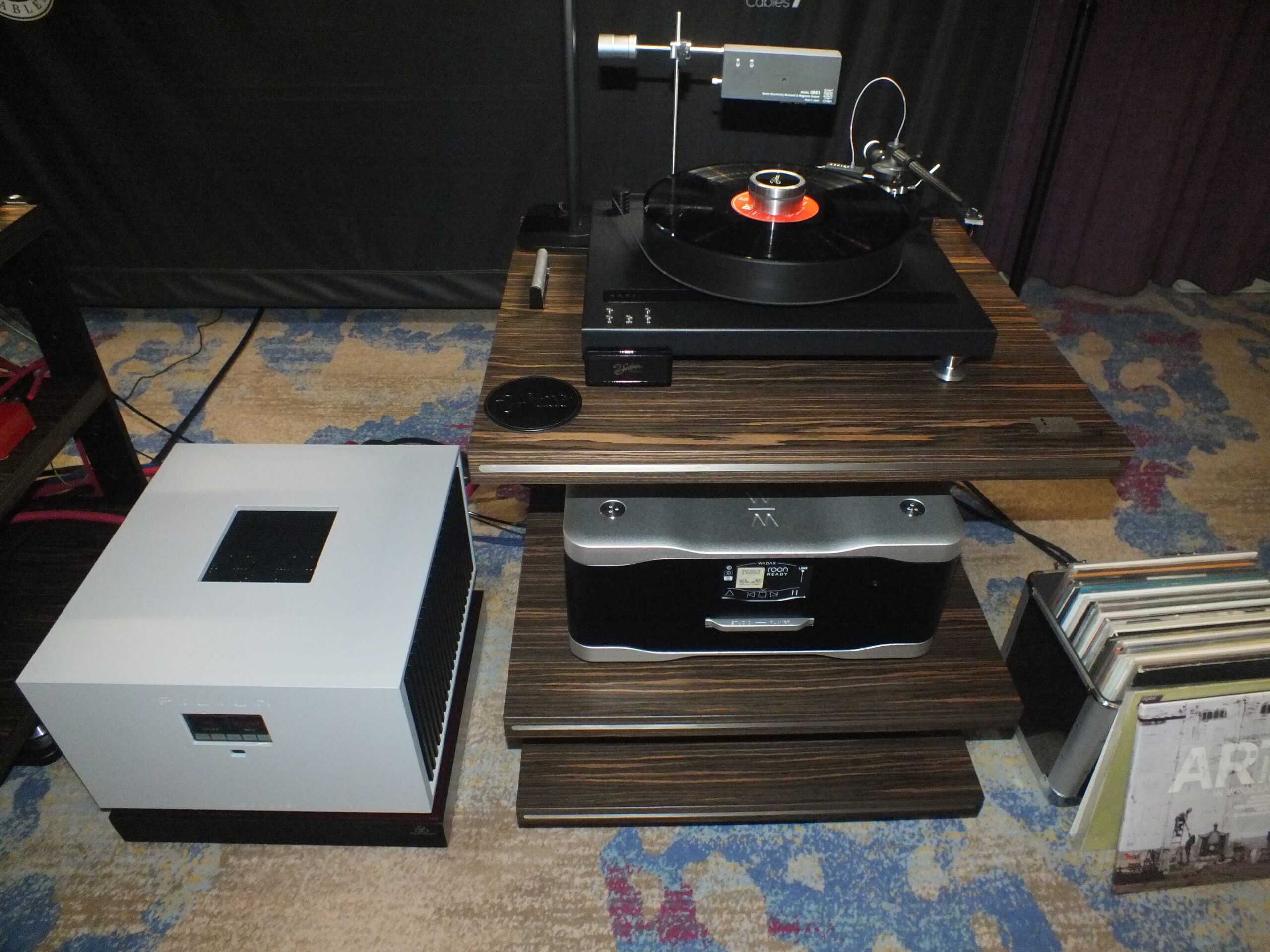
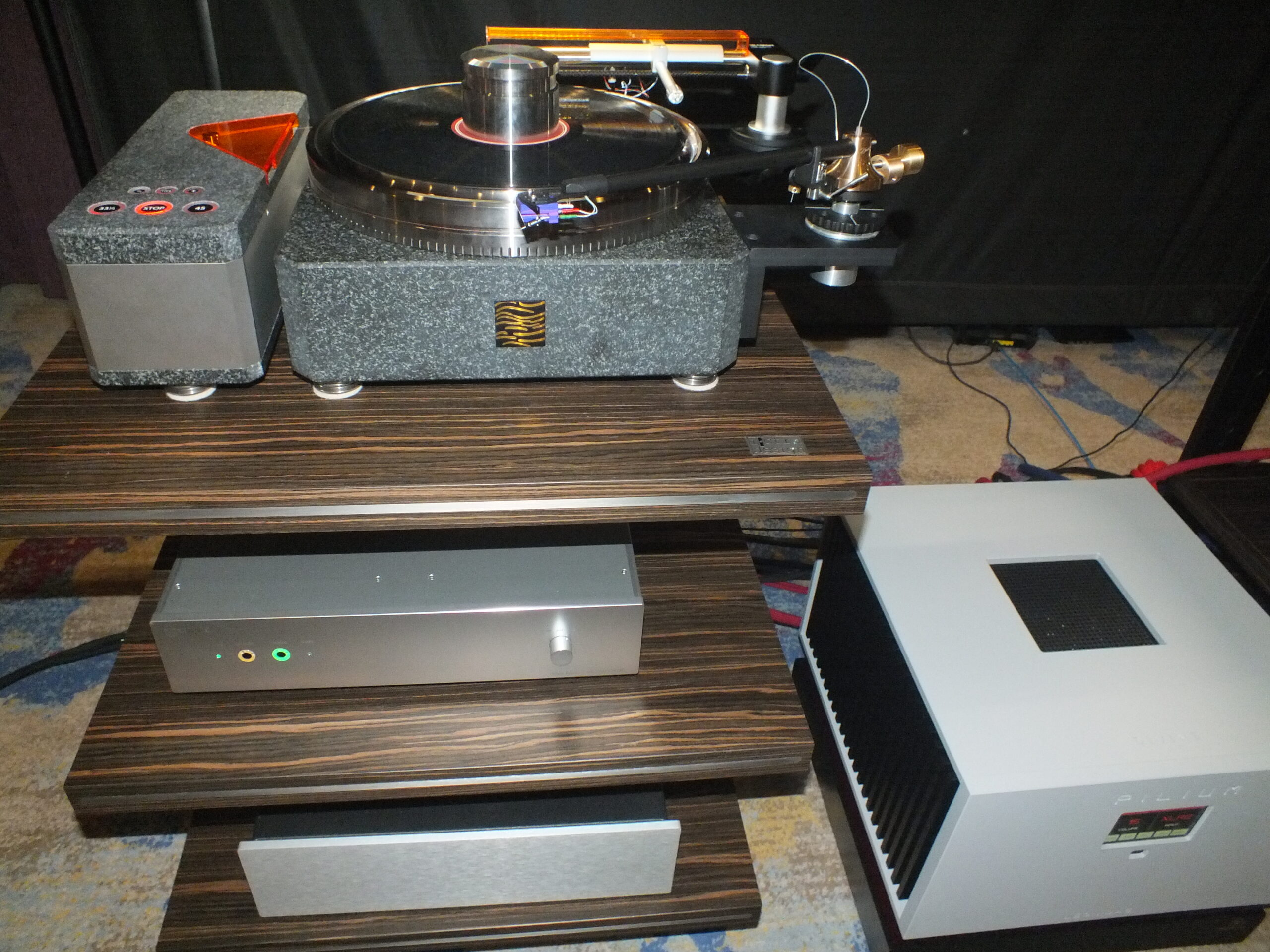
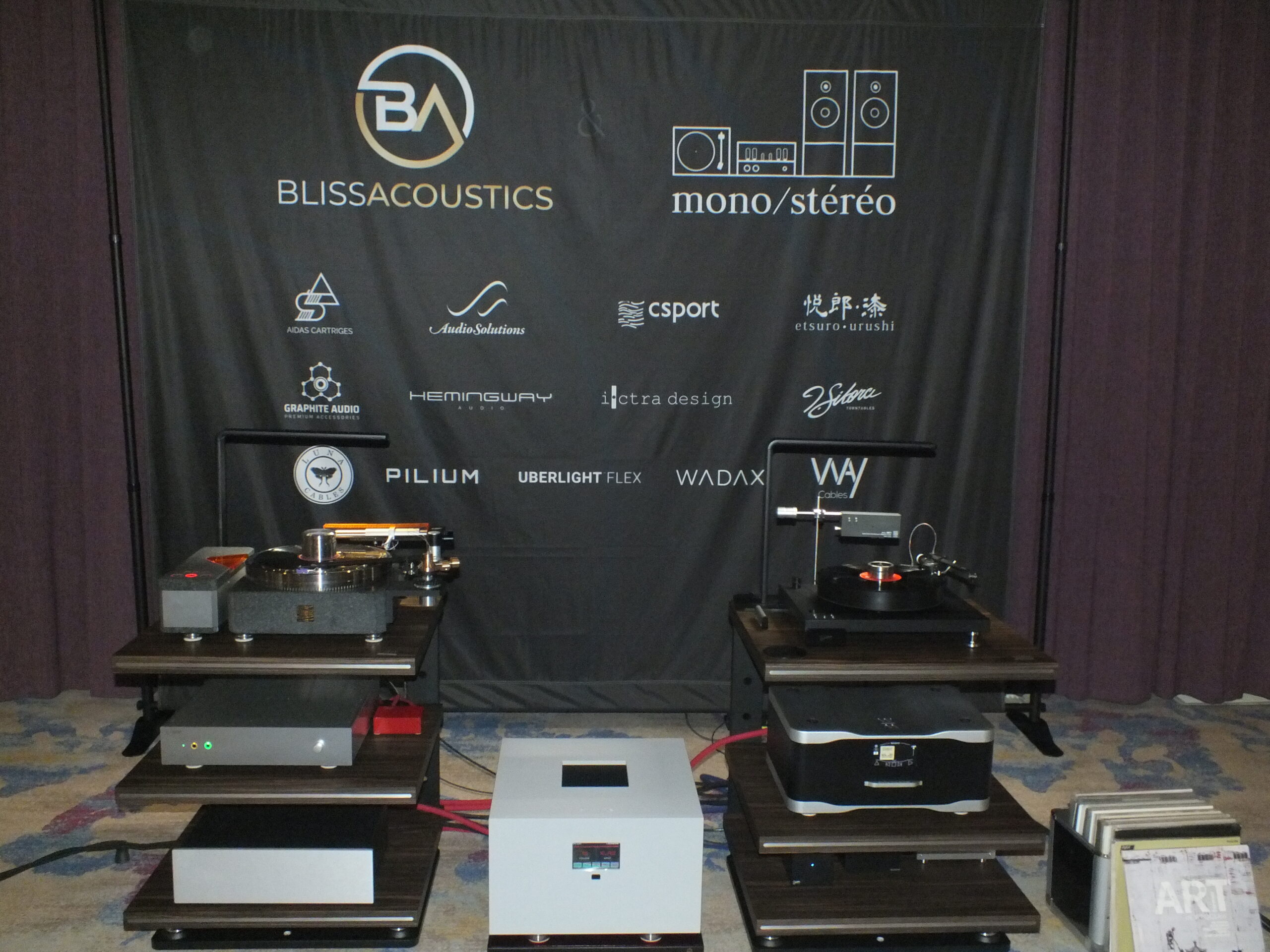
Based out of Ottawa Ontario Canada, Bliss Acoustics brought two turntables to TAF 2025. The first was a Polish J. Sikora Aspire turntable with a carbon-fibre tonearm ($13,600 CAD). The second turntable was a Japanese C.S. Port TAT-1 M2 'table ($42,950 CAD) with a C.S. Port AFU 1-2 linear tonearm ($13,850 CAD).
Bliss Acoustics J. Sikora Aspire turntable
Bliss Acoustics CS Port TT linear tonearm
Combined with a CS Port C3EQM2 battery-powered phono stage ($18,250 CAD) and a several Etsuro M/C cartridges, these two vinyl sources both sounded amazing.
For digital source components, Bliss also brought a Wadax Studio Player ($57,500 CAD), a Synergistic Research network switch ($3200 CAD), and a WAY Mind Intuition X Ethernet cable ($2985 CAD in a 1.5m length).
Bliss used a Pilium Leonidas MY-25 integrated amplifier ($71,000 CAD) to drive a pair of Audio Solution Virtuoso S tower loudspeakers ($58,560 CAD in the custom Martini Racing finish). Featuring a mixture of Hemingway Audio and Luna Audio cables, Ictra Design amp stands and equipment racks, and Graphite Audio isolation platforms, the sound quality of this system was breathtaking.
For more information on Luna Cables, please visit their website HERE.
EQ Audio
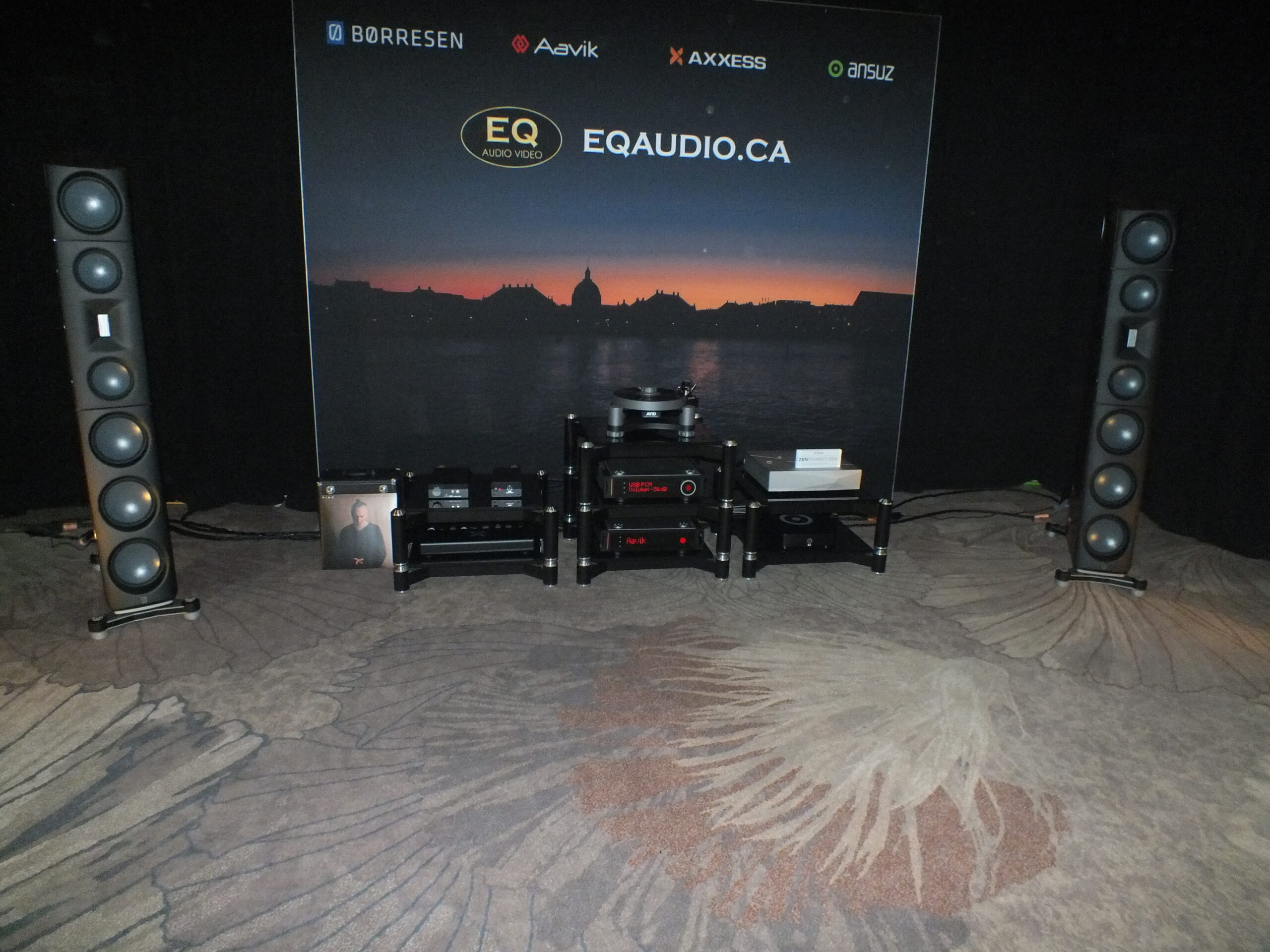
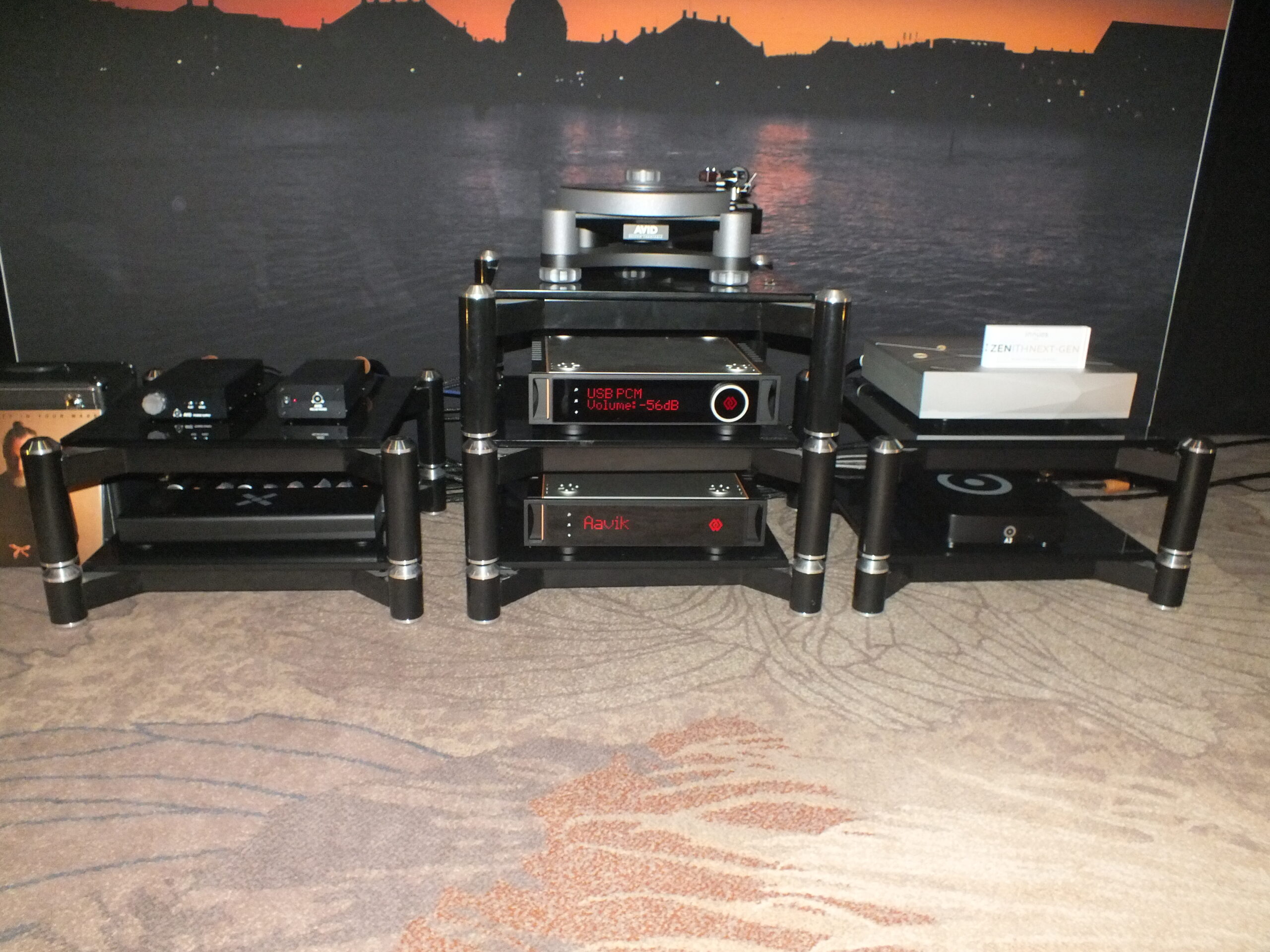
For TAF 2025, EQ Audio from Barrie Ontario, (about 60 miles north of Toronto), brought an Avid Relveo turntable ($16,000 CAD including standard tonearm), an Aavik U288 preamp + DAC + streamer ($41,000 CAD), and an Aavik P288 power amp ($33,000 CAD).
EQ Audio room
Driving a glistening pair of Borresen T-5 Cryo floorstanding loudspeakers, ($212,000 CAD), this 2-channel system had toe-tapping PRaT and deep resolution.
EQ Audio gear
Using a full loom of Ansuz cables, an Ansuz A3 network switch ($5800 CAD), and an Ansuz power distribution filter ($10,000 CAD), EQ Audio's system created wonderful sound.
Up on the 3rd and 4th floors of the Airport Westin Hotel, I walked past many rooms that had… ehm… less than pleasing sound. If the sound out in the hallway is fatiguing, I won't waste my time even entering the room. I truly do not understand why sooooooh many exhibitors think that cranking their stereos up to ear-splitting 120+ dB concert-level volumes is the best way to showcase their equipment, cables, and tweaks. Believe me, it isn't. Suffering through deafeningly loud noise is more like torture than a pleasing musical experience.
I know that I sound like a broken one-note Piano-Saurus, but if you're an exhibitor, please… pull-lease… do your potential customers a sincere favor and stop playing your systems at ridiculously high SPL levels.
Maco Loudspeakers + Whammerdyne
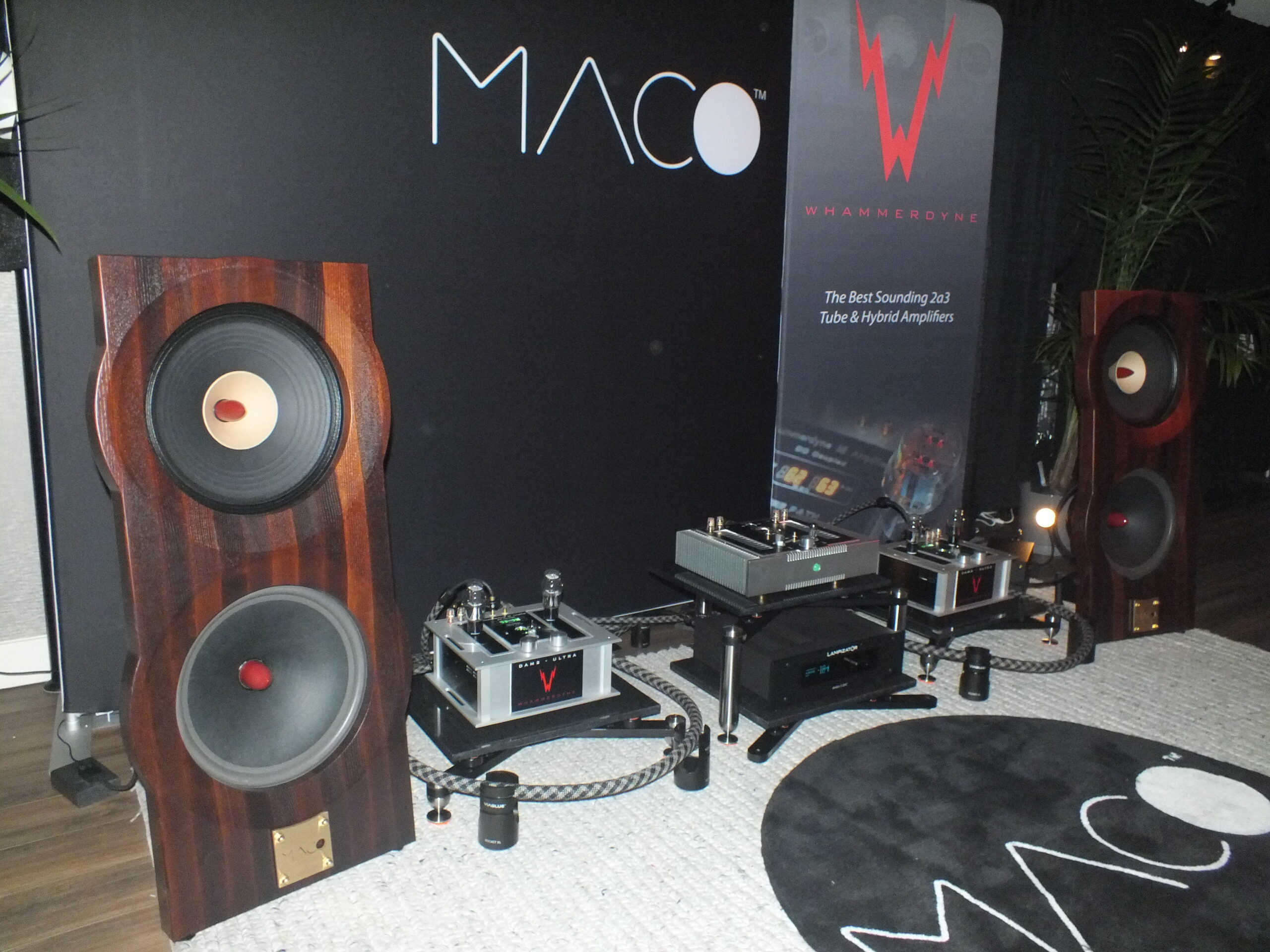
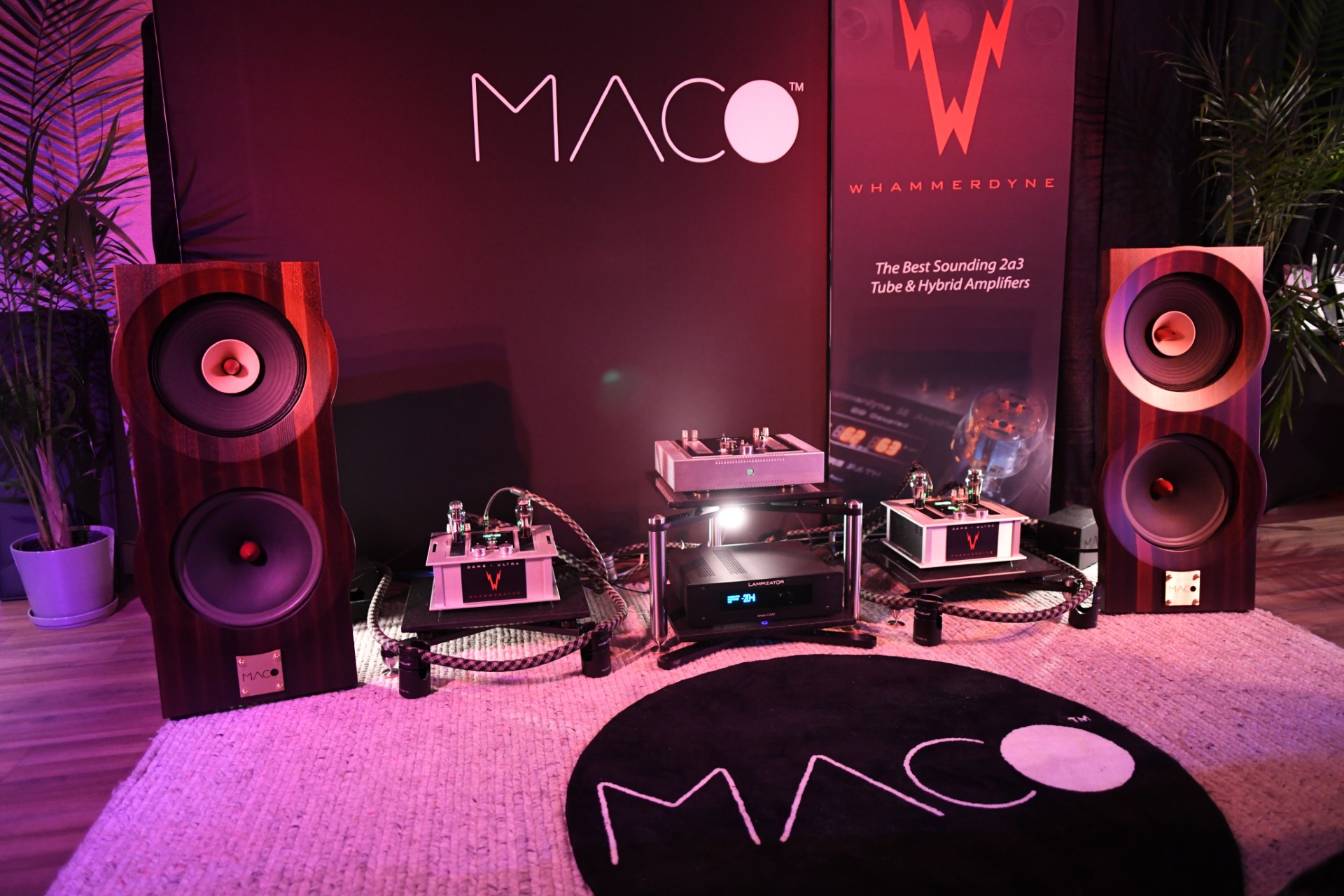
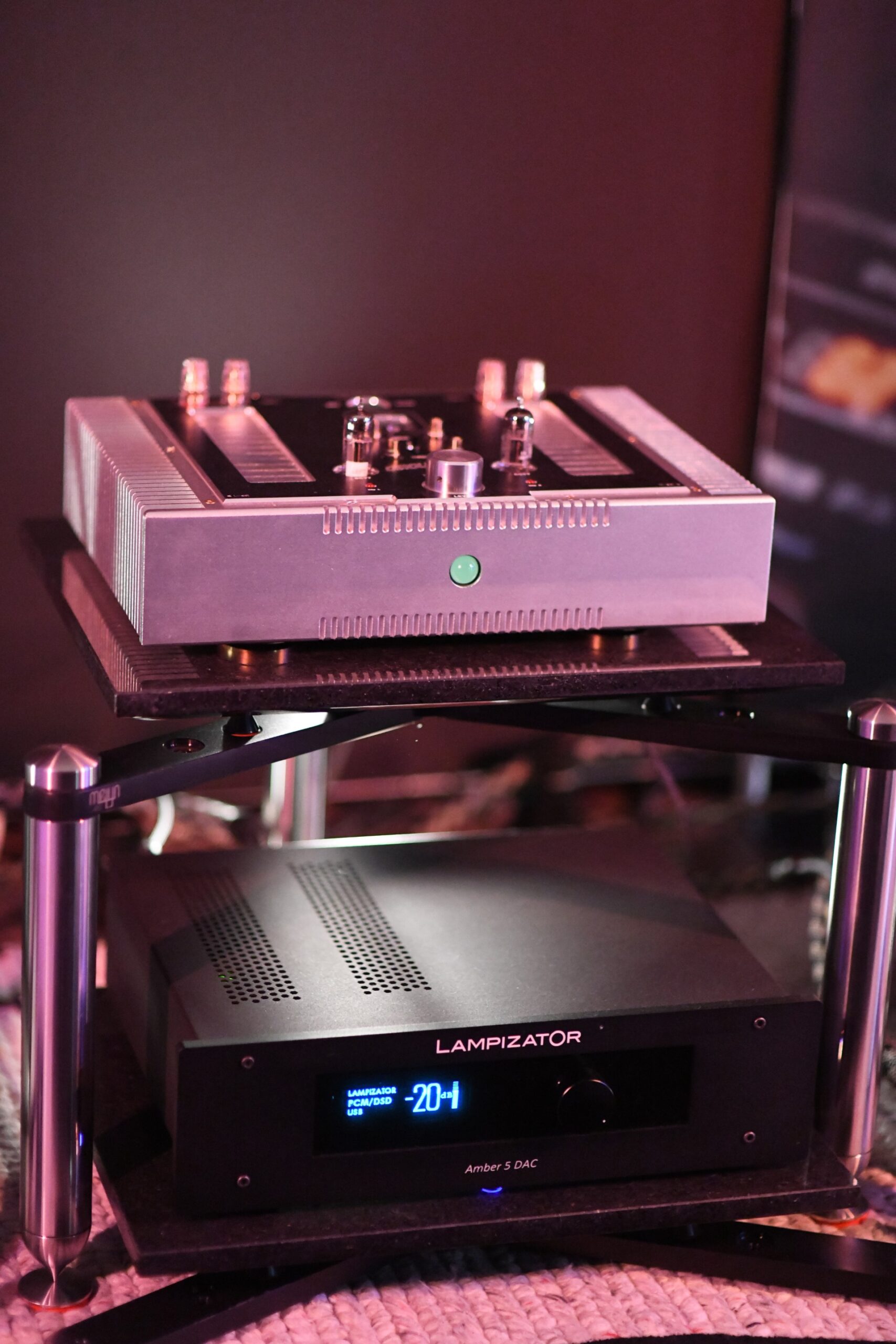
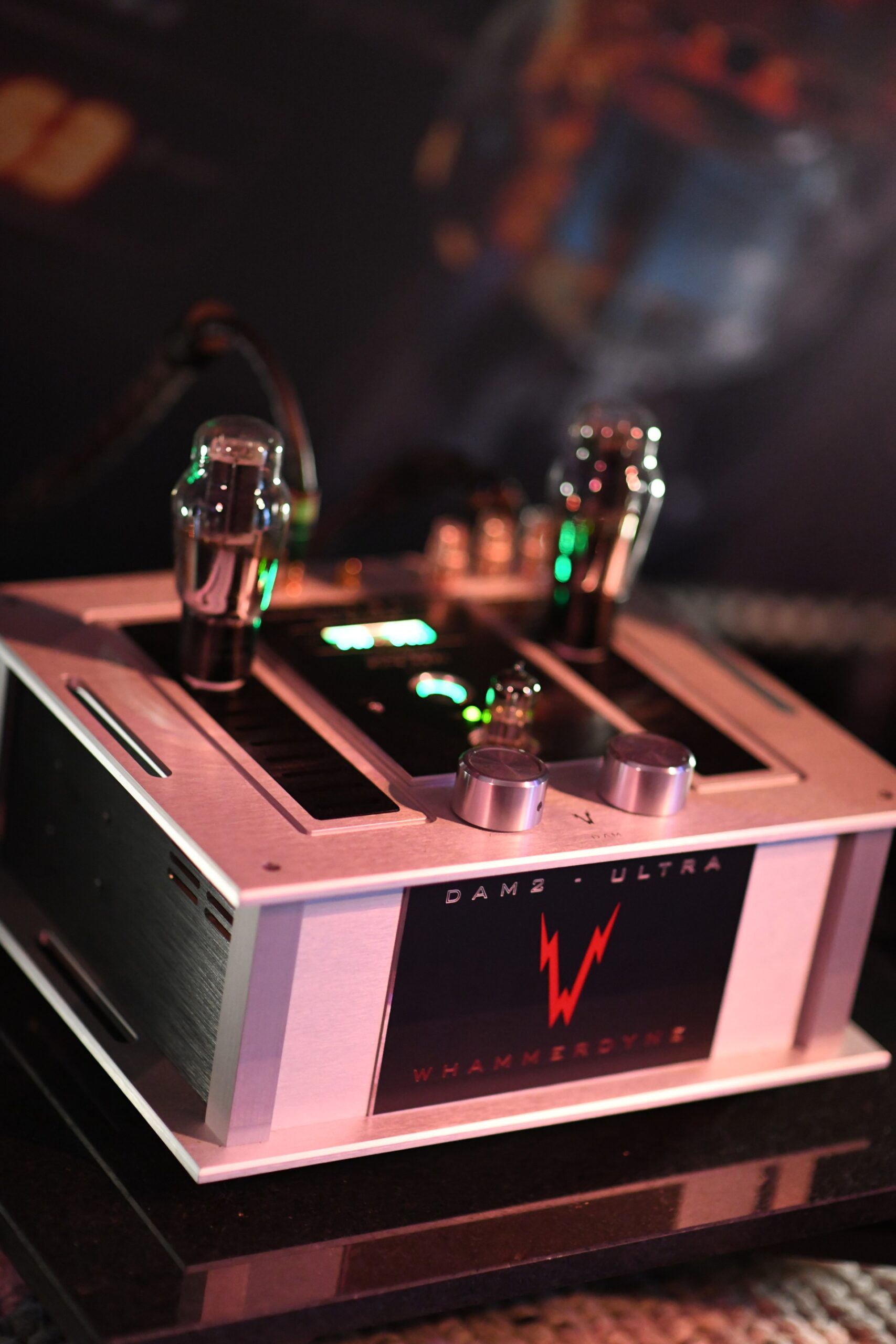
Room 354 featured a pair of Maco Macaria open-baffle loudspeakers ($15,699 CAD) and a pair of Whammerdyne Heavy Industries single-ended triode (SET) DAM-2 Ultra 2A3-based mono-block tube amplifiers ($17,500 USD). Using a LampizatOr Amber-5 ($7000 USD) as a digital source and cabled up with a full loom of German Via Blue cables, this 2-channel stereo easily ranked in my top-3 sounding systems at TAF 2025. Compared to the Whammerdyne + Maco 2-channel system, the sound quality of most of the other stereos at TAF 2025 was drier than a California fire hydrant.
Waco Whammerdyne
Listening to Led Zeppelin's song 'Hairway to Steven'… er… 'Stairway to Heaven', the breathtaking warmth, palpable textures, and immediacy of this lengthy track gave me shivers. The Whammerdyne + Maco system easily won my annual Yennifur Low-Pez 'Big Ass Soundstage' award for 2025.
Maco Whammerdyne
The glowing warmth of the Old School 2A3 vacuum tubes used in Whammerdyne's mono-block amps mesmerized me like a stack of gold bars. These valve amps created the midrange bloom of vintage tube gear with the power and control of the best solid-state amplifiers that I've ever heard.
Maco Whammerdyne gear
As I barnstormed from room to room and floor to floor, I kept hearing audiophiles and music lovers chatting excitedly about that 'Maco/Whammerdyne' room. I even overheard a sight-impaired gentleman being protected by a gentle guide dog and led by a female friend mention something to the effect that he felt that: 'Whammerdyne had the best sound at the entire show'.
If you had asked blind guitarist Jeff Healey (God rest his soul) which stereo system sounded the best, back in the day, you'd likely have gotten a much more accurate opinion on the actual sound quality than from a person with 20/20 eyesight. In theory, there would be nothing—in terms of aesthetics—that would cloud Mister Healey's thinking on the overall sound quality. It (obviously) wouldn't matter what the gear looked like to him. Hearing a blind gent remember a specific room as having the 'best sound at the entire TAF 2025 show' really does say something profound about the sonics of that specific room. And that room was 354: the LampizatOr, Maco, and Whammerdyne room.
Why go to any audio show? Why do this? Stated succinctly, if you love listening to recorded music, there is no better way to see, hear, and possibly even buy such a large volume of components, speakers, cables, and all manner of audiophile tweaks than at the annual Toronto Audio Fest trade show. You can get face-to-face access to the lords and ladies who design and build the high-end audio products that they sell. Learning how good recorded music can sound is worth the price of admission alone. Do make the pilgrimage. Believe me, it's worth doing so.
Today, we are going to take a dive into the performance of the two-hundred-dollar Fosi Audio ZP3 balanced preamplifier, yet another well-built and overachieving device.
And then, we will give it an upgrade, rolling out the OpAmps with the SparkoS Labs SS3602 discrete devices. Spoiler alert! BIG difference!
Today we take a closer look at a new, world-class phono cartridge, the Hyper Analogue Sonic X4.
The Sonic X-4 is the first no-holds-barred cartridge in the Hyper Analogue line. To realize a phono cartridge intended to exceed the performance of all others, EVERYTHING matters.
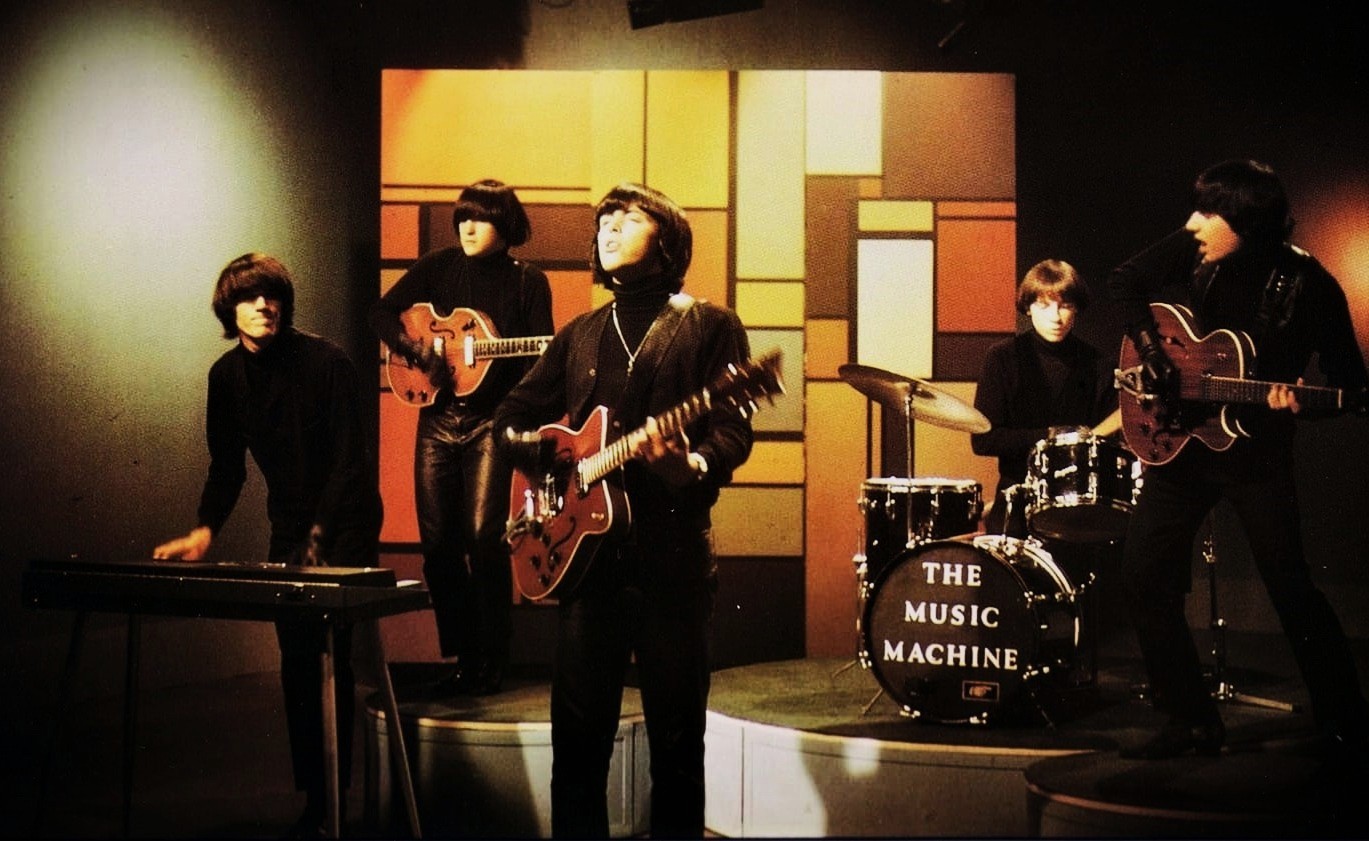
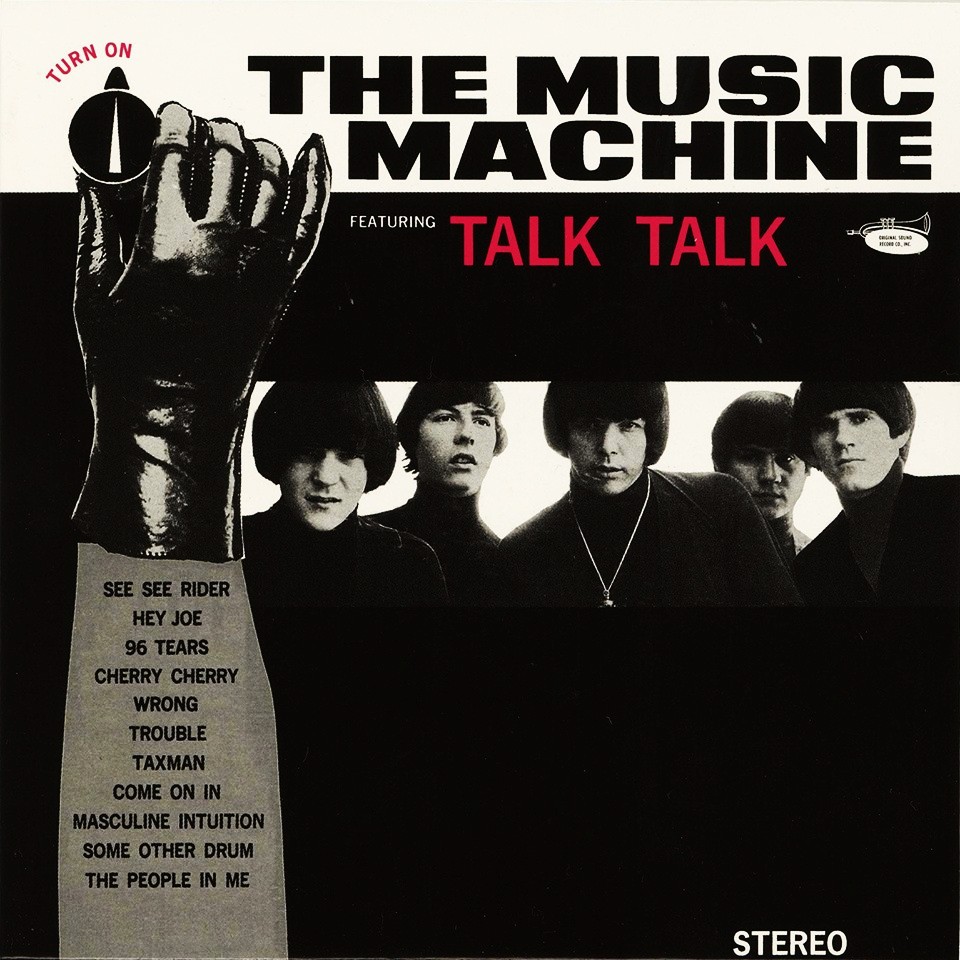
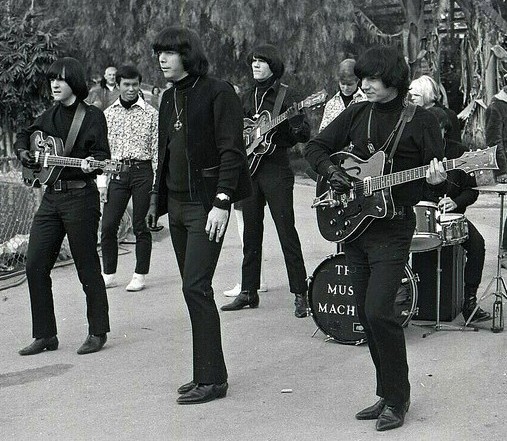
With the exception of a few songs by The Ramones, I dislike punk rock. However, I love punk-like songs from the sixties, the music that some experts now call proto-punk. Examples include The Kinks' "You Really Got Me" and "All The Day and All of the Night," The Who's "My Generation," and The Sonics' "The Witch." In addition to their aggressive style, another thing these songs have in common is they were singles which were later placed into mediocre albums. Mid-sixties rock albums tended to be shoddy. They were mostly slapped together by shirt-and-tie execs who just wanted something ready for the Christmas shopping season. In other words, something with an eye-catching cover that could be sold for more than ninety nine cents! Prior to the Doors' first album, and the Rolling Stones' Aftermath, The Beatles were unique in their ability to create strong albums. Having said all of this, there was a band from Los Angeles, who dressed in matching black clothes, wore matching black gloves, dyed their hair black, and made music that was aggressive, spooky, and sophisticated. And they, meaning the actual musicians, also created a great debut album in 1966 when most bands were struggling to produce two sides of a seven inch single. The band was The Music Machine, and the album was Turn On The Music Machine (Original Sound LPS 8875). Some historians call them proto-punk, while others call them a garage band, or both. To me, they were simply a unique band who created one great album.
Before I tell you about the album, I'm going to tell you how I discovered it. The first time I saw the iconic album jacket was in a used record store in 1979. All I knew from this band was their hit, "Talk Talk," but for $1.99 buying the album was a no-brainer. It was also a stereo copy, and all that remains of it today is the jacket. The record was so scratched and filthy that I'm amazed that I played it, but persevered I did, through loads of surface noise and inner-groove distortion. In the process I fell in love with it. Some time in the mid-nineties, long after I discarded the trashed record, I found it on a CD (Performance Records Perf 397) and that's what I'm reviewing. And, by the way, the sound quality is excellent. And when I say excellent, I'm referring to an undoctored transfer of a mid-sixties master tape. The sound isn't squeaky clean, like a Steely Dan album, nor does it have a glistening soundstage like Love Over Gold, or subterranean bass, like Dark Side Of the Moon. Instead, it has a vintage all-tube sound that you can practically touch. More recently, it's been reissued with the mono and stereo mixes together on one CD. It can also be streamed in undoctored stereo.
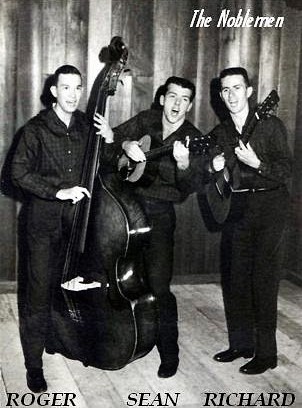
The Music Machine, originally The Raggamuffins, were formed in 1965, and their leader was folk-musician-turned-rock-n-roll shamen Sean Bonniwell (1940-2011). Bonniwell, the very definition of a cult artist, wrote all of the original material on this album, and I'm pretty sure he wrote all of the band's second and final album. The album also has five great covers. If you collect folk records, his name might be familiar. He was a member of a folk quartet called The Wayfarers who made three albums for RCA. Come Along With the Wayfarers (LSP 2666) was their debut from 1963. In the eighties, the album used to sell for one dollar and you could find it wherever used records were sold. I found my copy at my local Salvation Army in the mid-eighties. Seeing Bonniwell's name on a stereo copy (this time in good condition) made it another no-brainer. Unfortunately, the material was sappy and the sound was mediocre, so I didn't keep it. I did, however, keep their superior third album, a live recording called At the World's Fair (LSP 2966). Before The Wayfarers, Bonniwell was in a folk trio called The Noblemen. They never released a record.
The members of The Music Machine were Bonniwell on rhythm guitar and lead vocals, Mark Landon on lead guitar, Doug Rhodes on keyboards, tambourine, and backing vocals, Keith Olson (1945-2020) on bass and backing vocals, and Ron Edgar (1945-2015) on drums. You might know Grammy Award winner Olson's name. He engineered and produced albums by Fleetwood Mac, Pat Benatar, The Grateful Dead, Santana, Foreigner, and Ozzy Osborne, just to name a few. Olson, who built The Music Machine's fuzz boxes, was also a folk musician. He played standup bass with singer Gale Garnett before joining The Music Machine.
The album opens with Bonniwell's best-known song "Talk Talk." The song describes the crumbling of a young man's world because his child was born out of wedlock. The bleak lyrics include "I know it serves me right / But I can't sleep at night / I have to hide my face / Or go some other place." And the lyrics that always stick in my mind: "My social life's a dud / My name is really mud / I'm up to here in lies / I guess I'm down to size." The powerful lyrics are matched by powerful musicianship. Here's a breakdown: It opens with explosive bursts from Rhodes' organ, and tom tom rolls from Edgar. This is quickly followed by more blasts from the organ, a cymbal crash, a slice from the highhat, and Olson's fuzz bass. The explosive intro comes out of the left speaker, setting the mood for what quickly comes out of the right speaker: Bonniwell's frenzied singing. At thirty seconds, also on the right, Olson's fuzz bass returns. At fifty-four seconds, again on the right, is Landon's power-packed lead guitar. At one minute, an aggressively played tambourine also appears on the right, effectively adding more agitation to the agitated mood. In short, this slightly-less-than-two-minutes song packs one of the hardest rock ‘n' punches ever captured on analog tape. The stereo mix, like many intended-to-be-released-in-mono singles from its era, sounds a little crude. The hard left/hard right stereo imagery is sonically akin to the first two albums by The Beatles. I'm a sucker for this sound, but I'm sure the mono mix sounds a little more cohesive. The rest of the album is stereophonically better, and Bonniwell's voice is placed where most people like it: in the center.
The second cut is Bonniwell's "Trouble." Just when you think the music couldn't smack you any harder than the first cut, "Trouble" will blow your mind to smithereens. It brilliantly picks up where "Talk Talk" left off. The lyrics deal with a Bonniwell specialty: mental trauma. He was a troubled soul. He left the music scene in 1969, and wrote a tell-all book in 1996, but more on that later. "Trouble" starts with a powerful buildup that lasts a mere two seconds. A big part of the buildup is Rhodes' ominous organ, which is also heard throughout the song. Landon's lead fuzz guitar is a big part of the song's appeal, and so is Edgar's impactful drumming. The incredibly tight musicianship is something you need to hear, along with Bonniewell's frantic singing. This amphetamine-laced song will make your body twist in ways you didn't think were possible. Do yourself a favor when you play it. Play it loud. And when I say loud, I mean your-neighbors-can-hear-it loud!
Cut three lacks the urgency that's typical of this band's music. It's a reimagining of Neil Diamond's "Cherry, Cherry." Instead of rocking the house down, Bonniwell and company went for a Caribbean sound, and added a flute. It's quite a stretch, but they pulled it off. I'd love to know who the flutist was, but the information is unavailable. It would be an awesome anecdote if the flutist was jazz legend Bud Shank. A year earlier, Shank played the flute on The Mamas & the Papas' "California Dreaming," so it's not impossible. Bonniwell's melodic singing harkens back to his time with The Wayfarers, and the vocal harmonies remind me of The Association. Olson plays an excellent fuzz bass solo which reminds us that they still had the capacity to rock. In short, this is a weird experiment that works.
Cut four is George Harrison's "Taxman." Some artists successfully reimagined The Beatles' songs into their own masterpieces. Examples include Joe Cocker's definitive version of "With a Little Help From My Friends," Stevie Wonder's socially conscious interpretation of "We Can Work It Out," and Sergio Mendes' very danceable reworkings of "Day Tripper" and "The Fool on the Hill." The Music Machine didn't reimagine "Taxman," but like Aerosmith's straight ahead recording of "Come Together," they performed an enjoyable no-surprises performance of a beloved song. It's a head-on assault with two groovy fuzzed-out guitars. This is the only cut where Bonniwell didn't sing the lead vocal. The unidentified lead singer sounds like a teenager from a high school choir, but the band's musicianship makes up for that.
Cut five is Bonniwell's "Some Other Drum." It's the only unplugged cut on the album. Some might see it as bubblegum filler. And that's how I hear it, but I love it anyway. Now that I'm older and a bit wiser, I noticed that parts of the song resemble The Lovin' Spoonful's "Did You Ever Have to Make Up Your Mind," recorded a year earlier. Another similarity to John Sebastian's song is the double-tracked lead vocal. Additional overdubs include a piano, finger cymbals, and an acoustic lead guitar. The song is proof that the innocent folksinger was still a lingering part of Bonniwell's persona.
Cut seven, "The People In Me," is my favorite cut. Bonniwell succeeded in writing one of most power breakup songs ever created, and right now I can't think of a better one. The words "When you see the people in me/Minus you/What will you do" will echo in your head when the album is over. It's menacing, haunting, and mesmerizing. It's also balls-to-the-wall rock ‘n' roll. And holy intermodulation distortion, Batman, Landon's fuzzbox is going to explode! Not to be outdone by Landon is Bonniwell's intense singing, and Edgar's impressive drumming. And like a plush carpet under everything is Olson's super ripe electric bass. If you're not playing air guitar, pounding on air drums, and not playing it freakin' loud, your local morgue has a table waiting for you.
Cut eight is a cover of The Animals' "CC Rider." It's my favorite cover song on the album, and it's also my second favorite cut. "CC Rider," originally "See See Rider Blues," was first recorded by Ma Rainey (1886-1939) in 1925. She also wrote the song, but her record sounds nothing like the rock classic. This seems to be a pattern with rock songs based on old blues records, and I cite Cream's cover of Skip James' "I'm So Glad" as another example. I could have described it as The Music Machine's interpretation of a song that's been covered by many artists. However, their template is the single by The Animals. And I learned it from The Animals, but as much as I love them, I haven't felt the desire to play their version since I discovered The Music Machine. And it's not because Bonniwell sings better than Eric Burdon (that would be impossible); they just play it so much better! Compare the two for yourself. With Edgar's viciously pounded skins, Rhodes' pumping organ (it's a Farfisa organ), and Landon's screaming lead guitar, you won't find a better performance of this song anywhere. You can practically see the sweat rolling down Bonniwell's face while he sings. If your foot isn't tapping to the beat, seek medical help. And, by the way, this isn't a Haydn string quartet, so honor the band with some respect. Crank it up!
Cut nine, "Wrong," is a frantic song about being wrong, when you thought for sure you were right. We've all eaten crow, but as adults we learn and move on. But Bonniwell wasn't one to surrender. He knows he's wrong, and he's having such a tough time dealing with it that he wrote a song. In this song he turns that crushed feeling into rage. His lyrics, his maniacal singing, the menacing backup vocals, and the band's frantic playing creates a rip-roaring flood of emotion. And the energy is so powerful that you won't be able to resist it! Rhodes' pulsating organ, Landon's fast guitar playing, and Edgar's ever-intense drumming add fuel to Bonniwell's utter madness. Noteworthy is Rhodes' masterful tambourine playing. (The Tambourine had to be an overdub, but you'd never know it.) If your listening chair lacks a seatbelt, hold onto it tightly!
Cut ten is a great performance of "96 Tears." It would be impossible to improve upon the original by ? (Question Mark) And The Mysterians, but hearing it performed by The Music Machine is a blast. They open the song with a short introduction of their own. A stark contrast to the the original is the use of a fuzz guitar and a fuzz bass. The original relied heavily on Frank Rodriguez's Vox Continental organ, while Rhodes' used his Farfisa. The original featured the tenor voice of Rudy Martinez, while The Music Machine has Bonniwell's baritone. All of these factors contribute to an appealing but different flavor of the classic song. Thanks to The Music Machine, you can have 192 tears instead of the old 96! The stereo imagery is fantastic: The instruments are beautifully focused. During the intro Olson's bass bass on the left, but quickly he's panned to the middle. The drums are also on the left, Bonniwell's voice and the organ share the middle, and the lead guitar is on the right.
Cut twelve, the closing cut, is a uniquely slow and brooding version of "Hey Joe." What will be interesting to some is that The Music Machine released their slow "Hey Joe" eight months prior to the release of The Jimi Hendrix Experience's debut album, Are You Experienced?. Prior to these two recordings, "Hey Joe" was traditionally a fast song; The best examples are the recordings by The Leaves and Love. In the mid-sixties, recording "Hey Joe" was a rite of passage for American garage bands. The Music Machine's slow tempo was a break from normality, and to my ears they lack some of the magic that makes the Hendrix version more enjoyable. But I've heard more versions than I care to count, so I'm guessing that readers will love it. It's really spooky.
The Music Machine were ahead of their local competition in one area: Their tight musicianship. The Byrds were better at vocal harmonies, and their collective songwriting provided us with timeless songs, although it took them a few albums to create them. And until their fifth album, they were sloppy musicians. Prior to The Doors, the only Los Angeles band in my record collection that featured the musical chops of The Music Machine was Love. But Love's talent was crumbling by their second album. And by their third album, the celebrated Forever Changes, they needed help from studio musicians, like bassist Carole Kaye and drummer Hal Blaine. Turn On The Music Machine didn't require outside help.
I couldn't help but wonder what Mark Landon did after leaving The Music Machine in 1967. From 1969 to 1971 he was the touring guitarist for The Ike & Tina Turner Revue. However, despite his work for the dynamic duo, there is no evidence that he played on their records. Later, he became an Emmy Awarded makeup artist. His work includes The Young and the Restless and Roseanne. He is not related to actor Michael Landon.
Along with Landon, Doug Rhodes left The Music Machine after a promotional tour for their debut album. Bonniwell became too much of a control freak. He played in a number of bands, and he did some studio work. Here's an interesting piece of history: He played the celeste on The Association's "Cherish." In 1971, he moved to Victoria, British Columbia, and became involved in traditional jazz and klezmer music.
Articles about Bonniwell are becoming fewer as time goes on. This is sad. Prior to his death in 2011, his residence was a one room apartment in Visalia, California. I've had zero luck finding his book. Regarding the music he made after the band's debut, they or he (depending on your interpretation) released a second album in 1968, The Bonniwell Music Machine (Warner Brothers WS 1732). Part of the album features members of The Music Machine, while the rest features a different band. It's been reissued in various forms, including a Sundazed CD called Back To The Garage. On numerous occasions I've attempted to enjoy songs from the second album, and I failed every time. According to various sources, including Landon, Bonniwell penned enough songs to fill the debut album. Allegedly, their producer forced them to record covers. But were they forced to play those same covers on stage? I doubt it. I saw a setlist featuring the same covers they recorded. Also, I love the covers on the album, especially "CC Rider" and "96 Tears." I think the album would be inferior without them.
This is a great album heard as a whole. Here's some advice to my streaming friends: Let the whole thing play. Pour yourself some bourbon, or a cup of coffee, and swallow the whole thing. It's wonderful!
Orange, CA - December 2025 - ELAC, a global leader in high-fidelity audio solutions, proudly announces the launch of the ELAC NAVA100, a portable Bluetooth speaker that brings 100 years of sound innovation into a compact, modern form. Designed for music lovers on the move, the NAVA100 delivers premium ELAC sound in a beautifully crafted, take-anywhere design.
Inspired by ELAC’s maritime heritage in Kiel, Germany, the name NAVA reflects movement, exploration, and freedom. Just as a vessel carries you across waters, the NAVA100 carries your music wherever life takes you.
“The NAVA100 embodies ELAC’s heritage while answering the way people listen today - portable, powerful, and beautifully designed,” said Joe Riggi, President of ELAC Americas Inc. “It’s more than just a speaker - it’s Music in Motion.”
Adding a design forward twist, ELAC partnered with New York-based label Adsum to create the Adsum × ELAC Cream Edition. Finished in a soft cream colorway, it combines audio excellence with minimalist style, appealing to collectors and design conscious listeners alike.
NAVA100 Features: Compact Form, Big Sound
Premium ELAC Sound – 3” full-range driver with dual passive radiators for deep bass and clarity.
All-Day Battery – Up to 15 hours of playtime at 25% volume, 6 hours at maximum.
Dual Play – Pair two units together for immersive stereo playback.
USB-C Fast Charging – Quick recharge in just 2 hours at 1.5A.
Classic ELAC Black – timeless and premium.
Adsum × ELAC Cream Edition – an exclusive co-branded design for collectors and style-conscious listeners.
Portable Design – Compact footprint (150 × 78 × 128 mm) and lightweight at 1.4 kg, built to move with you.
Two Editions Available
Pricing and Availability
The ELAC NAVA100 will begin shipping December 10, 2025 at an MSRP of $229 USD, available through ELAC.
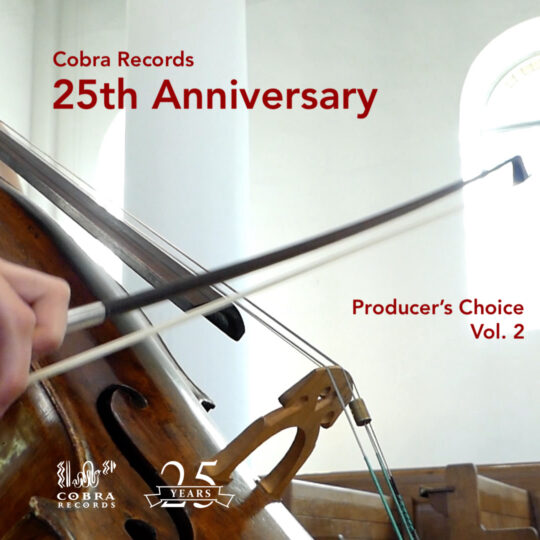
Producer's Choice, Vol. 2. Cobra Records 2025 (Pure DSD256-Direct Mixed, Stereo) Edit Master Sourced (To be released December 12 at NativeDSD)
Cobra Records' 25th Anniversary celebration continues with the release of Producer's Choice, Volume 2. And it is phenomenal.
Earlier this year, I wrote with enthusiasm about the release of Volume 1 which included selected tracks recorded in DSD64, all from albums released before the introduction of DSD256, HERE, and with an early preview and free sample download HERE
For Volume 2, Tom Peeters has selected from later albums, all of which were recorded in DSD256. Tom made the change to DSD256 when he switched to using a Merging Technologies' Hapi A/D converter following the release of DSD256. But, it was not possible to mix DSD256 tracks at the time, so the originally released albums were mixed in DXD (PCM 352.8kHz/24-bit) and then converted to DSD256 after mixing. Now it is possible to mix purely in the DSD domain. And that is what we have here.
As in in Volume 1, Tom has pulled from his archives the original tracks, this time DSD256 tracks, and collaborated with Tom Caulfield at NativeDSD to re-mix them in Pure DSD256-Direct Mixed using HQ Player Pro, per instructions from Tom Peters.
And the results? Oh, the results are just immensely gratifying. Across the board there is a greater transparency, greater clarity, and more natural sound in these new Pure DSD256-Direct Mixed remastered tracks. Do the originals still sound good to my ears? Yes, they do. And, depending on your audio system's resolution and transparency, you may or may not hear a difference—I can't guarantee you will. But in our household, in both our primary system and in Ann's office system, the sound quality improvement just makes us want to stand up and cheer! This is what recordings of acoustic instruments played in a natural acoustic environment can and should sound like.
I asked an astute audio listening friend of mine to listen to a track from the new Producer's Choice album and compare it to the original release (the same tracks provided in the free sample download below). He listens over speakers and I wanted to get his assessment of the sound stage he heard in the new Pure DSD256 re-master. His comment:
"The differences to me are plainly evident. The sound stage seems suspended in front of me with the Pure DSD256 mastering. And the castanets in the right channel are right there. The sound is very fluid. The DSD256 file converted from the DXD edit master sounds more two dimensional and less natural in comparison."
But don't take our word for it. Listen for yourself.
Tom Peeters has graciously given us permission to share a sample track so you can hear in your own audio system the difference between the same track mixed and mastered in Pure DSD256-Direct Mixed versus mixed and mastered in DXD and then output to DSD256:
The track Tom selected for this comparison is Track 5, "Fuentes si naceis" from the album Muy hermosa es María, by Música Temprana (COBRA0068). Of this track, Tom commented: "It's a very interesting setting of instruments (guitar, harp, violone, dulcian, organ), double choir, and soloists all over the ensemble. Musica Temprana demonstrates again the flexibility between complete blend of voices/instruments and the distinguished solos. It’s a very rich colorful palette of sounds, but always transparent."
Of course for more samples, consider adding the Producer's Choice, Vol. 2 album to your music library. You will then be able to hear Pure DSD256 samples from over a dozen Cobra Records albums. Hopefully Tom will start working his way through the extensive Cobra Records catalog remastering and re-releasing the full albums.
The Cobra Records catalog contains many recordings that are favorites in our household. Tom works with some terrific musicians. We are always excited by the albums released by Cuarteto Quiroga, The Hague String Trio, Música Temprana, Nuala McKenna, Lisa Jacobs, Pauline Oostenrijk, and Enno Voorhorst, among others. These are superb musicians performing varied, and sometimes seldom performed, works of distinction. The albums produced typically have a story to tell, and the artists are always passionate about the music they've selected to perform. Cobra Records is a label well worth your time to explore, just take a look here. I think you'll find your adventures most rewarding—Ann and I certainly do.
Can you tell that I am excited about the possibilities this Producer's Choice album opens? Yes, indeed. I have visions in my head of Tom re-mixing some of his full albums in Pure DSD256-Direct Mixed and re-releasing them. It also opens hopes that some other producers who have original DSD256 tracks in their archives may follow Cobra's lead in similarly remixing and re-releasing some of their albums in Pure DSD256-Direct Mixed. Several labels come immediately to mind.
Importantly, I am excited by this Producer's Choice release because it portends the greater possibility that other producers will begin choosing to release albums in Pure DSD256, whether direct mixed or analog mixed. Positive Feedback's Editor-in-Chief, Dr. David Robinson, has often opined that we live today in the golden age of audio. I believe that is true, and ever more so with the advent of releases like the Producer's Choice, Vol. 1 and 2 albums Tom Peeters has given us.
Thank you, Tom. And congratulations once again on your 25th Anniversary of giving us exceptional recordings of excellent artists and music. I am very grateful for the listening enjoyment you've given me over the years.
Saturday, December 13th | 6:30–9:30 P.M. | Skokie, Illinois
Musical Artisans is pleased to announce its annual Fall Event, taking place on Saturday, December 13th, from 6:30 to 9:30 p.m. The evening will feature five significant product introductions and presentations from three distinguished guests: Robert Auer of Auer Acoustics, Timo Engström of Engström Audio, and Vassil Strachnikov of Taiko Audio. Food and beverages will be served. Due to limited space, guests are asked to RSVP to [email protected].
This year’s event will highlight a curated selection of ultra–high-end audio components, including Argento Audio cables, Auer Acoustics loudspeakers, Engström’s flagship preamplifier and monoblock power amplifiers, the latest digital components from Metronome Technologie, and state-of-the-art music servers from Taiko Audio.
Argento Audio will debut the new Flow Ultima signal and power cables, recipients of The Absolute Sound’s prestigious Product of the Year Award. These superb signal and power cables hold two world patents for their innovative connector-less architecture, in which the end of each conductor serves as its own termination. Each cable is fully carbon-shielded, built entirely in-house—including zirconium-ceramic fasteners—and employs only a single metallic element: ultra–high-purity (6N) silver.
Auer Acoustics will demonstrate their Versura V2 and V4 loudspeakers, featuring the brand’s distinctive Tankwood cabinetry. This stabilized natural material offers exceptional resonance behavior and structural integrity, forming the foundation of Auer’s design philosophy. The Versura line combines Bliesma’s reference diamond tweeter with select ScanSpeak transducers, supported by precision crossover networks built with extremely tight tolerances. The result is a loudspeaker architecture focused on tonal purity, dynamic poise, and natural musical flow.
Taiko Audio will showcase their acclaimed Extreme Music Server alongside their new flagship, the Olympus Music Server, equipped with the highly praised I/O module.
Metronome Technologie will present the AQWO2+, an elegant and versatile CD/SACD player, streaming endpoint, and DAC with selectable tube and solid-state output stages. The system will be paired with the Elektra external reference power supply for maximum performance.
Musical Artisans looks forward to welcoming guests for an evening of exceptional sound and world-class craftsmanship.
A flagship-level USB DAC, A New IEM collaboration with VOLK Audio, and ACTIVO’s latest in-ear monitors highlight the year’s finale
Astell&Kern, a global leader in high-resolution audio players and accessories, announces the debut of three new products created to elevate listening across every category: STELLA, a flagship in-ear monitor developed in collaboration with VOLK Audio and GRAMMY-winning mastering engineer Michael Graves; AK HC5, a next-generation USB DAC cable that brings Astell&Kern’s flagship DAC architecture to a compact form; and ACTIVO Scoop, an all-new multi-driver IEM shaped by the brand’s pursuit of deeper, smoother, more natural sound.
Together, these products represent the latest evolution of Astell&Kern and ACTIVO’s mission to deliver truth in sound through precision engineering, acoustic innovation, and refined industrial design.
Astell&Kern fans can experience all three products in person from 13–14 December 2025 at Potafes Akihabara in Japan and the 2025 Guangzhou Headphone Show in China.
All three products will be available for purchase at authorized Astell&Kern retailers worldwide in late December 2025/early January 2026.
Astell&Kern AK HC5: Compact Form, Complete Perfection
The new AK HC5 sets a new benchmark for USB DAC performance, delivering flagship-grade sound in an ultra-portable form. Featuring the AK4499EX DAC, a component previously found only in Astell&Kern’s top-tier DAPs, paired with the AK4191EQ digital processor, the HC5 perfectly separates digital and analog stages, minimizing noise and revealing extraordinary detail.
Borrowing Astell&Kern’s High Driving Mode from the SP4000, the HC5 uses a horizontally arranged OPAMP architecture to deliver high-output driving power, greater density, and dynamic depth. A dual noise-shielded cable structure ensures clean, stable signal transmission, while a 1.62-inch OLED display and 150-step volume wheel provide precision control and elevated usability.
With support for DAR (Digital Audio Remaster), six DAC filters, and UAC 1.0/2.0 for wide device compatibility, including gaming consoles, the AK HC5 brings uncompromising Astell&Kern performance to any smartphone, laptop, gaming, or portable device.
The AK HC5 will retail for $450 (US pricing TBD).
Astell&Kern × VOLK Audio STELLA: The Single Pursuit of Truth in Sound
STELLA is the culmination of three disciplines guided by a single pursuit of truth in sound:
Astell&Kern, representing the precision of modern engineering
VOLK Audio, defining the architecture of design and acoustic form
Michael Graves, the five-time GRAMMY Award–winning mastering engineer who understands the line between control and emotion
Built on a 12-driver quadbrid system with a 6-way crossover network and five precision sound tubes, STELLA unites four transducer technologies — dynamic, balanced armature, planar magnetic, and electrostatic, into one coherent acoustic architecture. Each component was developed for its distinct role and tuned through precise control of phase, pressure, and motion to achieve tonal accuracy, spatial coherence, and full-spectrum balance.
Machined from 6061-T6 aluminum, combined with a stainless-steel faceplate frame and 9H sapphire crystal, the chassis reflects the same discipline that shapes its sound: nothing decorative, nothing redundant. Every contour, cavity, and vent exists to preserve acoustic integrity.
STELLA represents an unprecedented collaboration where engineering, design, and artistry converge into an instrument meticulously crafted for mastering-level precision yet deeply engaging for personal listening.
The Astell&Kern × VOLK Audio STELLA will be available for $3,900.
ACTIVO Scoop: Deeper. Smoother. More Natural.
ACTIVO, the audio brand by Astell&Kern, focuses on promoting an active lifestyle, with music as the companion on your journey. With ACTIVO, music isn't just a background; it's the force that propels your life forward.
Shaped by the belief that great sound should feel effortless and fluid, ACTIVO Scoop introduces a new approach to multi-driver in-ear design. Inspired by the gentle, polished form of a pebble, Scoop pairs its smooth exterior with an equally refined acoustic core.
A 3DD + 2BA configuration, featuring a single 8mm dynamic driver, dual 6mm dynamic drivers, and dual balanced armatures, delivers a natural, resonant sound signature from rich, full-bodied lows to crisp, articulate highs. A proprietary internal acoustic port and a dedicated terminal-stage circuit ensure seamless driver integration and clean, stable performance.
Its premium hybrid cable (silver-plated copper + OFC) enhances signal transmission and durability, while universal connectors (3.5mm, 4.4mm, USB-C) allow effortless compatibility with audio players, smartphones, and laptops.
Designed for comfort, tuned for fluidity, and crafted for all-day listening, Scoop brings ACTIVO’s philosophy of deeper, smoother, more natural sound to a broader audience.
The ACTIVO Scoop will be available for $80 (US pricing TBD).
STELLA, AK HC5 and ACTIVO Scoop will be available for purchase at authorized Astell&Kern dealers worldwide.
Crafted in Denmark, Engineered for Musical Truth
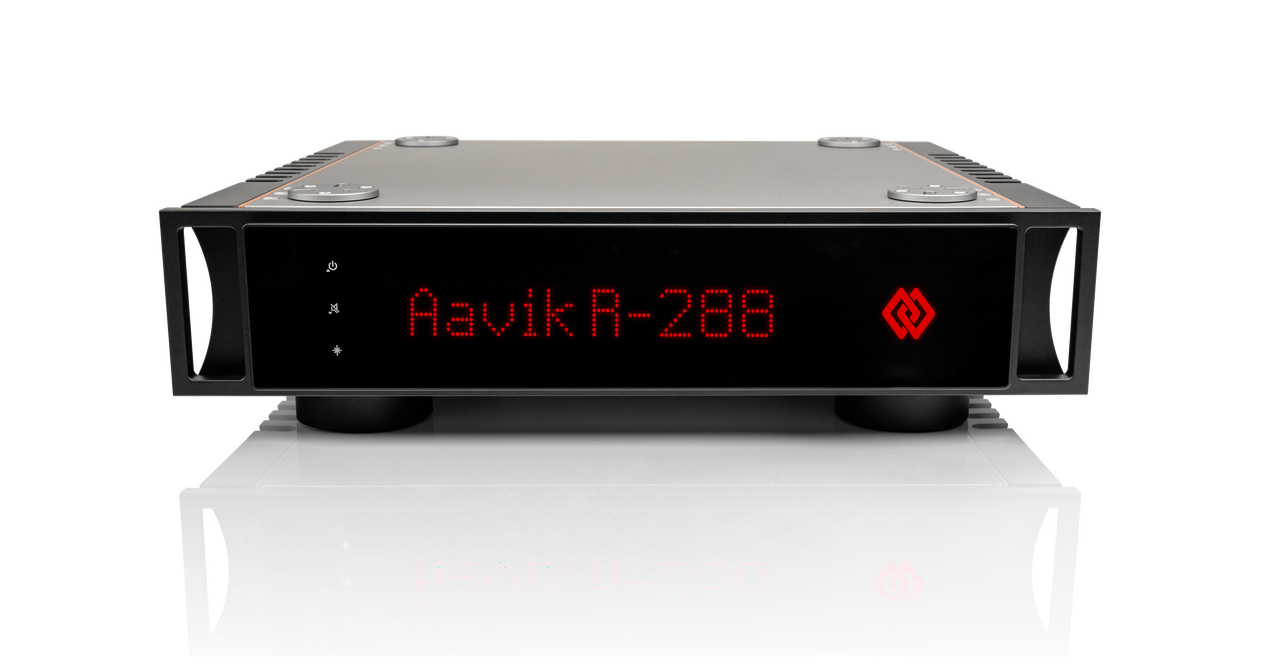
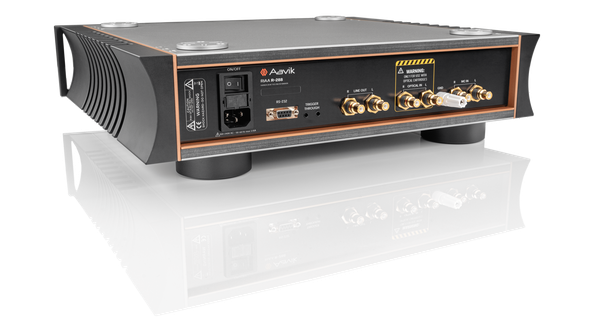
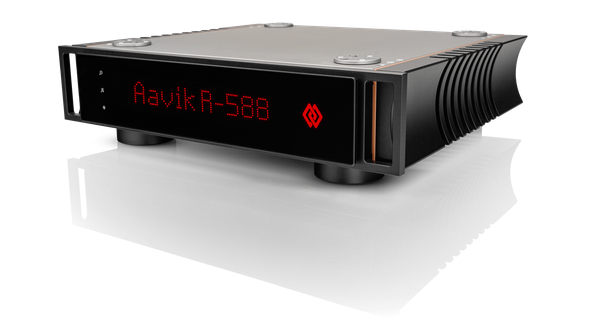
Aavik proudly introduces the new R-x88 phono stage series, a culmination of decades of engineering innovation and musical passion. Drawing inspiration from the acclaimed Aavik R-880 reference model, this series brings reference-level analog performance to a broader audience — designed for both Moving Coil (MC) and DS Audio optical cartridges in one elegant enclosure.
Pure Musicality, Advanced Engineering
At Aavik, everything begins with the music. The R-x88 series has been meticulously developed to deliver an authentic, noise-free signal path, preserving every nuance of the original recording. Each model — R-188, R-288, and R-588 — embodies our vision of creating uncompromising phono stages that combine cutting-edge technology with refined Danish design.Made in Denmark Each Aavik R-x88 is handcrafted in Aalborg by highly skilled technicians, combining in-house production with carefully selected Danish and international partners. This synergy ensures uncompromising quality and reliability.
KEY TECHNOLOGIES NOISE REJECTION
Integrated Ansuz Active and Square Tesla Coils, Analog Dither Circuits, and Anti-Aerial Resonance Coils work in synergy to ensure an exceptionally low noise floor and outstanding signal purity.
VERSATILITY
Supports both MC and optical cartridges with precise gain and filter adjustments, offering unmatched flexibility.
RESONANT-MODE POWER SUPPLY
Custom DC/DC converters generate clean, sine-wave voltages with ultra-low noise and minimal distortion, providing a stable foundation for superior sonic performance.
REMARKABLY LOW NOISE FLOOR
The Aavik RIAA section features a discrete input stage built around ultra–low-noise bipolar transistors, which paired in parallel create an exceptionally quiet circuit, achieving a signal-to-noise ratio of 94 dB measured at 1 kHz. The input stage for Moving-Coil (MC) cartridges is also topologically balanced and floating, so not connected to ground.
ADVANCED CIRCUIT DESIGN
The flagship R-588 incorporates Aavik’s discrete operational amplifiers and independent voltage rails, achieving remarkable resolution, dynamics, and transparency.
CABINET CONSTRUCTION
Designed by Flemming Erik Rasmussen and Michael Børresen, the hybrid enclosure combining wood, copper, and steel offers exceptional resonance control and structural stability, complemented by a striking visual appeal.
MSRP (Prices may vary by market): Aavik R-188: € 15.000 | Aavik R-288: € 20.000 | Aavik R-588: € 25.000
For more information, please contact: [email protected]audiogroupdenmark.com
After a year of hiatus from reviewing, I'm thrilled to return with a series of three reviews that will highlight significant changes to my system.
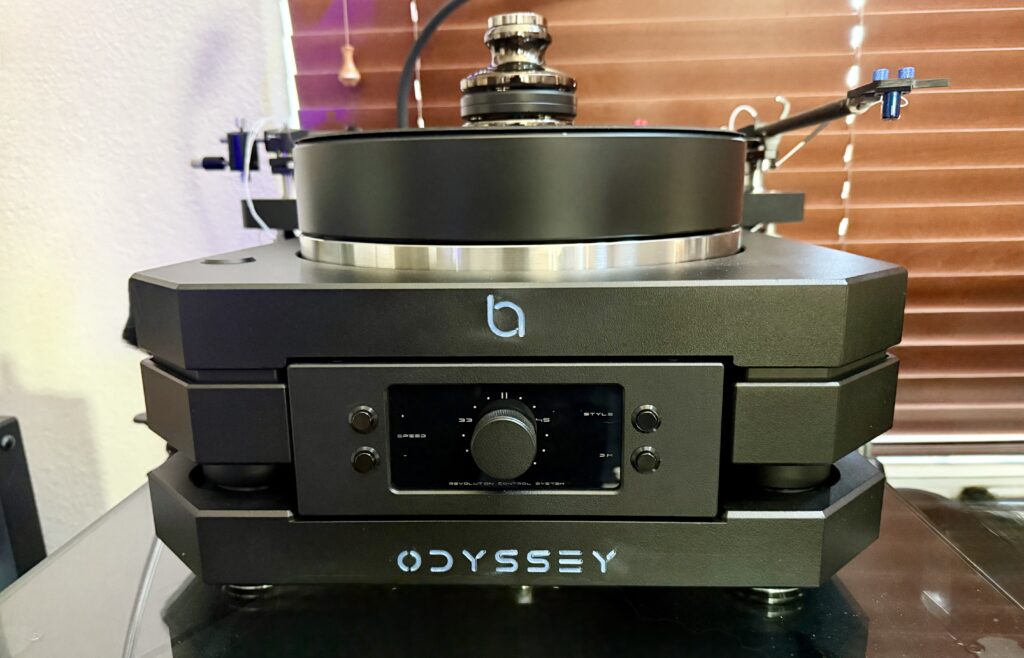
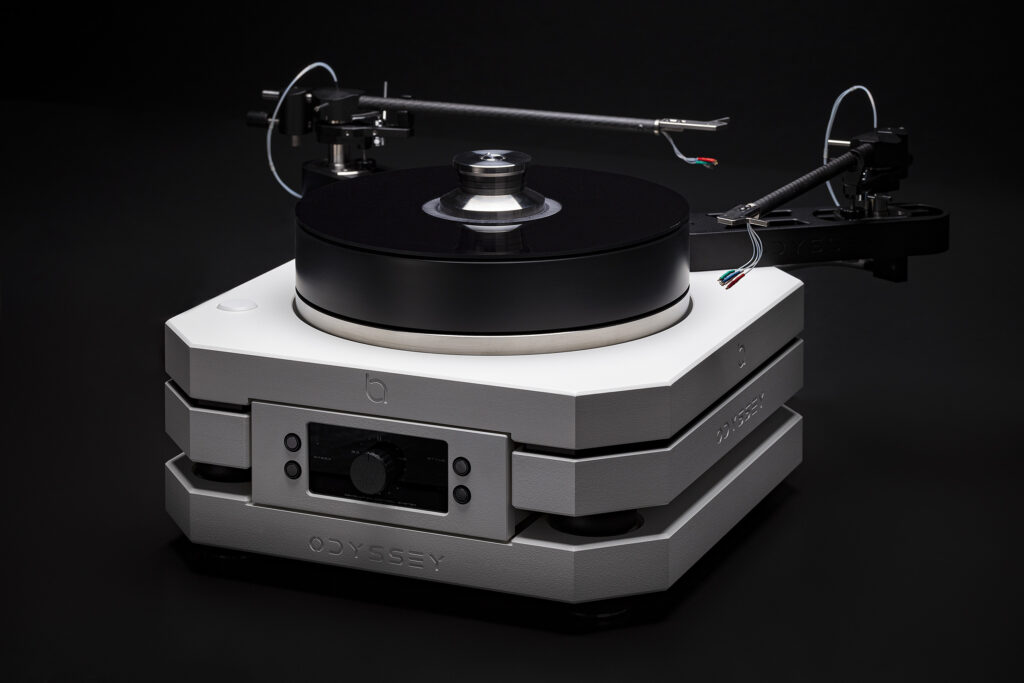
My system is now anchored by the finest Cary Audio amps and preamp, including the SLP-5 preamp and the 211 Founder's Edition Power amps. (I replaced my 805C amps and SLP98 Preamp.) To this foundation, I've added the Odeon Carnegie horn speakers and the newly introduced Benny Audio Odyssey Turntable, which has just entered the US market.
Let's delve into the first of these three additions: the Benny Audio Turntable. This is my personal turntable. Crafted in Poland by the talented designer Thomasz Franielczyk, Benny Audio manufactures two turntables: the entry-level Immersion II and the subject of this review, the extraordinary Odyssey. I've been using this turntable for nearly a year, and it will remain an integral part of my system until my passing!
I firmly believe that unless Thomasz can create something even more exceptional, I'll never use another turntable in my life. While I'm certain that there will be minor improvements (two have already arrived), I firmly believe that this turntable is already an incredible piece of engineering.
This belt drive turntable features two plinths, a three-piece platter consisting of a two-piece main platter and a drive platter, and is relatively easy to assemble. Thomasz meticulously packs all the parts into two flight cases, and the foam surrounds are clearly labeled. The assembly process is straightforward. However, it's important to note that ease of assembly does not imply ease of lifting. This turntable is quite sturdy. It weighs a hefty 130 lbs, but thankfully, it's broken down into manageable parts. Nevertheless, it can still be a workout for the arms and legs (if lifted properly).
Start by leveling the bottom plinth with the included bubble level. Then, place the bearing assembly and the drive platter on top. Next, install the independent drive motor and thread the belt. Finally, place and level the top plinth. (That's at least how I do it.)
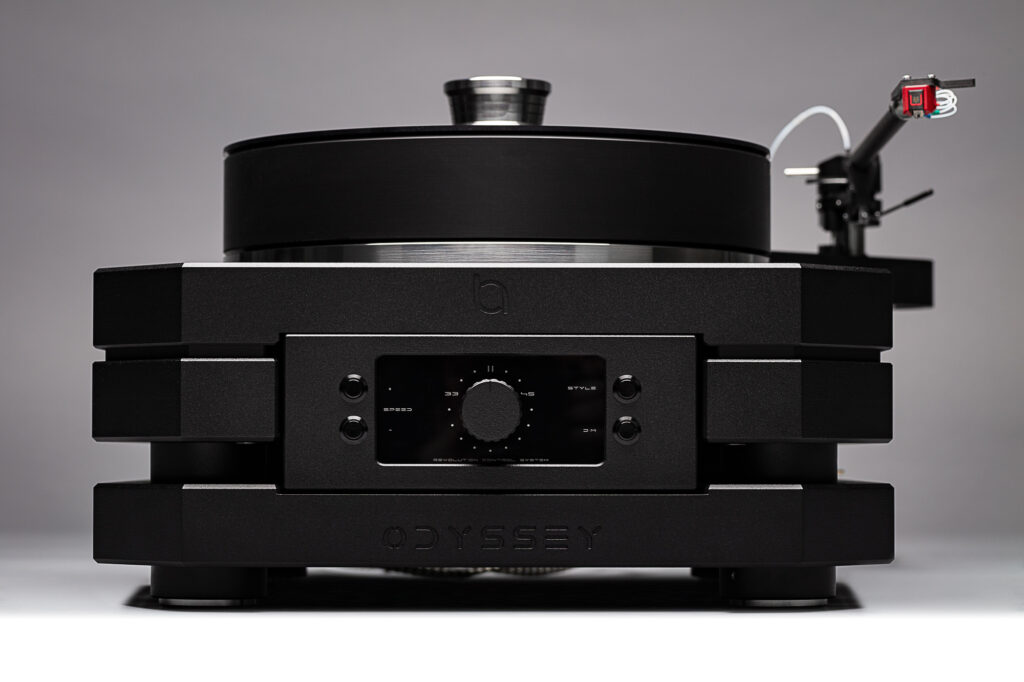
Let me explain the drive unit. It's a box that neatly slides in between the top and bottom plinths. It features a single rotating knob to select the speed and a series of buttons that operate other functions, including an array of about 14 colors for the LED readouts. Mine is always set to blue, of course, to match my room lighting scheme.
Next, place the two platters. The bottom platter is made of solid stainless steel, about an inch and a half thick. The top platter is a proprietary composite, also about the same thickness and exceptionally dense, as heavy as the bottom platter. You'll need the included lifting screw handles because the platters are half the weight of this behemoth.
Once the turntable is set up, it's time to add a tonearm or three. Yes, it can handle three tonearms. Overkill? Not even close. I prefer two, but I might eventually add a third arm for easier cartridge reviewing. So far, two has been plenty.
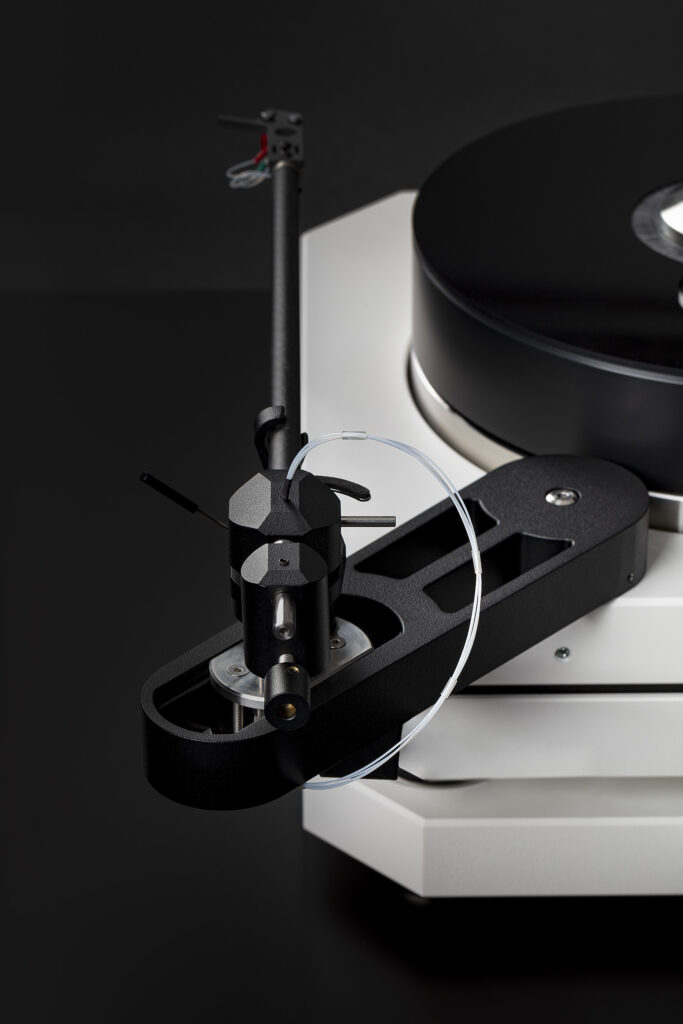
The standard tonearm for the Odyssey is a 14-inch carbon fiber arm specially designed by Thomasz for this table. I say "standard" only because it's the only tonearm for this table. That being said, it is anything but standard. The tonearm is a classic unipivot with lateral stabilization, which is the key to its uniqueness. Every unipivot user knows the pain of constantly correcting azimuth. In the BennyAudio design, this problem has been effectively eliminated, resulting in easier setup, stress-free day-to-day use, and more stable sound.
The 14-inch effective length is no mere coincidence. It's a long, ultra-rigid armwand that ensures precise transfer of mechanical energy into musical information. This design eliminates any room for shortcuts: a poorly executed 14-inch arm will sound terrible, while a properly engineered 14-inch arm with high stiffness delivers exceptional speed, clarity, and tonal balance.
The arm is crafted from stainless steel and carbon fiber. The junctions between these materials are meticulously engineered to be extremely rigid, facilitating efficient dissipation of vibrational energy from the cartridge into the arm structure. Internal damping is implemented at precisely calculated points, tailored specifically for this model.
The headshell is a proprietary Benny Audio design that decouples vertical tracking angle optimization from overhang adjustment, making fine-tuning both parameters significantly more intuitive. Signal wiring is high-purity mono-crystalline silver from Polish manufacturer Albedo. Connection is via DIN socket; a direct-wired option is also available for users who prefer this approach, though it comes with its own set of setup sensitivities. VTA adjustment is straightforward and can be performed on the fly.
Overhang and armboard positioning are straightforward, with clear geometry and user-friendly adjustment ranges. Oil damping is included as standard. The oil trough remains concealed during normal use but becomes easily accessible once the arm is lifted.
The tonearm underwent a proprietary measurement methodology analyzing vibrational behavior from 20Hz to 20kHz. This process enabled Thomasz to identify resonant modes and apply targeted, highly effective damping, directly contributing to the arm's composure, resolution, and musical coherence.
It's a beautiful piece attached to the table with a slightly teardrop-shaped mounting plate, allowing for precise adjustment of angle and proximity. You could use any high-end tonearm and dial it in perfectly in this system. But why would you? The tonearm is one of the best I've had (now I have two), and it's incredibly well-balanced and easy to dial in. Each arm comes with both a carbon fiber headshell or a titanium unit. I discovered that the carbon worked best with analytical cartridges like the Lyra. I use that headshell with it, and it slightly warms the cartridge. The titanium headshell works best with my Etsuro and Hana Urushi cartridges, giving them a slight sparkle. I imagine any Koetsu-type cartridge would benefit from the titanium. The most important thing is that you have the option as part of the standard package. I calibrated both tonearms with the complete Wally Tools setup. You also get a fantastic record clamp and a wonderful antistatic cleaning brush for your LPs! It's the complete package. The only thing I changed was to replace the standard power cord for a more upscale XLO Signature 3.
The final step is to plug in the outboard power supply and crank it up!
Here are the technical specifications:
Model: Odyssey
In production: 2023 (prototype), since 2024 Official
Dimensions: 242 (H), 400 (W), 400 (D) 9.5" x 16" x 16"
Dimensions with one tonearm: max 230mm + regular W and D
Weight: 59 kg (without tonearm) 130 lbs
Number of tonearms: Up to 3 tonearms (4 mounting points)
Power supply: ULPS 12 VDC
Rotational speed: 33.3 rpm and 45 rpm
Wow&Flutter: IOS RPM App: 0,07% (best run)
SHAKNSPIN MK2: DIN 0,002, WRMS 0,000 (SHAKNSPIN Database)
Service interval: 3 years (oil refill)
So there you have the technical details, but let's get to the important part: how it all sounds!
Well, the simple answer is that it doesn't. At all. It's dead quiet with the stethoscope. Zero, zip, ziltch, niet, nada!
This table is as solid as you need. While there are undoubtedly larger and heavier turntables available (I've owned a few myself), many of them are equally quiet, visually appealing with great aesthetics, and packed with interesting features. Tables made from Unobtainium and Can'taffordium, featuring exotic fluid-filled platters, magnetic drives, laser-guided tonearms, and total automation. All these features are undoubtedly impressive and keep things fresh and innovative. However, do they truly make a significant difference in the listening experience? I've had the pleasure of listening to several of these super-exotic tables at shows like AXPONA and the MUNICH show, and I was definitely impressed. But I've yet to find anything that offers such a comprehensive package at such an affordable price as the Benny Audio Odyssey.
Moreover, introducing new, exciting, and flashy features adds a layer of complexity that increases the risk of failure. I've been drawn into that trap before and prefer a simpler approach. Besides, I absolutely adore the aesthetics of the Odyssey. When you see it in person, you're instantly aware that you're in the presence of something truly special. Everyone who's spent time listening to my system always takes the time to examine the turntable and arms thoroughly. The consensus is universal: "I want that turntable!" There's nothing wrong with making a turntable that also happens to qualify as audio art. You end up looking at it a lot. It's wonderful that it's physically so alluring.
Now, let's talk about the features. It's dead quiet, stable speed, and instantly changeable between 33 and 45. While this may not be the best choice for those with a large collection of 78 albums, I firmly believe that the vast majority of vinyl enthusiasts will be perfectly served by this table. The good news is that if you have a large collection of 78s, he can configure a 78 speed for a slight up-charge.
Using the Odyssey is a breeze. Just like any turntable, simply place the album on the table, clamp the spindle, and rotate the dial to the desired speed. Swing the arm over and drop the cueing lever, and it smoothly descends onto the record. Now, relax and enjoy the music.
The sound emanates with incredible detail and focus. Even large-scale pieces are handled with ease, while quieter passages sparkle with life and vibrancy. Low-level detail is meticulously detailed, free from smears and producing no sound staging or depth loss.
Now, let me mention some of the updates Thomasz has made since I first set up my table:
The first change is a new "anchor piece" for the tonearm mounting. These are roughly twice the mass of the originals and now come with two rubber grommets to isolate the metal-to-metal contact points. This made a noticeable improvement in detail. If I hadn't spent a year with the old setup, I'm not sure I would have ever noticed, as the original configuration was already stellar in this regard. I was certainly surprised at the difference it made. The focus improved, and the space between players is now even clearer and more defined. The background is as dark as the center of a 3000-foot deep mine. If you've never experienced absolute darkness, let me tell you, you haven't experienced it until you visit an old mine and turn off all the lights.
The second change is a new record clamp. This is a serious record clamp. The original was a nice, heavy clamp that anyone should be satisfied with and did the job admirably. But Thomasz isn't the "it's adequate and that's okay" kind of guy. He's always looking for improvements, and this clamp completely and thoroughly demonstrates that ethos. Made by Omicon Group, it's a little 3-pound marvel unto itself. The clamp features the cutting-edge Omicron Magic Dream energy dissipation system, which enhances the precision of your turntable's cartridge, delivering sound with exceptional accuracy and dynamic clarity compared to the baseline. It helps to produce an enriched soundstage, precise low-frequency performance, and refined micro-details that bring your vinyl collection to life.
Add to that, it's quite the looker. Crafted from premium brass and bakelite with sumptuous finishes, this clamp combines timeless aesthetics with innovative sound technology.
Buying it on the open market will set you back about $800 alone, and you get it with the table as a standard piece.
Sound? Well, in a nutshell, it doesn't have a sound, and that's a wonderful thing. It simply spins at precisely 33.3 RPM and adds nothing and takes nothing away from whatever record you place on it. In my opinion, simplicity rules. The tonearm(s) provide exactly what you want from a tonearm—rigidity, damping capabilities, and adjust-ability for VTA, as well as the ability to accept a broad array of cartridges and get the absolute most out of whatever cartridge is attached to it. The physicists and engineers can way in with way more in-depth explanations.
Listening
Chris Botti is a favorite of mine because he doesn't hog the spotlight in most of his songs. He collaborates with various guest artists and maintains a consistently high-quality core group. The jazz variety on any of his albums is extensive and dynamic. His live performances are truly exceptional.
The latest addition to my Botti collection is the Blue Note recording Chris Botti Vol.1, B00375120. One of my favorite Botti tracks is "Bewitched, Bothered and Bewildered." It features a delightful blend of sweet jazz guitar from Gilad Hekselman and Chris's superb trumpet.
From the moment I started playing this turntable, I noticed a slight improvement in the guitar's presentation. The notes were crisper, and the tone was more fleshy and smooth. While my previous setup had a similar quality, this improvement was more pronounced and defined.
It's the same cartridge, but the table and arms are different. I had previously alternated between the JNT table and the Musical Soundings tables, but neither of them produced the level of clarity and detail that came through with the Odyssey. I suppose that's to be expected considering the cost difference, but as we all know, more expensive doesn't always equate to better performance.
Joe Satriani's Flying in a Blue Dream, released in 1989 by Relativity Records (88561-1015-1), stands as one of my all-time favorite Satriani records. The title track effortlessly tops my Satriani playlist selections. This enchanting tune begins with a delicate girl's voice, accompanied by a nylon string guitar and synth. The drums and bass gradually join the ensemble, and the voice becomes remarkably clear, allowing me to comprehend its lyrics with unprecedented clarity. The snail drum hits are tighter and more pronounced, infusing the track with a subtle pop. Satriani's guitar sizzles throughout the song, while the nylon string guitar maintains a focused yet warm tone that permeates the entire track.
Mannheim Steamroller's Fresh Aire III, released on American Gramophone (365), is a captivating album. During this session, I particularly focused on "The Woods Are Alive - Morning." This soft and soothing track features wildlife sounds played against a gentle piano melody. I have always cherished this album for its softer edge and some of its more spirited tracks. On this particular track, I noticed that the animal sounds were sharper and more prominent than before. The crickets are more prominent and alive. The second side of the album seems to have a tighter and better-balanced sound. While it may not be a life-changing event, it suddenly becomes more detailed and enjoyable, as if every tiny speck of information is brought to life.
Finally, I decided to highlight Anne Bisson, one of my all-time favorite singers. I've had the pleasure of meeting her more than once, including running into her and her husband in Munich last year. I've made it a habit of looking for her at shows, buying albums, and getting them signed.
One day, I was walking through a show and, to my surprise, there they were—Anne and her husband. We instantly spotted each other and stopped to chat for a bit. I immediately mentioned that I had a $100 to spare and wanted to buy a replacement album. She said she was just singing and didn't have any money.
"Oh, too bad," I said. "Well, next time, for sure!"
Her husband, in his infinitely charming way, immediately said, "Not so fast, Gary. I have all your information. Give me that $100, and I'll ship it to you as soon as we get back home."
He took the $100 bill and handed it to me. What a salesman! About a week after the show, the album arrived. I don't know many artists who treat their fans so well.
Anne is not only a phenomenal singer, but also a truly lovely human being who always has time for her fans.
I'm not sure if it's the tonality of her voice or the ease with which she delivers the song, but there's no doubt that she has the talent. I just never get tired of listening to her. All of her albums are available on 45rpm, which sonically is preferable.
I'm also a fan of Diana Krall, but in comparison, I find Anne's vocal delivery much more enthralling. Maybe because I've listened to her speak about singing and recording, I feel it's more approachable. Whatever the case, I'll always go with Anne as my first choice for a female jazz singer.
That very album, titled Anne Bisson Keys to My Heart, released by Camilio Records (CAM5034), was the one I chose for this review. One of my favorite tracks on the album is "Where Am I Now?" It's a lively and upbeat tune that features Anne Bisson on vocals and piano, accompanied by Darek Oleskiewicz on acoustic bass and Joe LaBarbera on drums. Listening to the entire album on the Odyssey was like having Anne in the listening room with me. Her voice was incredibly smooth and romantic, almost ethereal. Her piano playing was on par with anyone else currently recording, with notes that popped with a lightness and clear attack. The bass was so alive that you could feel the flesh plucking the strings, and the sliding of notes was definitely present, but not overly pronounced. It felt more like a live performance than a recording. I'll attribute that to the Odyssey's ability to deliver every aspect of the album's groove without adding any of its own characteristics. It was simply stellar!
Suffice it to say that if I've dedicated half a year of my life working to afford and finally owning the BennyAudio Odyssey, it speaks volumes about its incredible capabilities. Mine is all black, with the engraving painted in a light blue metallic and pearl finish. Other colors are available, including silver and white, and Thomasz is reportedly working on more options.
If you're seeking the ultimate turntable to elevate your system and ensure decades of satisfaction, the Odyssey should be at the top of your list. Its performance is unparalleled, and I can't imagine anyone not being fully content for a long time.
However, if you're looking for a competitive advantage in a spitting contest with your audio buddies, spending a lot more money won't necessarily translate into a significant improvement in sound quality. As I mentioned earlier, there are turntables that cost much more and have more intricate features, but they often come with unobtainium and can'taffordium bits and pieces that don't always equal a relative improvement to the sound and add more complexity.
In my opinion, it's better to save the extra money and invest in more reference vinyl or upgrade the cartridge. That, in my view, would be a more prudent choice. You simply can't get a better bang for the buck.
Odyssey Turntable (single tonearm)
Retail: 32,900 EUR (VAT included), approximately $45,000 USD
Additional tonearm
Retail: 7,900 EUR (VAT included), approximately $10,900 USD
Please note that these prices are subject to current conversion rates and tariffs.
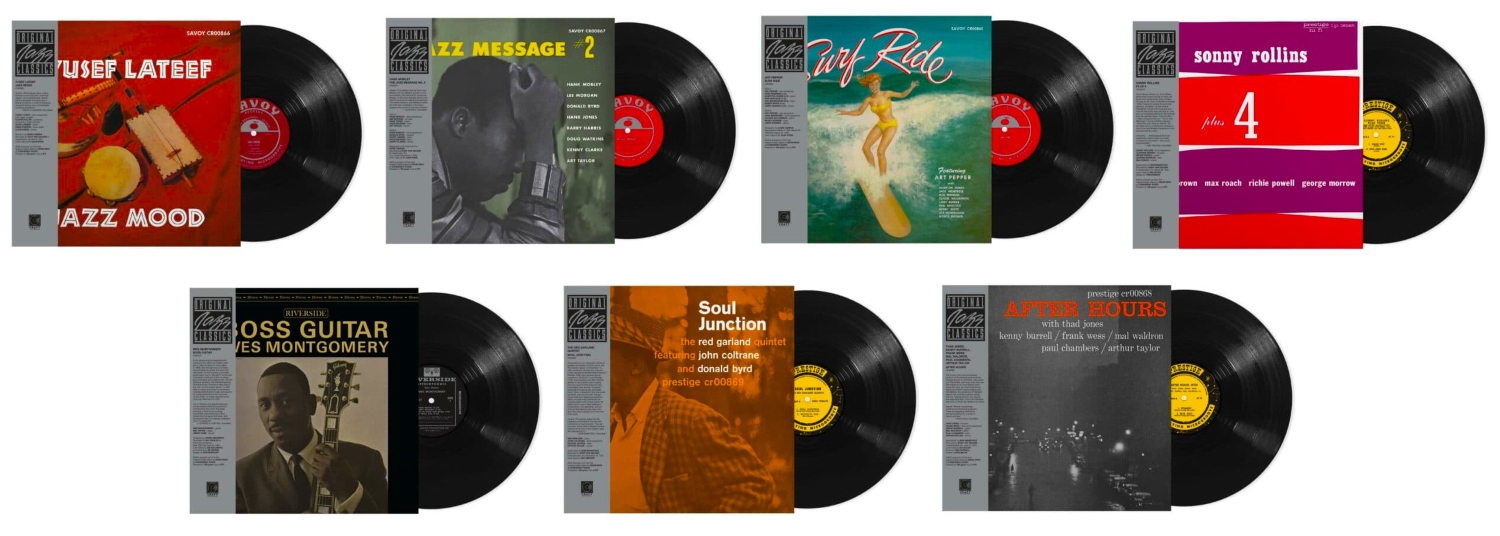
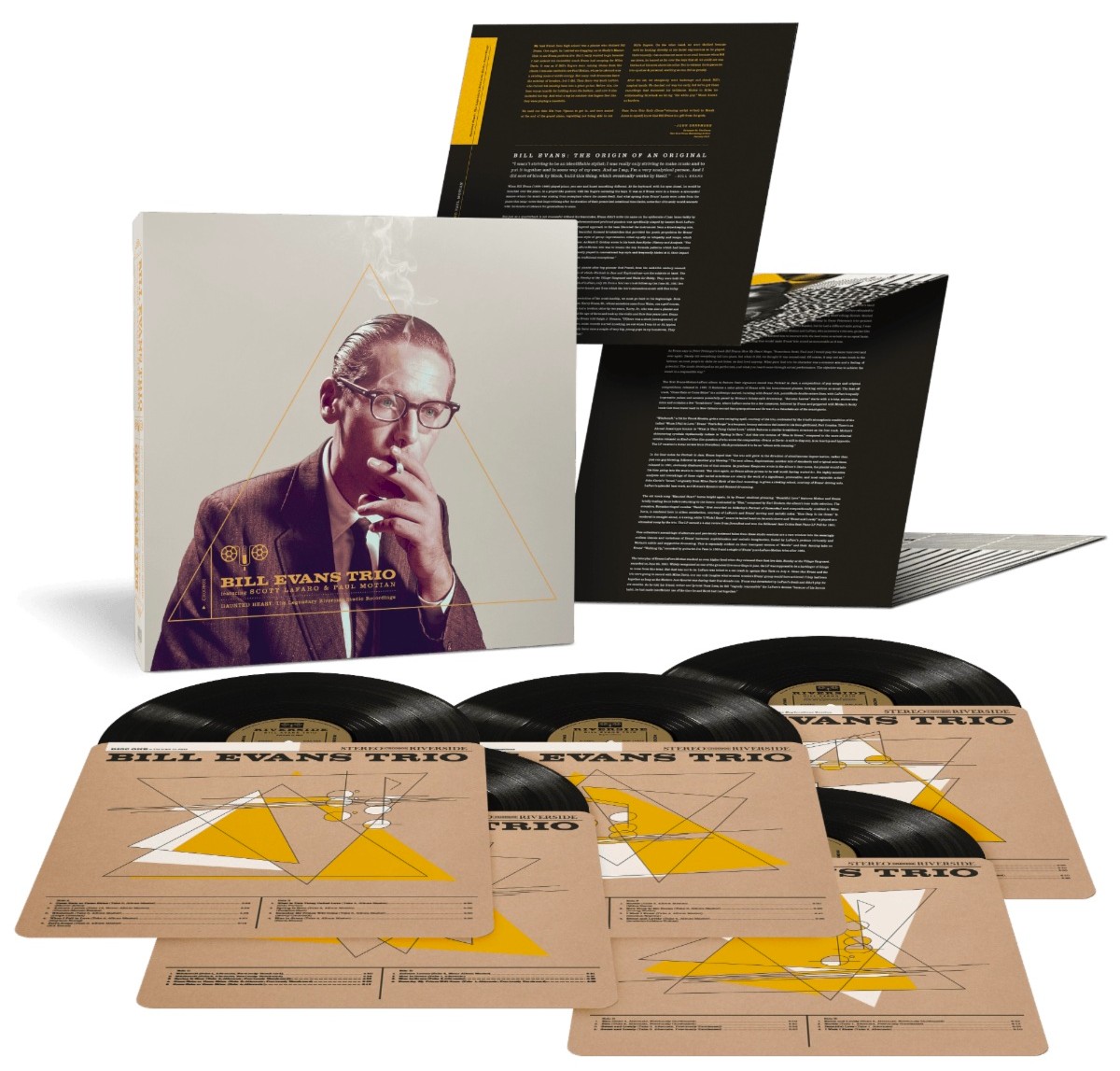
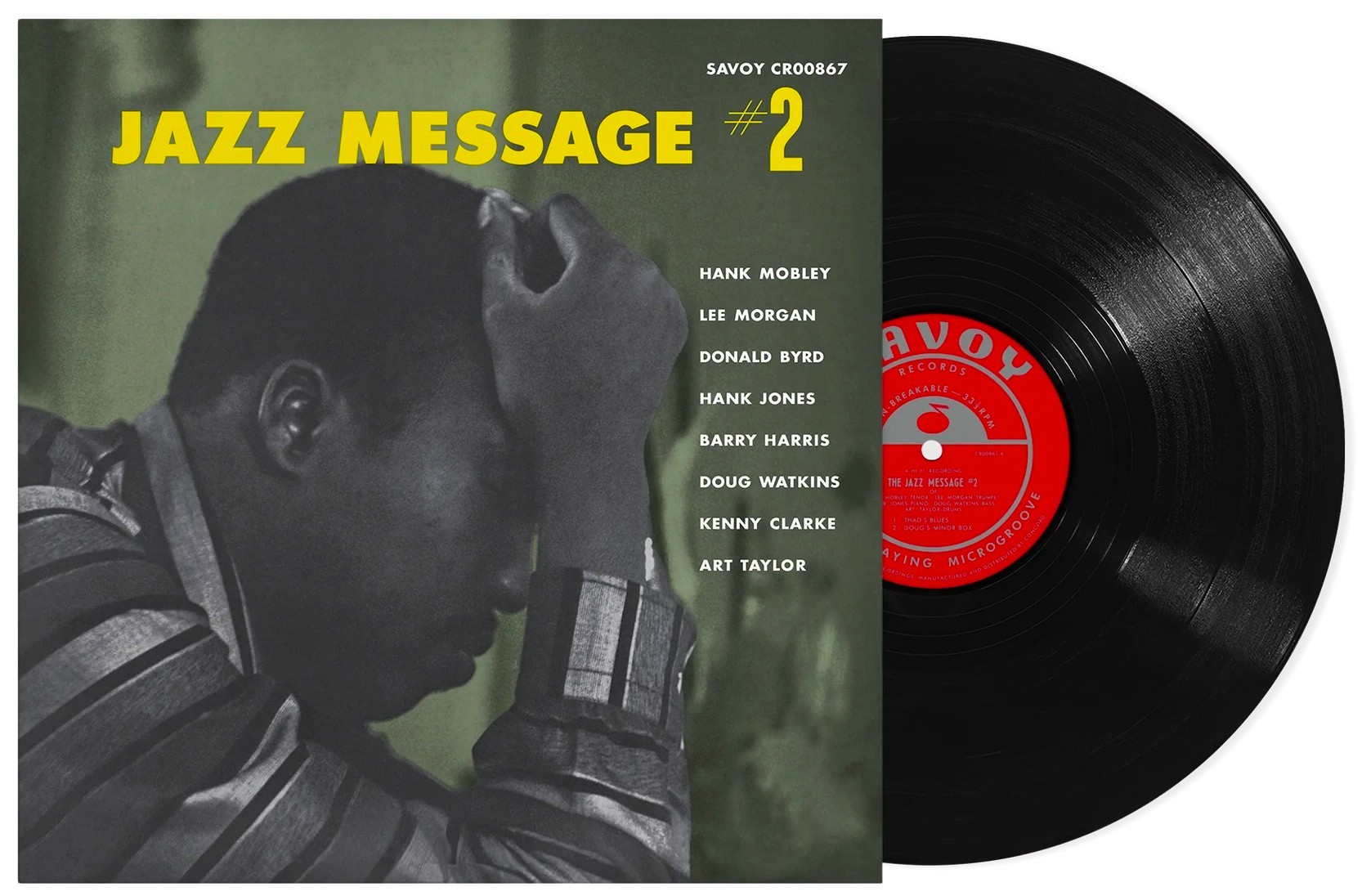
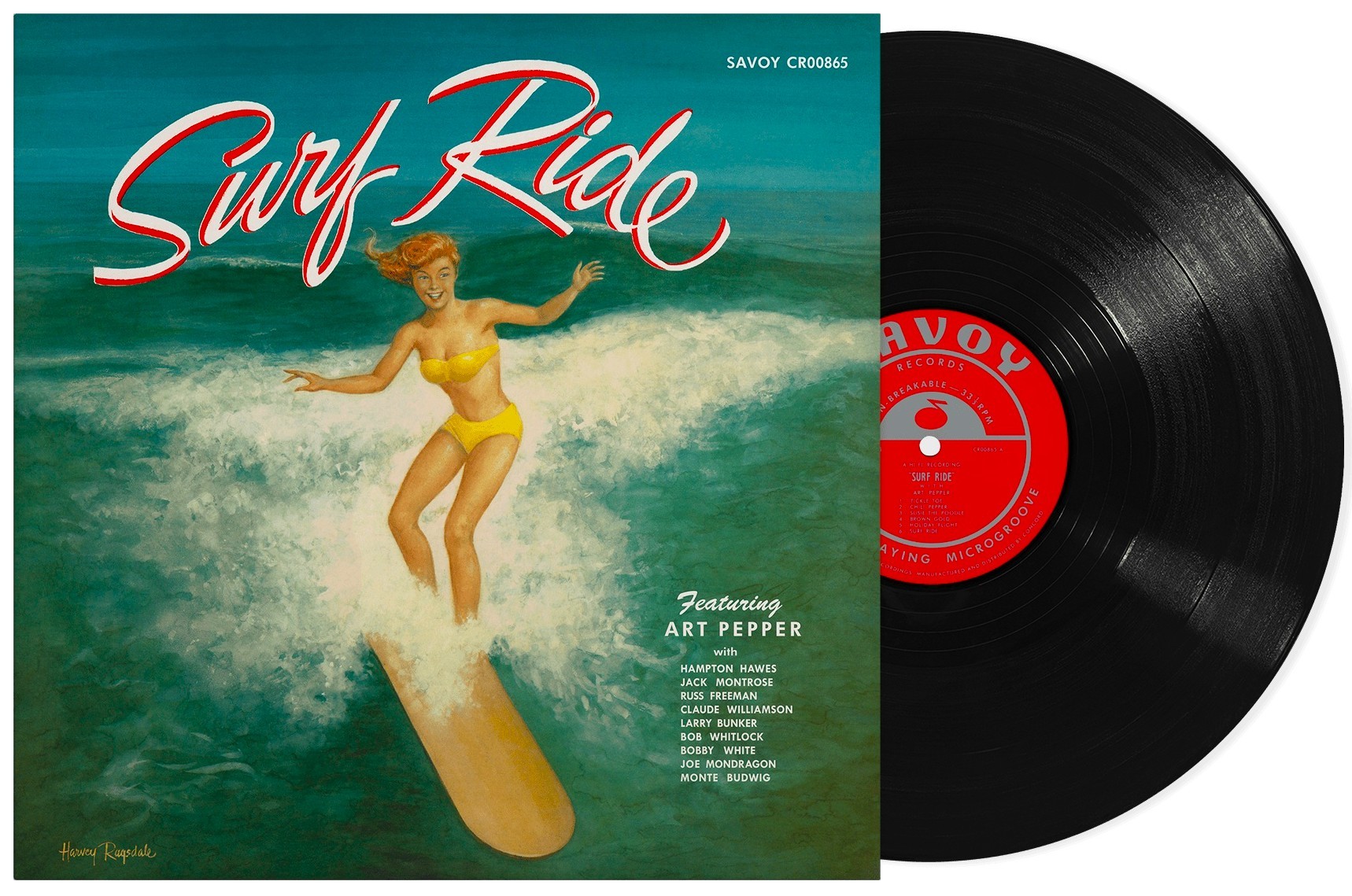
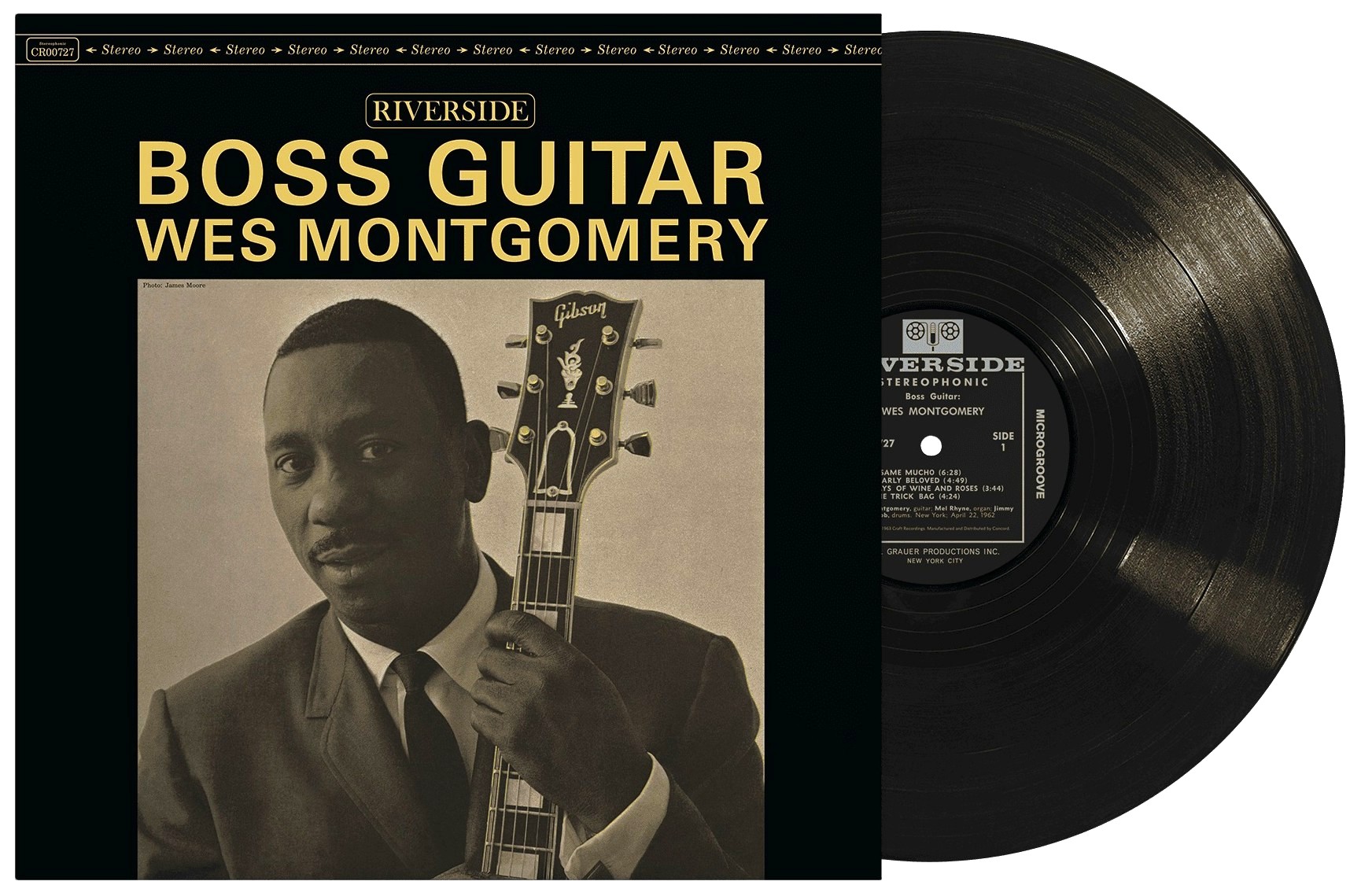
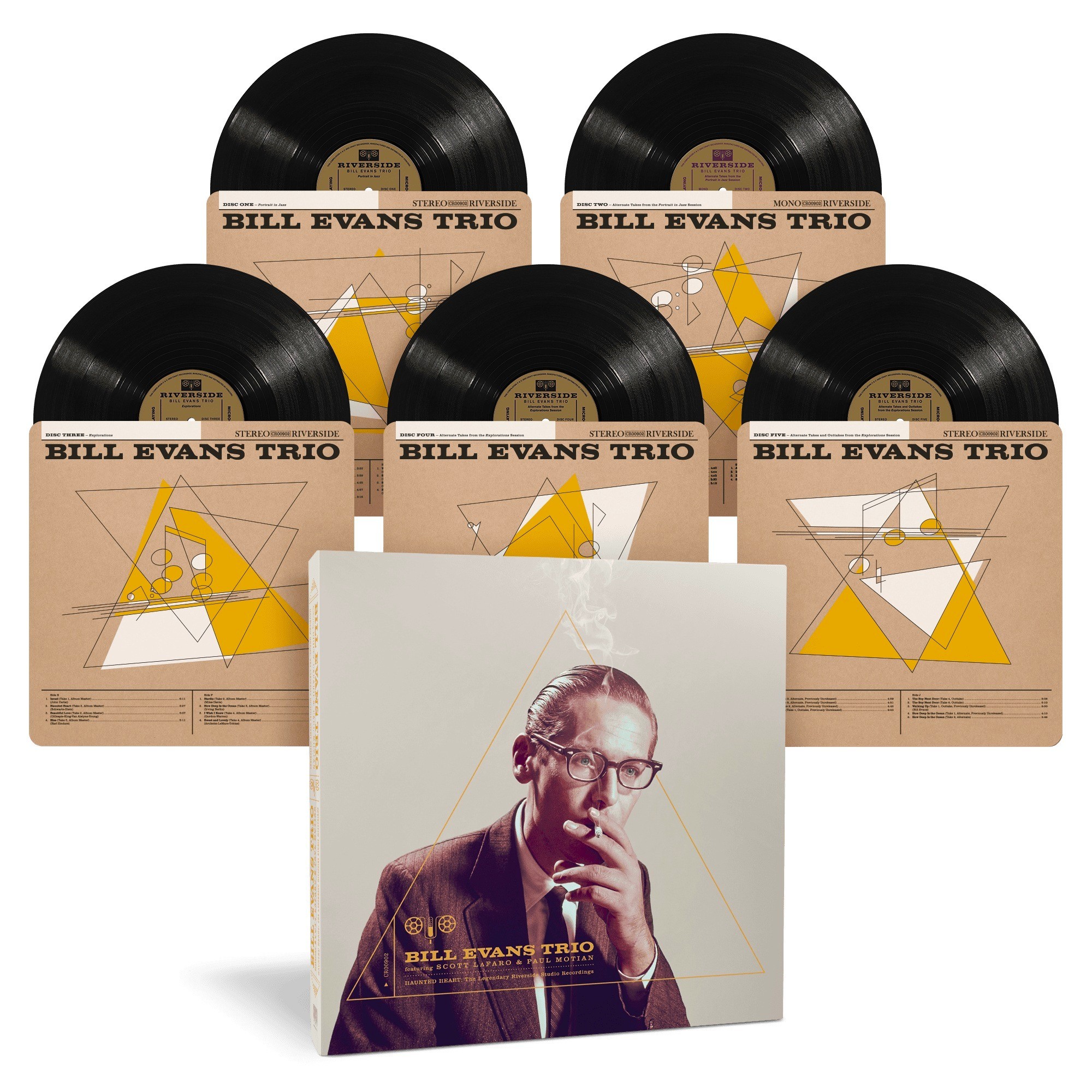
Among Craft Recordings' late-season jazz releases are seven new titles in the Original Jazz Classic reboot series, along with an exceptional new Bill Evans Trio box set that highlights the complete studio recordings of his classic first trio. The OJCs feature three 1957 releases on the Savoy label, including reedman Yusef Lateef's Jazz Mood, saxophonist Hank Mobley's Jazz Message #2, as well as West Coast sax player Art Pepper's Surf Ride. Also available is guitarist extraordinaire Wes Montgomery's 1963 Riverside Records date, Boss Guitar; along with three Prestige label recordings, saxophonist Sonny Rollins' Plus 4 (1956), trumpeter Thad Jones' 1957 sextet date, After Hours, and pianist Red Garland's 1957 quintet session, Soul Junction. Craft's new 5-LP Bill Evans Trio box set, Haunted Heart: The Legendary Riverside Studio Recordings, collects every studio track from his classic, but tragically short-lived early trio that featured bassist Scott LaFaro and drummer Paul Motian. I received evaluation LPs for the OJC titles from Yusef Lateef, Hank Mobley, Art Pepper, and Wes Montgomery, as well as the Bill Evans Trio LP box set.
Of course, the OJC reissues were remastered from the original analog tapes by Kevin Gray at Cohearent Audio; he also cut the lacquers for the LPs that were pressed on 180 gram audiophile vinyl at RTI. All were housed in heavy tip-on outer jackets printed by Stoughton, with crisp artwork sourced from the vaults of Prestige, Riverside, and Savoy Records. The outer jackets all have the classic, high-gloss coating that matches the originals, and each sports a custom OBI strip that offers a glimpse of each reissue's artistic and technical information. All Craft OJC LPs arrive inserted in premium rice paper inner sleeves, and the pressings from RTI are near perfection. Haunted Heart: The Legendary Riverside Studio Recordings was remastered by Paul Blakemore at CMG Mastering, while tape transfers and audio restoration for the set's pair of studio albums, 1960's Portrait in Jazz and 1961's Explorations, were performed by Jamie Howarth and John Chester at Plangent Processes. Kevin Gray mastered the vinyl and cut lacquers for the 180 gram LPs at Cohearent Audio. No information is yet available as to where the 180 gram LPs were pressed, but they're beautifully glossy, pristine, and whisper quiet during playback.
Haunted Heart: The Legendary Riverside Studio Recordings's elaborate packaging includes a satin varnished, foil-stamped outer slipcase, with two expanded, single pocket album jackets inserted within. Those jackets are die-cut across their faces with a triangular motif that matches that featured on the outer slipcase; printed slipsheets featuring the original album art for Portrait in Jazz and Explorations peek through the die-cuts for each jacket. The jacket for Portrait in Jazz contains two LPs; one with the original studio LP, and a second with the alternate takes. While the jacket for Explorations contains three LPs, with two additional discs of alternate takes (the sessions for this album were difficult by all reports, with multiple takes of almost every tune). Each LP is inserted in a stylized, printed paperboard inner sleeve that's surprisingly lined with a rice-paper insert (nice touch!). An accordion folded printed insert sports a stylized poster of Bill Evans on one side, while the opposite features an introduction by Door's drummer John Densmore (he actually snuck into Shelly's Manne-Hole as a teen to see this trio!) and an informative and entertaining essay from jazz writer Eugene Holley Jr (Downbeat, Hot House Jazz Guide, SFJAZZ).Haunted Heart: The Legendary Riverside Studio Recordings is one of the most visually striking box sets I've ever seen!
The OJC reissues are being made available as LPs and high resolution digital files for download or streaming on most major services, and can also be ordered (or in certain cases, pre-ordered) from Craft's web store HERE. Haunted Heart: The Legendary Riverside Studio Recordings is available as 5-LP or 3-CD sets, as well as digital downloads, and can be ordered from the web store HERE. They'll also be available at many online providers, as well as brick and mortar locations like your favorite independent record store. As of the time of this review, many of the titles were sold out on Craft's web store, but I've seen them currently available at other sites online and at my local independent record store, so they shouldn't be too difficult to track down.
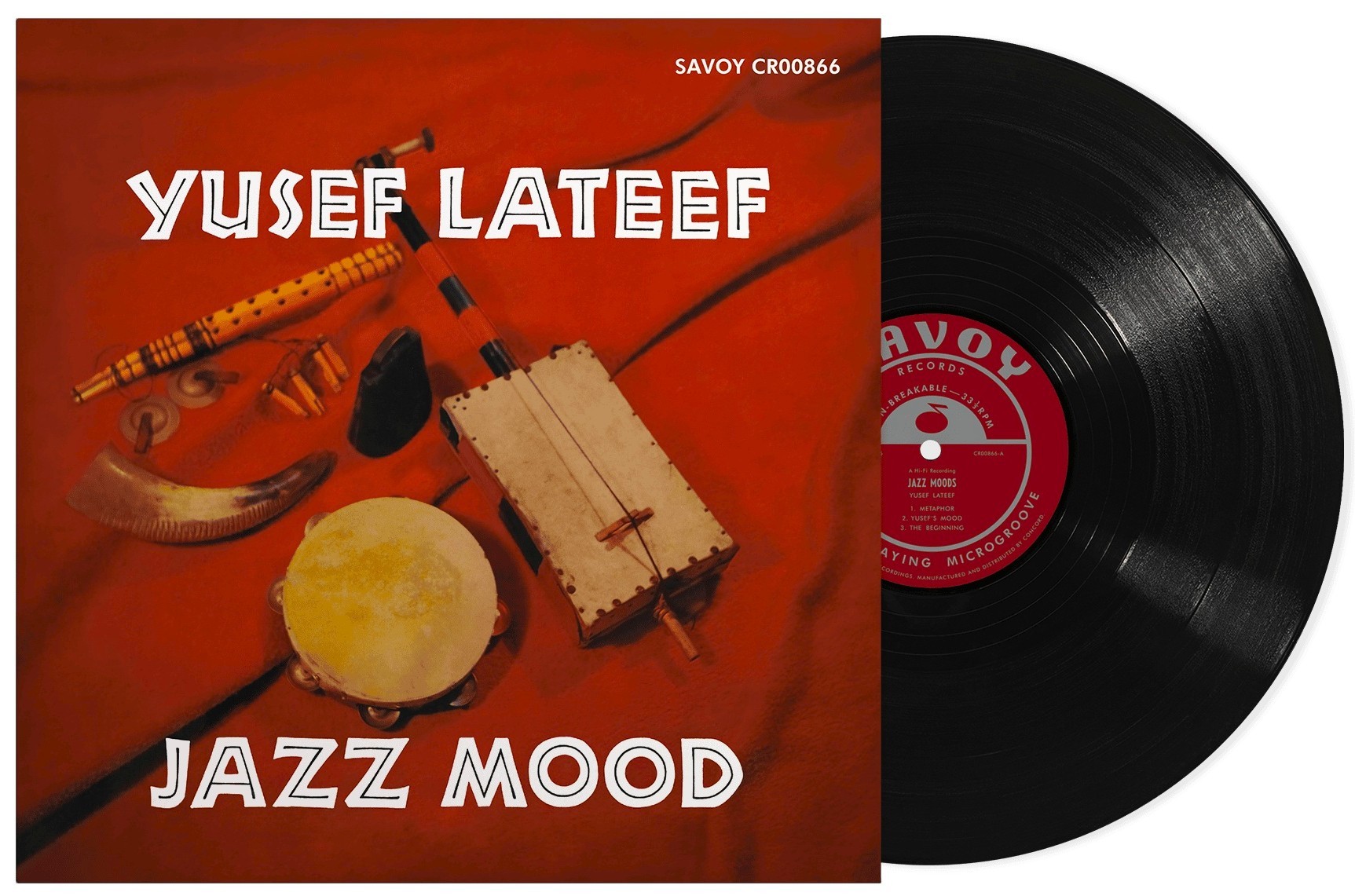
Yusef Lateef, Jazz Mood. 180 gram Savoy Records LP, $39
Yusef Lateef's perennial chestnut Eastern Sounds may have become his most celebrated exploration of a melange of hard bop with Mid-Eastern music upon its 1962 release, but the seeds were sown five years earlier with his second studio album, 1957's Jazz Mood on the Savoy label. Lateef performs on a variety of reeds and blown instrumentation here, including tenor sax, flute, and the argol (an ancient, Mid-Eastern reed instrument similar to an oboe), along with accenting his performances with the guiro, which is a hollow gourd with parallel notches that's scraped to create a percussive sound. He was joined in the sessions by Curtis Fuller on trombone and tambourine, Hugh Lawson on piano, Ernie Farrow on bass and rabat (another Mid-Eastern stringed instrument that's bowed or plucked), along with Louis Hayes on drums and Doug Watkins on finger cymbals and percussion. Many of the exotic instruments in use are depicted on the album's cool cover art, which serves to reinforce the Eastern vibe of the sessions.
All the tracks on Jazz Mood were penned by Yusef Lateef. The album opens with "Metaphor," in which he plays a haunting wail on the oboe-like argol as the track evolves into a more traditionally melodic blues. Lateef then switches to tenor sax, and is joined by Curtis Fuller's trombone along with piano and bass accompaniment. "Yusef's Mood" is a traditional blues performed with more customary jazz instrumentation that develops into an all-out blowing session between Lateef's sax and Fuller's trombone. "The Beginning" plays in 7/4 time, and Lateef's motif on sax gives the tune a heavily Asian feel. Side two opens with "Morning," which features Ernie Farrow on plucked rabat in place of the more traditional bass; Hugh Lawson soon joins in with a nice vamp on piano, while Lateef's sax and Fuller's trombone take the tune into more traditional jazz territory. "Blues in Space" takes an Arabic motif and turns it into another blowing session with a really swinging groove. Other than an unofficial reissue in 2022, Jazz Mood has been out of print on LP in the US since its 1957 release. And was never reissued domestically as a CD—listings for the album are virtually nonexistent on Discogs.
Hank Mobley, Jazz Message #2. 180 gram Savoy Records LP, $39
Hank Mobley's long association with Art Blakey's Jazz Messengers obviously impacted his creative process, as his initial forays as a leader often featured some variation on a "jazz message." His first two outings for the Savoy label were 1956's The Jazz Message of Hank Mobley, followed by 1957's Jazz Message #2, both of which followed a format that featured two distinctly different groups of players performing on each album side. Mobley was actually very prolific in 1957, recording no fewer than seven studio albums scattered across the Savoy, Prestige, and Blue Note labels. Jazz Message #2 was recorded at the Van Gelder Studio in Hackensack, New Jersey, with Rudy Van Gelder at the controls; Ozzie Cadena produced the album for Savoy Records. The only constant between both sides is, of course, Mobley on tenor sax and Doug Watkins on bass. Side one features the upstart Lee Morgan on trumpet (he was still a teen at the time!), Hank Jones on piano, and Art Taylor on drums. Side two has Donald Byrd on trumpet, Barry Harris on piano, and Kenny Clarke on drums. The dual groups give each set of performances a distinctly different flavor.
Side one opens with the album's longest track, trumpeter Thad Jones' "Thad's Blues," with Lee Morgan giving a star turn here with the kind of piercing trumpet solos that would soon find the eighteen-year-old at the forefront of hard bop jazz. Thad Jones' brother Hank adds a particularly effective piano solo in the tune's center. Doug Watkins' "Doug's Minor B'OK" is a rhythmic blues that offers plenty of room for all the players to stretch out, with both Lee Morgan and Watkins taking extended solo turns; Art Taylor cuts loose and pounds the skins towards the final chorus. Mobley wrote all three tunes on side two, which opens with his "B. for B.B." , another excellent blues that features some superb interplay between Mobley's lyrical sax and Donald Byrd's bell-like trumpet tone. Barry Harris's silken piano ices a tune that playfully bops along. "Blues Number Two" takes a more measured and lyrical approach, with Mobley and Byrd duetting throughout the tune's opening, followed by alternating solos from Mobley, Harris, and Byrd. Jazz Message #2 closes with "Space Flight," which finds both Mobley and Byrd providing solos that reach for the stars. It's a great album that never fails to entertain, and other than a 1998 CD issue, Jazz Message #2 has been out of print domestically since its original release.
Art Pepper, Surf Ride. 180 gram Savoy Records LP, $39
Alto saxophonist Art Pepper first came to prominence playing in Stan Kenton's big band; Surf Ride was his 1957 debut as a leader on Savoy Records. A practitioner of West Coast cool jazz, he often gave emotionally charged performances and is regarded as one of the greatest alto sax players—if not the greatest—of all time. Pepper struggled with drug addiction throughout his career, and often had long stints of inactivity as a result—that could possibly explain why it took a year-and-a-half to complete the recordings for Surf Ride, which took place over several sessions from March 1952 to August 1954. The Los Angeles recordings were supervised by Ozzie Cadena for Savoy Records, and were also (surprisingly) engineered by Rudy Van Gelder. In addition to Art Pepper on alto sax, side one featured Russ Freeman and Hampton Hawes on piano, Bob Whitlock and Joe Mondragon on bass, and Bobby White and Larry Bunker on drums. For side two, Jack Montrose appears on tenor sax, Claude Williamson is on piano, Monte Budwig is on bass, and Larry Bunker hangs around behind the drum kit. Other than a 1991 CD release and a limited LP reissue in 2016, Surf Ride has been out of print domestically since its 1957 release.
Art Pepper composed most of the tunes on Surf Ride, with the exception of Lester Young's "Tickle Toe" and Jerome Kern's "The Way You Look Tonight." Side one opens with a rousing version of "Tickle Toe," which brings to mind the album's really fun front cover illustration where a fetching young lass hangs ten on a surf board that cuts through the waves. "Chili Pepper" is a clever play on Pepper's name and continues the sassy groove; "Suzy the Poodle" features Pepper in another mind-numbingly rapid solo turn. "Brown Gold" is from the session in 1953, where Pepper's superb soloing is followed by an equally impressive turn from the ever-lyrical Hampton Hawes on piano. "Surf Ride" picks up where "Tickle Toe" left off, and Pepper's rapid-fire soloing literally plows through the waves while Hawes tickles the ivories. The action switches yet again to the final group lineup for "Straight Life," which is one of Art Pepper's most iconic tunes, and his solos here seriously shred as he alternates with Jack Montrose on tenor sax. Surf Ride reaches its conclusion with a quad of spicy tunes, starting with "Cinnamon," which features superb interplay between Pepper and Montrose; pianist Claude Williamson joins in with a lyrical solo turn that transitions to a trio between his piano and the dual saxes. "Nutmeg" opens with a nicely mirrored duet from Pepper and Montrose; "Thyme Time" is perhaps one of the album's highlights, with Montrose providing counterpoint to Pepper's rapid fire runs and fills. "Art's Oregano" closes the proceedings with a healthy dose of West Coast cool.
Wes Montgomery, Boss Guitar. 180 gram Riverside Records LP, $39
Boss Guitar was Wes Montgomery's eighth session for Riverside Records and his seventh studio album for the label. It's often cited as perhaps his finest trio recording, and was his first return to that format since his 1959 debut, The Wes Montgomery Trio. And it's also one of the most revered hard bop albums from his entire discography. Boss Guitar found Montgomery again accompanied by Mel Rhyne on organ, but this time with Jimmy Cobb behind the drum kit. The 1963 session was recorded at Plaza Sound Studios in NYC, with Ray Fowler at the controls and Orrin Keepnews in the production chair. The album consists of mostly standards, with a couple of Montgomery originals thrown in for good measure. At the time of this album's release, Playboy Magazine's Jazz Poll had just been published, and it featured vote totals from both fans and the jazz musicians who'd been selected in the previous year's poll. Readers placed Wes Montgomery in the fourth position, behind Chet Atkins, Barney Kessel, and Charlie Byrd. Unsurprisingly, the musicians poll—which featured the likes of Miles Davis, Coltrane, Paul Desmond, Duke Ellington, and Frank Sinatra, among many others—selected Montgomery for the top position.
Side one opens with a rendition of "Besame Mucho," which thankfully is played in 6/8 time, and moves along at a much faster clip than the usual measured pace of the tune when used as a vehicle for a vocalist. Jerome Kern and Johnny Mercer's "Dearly Beloved" (a favorite of none other than Charlie Parker) features a rapid-fire pace with an intense exchange between Montgomery and drummer Jimmy Cobb. The trio takes a very lyrical approach to "Days of Wine and Roses," and the side closes with Montgomery's own "The Trick Bag," which features some scintillating fingerpicking from the "boss guitar." Side two opens with another Charlie Parker favorite, "Canadian Sunset," which is given a lilting, bossa nova take here. Montgomery's "Fried Pies" picks up the pace; it's the album's longest track, and he occupies an almost supporting role throughout as organist Mel Rhyne turns in an extended solo turn. "The Breeze and I" is typically played with a Latin vibe, but Montgomery gives it a more straight-ahead rendition here. Boss Guitar closes with "For Heaven's Sake," an infrequently played ballad that's given a very tender reading by Montgomery, with some very nice fingerpicking interspersed with his trademark block chords.
Boss Guitar was consistently popular, and was reissued in multiple guises, not only as the original release, but also with a different title and cover art as This Is Wes Montgomery.Boss Guitar also had multiple CD reissues, as well as an Original Jazz Classic LP in 2015. Simultaneously released in both stereo and mono, the mono LPs have been out of print since the album's original issue—leaving a nice opportunity for Craft to jump in with a special mono edition!
Bill Evans Trio, Haunted Heart: The Legendary Riverside Studio Recordings. (5) 180 gram Riverside LPs, $150
Haunted Heart: The Legendary Riverside Studio Recordings covers the only two studio albums generated by the "classic" Bill Evans Trio that featured Evans on piano, Scott LaFaro on bass, and Paul Motian on drums. Bill Evans' artistic conception of jazz performed by a trio ensemble had expanded the boundaries of the format, but Portrait in Jazz (1960) and Explorations (1961) were birthed during a tumultuous time for the pianist, where Evans' deepening heroin addiction threatened to tear the group apart. By the time the studio sessions commenced for Explorations, Scott LaFaro's patience for Evans' drug use was growing thin, and he regularly screamed at him during their time in the studio. Multiple takes and re-takes were often necessary for many of the tracks, such that the overall impression of both Evans and producer Orrin Keepnews was that very little of the recorded material might be salvageable.
Fortunately the opposite proved to be true, and Keepnews assembled Explorations into perhaps the most cohesive album statement the Bill Evans Trio had yet generated. Buoyed by the positiveness surrounding the new record, the trio hit the road, and within a few months had landed at NYC's Village Vanguard for two days of live recordings. Those dates saw the trio's playing lifted to a new level of transcendence that would likely propel their popularity to even greater heights. But ten days following the recordings, Scott LaFaro was killed in an automobile accident, and the greatest jazz trio of all time was no more. Two albums were issued from the Village Vanguard recordings, Sunday at the Village Vanguard and Waltz for Debby; when combined with Portrait in Jazz and Explorations, they've formed the cornerstone of jazz trio literature for the last six decades.
Supplementing the catalog albums in Haunted Heart: The Legendary Riverside Studio Recordings are three additional LPs that contain a veritable treasure trove of unreleased material. With twenty-six alternate takes scattered across the three discs; astonishingly, seventeen of them are previously unreleased, and Bill Evans/Scott LaFaro/Paul Motian completists will most likely froth over this set! That said, the studio albums have been remastered and reissued ad nauseam over the years, and many jazz lovers may wonder why they need this new Bill Evans box. Upon opening the box and first listening to Portrait in Jazz and Explorations, I felt the new LPs rendered the classic recordings with greater clarity, a deeper level of quiet, an improved transient presentation, and a more impressive stereo image. That's very likely due to the use of the Plangent Process to restore the master tapes.
This is the point where things are likely to get iffy for many audiophiles: the Plangent Process definitely involves a digital transfer, which might not thrill too many analog purists. Plangent processing digitally locks onto the bias tone embedded in the analog tapes, then corrects for speed variations, eliminates any wow and flutter, and performs high-resolution pitch correction on the audio signal. The process essentially realigns all aspects of a vintage analog tape, restoring it to a pristine version of the original for mastering to LP. But whether it also emasculates audiophile treasures by removing spatial cues and sucking the "air" from them is a topic of serious debate. I don't have any problems with analog to digital conversion, as long as it's done well, and with these new LPs, I'm fairly impressed that the process has indeed been very well done!
One thing that definitely needs to be pointed out—with regard to Portrait in Jazz, it appears that the stereo tapes for the album's alternate takes may no longer exist, with only the mono tapes currently available. However, stereo tapes were available for Explorations, so all the alternate takes are in stereo here—so anyone who might be confused by the mix of stereo and mono tapes for the alternate takes—it's all there is. And if you appreciate great mono jazz recordings from that era, you won't have a problem with this set, anyway.
Hearing the new LPs for both Portrait in Jazz and Explorations was like hearing them for the first time, then marveling at the peerless artistry of the classic Bill Evans Trio and the brilliance of these new masters. Despite owning multiple LP pressings of both studio albums, along with multiple CD and even SACD versions, the new transfers for Haunted Heart: The Legendary Riverside Studio Recordings are undeniably the best available. The price for the LP box set is high, but compared to every other aspect of the audiophile experience, well within reason.
Listening to Craft's latest jazz LPs
By clicking on my name in the header above, you can see the full complement of components in my audio systems. I evaluated all the LPs on the system that features the high-efficiency Klipsch Heresy IV loudspeakers that run in tandem with a pair of Caldera 10 subs. They're powered by a Reisong Boyuurange A50 Mk III Single Ended Triode (SET) tube amplifier that was recently upgraded with a full set of RAY Tubes, including Reserve 300B and 6SN7's, and a Select 5U4 rectifier tube. The Ortofon Quintet Bronze moving coil cartridge that's fitted to my ProJect Classic EVO table tracked these albums precisely, sending a perfect signal to my PS Audio Stellar phono preamp. It's an intoxicatingly heady sound that breathes new life into every LP I played across it, and music through this system is presented with improved clarity, a more liquid midrange, and a greater level of treble sparkle that rivals that of any tube-based system I've ever encountered. And regardless of their origin, the LP sound from the OJCs and Haunted Heart was absolutely brilliant across this system.
Other than the pair of studio albums that form the centerpiece of Haunted Heart, I didn't have any originals or reissues on hand for comparison purposes. All the albums were a mix of early stereo recordings and the classic, wide mono sound that characterizes many 1950's jazz recordings, and those sounds thrilled me with every album side—with one notable exception. Wes Montgomery's Boss Guitar is a 1963 stereo recording that I'd have thought would display a better stereo spread, but his trio is very heavily stilted toward the left channel, with very little info in the right channel, other than some ambient overlap. Otherwise, the sound quality is excellent, but the almost unnatural imbalance was hard for me to listen to—I have a new phono preamp in for review (the Parks Audio Waxwing, review forthcoming) that has a mono switch; swapping that into the system and engaging the mono switch fixed everything for me. Boss Guitar was issued at the time of its release in both mono and stereo, and in this case, Craft should probably have gone with the mono tapes—it is what it is.
Craft's classic jazz reissues are always among the very best out there!
Despite my nitpicking with Wes Montgomery's Boss Guitar, this has been another superb batch of releases from Craft Recordings, and all of these LPs will be indispensable to collectors and fans alike. Haunted Heart: The Legendary Riverside Studio Recordings provides a deep dive into the creative process of the greatest jazz trio that ever existed, with exceptionally good upgraded sound. Thanks again to Jacob Kossak for his consideration and assistance—all these albums come very highly recommended!
JPLAY, the premier software for audiophiles seeking ultimate sound quality, has released a new version of its music playback application, bringing one of the most requested features to users worldwide: full support for Apple CarPlay.
This significant addition allows JPLAY users to enjoy a safer, more seamless, and more intuitive music experience directly from their car’s built-in display.
With Apple CarPlay, JPLAY users can now browse their library, access playlists, view what’s playing, and control playback using the familiar car dashboard interface — all without needing to touch their phone. This integration enhances comfort, driving safety, and overall usability for music lovers who rely on JPLAY on the road.
Beyond CarPlay, the update includes several functional improvements designed to refine the user experience:
Tag display added on album, playlist, and artist screens, offering clearer context and easier navigation.
New “Last Played Period” filter, helping users quickly rediscover recently enjoyed music.
Various bug fixes and performance enhancements for greater stability and responsiveness.
“Introducing Apple CarPlay support marks a major milestone for JPLAY,” said Marcin Ostapowicz, JPLAY Founder. “Our goal has always been to deliver a premium, intuitive listening experience — whether at home, in the studio, or now, seamlessly integrated into the driving environment.”
The update is available now on the App Store. The update is available free of charge for current subscribers.
About JPLAY app
JPLAY is a revolutionary hi-fi app designed to give music lovers and audiophiles the ultimate streaming experience. With JPLAY app, you can connect to nearly every streamer or network DAC on the market without needing a core, making it easy to enjoy your favorite music without the hassle of complicated connections.
JPLAY app offers seamless integration with Qobuz, Tidal, HQPlayer and local files (UPnP servers), allowing users to combine all their music in a single library or access each music server and streaming service separately. With lightning-fast context search and an intelligent radio feature, JPLAY app makes it easy to discover new music and check which songs have grabbed your attention.
The most significant advantage of JPLAY app is its extreme optimization and native iOS programming, which guarantees exceptional speed and responsiveness, unlike other hi-fi apps. JPLAY minimizes network traffic between the app and the audio endpoint, significantly reducing network noise and improving sound quality. With JPLAY, you can enjoy the purest sound possible, without unwanted noise.
JPLAY was designed by music lovers and extreme audiophiles who understand the importance of sound quality. It features a folder view for old-school users, always displays the quality and source of the music, and shows which artist is currently playing, among other exciting features.
"JPLAY for iOS is easily the best control point app I've used to date," said Chris Connaker, founder of Audiophile Style and a respected voice in the audiophile community.
JPLAY for iOS can be downloaded from the App Store. It is compatible with iPhone, iPad and M CPU equipped Macs.
JPLAY Certified Partners
To ensure the best possible user experience, JPLAY collaborates with selected manufacturers through the JPLAY Certified program. Certified devices are fully tested for stability, compatibility, and performance with the JPLAY app, guaranteeing seamless integration and the highest sound quality.
JPLAY offers flexible pricing options to suit the needs of every audiophile. The Yearly Subscription is available for $49, providing full access to all features and updates throughout the subscription period. To make it easy for new users to experience JPLAY, we offer a free two-week trial. For those who prefer a one-time purchase, the JPLAY Lifetime License is available for $199, with a special upgrade price of $149 for current subscribers.
JPLAY app is available in 15 languages.
Further details at www.jplay.app
December 1, 2025 – Succasunna, New Jersey – Orchard Audio is proud to announce that the company’s PecanPi+ Streamer Premium now supports Qobuz Connect, bringing seamless high-resolution streaming through native Qobuz app control.
With Qobuz Connect integration, users can now stream directly from the Qobuz app to the PecanPi+ Streamer Premium—no additional software or configuration required. This enhancement delivers a more intuitive and immersive listening experience, allowing music lovers to more easily enjoy Qobuz’s extensive catalog of lossless and high-resolution audio with Orchard Audio’s award-winning sound quality.
The PecanPi+ Streamer Premium is known for its precision-engineered DAC and ultra-low-noise design, delivering exceptional clarity and detail. With Qobuz Connect, users can now experience studio-quality sound with the convenience of native app control—whether on mobile, desktop, or tablet.
“Our mission has always been to make high-fidelity audio accessible and effortless,” said Leo, founder of Orchard Audio. “Adding Qobuz Connect to the PecanPi+ Streamer Premium is a natural step forward, giving our customers more flexibility and control over how they enjoy their music.”
The Qobuz Connect feature is available now to all existing PecanPi+ Streamer Premium customers, via free software update.
About Orchard Audio, LLC
Orchard Audio specializes in designing and manufacturing high-performance audio equipment. Founded by Leonid Ayzenshtat, the company blends advanced technology with meticulous craftsmanship to create amplifiers, DACs, and more, all aimed at delivering unparalleled sound quality for music lovers worldwide.
Fine audio at its best is a passion for fine recordings of music by great artists.
If that's not true of your relationship to audio, then you'll have to examine yourself to see if your love is for gear first, with no particular deep feeling for recorded music.
For it is the first sentence above that drives the members of this committee:
Myles Astor, Senior Editor at Positive Feedback; Chief Honcho of audionirvana.com
Jeff Day, Senior Associate Editor at Positive Feedback; Founder and Editor of "Jeff's Place" at Positive Feedback
Tom Gibbs, Reviewer at Positive Feedback
Dan Meinwald, Proprietor of EAR USA
Marc Philips, Editor of Part-Time Audiophile
Paul Seydor, Senior Contributor/Reviewer, The Absolute Sound
Greg Weaver, Senior Editor at Positive Feedback; Editor of the audio analyst
Dr. David W. Robinson, Positive Feedback, Chair
This community arose out of an earlier awards group, the Los Angeles and Orange County Audio Society (LAOS). For a handful of years, the people above served on its ARYA (Audiophile Recordings of the Year Award) committee, which produced nominations for the best new and reissue recordings, and then sorted and voted for the winners. We also produced the MUSE Award for best lifetime achievements/contributions to the audio arts. It was good fun with an engaging group of fellow lovers of first-rate musical recording projects.
At the end of 2024 the LAOC made the decision to discontinue the ARYA and MUSE, and shift to a single award by Michael Fremer.
After consideration, over half of the remaining members of the old ARYA committee (see list above) decided to continue our model as an independent group. As before, we would nominate titles for the Best New Issue recording, the Best Reissue recording, and our MUSE Award for the lifetime achievement/contributions to the audio arts.
This year's award winners are as follows:
Best New Issue
Maria Dueñas, Paganini: 24 Caprices – Caprices by Berlioz, Cervelló, Kreisler, Ortiz, Saint-Saëns, Sarasate, Wieniawski. Deutsche Grammophon LP.
Best Reissue
Yes, Fragile, Atlantic 75 Audiophile Series by Analogue Productions. (APA 014-45), 2 x Vinyl, 12", 45 RPM, Album, Limited Edition, Numbered, Reissue, Stereo, 180g, Gatefold.
2025 MUSE Award
Chad Kassem, Acoustic Sounds/Analogue Productions/Quality Record Pressings
Chad Kassem: a fantasy portrait in Water Color mode, AXPONA 2023
There were other nominations, and the voting was close, but Chad Kassem took this year's MUSE Award. Given his extraordinary accomplishments over the years, this recognition was well deserved.
Remember that our MUSE Awards are given only once. Next year will feature another deserving name.
So...
It was a lot of work. A lot happens behind the scenes of any awards group; if you've done it, you know; if you haven't...well, you don't.
But the results this year are quite satisfying. Our committee congratulates our winners for 2025!
My meanderings in music over the past few weeks have surfaced some nice releases at NativeDSD, with quite varied selections to share. We have three new Pure DSD releases from Hunnia Records, APSoon Records, and Octave Records (good to see them back in the Pure DSD game). And we have music ranging from the Suites for Solo Cello by Benjamin Britten (marvelously performed by Amalie Stalheim) to interesting collusions by the ever-exploring Hazelrigg Brothers, to a wonderful performance of Shostakovich's Concerto for Piano, Trumpet and Strings performed by Saskia Giorgini and TrondheimSolistene. Oh, and clarinet fans should not miss the Brahms Clarinet Sonatas released on Fuga Libera—I think you'll love it. So, I hope you'll browse what I've laid out for you below and find something that gets you excited.
Britten, Suites For Solo Cello, Amalie Stalheim. Lawo Classics 2025 (DXD 32-bit, Stereo, MCh) Edit Master Sourced HERE
Our household is divided on the matter of music by Benjamin Britten. I very much enjoy almost all of his music, whether opera, or orchestral, or choral, or chamber. Ann not so much. Perhaps hardly at all. But, we both really like his Suites for Solo Cello. And we particularly like this recording of them by Norwegian cellist Amalie Stalheim (b. 1993), She just hits the right balance for us.
Britten composed all three of these suites for Mstislav Rostropovich, whom Britten first met in 1960 at the London performance of Dmitri Shostakovich's Cello Concerto No. 1, with Rostropovich as soloist and Sir Charles Groves conducting. Shostakovich had traveled to London for the performance and made the introduction. Britten had been thrilled by the Shostakovich's new concerto (he was "bobbing up and down like a schoolboy," remembered Shostakovich). When Rostropovich begged Britten to compose a piece for him, Britten readily obliged. The result was the Sonata for cello and piano, Opus 65, which Rostropovich premiered in 1961 at the Aldeburgh Festival in Suffolk.
Britten followed this with a 10-year streak of compositions for cello beginning with his Cello Concerto and followed by compositions for cello and piano and for solo cello. His Suites for Solo Cello are all dedicated to Rostropovich and Rostropovich gave the first public performance of each of them at the Aldeburgh Festivals: Cello Suite No. 1, Op. 72 on 27 June 1965; Cello Suite No. 2, Op. 80 at on 17 June 1968; and Cello Suite No. 3, Op. 87 on 21 December 1974.
In each of these suites, Britten uses multiple short movements, as many as nine, typically without a break—simply flowing from one into the next, the longest at 7:44 in the final movement of Opus 87 and the shortest at 1:12 also in Opus 87. Heard consecutively, as in this album, the total playing time is over an hour and six minutes.
Britten wrote of Rostropovich: "[he] freed one of my inhibitions. He's such a gloriously uninhibited musician himself, with the enormous feeling of generosity you get from the best Russian players, coming to meet you all the way. I'd heard about him and rather unwittingly listened to the wireless. I immediately realized that this was a new way to play the cello, in fact almost a new, vital way to play music. I made arrangements to come to London and heard him again, and found him in the flesh even more than I'd expected."
In making this acquaintance with Rostropovich, which turned into a long friendship, Britten launched onto one of the most excellent series of compositions for cello in the musical catalog.
Amalie Stalheim's performance do full justice to these suites. Britten composed them without any regard for the extreme technical challenges they present because he enjoyed the complete freedom of knowing that Rostropovich's skills would brook no obstacles of performance. Not all cellists are nearly so blessed. But Stalheim delivers performances here that scale those challenges with aplomb.
Thomas Wolden's recording for Lawo Classics similarly brooks no obstacles. It is resonant, detailed, immaculate. The sound of the cello is captured beautifully in the natural acoustic of the recording venue, Sofienberg Church, Oslo.
Amalie Stalheim
Let's Swing, Tiit Kalluste Quintet. APSoon Recordings 2025 (Pure DSD256-Analog Mixed, Stereo) HERE
Live, unedited, analog mixed via Rens Heijnis 8 MS and Grace Design Mk II microphone preamplifiers to a Merging Technologies Horis A/D converter in DSD256 and using Sonodore and Josephson microphones, this is as transparent and alive recording of a jazz ensemble as one ever gets to hear. No PCM in the chain, no compression, no post processing—for those who love hearing live unedited performances just as captured by the microphones, this is great stuff. Yes, it is multi-mic'd, but tastefully accomplished via an analog mixing console.
And what a challenge for these artists! No mistakes because there will be no over-dubbing, no editing. What they deliver live on stage is what we hear in this recording. As vocalist Susanna Aleksandra says, "It's very exciting to be part of a project where you don't do any dubbing or cutting. It's a challenge, but a fun one."
Tiit Kalluste - accordion
Susanna Aleksandra - vocals
Taavo Remmel - double bass
Ain Varts - guitar
Kaspar Kalluste - drums
Recorded in the Tubin Hall at the Eller School of Music in Tartu, Estonia, the musicians are all Estonian artists showing us once again how international jazz has become over the decades. Here they perform a combination of standards and new compositions from Count Basie's "Jive at Five" to Toots Thieleman's "Bluesette" to Fats Waller's "Ain't Misbehavin'" to Cole Porter's "I Get A Kick Out Of You." All the renditions have a nice swing to them, a joyful vibe, and the band is clearly having fun. It's live in the sense that the recordings are all single takes, but I don't believe there was an audience during the recording sessions.
This is a fun, upbeat, well-performed album that swings gently. As a brief introduction and teaser, watch the YouTube video they created during rehearsals:
Brahms, Clarinet Sonatas, Op. 120 & 3 Intermezzi, Op. 117, Anthony Romaniuk (piano), Nicola Boud (clarinet). Fuga Libera 2025 (192k*, Stereo) Edit Master Sourced HERE
Are you fond of chamber music? Do you enjoy the complex sounds of the clarinet? If the answer to these questions is "yes," then you certainly already know the Brahms Clarinet Sonatas, Op. 120. They are a mainstay of the clarinet repertoire. And they have been recorded many times. So, it is brave to venture into such well trod territory—musicians doing so must have something new to say that warrants the risk.
And here I think our musicians do have something more to say, and something well worth hearing.
These four works by Brahms, the two sonatas and the three intermezzi, are works filled with tenderness and a quiet intensity. They are Brahms at his best. Brahms once called the Op. 117 Intermezzi "three lullabies of my grief." They are restrained, elegiac, reflective. They create a gentle quiet respite. The Sonatas, with clarity and balance, bring forth a dialog that is both meditative and tender—sometimes sorrowful.
Together, these warm, reflective and deeply emotional works offer a glimpse into Brahms' final years. They are often described as illustrating a creative reawakening towards the end of his life.
Anthony Roumaniuk and Nicola Boud do honor to them with performances of great nuance, emotional expressiveness, and delicacy—and tremendous technical proficiency that makes it all sound effortless.
Their choice of instruments takes this recording to a further level of creative excellence. They searched for just the right instruments to balance the realities of modern performance expectations with finding the right timbre to do full justice to Brahms' intentions and how he may have performed these works.
For Boud, the choice of clarinet is a replica of Mühlfeld's 19th-century boxwood clarinet, fitting as the two Sonatas were written for the clarinetist Richard Mühlfeld whose playing captivated Brahms upon hearing him perform with the Meiningen Court Orchestra in 1891. She writes, this copy of Mühlfeld's own Ottensteiner clarinet is "a German clarinet made from boxwood with a warm, grainy resonance. It has fewer keys than a modern clarinet and a narrower bore, giving it a softer, more vocal sound. Despite being able to use keys for many of the notes, the old fingering system from earlier clarinets still works beautifully on these instruments, what we call cross-fingerings. Although these notes can sound weak or shaded to modern ears, they lend many colour options, especially in these works. Its limitations are also its strengths: each note requires careful negotiation, creating a shaping of line and color that feels intensely human."
For Roumaniuk, the choice of piano is an American Steinway piano built in 1875. He writes, "Although there is little to no mystery surrounding the various pianos that Brahms played and liked during his lifetime, the particular choice for this particular repertoire is somewhat complex. I found it wise in this case to balance historical awareness with present-day realities, understanding the spirit of the past without unquestioningly following its lead...I had the good fortune to try out several late 19th-century pianos from both Viennese and German builders such as Streicher, Ehrbar, Bechstein and Bösendorfer, although the final choice proved to be an American instrument: the 1875 Steinway on which I had already given many concerts over the years. The instrument has it all, from whispered pianissimos to thunderous fortes, all of which have an unusual clarity due to the fact of the bass strings being somewhat less overstrung (i.e. straighter) than your typical Steinway."
Boud concludes: "The piano too, from Brahms' own sound world as Anthony says, changes the nature of the dialogue with clearer textures and a more natural balance. Rather than the clarinet floating over a sea of sound from a much later, or modern piano, both instruments feel as if they are speaking as equals. It's so thrilling to be able to whisper the quietest dynamic markings, and there is air between the notes and a natural decay to each phrase that both instruments naturally agree upon."
These choices bring a soft, transparent quality to the sound, one that creates a more intimate listening experience than modern instruments might deliver. It is a deliciously different listening experience. And it is in these considerations that Boud and Roumaniuk have indeed brought us something new and different to hear in these works that in the many alternate recordings that exist in today's catalog.
I heartily recommend you listen to these performances!
As to the sound quality of the recording, it is close-up and intimate. It is perhaps a bit more closely miked than would be my preference as there is not much sense of the room. But the recording fully captures the timbre of the two instruments in an very natural way otherwise.
* For those who may care, I'm listening to the DXD resolution of this release. The original recording is 192k. But I'm unsure in what resolution the edit master was created since NativeDSD does not offer a 192k WAV file, usually an indicator that the WAV file is the edit master. In such cases, I'll default to the DXD as the likely candidate.
It's Never Over, Hazelrigg Brothers, Ola Onabulé. Aliud Records 2025 (DXD**, Stereo, MCh, Immersive) Edit Master Sourced HERE
It is always a pleasure to listen to a Hazelrigg Brothers project, here in collaboration with singer/composer Ola Onabulé, and recording engineer/producer Jos Boerland, founder of Aliud Records. The artistic sensibilities of all four led to the creation of a purist audiophile recording capturing the sound of their collective artistry transparently and authentically.
Ola Onabulé – Vocals & Song Writing
George Hazelrigg – Piano
Geoff Hazelrigg – Bass
Thomas Käfel – Drums
The musicians came together in the intimate acoustic setting of the historic Sendesaal in Bremen, renowned for its warm, enveloping sound. The enclosed booklet tells us: "None of the musicians were amplified; there were no headphones or electronic monitoring. Instead, the ensemble played acoustically together in the same space, responding naturally to the room and each other's sound. This allowed for genuine interplay and balance—no overdubs, no edits, just complete takes captured as they happened. All microphones were top-tier Neumann, Schoeps and DPA models chosen for their accuracy and neutrality."
We have here an example of contemporary popular music recorded in the purist manner that we've so far heard only rarely outside of classical music recordings. It joins a small but growing number of jazz and popular releases finding their roots once again. And I welcome this new ultra-high resolution release of non-classical music with immense gratitude—a release created from the participants' expressed interest in creating something acoustically genuine, transparent, and real.
The shared artistic values are readily apparent as I listen through the cuts on this album. Their temperaments are in sync, their musical values align, and their commitment to authenticity in music-making is a joy to hear.
Co-producer Andrew Read writes in the enclosed booklet: "The vision was straightforward: revisit a selection of Ola's songs from previous albums alongside a single Prince cover and let the music unfold in real time, without rehearsals or over-planning... We wanted spontaneity; we wanted to document honest interaction and true ensemble playing. The concept was less about executing a preconceived product and more about documenting the moment when creative process, trust, and environment converge. That, for me, is where this album's story truly begins."
And the vision Andrew Reads describes is fully accomplished to my ears. Congratulations to all involved! This album is a pure pleasure.
Mozart and Shostakovich, Concertos for Piano and Strings, Saskia Giorgini, TrondheimSolistene. Pentatone 2025 (192k*, Stereo) HERE
These are alert, vibrant performances by pianist Saskia Giorgini (b. 1985) and TrondheimSolistene. The album opens with a delightful performance of Mozart's Piano Concerto No. 12 in A Major K 414, followed by a scintillating performance of Shostakovich's Concerto for Piano, Trumpet and String Orchestra Op. 35. Giorgini plays this Shostakovich concerto with passion, wit, bravado, and insight, together with immense technical skill. Trumpeter Per Ivarsson delivers a masterful performance, virtually a technical tour de force. The interplay of the two is as good as it gets, in my opinion. And the TrondheimSolistene are right on top of their very reliably excellent performance standards.
Giorgini captures the sense of this programming well in her comment, "From the most serene, light, and smiling Mozart, through the grotesque circus acrobatics and the haunting, beautiful broken waltz of Shostakovich's concerto—this has been an unforgettable journey."
The album concludes with a fine performance by Giorgini of Shostakovich's Piano Sonata No 2 in B minor Op. 61. Written in 1943, this is a rather strange and complex work that presents a heartbreaking and merciless view of the loneliness of grief and human existence, imbued with the experience of the collective tragedy of the gruesome Siege of Leningrad.
The sound quality is excellent, with very nice balance of soloists and string ensemble.
Saskia Giorgini made her debut at the Vienna Musikverein in February 2017 playing an all Mozart recital. Her recording of Liszt's Harmonies Poétiques et Religieuses was released on the PENTATONE label in 2021 to great acclaim, winning a Diapason d'Or.
This album was recorded live at Stormen Konserthus in Bodø, Norway, between 28-31 May 2025
Otis Taylor, Hey Joe Opus/Red Meat. Octave Records 2025 (Pure DSD64-Analog Mixed, Stereo) Edit Master Sourced HERE
It's a pleasure to hear some great blues captured in Pure DSD with analog mixing. This recording was made with the Sony Sonoma DSD Multitrack recording system and was originally released as a CD and 45-rpm vinyl on Otis Taylor's Trance Blues Festival label. This Pure DSD release is a remastering from the original DSD tracks via an analog mixing console by Gus Skinas for Octave Records.
Joined by former Allman Brothers guitarist Warren Haynes, jazz trumpeter Ron Miles on cornet, singer Langhorne Slim with backup vocals, and violinist Anne Harris, among others, blues singer, guitarist and songwriter Otis Taylor has crafted a suite of 10 continuous songs threaded with urging motifs, dynamic textures, and hypnotic passages interplaying with Otis' signature lyrics and vocal style. From simple acoustic guitar and voice, to full blown electronic, the album is a welcome journey with the blues.
Otis Taylor was born in Chicago in 1948 and was raised in Denver's historic Five Points neighborhood. His father worked as a Pullman porter. Both parents were jazz fans. As a teenager, Taylor drew musical inspiration from the Denver Folklore Center, where he first heard blues artists like Muddy Waters and John Lee Hooker. There he learned to play banjo, guitar, and harmonica and then formed a band called the Butterscotch Fire Department and later the Otis Taylor Blues Band.
László Borbély, Snapshots. Hunnia Records 2025 (Pure DSD256-Analog Mixed, Stereo) Edit Master Sourced HERE
I am a huge fan of Hungarian pianist László Borbély and I look forward to each recording he makes with Hunnia Records. His playing is concise, well-considered, extravagantly capable. He makes sense out of the works he chooses to play, often modern, almost always exceptionally challenging. And, for the vast majority of the albums he's released with Hunnia, he is playing live before an audience. To my ears, there is almost always a special degree of added spontaneity and responsiveness to performances with an audience present when presented by highly capable artists confident in their skills. There is a self-reinforcing feedback loop between the audience's appreciation and the artist's efforts to achieve just a bit more, a frisson that enhances the experience.
Snapshots is both an homage and an in memoriam to two contemporary Hungarian composers of the same generation: József Sári, who would have celebrated his 90th birthday this year, and József Soproni, who would have been 95 this year. These two composers share a common heritage with the music of Béla Bartók, but each emerged with a distinctive individual voice.
Borbély has chosen collections of miniatures for piano by each of these composers. I applaud his decision. Piano miniatures are to music as haiku is to poetry—immensely challenging to work in such concise language to tell a story, paint a picture, or share an emotion. When done well, they can be marvelous jewels of great treasure. And great treasure is what I find here in these 1, 2 and 3 minute works. Soproni's "Memory Pages No. 2, Like a Stream" is but 39 seconds but fully communicates a visual image through sound. Sári's "Snapshots No. 9, It is Hailing on The Tin Roof" in 2:02 minutes is fully evocative of it's title, but manages to be intriguing and surprising as the music syncopates, twists, and turns.
The programing gives the audience a introductory and closing prelude and fugue by Soproni, with alternating sets of miniatures in between, first a set by Sári, then a set my Soproni, then another set by Sari. The choice keeps the recital shifting between styles, between differing voices, as the composer changes. In all, Borbély keeps the momentum, maintains one's attention, commands one's concentration. As any excellent recital should.
The recorded sound quality is excellent once again from recording and mastering engineer Sándor Árok. As is now typical of Hunnia productions, the recording was tracked in DSD256, then analog mixed using a Studer 962 console, then converted once again to DSD256 from the console. The analog mixing gives the sound a gracious, rounded voluptuousness that, while perhaps not utterly true to the microphones, is certainly engaging and gratifyingly natural sounding to the ear. I could listen to this all day. And have already enjoyed multiple replays. Seeing the sixteen lucky members of the audience makes me envious to have hear this performance live! I am grateful to have this excellent recording to enjoy the concert virtually.
Recording session at Hunnia's ProVibe Park Studios, Budapest, September 6, 2025
Elgar, Solo Piano Works Vol. 2, John Bryden. HR Recordings 2025 (DXD 32-bit, Stereo) Edit Master Sourced HERE
There are times when I wonder if I might not just prefer Elgar's piano music over his orchestral compositions. There is something more intimate, more tangible about these piano pieces that I don't hear in his works for large ensembles. It is as if, here, he is composing for himself and not for that larger public audience.
This is John Bryden's second volume of Elgar's piano works, and it is just as enjoyable as his Volume 1 released earlier this year, HERE. What I say about this Volume 2 stands as well for Volume 1.
Bryden plays a very interesting sounding C. Bechstein Klavier, Berlin, 1899, so the sound is that with which Elgar would have been familiar. He says of the recording, "I have just listened for the first time to the finished recording and I recommend to you all to sit and allow the sounds of a remarkable Bechstein of 1900, right in the centre of the composer's life span, to take you on an irresistible journey through his inner musical life."
His playing style is subtle, direct, and highly communicative.
The piano is very nicely captured by Sean Murray using Soundfield microphones. The Soundfield microphone is interesting in that it is an early iteration of closely spaced capsules in a single microphone. Arranged in a tetrahedron, the microphone was invented by Michael Gerzon and Peter Craven. Their theoretical design was developed into a practical microphone system by Calrec Audio Limited, who launched the first Soundfield microphone in 1978. It can function as a mono, stereo or surround sound microphone, optionally including height information.
This is the ninth recording John Bryden has released with HR Recordings, all performed on this Bechstein piano and all engineered by Sean Murray using the Soundfield microphones. For other albums, from Bach to Brahms to Haydn to Scarlatti to Schubert to Schumann, see HERE.
John Bryden
* For those who may care, I'm listening to the DXD resolution of this release. The original recording is 192k. But I'm unsure in what resolution the edit master was created since NativeDSD does not offer a 192k WAV file, usually an indicator that the WAV file is the edit master. In such cases, I'll default to the DXD as the likely candidate.
** Once again, I am listening to the DXD stereo edit master, which gives me the best sound quality in my primary audio system. You should compare alternate resolutions for your own playback system.
All images courtesy of the respective labels.
For those readers new to this column, please read the introductory comments in Part 1 HERE.
I thought this time I would explain a little about my record shopping habits and how my collection grew to what it is now. After collecting a hundred or so 45-singles as a kid in the 60s, I started with LPs in the mid to late 60s when I was about ten or eleven years old, usually bugging my parents to buy me something when we were out shopping at The Boston Store in downtown Utica, NY. Some of those earliest LPs included:
The Rolling Stones, Big Hits (High Tide and Green Grass) 1966
The Beatles, Pepper's Lonely Hearts Club Band 1967
The Rolling Stones, Between the Buttons 1967
The Doors, The Doors 1967
The Association, Insight Out 1967
Vanilla Fudge, Vanilla Fudge 1967
The first LP I bought with my own money was the Mike Bloomfield/Al Kooper/Steve Stills, Super Session in 1968 when I was eleven years old. That album meant the world to me. My first album of classical music was also from 1967, E. Power Biggs, Bach Organ Favorites which was my first introduction to "serious" music. I still have that LP and I still listen to it and love it. My first orchestral LP was Ormandy conducting Dvořák's 9th Symphony on Columbia, also around 1967 or 68, which my mom bought for me. Though I have found several superior performances of that symphony since (Kubelik on DG being my favorite) the piece itself remains one of my favorite symphonies.
When my brother left for college in 1971, we split up the record collection, and he got a lot of what would now be the "classic rock" LPs. I drifted towards prog rock and classical in my high school years, and by the time I left for college in 1975, I had about 50 LPs to bring with me.
One of the best things while in college was discovering the Great Great House of Guitars (645 Titus Ave, Irondequoit, NY!!) with their massive selection of records, including imports and the best prices in the Rochester area. For the next four years I made weekly trips there and sometimes cut back on food to be able to buy at least one record on each trip. By the time I graduated I had over two hundred records, maybe closer to three hundred. That was probably why I weighed only 148 pounds at the time!
The biggest changes in record buying came after I moved to California in 1980 immediately after graduation. Local record shops, Tower Records, Moby Disk, and several others meant weekly additions to the collection, in all genres. But it was about 1984, after buying my Linn LP12 where things really changed. The dealer I bought the table from introduced me to another of his customers, Judy Davisdon, who was the classical music reviewer for the Long Beach Press Telegram. She also did equipment reviews for Hi Fi Heretic and later TAS, and I became her setup technician. Through her I also met Neil Levenson (classical music and audio equipment reviewer for Fanfare magazine) and Enid Lumley, of TAS fame. It was also through Judy that I was introduced to Art Dudley while covering CES for our audio society's newsletter. That would become a very significant introduction for me more than ten years down the road.
Anyway, as a group we would plan day long used record shopping sprees, hitting all the big used record stores in Los Angeles and Hollywood - Aron's, Record Surplus and a few others I can't recall the names of right now. Hours were spent digging through used record bins and buying anything of almost any genre that seemed in any way interesting. After going out for dinner as a group, I'd head home with anywhere from twenty to fifty records, rarely spending more than $50 or $60 dollars total. For me, it was tough to try unknown or new things when spending full price for a new record, but for one or two dollars each, used LPs open up a world of new musical opportunities.
By the end of the 1980s I had over two thousand records, maybe closer to twenty-five hundred, but then I started a long sabbatical from audio and record collecting that didn't end until 1997. That story will be told in a future edition of this series.
The B-52's, The B-52's Label: Warner Bros. Records – BSK 3355 Format: Vinyl, LP, Album, Repress, Jacksonville Press Country: US Released: 1979 Genre: Rock Style: New Wave
I bought this as soon as I could find it at my local record store after they appeared on SNL in January 1980. Probably at the small record shop I passed on my way home from work. I stopped at that shop every Thursday to buy a new record until midway through 1981 when I moved to the west side of the Valley and started shopping at Tower Records and Moby Disk.
Still a crazy good album and my favorite of all their releases. I was shocked at how good the record sounded, too. As long as your system doesn't tend toward too much upper midrange presence it sounds spectacular! Cindy Wilson and Kate Pierson were possibly the two coolest women in rock!
Tracklist
A1 - Planet Claire 4:35
A2 - 52 Girls 3:34
A3 - Dance This Mess Around 4:36
A4 - Rock Lobster 6:49
B1 - Lava 4:54
B2 - There's A Moon In The Sky (Called The Moon) 4:54
B3 - Hero Worship 4:07
B4 - 6060-842 2:48
B5 - Downtown 2:57
Jan Peerce, Jan Peerce on 2nd Avenue Label: Vanguard – VSD 79166 Series: Vanguard Stereolab Format: Vinyl, LP, Album, Stereo Country: US Released: 1964 Genre: Folk, World, & Country Style: Yiddish Theater
When you decide to listen to everything in your record collection, you play things you might likely otherwise overlook. This is a 1964 recording on Vanguard of songs from Yiddish Theater. I've had this since the mid/late 1980s but can't ever remember listening to it before. Probably got it during a day of mass LP shopping at Record Surplus or Aron's back in the day…
I'm sure I picked it up thinking of my grandfather on my mother's side who was an actor in the Yiddish theater before and after the war. He continued acting after emigrating to New York City. He did have a record (multi disk set actually) of him giving a speech at Madison Square Garden but again, it was in Yiddish so I'm not sure what it was about. He was one cool guy, and listening to this record made me think of him. Now I just wish I understood Yiddish…
Peerce's voice is amazing, and he was also the tenor on the famous Toscanini Beethoven 9th(with the NBC Orchestra) from 1958, which will show up in a future column.
Tracklist
A1 - Mein Shtele Belz (My Little Town Belz) 4:13
A2 - Mirele 4:22
A3 - Eishes Chayil (A Woman of Valor) 3:03
A4 - Ich Hob Dich Lieb (I Love You) 3:33
A5 - Ich Sing (I Sing) 3:38
A6 - Mein Yiddish Maidele (My Yiddish Sweetheart) 3:25
A7 - Malkale Dem Reb'Ns (The Rabbi's Daughter) 1:55
B1 - Ich Hob Dich Tzu Fil Lieb (I Love You Too Much) 4:26
B2 - Du un Ich (You and I) 3:01
B3 - Liebes Shmertzen (Pangs of Love) 2:48
B4 - Fargess Mich Nit (Do Not Forget Me) 3:46
B5 - Ein Mol In Leben (Once In A Lifetime) 3:02
B6 - Gib Mir Liebe (Give Me Love) 3:48
B7 - Oib S'Iz Bashert (If It's Meant to Be) 3:04
The New Jersey Percussion Ensemble, Raymond DesRoches, Varèse, Colgrass, Cowell, Saperstein, Oak, Percussion Music Label: Nonesuch – H-71291 Format: Vinyl, LP, Album, Reissue, Stereo, SP Pressing Country: US Released: 1974 Genre: Classical Style: Modern, Contemporary
This is from my college days, and I'm sure a lot of readers here have this, too. It was on Harry Pearson's list in TAS for many years, though I had not yet heard of either Harry or the magazine when I bought it. It was mastered by Bob Ludwig. I used to love this "white cover" series from Nonesuch as it was a great source for 20th century composers and I still buy them if I find any in good condition when shopping for used records. They generally had excellent sound and music you would not find anywhere else. Varèse's "Ionization" is probably the best-known piece here. Not an everyday listen, but when the mood hits me, it is very good.
Camel, Rain Dances Label: Janus Records – JXS-7035 Format: Vinyl, LP, Album, GRT pressing Country: US Released: 1977 Genre: Rock Style: Prog Rock
A generally underrated prog rock band from the classic prog era, with their first LP being in 1973. I discovered them with their fourth album, Moonmadness, in 1976, near the end of my first year in college. This one is their fifth album, where replacing Doug Fergusen with Richard Sinclair on bass and adding Mel Collins on sax certainly changed their sound, though Andrew Latimer on guitar and Peter Bardens on keyboards still lead and dominate the sound. Still, they remained one of my favorite bands from the 1970s. It was also their last album where they focused on their prog sound, as their next album tended towards shorter, more pop and commercially oriented songs. Rain Dances was for me their last great album.
Tracklist
A1 - First Light 5:02|
A2 - Metrognome 4:14
A3 - Tell Me 4:06
A4 - Highways Of The Sun 4:29
B1 - Unevensong 5:34
B2 - One Of These Days I'll Get An Early Night 5:50
B3 - Elke 4:25
B4 - Skylines 4:23
B5 - Rain Dances 2:53
Genesis, Trespass Label: ABC Records – AB-816 Format: Vinyl, LP, Album, Reissue, Stereo Country: US Released: 1974 Genre: Rock Style: Prog Rock
Even without Steve Hackett or Phil Collins, who wouldn't join the band until their next album, this is the first of the great Genesis albums of the Peter Gabriel era. Hard to believe they were all about nineteen or twenty when they recorded this. I have Classic Records reissues of the other Gabriel era Genesis albums, but they apparently never reissued this one. Not as refined or coherent as their next four LPs would be, but still, an essential album from one of the leaders of the prog rock genre.
Tracklist
A1 - Looking For Someone 7:00
A2 - White Mountain 7:00
A3 - Visions Of Angels 7:00
King Crimson, Islands Label: Atlantic – SD 7212 Format: Vinyl, LP, Album, Stereo, PR - Presswell Pressing, Gatefold Country: US Released: 1972 Genre: Rock Style: Prog Rock
Clearly the most underrated of all the early KC albums, it includes some of their most beautiful and intense music. If your system can play "The Sailor's Tale" and make sense of it, your system is doing something right! The title track that closes out the album is possibly the simplest and prettiest song they ever recorded. I was thrilled that they added it to the setlist when I saw them in concert at the Greek Theater in 2019. I bought this copy in 1975 for $3.98 from the surplus bin at Record Theater in Rochester, NY freshman year of college. Excellent sound quality.
Tracklist
A1 - Formentera Lady 5:46
A2 - Sailor's Tale 9:30
A3 - The Letters 4:23
B1 - Ladies Of The Road 5:29
B2 - Prelude: Song Of The Gulls 4:14
B3 - Islands 9:14
Baroque era vocal and choral music can be a tough one for me sometimes. This is well performed, very nicely recorded and hauntingly beautiful at times. Highly recommended for those who really like this type of music. Still, listening once every ten years or so is enough for me.
Tracklist
A1 - Duetto: Stabat Mater Dolorosa 5:02
A2 - Aria (Soprano): Cuis Animan Gementen 2:56
A3 - Duetto: O Quam Tristi Et Afflicta 2:56
A4 - Aria (Contralto): Quae Moerebat Et Dolebat 2:50
A5 - Duetto: Quis Est Homo, Qui Non Fleret 3:06
A6 - Aria (Soprano): Vidit Suum Dulcem Natum 3:33
B1 - Aria (Contralto): Eja, Mater, Fons Amoris 3:05
B2 - Duetto: Fac, Ut Ardeat Cor Meum 2:16
B3 - Duetto: Sancta Mater, Istud Agas 5:12
B4 - Aria (Contralto): Fac, Ut Portem Christi Morten 4:11
B5 - Duetto: Inflammatus Et Accensus 2:33
B6 - Duetto: Quando Corpus Morietur 4:30
Let's assume that, like many into hi-fi, you're extremely busy and prefer a minimalist aesthetic, reference-level sound, and low-fuss gear. In that case, the Sonore Signature Rendu SE Deluxe network music player may be the music player for you.
When I first spotted the Sonore Signature Rendu SE Deluxe, it was featured in a high-end installation totaling over $220,000 at Audio Expo North America 2024. Low-slung and unobtrusive in its sleek, 12.75" W x 3" H x 10.25" D black aluminum chassis, it performed seamlessly as it delivered music to a gleaming pair of $85,000 Von Schweikert VR-55 Mk II loudspeakers that were driven by four WestminsterLab REI Class A Monoblock Amplifiers ($67,800). Teamed up with the WestminsterLab dual-Mono Quest Balanced Preamplifier ($53,800) and Lampizator's Poseidon Balanced DAC/Preamplifier ($25,800), it rendered a rich and full-bodied delivery with dynamics and detail: Ricky Lee Jones' vocals in "Chuck E's in Love" were clear, the drums and percussion crisp and clean; Carlos Santana's guitar was vivid, as were the background female vocals, keyboards, and finger snaps. "Shirley Horn's vocals in 'Beautiful Love' were sultry and smoky; accompanied by a slow-plucked electric guitar, this torch song delivered in spades," I'd noted in my AXPONA 2024 report.
The Sonore Signature Rendu SE Deluxe, with its single enclosure of its optical Rendu transport and Signature Power Supply, is, according to their literature, the "absolute finest streaming USB source" they have made to date, achieving a very low-noise power delivery to a connected USB DAC by integrating the two components and incorporating a linear power supply, a redesigned circuit board, and an optical Ethernet input to eliminate network noise. Moreover, a stainless steel barrier inside the chassis acts as a Faraday cage, protecting processing circuitry from potential electromagnetic and radio frequency interference.
"The Signature Rendu SE Deluxe takes fiber optic Ethernet input, or cable Ethernet input, and renders it to a perfect, ultra-low noise USB feed to one's USB DAC," their literature says.
It builds and expands on the concept of their very successful opitcalRendu, using a single chassis design, which enables close coupling of its processing board and power supply for ultra-low impedance and low noise power. Its large processing board allows for multiple separate low noise regulation stages, increased physical separation of the USB output and Ethernet processing sections that, in turn, reduces crosstalk and noise even further. It also employs two "ultra-low phase noise (so-called "femto") oscillators to govern all processing, network circuits, and USB audio circuits." Two ultra-low phase noise (so-called "femto") oscillators are used to govern all processing, network circuits, and USB audio circuits. (www.smallgreencomputer.com)
Its software features a robust selection list of output modes, including:
Sonicorbiter 2.5 Mode #1 SqueezeLite Output. This output works with any Logitech Media Server and compatible controllers. This output supports true gapless playback of PCM, DSD/DoP, and native DSD.
Mode #2 ShairPort Output. This is an AirPlay emulator that utilizes streams sent to it from a compatible source. This output supports true gapless playback of PCM.
Mode #3 MPD/DLNA
Output Mode #3a DLNA Output. This output utilizes streams from UPNP/DLNA servers and controllers. This output can be configured as an OpenHome renderer. This output supports true gapless playback of PCM, DSD/DoP, and native DSD.
Mode #3b MPD Output. This output is intended to work with a SMB mount. This output supports true gapless playback of PCM, DSD/DoP, and native DSD.
Mode #3c Songcast Output. This output accepts streams from your computer running Linn Songcast. The application is in Beta form.
Mode #4 HQ Player NAA Output. This output utilizes streams from Signalyst's HQ Player running on your computer. Digital signal processing is performed by HQ Player and then asynchronously streamed to the Network Audio Adapter (NAA) output. This output supports true gapless playback of PCM, DSD/DoP, and native DSD.
Mode #5 RoonReady Output. This output utilizes streams from Roon. This output supports true gapless playback of PCM, DSD/DoP, and native DSD.
Mode #6 Spotify Connect Output. This output, which can be controlled by your computer or tablet running the Spotify application, is based on Librespot—an open source client library for Spotify.
Impressed, I spoke briefly with Andrew Gillis (whose company, Small Green Computers, assists in manufacturing the Sonore Signature Rendu SE and sells them) at the show and, months later, reached out to him to inquire about reviewing the Signature Rendu SE.
Photo courtesy of Andrew Gillis, Vortex Box Founder, LinkedIn.com page.
A Few "Bits" about Andrew Gillis
"I recently attended an audio show and had the chance to visit some high-end rooms with very expensive equipment," Small Green Computer's CEO, Andrew Gillis, wrote via email. "I noticed some of them were using our SonicTransporter Music Servers and a Sonore Signature Rednu as their source. We had no affiliation with the companies that set up the rooms, and they don't see our products. They were just using the best-sounding source they could get to show off their amps and speakers."
No doubt, he was wearing his signature chartreuse (bright yellow-green) Oxford shirt and blue jeans that he wears at trade shows. Slender and standing well in excess of six feet, he's soft-spoken, thoughtful, and given to an economy with words.
When queried where he grew up and attended school for background information, he responded, "Rhode Island," and "Yes, in Vermont."
Regardless, he hit the ground running when it came to computers, software, and peripherals.
He served as a customer support engineer at MultiLink for a couple of years, supported Solaris and Linux-based VOIP voicemail platform as a senior systems engineer for another two, and over five years started the Asterisk@Home project, and sold it to Fonality. "We renamed it to Trixbox," he noted on LinkedIn. "I then ran the trixbox.org project for Fonality." Then he founded VortexBox.
"We started selling VortexBoxes for use by the Squeezebox community," Gillis continued via email. "This was a wildly popular product, and we sold a lot of them. When Roon came out, we started selling Roon servers. We had both the first Roon-approved music server and the first Roon Ready streamer."
"I started the VortexBox project to build a simple CD Ripper and music server for the Slim Devices Squeezebox that later became Logitech Media Server."
And then in 2015, he founded the company, Small Green Computer, whose goal is "to build the fastest, most reliable, and simple-to-use music servers in the industry." Their servers are designed to work with Sonore streamers. SGC and Sonore are sister companies. They work together, and some of Sonore's components are assembled by SGC (Google AI search, October 25, 2015).
"We are two separate companies that work closely together on product development," Gillis elaborated. "SGC concentrates more on music servers, and Sonore focuses more on music streamers."
One of the crowning achievements of their partnership is the Sonore Signature Rendu SE Deluxe network music player. "Sonore has gone through many evolutions of streamers with a constant drive to make them lower noise and improve their sound," Gillis wrote. "The Signature Rendu SE Deluxe is the result of 10 years of research." It's been a fruitful venture, with sales going "Very well," he says. "There was a time that flashy music servers with screens, knobs, bells, and whistles were all the rage, but I think the music industry is back to focusing on what is the most simple and sounds the best."
Andrew Gillis demonstrates the Sonore Signature Rendu at a recent Audio Expo North America display (still image courtesy of a video on the Small Green Computer Facebook page)
The word on Small Green Computers seems to be getting around. "I recently attended an audio show and had the chance to visit some high-end rooms with very expensive equipment. I noticed some of them were using our SonicTransporter Music Servers and a Sonore Signature Rednu as their source," Gillis shared. "We had no affiliation with the companies that set up the rooms, and they don't see our products. They were just using the best-sounding source they could get to show off their amps and speakers."
Sonore Signature Features
The internal power supply is a no-compromise design featuring a custom-wound EI-style transformer from Mercury Magnetics (made in the USA). This transformer effectively blocks AC line noise, providing a solid foundation of clean power.
Ultra-soft recovery diodes and film capacitor damping assure a DC supply free of ringing artifacts, and massive power supply capacitance (50% more than used in even the Sonore Signature Supply) ensures low impedance/low ripple power delivery to our main, discrete linear pre-regulator.
A stainless-steel chassis divider protects the processing circuitry from both AC wiring and transformer-based stray RF and EM interference.
The Signature Rendu SE optical is housed in a beautiful custom-made aluminum chassis (made in the USA), which is right at home alongside the finest audio components in the world.
If your router or Ethernet switch has an SFP slot, add an additional Finisar SFP module with a 1M fiber cable
If your router or Ethernet switch has ONLY wired Ethernet, add the opticalModule Deluxe, a Finisar SFP module, a 7V linear power supply, and a 1M fiber cable
Impressions on Unpacking and Installing the Signature Rendu
The Sonore Signature Rendu SE Deluxe network player arrived with the Trendnet TEG-S52SFP Gigabit Switch, Sonore systemOptique fiber optic cable, fiber optic cables, and a systemOptique Finisar SFP module. The setup was pretty easy. I disconnected my network switch (the hardware device that connects my music server, computer, and other devices to my router upstairs via Ethernet cable), replaced it with their Trendnet switch, connected the fiber optic cable, and tethered it to my Schiit Audio Yggdrasil Analog 2 DAC (Digital to Analog Converter) with a Straight Wire USBF-Link USB cable. (Note: The Yggdrasil Analog 2 has a galvanically isolated USB output through its Unison USB interface, isolating it from the computer and its noise, resulting in a cleaner sound.) After plugging in the power cable, I located it on my network via the Roon Labs app on my iPhone, and minutes later, I had music! All told, setup consumed perhaps 2o minutes. (You can view a video on setting up the Sonore Signature Rendu SE Deluxe HERE.)
This was a far cry from the long hours it took to build and configure my Intel NUC with the Roon ROCK (Roon Optimized Core Kit), reinstalling the ffmpeg codecs in the Data/Codecs folder of my Roon OS to enable internet radio station playback (being a non-programmer, I had to scour discussion boards and talk with a Roon tech on the phone to facillitate the Codecs replacement), and the crazy process of taking apart the Nook, removing the fan, and reassembling it in a fan-less case. All told, the NUC and fanless solution ran me upwards of $1,100 and 25-plus hours of hand-wringing labor.
In terms of sound signature, initially, I felt the Sonore Signature sounded slightly more refined than my NUC server/player (the NUC served as the network media server in both cases). Still, after many close A/B playback comparisons, I found it difficult to distinguish between the two. It was like comparing the streaming service performance of Qobuz Hi-res files and TIDAL's Master Tracks; they both sounded excellent in my system (you can view that by clicking on my byline at the beginning of this review).
Note: When I shared my findings with Andrew Gillis, he wrote, "It's unfortunate that you didn't hear much of a difference between the Rendu and an NUC. Typically, there is a very noticeable difference between the two. The NUC has a lot of switching supplies and sends a lot of noise down the USB bus. Not sure what happened there." Perhaps the Yggdrasil's Unison USB galvanic isolation was working well?
Bottom line, it boils down to investing a larger premium for plug-and-play on an upscale network player versus shelling out less cash but paying a ton in sweat equity for this do-it-yourself approach.
A Small DSD-Playback Issue with My Non-DSD Playing DAC
There was a hiccup regarding DSD playback (Direct Stream Digital, a high-resolution audio format with an extremely high sampling rate, that arguably results in a more detailed and natural sound versus standard formats like PCM (Pulse Code Modulation) when using the Sonore Signature as the network player with my Schiit Yggdrasil DAC. The Yggie does not play DSD files natively, but requires a conversion from DSD to PCM files via the Roon or other media playback and managing software. With the ROCK-embedded NUC, this happened by default. However, with the Sonore Signature in the signal path, it did not. Suddenly, I could not listen to my DSD files on my server! Alarmed, I reached out to Small Green Computer.
Andrew Gillis responded with the following email message:
There is no way for a streamer to know if a DAC supports DSD. So how the DAC supports DSD must be set up in the streamer.
For the Rendu you can set this in sonicorbiter.com -> manage -> settings -> Roon Ready
Set DSD to none if your DAC does not support DSD.
-Andrew
Problem solved!
Also, occasionally, when there was a power blackout or I had to unplug my system during severe thunderstorms, a red indicator light at the back of the unit served notice that it wasn't powering up properly. In those cases, I conducted a hard reboot. I unplugged and reconnected the power cord, the fiber optic cord, and turned the unit on and off. Inevitably, soon the green indicator light turned on, and we were good to go.
And, like that, I was back to my blissful digital listening sessions without further ado. It's been wonderful! As it stands, I have enjoyed listening to premium digital playback using the Sonore Signature SE Deluxe network player for months on end. Where does the time go? But now it's time.
Amore with Sonore: The Official Listening Session
The warmth, power, and grit of Susan Tedeschi's contralto vocals shine in "Darling Be Home Soon" (Tedeschi Trucks Band and Leon Russell. Tedeschi Trucks Band and Leon Russell Present: Mad Dogs & Englishmen Revisited (Live at LOCKN'/2015). Qobuz FLAC 44.1kHz, 24-bit. Fantasy, September 12, 2025, Product No. 0888072705227). They sound buttery in contrast to the harder-edged piano and Hi-Hat in the opening moments following their vamp, but build in energy as tasty slide guitar comps. Then the full band of guitars, bass, and organ is accompanied by the choir vocals of Claudio Leanear, Rita Coolidge, Pamela Polland, and Chris Robinson. She's taking us to church! Derek Trucks' whining and wailing crescendos, giving way to her powerful lead in this energetic, feel-good anthem.
The slam of Zachory Alford's sticks on the snare's batter head and Hi-Hat are crisp and palpable. At the same time, Tony Visconti's bass line and Gerry Leonard's wailing guitar drive the charge behind David Bowie—who, according to producer Tony Visconti (The Guardian.com), employs "a perculiar nasal drone" in his vocals for the title track of his album, "The Next Day" (David Bowie. The Next Day. Qobuz FLAC 96kHz, 24 Bit. Rhino, March 8, 2013, No. 5054187573965). It's a well-recorded stomp, and the Sonore Signature Rendu Deluxe SE delivers it with vim and realism.
It's a sublime acoustic treat as Sonny Clark's left hand lays down a strutting bass line, while his band maintains a compelling medium-tempo blues walk in the title track of Clark's Cool Struttin' album (Sonny Clark, Cool Struttin', FLAC, 96kHz, 24-bit. Blue Note, January 5, 1958. No. 0602577997907). On the left channel, Art Farmer's sprightly trumpet and, subsequently, Jackie McLean's bright and buttery alto saxophone solo, while Paul Chambers' resonant bowed double bass solos and Philly Joe Jones keep time on drums on the right, and Sonny Clark's piano charms front and center.
Like being roused from a dream in a sun-kissed mountain meadow, it's a sensory immersive experience as the recording opens with a succession of woodwinds, strings, a bassoon, a harp, and the Royal Concertgebouw Orchestra cascade, swelling and refraining by the masterful conductor, Bernard Haitink, in La Mer, symphonic sketches (3) for orchestra, L. 109: II Jeux de vagues." (Bernard Haitink, Royal Concertgebouw Orchestra. Debussy: Orchestral Works. 96 kHz, 24-bit Super Disk Transfer in DFF DSD64. Phillips, Augst 18, 2004. No. 0028946469729). Performed at the Concertgebouw in Grote Zaal, Amsterdam, the timbre and sonics are superb, compelling you to turn up the volume to hear every last drop of delicious detail.
And as I was about to conclude the formal listening, the vibrant rendition of gold-gilt-edged strains of Henry Szerying's violin and Janos Starker's cello in "Beethoven: Violin Romance No. 2 in F Major, Op. 50" compelled me to sit back down and listen deeply (Henryk Szerying, Joanos Starker, Royal Concertgebouw Orchestra, Bernard Haitink. Brahm: Double Concerto. Qobuz FLAC 96kHz, 24-bit. Decca Music Group Ltd., September 15, 1970. No. 002894345274). That was a moving reminder of why we listen to the music as we do!
Concluding Thoughts
The Sonore Signature Rendu SE Deluxe is a beautiful, minimalist solution that fits in with anything. As such, it's a well-engineered and unobtrusive music network endpoint and transport solution optimized to minimize noise and deliver a pristine digital signal to a separate DAC. And with the ever-changing landscape of advancement in DAC technology, that's not a bad thing; what once passed for cutting-edge years ago is now deemed inferior to mediocre at best. Hence, by keeping the DAC separate, the risk of obsolescence is minimized. Moreover, this allows the owner to explore the latest developments, options, and flavors of DACs. You want to try the latest R2R, NOS, pro, or exotic tube DACs? That's not a problem! The Sonore Signature Rendu SE Deluxe integrates seamlessly!
It is also extremely easy to set up. If you're a busy person with little time to waste, it's a lifesaver! It's virtually plug-and-play, allowing you to decompress and enjoy your music with a minimum amount of hassle.
The Sonore Signature Rendu SE Deluxe is also extremely silent. It filters out network noise, gets out of the way, and delivers pure, unadulterated music to wash over you in your listening environment. It just sounds good.
For these reasons, I recommend the Sonore Rendu SE Deluxe for your consideration.
Android: App Available Online at Google Play Store - OrangeSqueeze
iOS: App Available Online at Apple App Store - iPeng
Roon App: for iOS or Android
The Capital Audiofest is an event more oriented around dealers than manufacturers. They take over a hotel in Rockville and set each of the hotel rooms up as listening rooms, and a person can wander from room to room listening to all of the different systems. Most of these systems are set up by dealers so in many cases you're auditioning a lot of different devices carried by the same dealer at the same time, and this can make it hard to isolate what you like and don't like to a single device. But it is an opportunity to hear a huge number of very different pieces of audio equipment at the same time and under similar listening conditions.
These rooms are never acoustically very good so there's a limit to how much actual information you can get about a given piece of gear. So other than a couple devices that I have auditioned more extensively, I am not going to give absolute recommendations or condemnations for anything that I have mentioned here. I only had a very short amount of time to listen to a huge number of systems and they were all under unfamiliar conditions so don't take any of this as gospel.
But, I do want to talk about a lot of the things that I saw at the show that interested me and that I wanted to listen to further, or that I thought other readers might want to listen to. And I want to thank the management of the Capital Audiofest for making it possible for me to listen to equipment that I never would have been able to hear otherwise. There are a few pieces of equipment that I was very interested in which I'd only heard about on the internet and now I'm able to say I have actually tried them.
Events like this are central to what makes the high end audio community work. I have written a lot in these pages about how much just plain bad-sounding stuff is being sold out there, sometimes at very high prices, and I don't think that is going to stop any time soon. The only way you can know about anything is by listening yourself, and there's no way to listen to everything. Events like the Audiofest make it possible to listen to a whole lot of things at one time in a way that would otherwise be impossible.
Loudspeakers
I saw Magnepans all over including their 30.7X system, a four-way arrangement with two panels on each side, each with two sections. The bass was much deeper and more solid than you'd expect from any planar, and although there was some midrange oddity that may well have been from the room and not the speakers. As a fan of Magnepan who uses an old pair of MG1.4s every day I am delighted to see new products still coming out from these folks.
I also heard one of the new electrostatic speakers from Popori Acoustics (WR2 Arrabona) and the demo sounded a little spitty which is not at all characteristic of typical electrostats so I had meant to come back and do a proper listen with my own material and never had to chance. I think these deserve a better listening than I was able to give them and I hope some readers can do that. I have heard their WR1 speakers elsewhere and they were good designs that deserve a good demo.
Also heard were the Sound Labs G5-4C electrostats with full-range panels, and they were also definitely worth giving more attention to in the future. I am a huge fan of planars on the whole and was so happy to see all of these newer planar systems showing up this year.
Classic Audio was once again showing off beautifully-made replicas of a number of old classic loudspeaker systems. They have long sold a new version of the JBL Hartsfield, but at this show they were also showing off the Studio Standard II, a speaker much like the Hartsfield on top with a similar horn and plate assembly, but with a ported woofer instead of a horn loaded woofer for deeper low end while still keeping very high efficiency.
Von Schweikert didn't have as large a presence at the show this year as they have had in the past, but their VR.30 compact speaker and their higher end UTRA.70 speaker were both available for audition. Both of these had the classic Von Schweikert sound and just sounded huge in the room. That hugeness is a thing that some people like and others don't but if you're a person that likes the large-scale presentation you should make every attempt to check these out.
I had a listen to the Fyne Audio F502P, a small floor-mounted speaker with a coaxial driver and an additional bass driver, which gave a very clean and understated sound with good definition and no top-end spittiness. This was one of the more interesting systems I have heard in a while and this is another thing I'd love to hear in the future under more controlled conditions.
Brad Lunde was with ATC showing their products, and this was a surprise to me since he's a pro audio distributor that I expect to see at conventions aimed at studio and mastering engineers. The thing about ATC is, though, that they basically make one line of speakers, all voiced the same way, and they make available variants for studio and home use with the variations all being cosmetic only. So the ATC home speaker is going to sound just like the ATC studio monitor and that is a huge deal, especially given how good the ATC studio monitors are. These guys deserve more attention in the high end world. I spent some time listening to the SCM20ASL active bookshelf speakers, and in the past I have spent plenty of time listening to the studio monitor version and I can recommend both.
Long-time readers will recall that I am in no way a fan of full-range driver based systems, as I think the disadvantages far outweigh the advantages of eliminating the crossover. But I did listen to the Charney Audio Lumaca IV speaker, a large conical device, and I was surprised at how it sounded. For readers who are fans of these designs I recommend checking them out.
There were a number of the Grimm Audio LS1 speakers around the show, which use an improved carbon fibre tweeter that reduces cone breakup. The LS1 isn't that new, but apparently the recent software upgrade for the internal DSP and control hardware makes such a dramatic difference that I'm going to call this almost like a new product.
Mission was selling an updated version of their old Mission 700 speaker, and it still had the same understated feel to it as the original. Very British, with a good low end for the size but without bloat. Not a powerful sounding speaker but a pleasant and recessed one.
Spendor also was showing their line of speakers which had a similar general sense to them. Not much top end detail, but no exaggerated top end either, and again very understated and very British.
Alcons was there but again they didn't have speakers set up the day that I was at the show. I'd really love to hear the new monitors that were introduced recently, but they didn't have them at the AES show (they did a demo in LA right after the end of the show) and I missed them then as well. I have liked their larger sound reinforcement and cinema speakers and am very interested in their M-series monitors. I may attempt to prod Dreamscapes AV for a pair for testing.
Acora was showing off their VRC loudspeakers made with high mass super-rigid pyramidal stone cabinets, using a unique finish that made them a one-off item. They sounded great and my friend who was coming along with us was incredibly impressed with them. If you're looking for a big sounding presentation for a big room and you have a big budget, these should be on your list to try out.
And Audio Note was demonstrating a system that used their AN-E-SOGON loudspeakers. These use electromagnetic field coils instead of permanent magnets and actually sounded very good. This was one of the very few rooms that actually seemed to be doing a good job of vinyl playback too.
Headphones
There were a lot of headphone vendors at the show because headphones are such a good introduction to the high end world for younger people who may not have a full-sized room or the ability to play music without bothering neighbors. I didn't get a chance to hear many of them but what made me so happy is to see that Stax was back again and selling both the SR-LS500 Mk2 which is similar to their original earspeakers, as well as some more affordable entry level electrostatic headphones like the SR-X1 and some higher end ones that are more like the headphone designs that people expect today rather than the square open designs of yesteryear. It's so good to see a company with this tradition still continuing to push the technology.
Electronics
Geshelli Labs has been known for a few years for their headphone amplifiers and they are expanding into making some larger power amplifiers for loudspeaker use. Their new Z-Blok series look interesting (although I am curious about their power ratings which don't appear to use FTC method).
Atma-Sphere, which has a long history beginning with OTL tube amplifiers, is still at the forefront of technology with a GaN-based class D amplifier which they simply call the "Class D." The dealers didn't have a lot of detailed information on these, not surprisingly because they are so new, but this is another sign that this technology is finally ready for high end use.
Boulder Amplification has been making great-sounding solid-state amplifiers for decades, and their 1151 monoblock showed up in a demo that made me very interested in their new products.
Digital
The Benchmark DAC3 was showing up in a lot of rooms including in rooms by dealers that didn't even sell the DAC3 but liked it so much that they used it to demo the equipment that they did sell. This is the highest recommendation that they could make for this product. John Saiu from Benchmark gave a good talk on their product and on intersample overload issues which have become severe in recent years as more CD are being cut louder and louder, but this is only one of the things that go into the Benchmark converters being good.
It seemed like everyone was showing off audio streamers this year, to allow direct playback from digital archive files without having to fiddle with computers or with physical media. I can't say anything good or bad about these as someone who doesn't use them, but the Grimm Audio MU2 looked quite interesting as it uses the same basic DAC as some of the other Grimm hardware.
Another company with a longstanding reputation in the converter world is Meitner Audio, and they were also showing off an audio streamer, the MA3i. They also were showing a CD transport, one of the few new ones at the show, the TXi. There are a lot of people who like physical digital media both because of the playback process itself, the metadata in the booklet provided with the disc, and the fact that it's a physical item that is directly under your control and physical proof that you have a right to play that material. Everybody should have a physical CD transport in their system and the TXi looks like a good one that can integrate well with Meitner's fine converters.
Danville Signal Processing makes a little box with a DSP system built into it, along with a development package that runs on a PC that allows users to design a signal processing chain graphically like a Simulink diagram, and then have it compile down into code that runs directly into the DSP engine. They were demonstrating a multi-way speaker system with their device being used as the crossover, but what was interesting wasn't the speaker or the crossover but how they were implementing it. Al Clark, the company founder, said that "Change scares people and it's also fun. But change is opportunity." Flexible easily-configured DSP that manufacturers and even home users can integrate into systems is change that we should all welcome.
Tape
There were a number of rooms featuring 1/4" tape playback and while I don't want to overlook some of the vendors like the United Home Audio folks who make a very popular recorder, and who were incredibly helpful at teaching me about the current market for recorded tapes, even so I think that Revox had the news of the show.
Revox is now selling a new version of the B77 recorder. They have made a few changes both for manufacturability and for better performance, but it is a complete and original B77 machine at its heart. There were some serious capstan motor upgrades (and the servomotor doesn't whine audibly any more). There are still some of the things about the original machine that I didn't like which haven't been changed but they kept all of the things that we did like.
Also, they said that Brian Tucker at Pro Audio Ltd near Chicago was able to order Revox repair parts which are otherwise unavailable in the US, and this is good news for people with B77 machines out there. For a long time I recommended people avoid the B77 and PR99 machines because the button assembly plastic became brittle and failed, but now they are saying that replacement assemblies are available which totally changes out the outlook for those older machines.
Analog Audio Supplies
Leslie Brooks from Analog Audio Inc. in Florida was showing off a good line of tape accessories from blue splicing tape and reels on up to new bulk RMGI tape. He's not listed on the Audiofest website or in the booklet but he was there! Also was showing off some fine and useful decals!
Vinyl
It seemed like everyone had a turntable in their room and of course that meant they were all showing cartridges. Something I thought was very interesting was the Ebi Khumar, a new moving coil cartridge being made in India, and one of the very few MC cartridges out there with a narrow Shibata-type stylus for better tracking (especially on worn records). Wood-bodied and timbrally pretty neutral (although it was hard to tell precisely on unfamiliar speakers in an unfamiliar room). These are not cheap cartridges but by the standards of the high end world they seem like a good deal for something almost unique.
SAT was showing their XD-1 turntable, which looked like a a nicely engineered and well-machined little device. I don't know much about this company and their website was a bit light on contact information and product details, but this is something I'd love to know a bit more about. I should have spent more time talking to their distributor.
VPI had a whole room there and I did not get any chance to actually audition anything there unfortunately. They had the Forever Model One which was introduced at last year's show and they were apparently giving out promotional LPs as well, but I missed all of that. My fault and they deserve better.
Wally Tools had an interesting assortment of useful turntable setup devices, gadgets for tonearm setup and anti-skate setup. Gadgets to make sure that your azimuth angle remains correct as you adjust your VTA. Gadgets that turn cartridge and tonearm alignment into a 20 minute job.
The Keith Monks record cleaners are back, in a somewhat scaled-down open frame design rather than in the big sealed cabinets of yesteryear. These are the most delicate cleaners and they are the only vacuum machines that are capable of cleaning acetate recordings without damage. They are slower to operate than many of the other vacuum machines, but at the same time they are quieter so you can clean one record while listening to another. They were showing their smaller model, the Prodigy Plus, and a slightly larger model, the Monarch. We have been hearing rumors about these cleaners being reissued for the past couple years and are pleased to see they are now actually offered for sale.
Other Stuff
This year there was a booth from the Mid-Atlantic Antique Radio club, which is primarily interested in classic radio but also has a great deal of attention being paid to hi-fi systems as well. It's kind of disturbing to see stuff that I remember as being new when I was a kid is now considered antique, but at least people are still interested in it! They have monthly meetings, a magazine, and a website at https://maarc.org too.
Mosart is a company that doesn't make audio gear but makes beautiful custom furniture for you to put audio gear into and on top of. They know about audio and know what is important in an audio rack. They were displaying their Quieten Audiophile Cabinets, solid wood cabinets made from exotic woods with shelves that were adjustable while still being rigid and mass'y enough to deal with vibrations. If you have ever had any worries about the so-called "Wife Acceptance Factor" you should talk to these guys.
AnTek was showing a balanced power box. These devices have isolation transformers for rejecting high frequency junk on the power line and to some extent on the building ground. They also have a balanced output, with each leg of the power line being symmetric around ground rather than one leg being bonded to ground. This means reduced hum in equipment that has issues with chassis-to-line leakage, which comes as a free bonus along with the isolation. There also is a more aggressive low-pass filter on the input. Now, a couple decades ago you could get inexpensive isolation transformers on the surplus market, but those are all gone and the competition for the AnTek is all pretty expensive. They had three models from 600 to 1300 watts, called the BP-600, BP-1000, and BP-1300 at surprisingly reasonable prices. I won't tell everybody to go out and buy an isolation device like this, but if you're in a place where there is a lot of line noise (like downtown LA or NYC), these can be a legitimate solution to a real and measurable problem.
And of course there were many, many vendors selling records, CDs, and SACDs for you to listen to on your equipment. I can't even list all of the different vendors, from audiophile labels like M-A recordings to record retailers specializing in rare and vintage classical recordings, to vendors who brought their cutout bins out with them. So much to listen to and so little time to go through it all.
Conclusion
You should have been there. I wish I'd had more time to slow down and take it leisurely. I wish I'd had more time to listen to some of the musical events they'd sponsored. I wish I'd been able to hear the Alcons monitors. You could have done these things and the Audiofest will be back at the same location next fall and you will have an opportunity to do them then. Make plans now because it's likely to be just as good as it was this year. Thanks also to my friend Tom Dings who came along with me in my rush, pointing out things I was missing.
This is the second part of the history of digital recording techniques and records by Nippon Columbia, a pioneer in digital music recording. In this part, we will focus on the tape recorder that was the first product developed by Denon engineers, the DN-023R. Part 1 is HERE.
Nippon Columbia, known outside Japan as Denon, was the first label in the world to offer an LP recorded originally on a digital tape recorder. Released in January 1971, Steve Marcus and Jiro Inagaki's Something was just the beginning of a revolution. Denon was a pioneer and leader in this revolution, but at the same time, its techniques did not directly influence other manufacturers. It is truly a "separate story."
When we start reading the Wikipedia entry on digital recordings, we will notice that a large part of it concerns the efforts related to the development of the PCM encoding system, the first attempts to use it, etc. There is also a lot written about the 1980s and a little about the 1990s, but the main body and axis around which we orient ourselves remains the 1970s.
The three most important technologies used by Denon in the 1970s in the production of LP records: PCM digital recording, Master Sonic, and Non-Distortion Cutting
This was a formative period for digital audio technology and, at the same time, a time when the best-sounding recordings of this type were made, perhaps with the exception of the best DXD and DSD recordings to date. It was a time when the most money was invested in this technology and recordings were made in the most purist and careful manner. And at the heart of this center, in the eye of the storm, as we might call what was happening around "digital" at the time, mainly in Japan, but also in the US and Europe, is Denon.
Let me invite you to take a look at the DN-023R tape recorder, the second machine of its kind in the history of phonography, along with more details about the experimental NHK tape recorder that preceded it. To verify the technical issues, we will look at three vinyl records: the world's first LP record with classical music recorded digitally:
W. A Mozart, The Haydn Quartets, perf. by Smetana Quartet, Nippon Columbia OX-7008-ND 24-26 April 1972
Earl "Fatha" Hines, Solo Walk in Tokyo, Nippon Columbia NCP-8502-N 10 July 1972
Eugen Cicero, My Lyrics, Nippon Columbia NCP-8503-N 23 July 1972
TECHNOLOGY
NHK Tape Recorder 1970
As we read in the heading of this part of the story about Denon's digital systems, it was the Nippon Columbia logo that appeared on the world's first LP record with a digitally recorded signal; find more about the record HERE.
Recorded in November 1970, when American jazz saxophonist Steve Marcus visited Japan for the second time to participate in the Newport Jazz Festival in Tokyo, it was created on an experimental digital tape recorder developed by NHK Science & Technology Research Laboratories (STRL, or NHK's research division (Nippon Hōsō Kyōkai), the state television broadcaster. It was the final chord in the efforts of local engineers, who presented their first, still monophonic machine in 1967.
NHK experimental tape recorder from 1970 (photo press release NHK)
According to the company's official website, encouraged by the 1964 Olympic Games in Tokyo, the Japanese government and private industries aggressively invested in research and development related to broadcasting technology. This impetus led to the growth and development of the domestic broadcasting industry. For example, satellite broadcasting was developed, followed closely by color broadcasting. And further:
Until then, however, advances in video and audio recording had been limited to analog technologies. Nakajima was struck with the idea of digitizing sound when trying to improve the sound quality of FM broadcasts. Nakajima thought that by using digital technology, which had only been used in computers and long-distance telephone transmission, the quality of recorded sound could be improved.
Sony – history. Chapter 7: Making Digital Audio a Reality, HERE , accessed: 6.10.2025.
As George Petersen writes elsewhere, the development of this first experimental NHK tape recorder cost 3-4 million yen (approximately $12-16 million today). The project was led by Kenji Hayashi (former head of the Consumer Products Research Center at Hitachi Ltd.), who oversaw the development of this technology at NHK. He collaborated with Dr. Heitaro Nakajima, who in 1955 developed, among other things, a prototype of the first Japanese condenser microphone, the Sony C-37A. In 1971, he moved to Sony, where he developed a prototype of a multi-track digital tape recorder (1972!), and many years later he led the work on the compact disc.
Three years, in 1969, and millions of yen later, the device used to create the Something album was ready. It was a two-channel tape recorder, and the 13-bit signal was recorded on a VCR recorder in stereo on 2-inch tape, with a sampling frequency of 47.25kHz. It was a tape recorder on which no editing could be done, and recordings had to be made from start to finish, as with Direct-cut LPs. Anyway, this technology was also developed in Japan in the late 1960s, so Nippon Columbia engineers had experience with this type of approach.
The world's first album with digitally recorded material: STEVE MARCUS + J. INAGAKI & SOUL MEDIA Something, released in January 1971; In front the original edition, below a re-issue from 2020
The first three "digital" records in the history of phonography were recorded on this prototype NHK tape recorder, after which the technology was passed on to Denon engineers; previously, engineers from the record label were responsible for sound production, while engineers from NHK were responsible for the technology. This is confirmed by Tom Fine, author of a seminal article on Early digital recordings, The Dawn of Commercial Digital Recording, who writes in summarizing the documents from Denn's presentations at AES conventions that Denon used its own technologies and those of NHK to "test various PCM methods" before developing its own tape recorder, and "in the Early 1970s, about 20 test albums were recorded."
Interestingly, the NHK tape recorder was actually portable, something Denon would not achieve until 1974 with the DN-023RA model. It looked a bit like a Christmas tree—three modules with electronics were mounted on a vertical rack, with the tape recorder on the bottom shelf. Unfortunately, the device has not survived to this day (at least nothing is known about it) and was probably dismantled and "cannibalized" for tests that Denon was already conducting in-house. So these first three published recordings, as well as others that never saw the light of day but which we know were made, will forever remain enchanted in the master tapes, because there is no way to play them back. Their only witness is the LP records.
Denon DN-023R 1972-1974
The circumstances surrounding this transfer of technology from NHK to Denon are unknown, as is the exact nature of the technology itself. What is important is that two years later (after the first published recording), in 1972, the first tape recorder branded by Denon, DN-023R, was ready. It can be assumed that Denon based its own machine on the NHK device, but used its own electronics—a PCM converter and analog-to-digital (for recording) and digital-to-analog (for playback) converters—and a different tape recorder. The tape recorder was different, it was a Hitachi VCR, and it was much larger and heavier than the one used by NHK.
DN-23R tape recorder, the first Denon’s digital tape recorder (photo press release by Denon)
We read:
(…) in 1970, with the approval of the new management of Nippon Columbia, a joint development project between NHK STRL and Nippon Columbia was launched. The work was carried out by Mr. Hayashi, Mr. Miyashita, Mr. Todoroki, Mr. Oshinden, and Mr. Anazawa, who were junior colleagues of Koichi Tsubota, at the Nippon Columbia factory in Mitaka City, where he worked before and after World War II.
In 1972, exactly 10 years before the format reached consumers in the form of CDs in 1982, Nippon Columbia completed the Denon DN-023R, the world's first PCM recorder for mastering recordings, which began to be installed in recording studios and record pressing plants in April of that year.
Takeaki Anazawa, Historical Development of Analog Disk Recording. Technology and Artifacts Now in Existence, "National Museum of Nature and Science Technology Systematization Survey Report" Vol.21, March 2014, p. 37, 1993.
I always claimed that it was smaller, but as it turns out, I was wrong. It was the DN-023R that turned out to be a real "beast." The whole thing weighed 400 kg, and a single hour-long tape reel weighed 10 kg and cost over $500, which is $3890 in today's money (according to the CPI Inflation Calculator). So it was only suitable for stationary recordings in Japan, and that's how it was used for two years. The device was both a recording and mastering tape recorder. It offered up to eight channels (8/4/2), and the operator could choose how many channels to use. The sampling frequency was 47.25kHz, and the bit depth increased from 12 to 13 (without pre-emphasis).
Perhaps most importantly, this system allowed for tape editing, hence the name "mastering tape recorder". This was possible because the tape with the digital signal, recorded as white dots on a black background in the image section, also had an analog track for the sound accompanying the image. When recording, the signal was recorded on both simultaneously. The LP record was cut from the digital signal, while the analog signal was used for listening and correcting the width and depth of the track. Let's return to Mr. Anazawa's memories once again:
During editing, the analog track of a 2-inch tape was played back, and the cut point was found by listening to the sound being played. (...) The analog signal was also used to change the groove pitch and lacquer cut depth during cutting.
Next, a method was used in which the recording side of the 2-inch magnetic tape near the editing point was covered with magnetic powder dissolved in a volatile liquid, the recording tracks were checked under a microscope, the tape was cut on both sides of the splice, the magnetic powder was cleaned at the splice point, and then the tape was glued with thin aluminum splicing tape.
Over a period of about eight years, until the advent of random access editing systems (NDD drives), tens of thousands of splices were made using this method.
Ibidem, p. 38.
Denon presented the technical basis for the DN-023R tape recorder at the 47th meeting of the Audio Engineering Society (AES Convention), which took place in Copenhagen. The materials from this presentation, signed by the company's engineers, Mr. Hiroshi Iwamura, Mr. Hideaki Hayashi, Mr. Atsushi Miyashita, and Mr. Takeaki Anazawa, were published in September of the same year; the latter, let us recall, was the sound engineer on the album Something.
The materials emphasized that the Denon tape recorder was based on a studio-quality video recorder (Hitachi 4-head open-reel broadcast videotape in low-band—black & white—mode that was cheaper & had fewer dropouts than colour), explained engineering issues, and provided data on the quality of the recordings. They also pointed out its use in mastering albums with "unprecedented fidelity."
Mr. Takeaki Anazawa next to the Denon DN-23R (photo press release by Denon)
The same document also includes an entry stating that the first commercial recording made on the Denon DN-023R system was by the Smetana Quartet performing Mozart's works, recorded in April 1972 at Aoyama Tower Hall in Tokyo: String Quartet No. 15 in D minor, K. 421 (417b), String Quartet No. 17 in B flat minor, K. 458 Hunt. At least six other digital LPs recorded by Denon will be released in October, including jazz, classical music, and traditional Japanese music.
To understand why musicians from what was then Czechoslovakia (now the Czech Republic and Slovakia) appeared on a Japanese recording, on what was then the most expensive product from an electronics company, on equipment that was a tour de force for 1970s electronics, and in Japan of all places, we need to go back again to the late 1960s.
As Robert Sipos writes in his review of the digital recording of Antonín Dvořák's symphony, Nippon Columbia signed many contracts in the 1960s to release albums with foreign partners. These included the American labels Columbia and Erato, the Czech label Supraphon, as well as the Polish labels Polskie Nagrania "Muza," Box, Everest, Hispavox, and others. Columbia's rights were later transferred to Sony, and Erato was bought by RCA (now Warner), which narrowed the Japanese publisher's options for cooperation with the largest companies:
Among the narrowing options Nippon Columbia increasingly had to rely on Czech Supraphon, founded in 1932. Nippon Columbia could not use the Columbia brand name for its electronic products overseas, which is why the DENON brand was created, which later played a pioneering role in the development of digital sound recording.
Robert Sipos, Digital Dvořák, HERE, access: 2.10.2025.
Interestingly, the official website of Supraphon states that the label's collaboration with Nippon Columbia (Denon) began in 1985 with a contract for the co-production of digital recordings, after Denon "appreciated the quality of Supraphon's recordings when recording Gold Discs for Dvořák and Smetana's albums" in 1984. The partnership included Denon supplying digital recording equipment in Prague, which led to the co-production of albums and the release of the first CDs under license from Nippon Columbia in 1986 and the first Supraphon CD in 1987.
Several units of the Denon DN-23R tape recorder were produced, differing in details; some of them are still in working order and are presented at special shows and exhibitions. (photo press release by Denon)
As Sipos adds, the Czechoslovakian Supraphon was not known for its high sound quality in the Eastern Bloc countries in the 1970s and 1980s. In Japan, however, it was perceived differently. Thanks to recordings co-produced by Nippon Columbia-Supraphon and Supraphon records released in Japan, a small cult developed around supraphon. Of course, this also required the wonderful Czech performers and orchestras of that era. This was particularly important for the first album recorded on DN-023R—an album featuring a string quartet.
Mr. Takei Anazawa writes that at that time, string quartets were a type of music that traditionally required ensembles to perform with exceptional precision (unlike, he adds, jazz, flamenco, Argentine tango, and percussion ensembles), and it was impossible to obtain the performers' consent to release the recording without editing.
The editing option in Denon tape recorders was therefore invaluable and it paved the way for the company to enter the European and then the US markets; it was performed using a microscope, which was tedious but feasible. On the other hand, only eight tracks with small ensembles were not a major problem, even though 16-track tape recorders were the standard for analog recordings at the time.
One of the characteristic features of the DN-23R tape recorder was its weight. At 400 kg and with three large cabinets, the device could not be transported. And Denon wanted to record digitally not only in Japan. This need gave rise to the much smaller, portable DN-23RA tape recorder. It was a much more compact machine in terms of both the drive and the electronics used. However, that is a completely different story, which we will return to in the third part of the article.
MUSIC
Denon DN-23R
1972-1974
W. A Mozart, The Haydn Quartets. Performed by Smetana Quartet. Nippon Columbia OX-7008-ND
The album with Hayden Quartets was recorded over three days at the Aoyama Tower Hall in Tokyo – April 24-26, 1972. The same repertoire was recorded again ten years later in Prague, also on a Denon digital tape recorder, but this time a DN-23RA. Masao Hayashi (林 正夫) was responsible for the sound on behalf of Nippon Columbia, and Toru Yuki (結城亨) was the producer. It can be said that they were the "court" sound engineer and music producer, respectively, for Denon (Nippon Columbia).
Aoyama Tower Hall (Japanese: 青山タタワーホホール) is a medium-sized concert hall located near Gaienmae Station. Located in Junzo Yoshimura's Aoyama Tower building, it seated approximately 220 people and was mainly used for classical and jazz concerts. The hall was opened in 1969 and closed a few years ago. The venue was popular with both classical and jazz music publishers, to mention, for example, Three Blind Mice, which often hosted its projects there; more HERE.
The Smetana Quartet (Czech: Smetanovo kvarteto) was a Czech string quartet that existed from 1943 to 1989, although it was not known as the Smetana Quartet until 1945. Its lineup was exceptionally stable. The album in question features Jiří Novák (first violin), Lubomír Kostecký (second violin), Milan Škampa (viola), and Antonín Kohout (cello); Kostecký and Kohout were the only members of the ensemble who played in it from the beginning to the end of its existence. The 1972 session was the ensemble's third in Japan after a ten-year absence.
This record has the catalog number OX-7008-ND, which suggests that it is only the eighth "digital" recording of this release. In fact, it was the first recording made on the DN-023R tape recorder to be made public, but it was released after seven later recordings. It is therefore the fourth recording in history with a digital recording, after the three experimental ones we mentioned at the beginning.
The album was released in a single sleeve, with an appropriate obi strip indicating the recording method—PCM Denon. This was repeated in large blue letters on the label; this color was reserved for classical music recordings, while jazz was given the color red. The version we are listening to is from 1975. The album was originally pressed using the Master Sonic technique, but the reissue was not.
Sound
The surprising thing, at least when listening to Denon's digital recordings for the first time, is how clEarly you can hear the air noise of the room in which the recordings were made and how natural it sounds. This is normal for classical music recordings, but let's be honest, it is usually masked by tape noise. Here, the transition from the run-up to the groove with the recorded data is clear and unambiguous. This is also excellent news when it comes to pressing—it is quiet, with almost no noise or crackling—despite the fact that more than fifty years have passed since the release of this album!
The second thing that may surprise you is how "vintage" the sound is. The sound is based on the midrange, closer to 600 Hz than 1 kHz. The extremes are clear and distinct, but the greatest energy is found where tube devices, mainly microphones, usually boost the sound. We do not know the details of the production of this album, as is the case with most Denon albums, so perhaps one of the classic microphones, such as the Neumann U67 or Neumann U47, which are currently used by, for example, the Tacet label, was used for the recording; more HERE.
The recording was made in Aoyama Tower Hall, which is a relatively small room. So there isn't much reverberation here, and either the engineers didn't use any external reverb devices, or they did so very subtly. The sound is therefore rather direct, rather dry and without a long "tail," similar to what we know from archival recordings often made for radio in the 1920s-1940s. Sometimes, as at the beginning of Adagio, in E-flat major, you can hear the not-quite-edited end of an announcement, either from the studio or from one of the musicians. And it is only this announcement that evokes a rather long but dark reverberation.
This contributed to the clarity of the presentation, even though the last thing that can be said about it is that it is "clear." And that is probably what people asking about digital technology wanted to know. Denon's recordings never, ever resemble what computer technology has done to digital sound by brightening and lightening it up. The production of the album I am talking about is extremely balanced, even dark, but not because the upper treble has been cut off, but because it is well proportioned with the rest of the spectrum. Interestingly, the sound of the album Something, recorded in 1970 on an NHK prototype, was more heavily weighted in the upper range.
Earl "Fatha" Hines Solo Walk in Tokyo. Nippon Columbia NCP-8502-N
Earl "Fatha" Hines was an American jazz pianist and band leader, known mainly in the 1940s and 1950s. He was one of the most influential figures in the development of jazz piano and, according to one source, "one of the few pianists whose playing shaped the history of jazz." He made his first appearance in Japan relatively late, in July 1972, at the age of 66. However, as we read in the essay accompanying this edition, "he looked young and impressive, and when he appeared on stage, he showed no signs of slowing down."
The album was recorded on July 10, 1972 at Studio 2 Nippon Columbia during Hines' stay in Tokyo. Usually, recordings of this type took three days to complete, but this time, because it was to be a solo album, the whole thing took an hour and a half—recording began at 1:00 p.m. and ended at 2:30 p.m. All recordings were first takes, played live—the pieces were not repeated.
This is a prestigious Denon project, which is why the vinyl featured a double, luxurious cover. This release was intended for sale only in Japan, which is why it bears the Nippon Columbia logo, and the label says "Columbia" instead of "Denon." The obi is placed differently than usual, at the top. This was to help buyers in stores quickly familiarize themselves with the contents of the album while browsing in a record store.
Sound
The copy of the Hines album that I own is in slightly worse condition than the Mozart pieces played by the Smetana Quartet—it crackles and hisses a little more. But even in this comparison, it is a very quiet pressing. And extremely similar in aesthetics to what I heard in the Mozart recordings. That is, a sound based on the midrange. The Denon DL-103R cartridge, which has a tendency in this direction, helped in this perception, but it did not cover up the recording itself, because a very similar sound repeated when I listened to it with the Miyajima Lab Destiny cartridge.
I am talking about a distinctly dark sound. And again, not dark because of the high frequencies being cut off, but because of a kind of emphasis placed on the lower midrange. As with the classical music recording, this recording also presents the instrument from a certain distance, without long reverberation. It is as if the engineers wanted to use as little signal processing as possible before recording it on the disc. And there is no question of the close sound that dominated piano recordings in jazz and classical music, where microphones are placed under the lid and under the soundboard.
Here, the whole thing sounds like it was recorded with a pair of stereo microphones placed at a certain distance from the instrument. I could hear the musician accentuating individual phrases, transitions, and tempo changes with sighs, sometimes even murmurs. These elements do not dominate the music in any way, but are rather something "beside" it, part of the mystery, something that adds emotional depth. Let's repeat: it is a dark, dense sound with a direct, almost monophonic perspective.
Its dynamics seem strong, but because the microphones are positioned far away from the instrument, the contrasts are not exaggerated. We get the impression that the sound engineers wanted to showcase the silky smoothness of the sound rather than contour it. In the 1980s and 1990s, we will witness the opposite trend, which will lead to a caricature of the sound we collectively call "digital." Here, it sounds as if the sound of a roller has been combined with tin foil and the precision of a tape recording. Digital? It is clear that we have lost several decades to catch up with what the Japanese were doing in the 1970s and, ultimately, to surpass it.
Eugen Cicero My Lyrics. Nippon Columbia NCP-8503-N
As we read in his biography, Eugen Cicero (born Eugen Ciceu; 1940-1997) was known as "Mister Golden Hands." He was a Romanian-German jazz pianist who performed in a mixed classical-swing style.
Born in Vad, Romania, to Teodor and Livia Ciceu, an Orthodox priest and a professional singer, he began playing the piano at the age of four. At the age of six, he performed Mozart's piano concerto with the symphony orchestra in Cluj. wikipedia adds that after graduating from the conservatory, he abandoned his career as a concert pianist and that his own style was somewhere between classical and jazz piano, as he introduced swing harmonies into Baroque, Classical, and Romantic compositions, often in the form of spontaneous improvisations.
The album My Lyrics was recorded in a single day, on July 23, 1972, at Nippon Columbia Studio No. 1 in Tokyo, and released in November of the same year. The album features a trio consisting of Eugen Cicero on baby grand piano, Johann Anton Rettenbacher on double bass, and Dai Bowen on drums. In an essay accompanying the album's release, the recording director, Takuo Morikawa, writes:
Eugen Cicero left this album as a gift to his Japanese fans, who enjoyed his beautiful and poetic piano playing. The album conveys the harmony between the naivety of someone who followed the path of classical piano and the swing of someone who always felt jazz. This is the musical world of Art Tatum and Eugene Cicero, who respects Rachmaninoff as a pianist. This is what sets Cicero apart from many other jazz violinists and classical pianists around the world.
The album was released in two formats—as a gatefold and a single; we are showing the latter. In both cases, it featured obi strips attached from above—cap obi. Inside, we find a printed insert with descriptions of individual tracks. The disc was pressed using two of Denon's flagship techniques from that time—Master Sonic and Half-Speed.
The first involved reducing the size of the groove so that the cutting head needle would move in the same way as a turntable stylus. This was to prevent the needle from moving during playback along the lower part of the groove, where there is no information, only noise. Some of the Non-Distortion Cutting records were additionally recorded using the Half-Speed technology. This technology, known from many later audiophile releases and currently celebrated at Abbey Road Studios, involves playing the tape twice as slowly and cutting the lacquer in this way. This results in significantly lower distortion and a wider frequency response.
Sound
Everytime I hear a new recording from Denon, made on tape recorders whose resolution we would today describe as "ridiculous" or even "embarrassing"—in this case, let me remind you, a whole 47.25kHz sampling frequency and 13 bits of resolution—I understand people who for decades refused to accept digital recordings. Compared to what we hear on Eugene Cicero's album, the 1990s and much of the 2000s seem lost—not always, but still.
The sound of the record in question is wonderful because it is naturally large and present. The piano, shown up close, is neither glassy nor aggressive. The double bass, positioned in the right channel, has a strong slam and excellent selectivity. But it is also dynamic and energetic, without the fattiness that muddies its sound on many analog recordings. The drums are shown at a certain distance, so they are not immediate. Perhaps that is why the cymbals sound so great here. They are resonant, have weight, and are not "dry."
The piano opening A-3 Impression Of A Hungarian Land Scape has a very nice depth, even though it is presented almost monophonically, on the listening axis. When Cicero strikes harder, when he attacks the instrument, we get a bigger picture, without it imposing itself on us. It is an extremely organic sound, aided by great bass and very nice percussion. You can hear that the instruments were placed either behind an acoustic screen or even in a separate room, because they are strongly acoustically isolated from each other and from the piano. But it comes across very naturally, nicely.
In the last tracks on the album, for example in A-4 Chorus Of Victory (From "Aida"), the acoustic response of the interior is more audible in the sound of the drums—so perhaps it was not placed separately, but only isolated from the rest of the band by partitions. The sound of the cymbals is reflected in the right channel, in the double bass channel, which plays here in a richer and deeper way than in the previous tracks.
Sometimes, as in Hana, the piano touches on a more penetrating sound. However, it does not exceed good taste. At the same time, it sounds clear, which is not always the case with analog recordings. In the next track on the album, And If You Find That You'd Call Her Kyoko, this is corrected towards a darker sound, although here too it is a powerful sound at times. But in this track, the double bass solo is more important. If we want to hear what Denon's digital tape recorder offered in terms of tone, selectivity, and clarity, this is a good moment.
It's great music, excellent musicians, and perfect production. If we could record like that today, we'd be happy. But that's the advantage of a perfectionist approach and the fact that there wasn't much "fiddling around" here, that it was actually a "100%" recording and that it was controlled by people who really cared about combining music with sound.
Summary
It is still impossible to accurately trace the processes that led to the creation of the first digital tape recorders due to scarce source materials. Language and cultural barriers are also a problem. Although we have several documents at our disposal, usually part of panel presentations at Audio Engineering Society (AES) conventions, this is still not enough. Much of this information is not confirmed in documents, but is a compilation of the memories of the sound engineers, electronics engineers, producers, and directors who participated in them. And, as we know, memories and biographies are not very reliable.
Initially, Denon did not elaborate on the technologies they used, merely noting on the inserts that it was a digital recording and informing listeners which tape recorder was used to make the recording. Over time, more and more information was provided, until finally, at the end of the 1970s, with the advent of the U-Matic tape recorder, this information disappeared from the disc descriptions.
That is why even the most well-known articles and materials discussing the first decade of this ferment, including my Early articles on digital systems, need to be corrected with new information from time to time, and enriched with newly discovered details. This is how science works in practice, as a self-regulating and self-correcting "machine." Despite my sincere intentions (truly sincere) and the time (five years) and work (countless hours) I have devoted to exploring this topic, I still have to correct myself. However, I believe that even in this form, it is worth sharing this information.
Returning with you to Denon's Early years in digital recording, I had to rewrite this story in many parts. I hope you will agree with me that it was worth it. As it turns out, it is an even more fascinating story than the one that was told at the time—richer internally, more feisty, and more powerful. It involves incredible amounts of money, enormous ambition, the enthusiasm and passion of the people involved, and above all, wonderful music recorded in a way that is rare even today.
The development of the smaller, lighter DN-23RA tape recorder enabled Denon to take digital recordings out of the studio and travel to Europe—Paris, Stuttgart, Prague, etc.
The first two parts of this article dealt with the world's first digitally recorded LPs, first using an experimental NHK tape recorder, and then the first Denon tape recorder, which in turn produced the first classical music record in history recorded on digital equipment. The next, third part will focus on the DN-23RA tape recorder, which allowed Denon engineers, and later also producers from the Czechoslovakian label Supraphon, the French label Erato, and others, to record outside of Japan and outside of the studio. I would like to invite you to part three, covering the years 1974-1977!
Eugen Cicero1940 – 1997, HERE, accessed: 6.10.2025.
Hiroshi Iwamura, Hideaki Hayashi, Atsushi Miyashita, Takeaki Anazawa, Pulse-Code-Modulation Recording System, AES Journal Volume 21, Number 7 pp. 535-541, September 1973.
Takeaki Anazawa, Hideaki Hayashi, Keizo Inokuchi, Kouichi Oshinden, Yukio Takahashi, Akihiko Takasu, Karou Yamamoto, Shigeo Todoroki, An Historical Overview of the Development of PCM/Digital Recording Technology at Denon, 7th International Conference: Audio in Digital Times, April 1989, Paper Number: 7-004.
Tom Fine, [ARSCLIST] Dawn of digital - more info provided and more needed, HERE, accessed: 2.10.2025.
General Catalogue. 1980/81. Denon source: HERE, accessed: 2.10.2025.
Bert Whyte, Behind the Scenes, Audio, August 1981, source: HERE, accessed: 2.10.2025.
Robert Sipos, Digital Dvořák, HERE, accessed: 2.10.2025.
WOJCIECH PACUŁA, Denon PCM Digital - Part 1, High Fidelity № 253, 1 May 2025, HERE, accessed: 2.10.2025.