

Many of us know Robin Trower from his years with Procol Harum, but most became aware of the guitarist after he went solo and helped us fill the Hendrix void with his 1974 album Bridge of Sighs. Trower (born March 9, 1945, Catford, London) is one of the most identifiable British guitar stylists to emerge from the late 60s and early 70s rock landscape. He first gained international recognition with Procol Harum from 1967 to 1971, appearing on the band's first five albums and contributing with notable tracks such as "Whisky Train." These years were, in his own words, his "schooling"—a period where he learned recording, touring, and the discipline of working inside a structured band format to develop a musical identity.
By 1973, Trower stepped out to pursue a sound that Procol Harum's framework couldn't fully accommodate. After a brief stint in the short‑lived group Jude, he formed the Robin Trower Band, a power‑trio that let his guitar voice take center stage. His early solo run produced four consecutive gold albums between 1974 and 1977, including the landmark Bridge of Sighs, which remains his signature work. Critics frequently compared his fluid, vibrato‑rich phrasing to Jimi Hendrix—an influence Trower openly acknowledged.
Across six decades, Trower has remained a working guitarist with a distinctive sonic identity: Fender Stratocaster, Marshall amplification, wide‑interval bends, and a vocal‑like vibrato that became his fingerprint. With over 20 solo albums, including collaborations (notably with Jack Bruce), periodic returns to Procol Harum, and a steady stream of solo releases well into the 2020s, Robin Trower continues to bring music into our lives.
Robin Trower Live! is the follow up their second album, Bridge of Sighs. It was recorded just as they had completed, but not yet released, their third album For Earth Below.
Two things stand out in the Chrysalis 50th anniversary of Robin Trower Live!
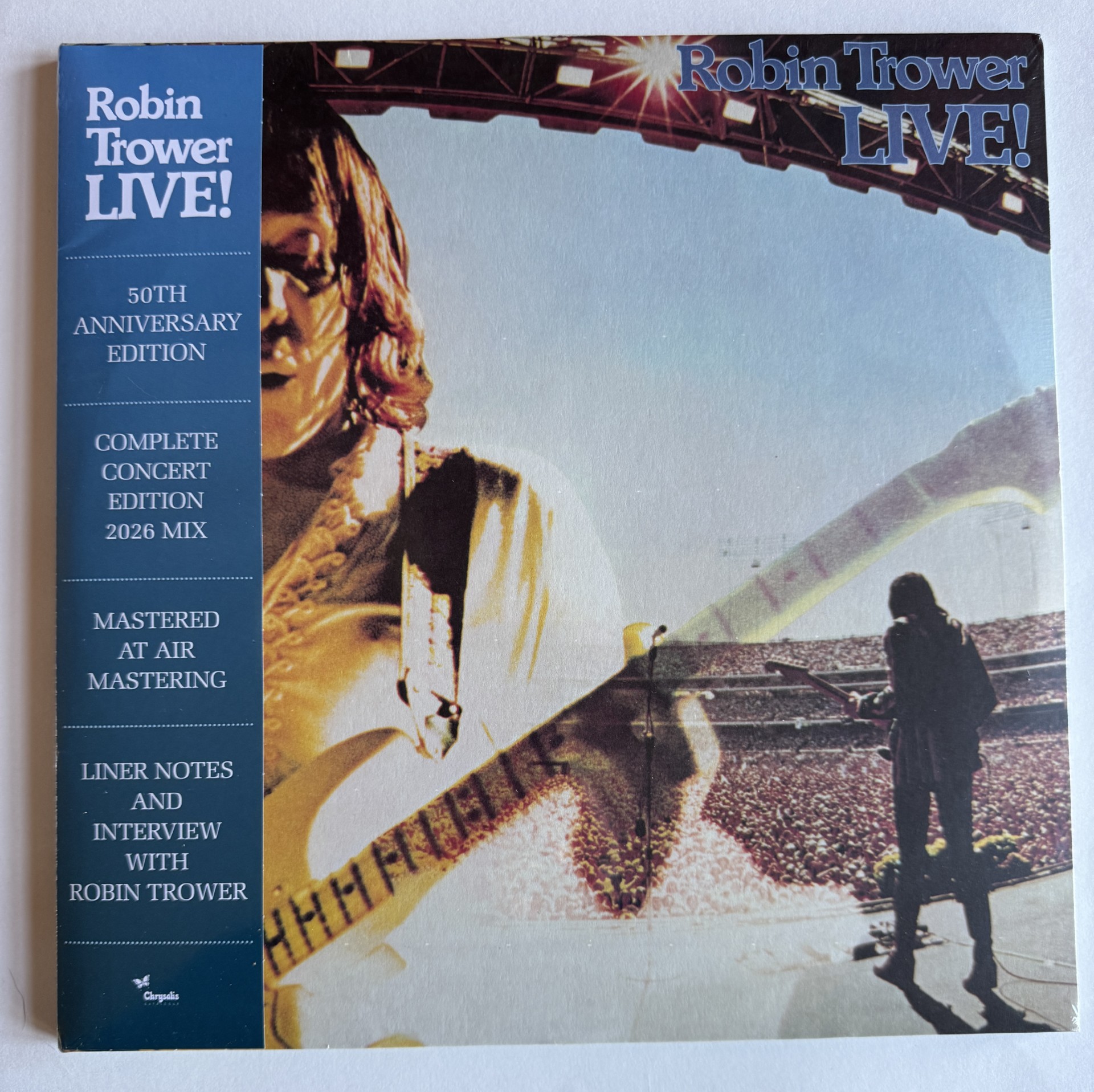
For the first time we have the entire February 3, 1975, Stockholm Concert Hall performance, and in the song order in which they were played. Not only does this reissue have 12 songs (the original 1976 release only included 7 songs on a single LP) across two LPs, but to have the proper order offers a cohesiveness not available until now. A big step up in my opinion!
The complete concert has been remixed resulting in better fidelity over the original. Don't expect audiophile demo material here though. This is live rock and roll from 1975, as recorded for the Swedish Broadcasting Company to 8-track by Electrosound Productions, Ltd. It was not intended at the time to be released. In fact the band did not know they were being recorded, which may contribute to the relaxed, yet energetic performance.
The Stockholm Concert Hall is not a big venue, like the stadium photo used on the album cover. It seats only 1770 and its wooden interior offers warm acoustics. It should be noted that James Dewer did re-record his vocals because the original vocal track had too much drum leakage to his mic to be usable. Richard Whittaker, 2026 remix engineer, notes that he retained the original vocals when possible, and that all the new tracks are from the live band performance. The trio is Robin Trower on guitar, James Dewer on bass and vocals, and now Bill Lordan on drums (replacing Reg Isidore).
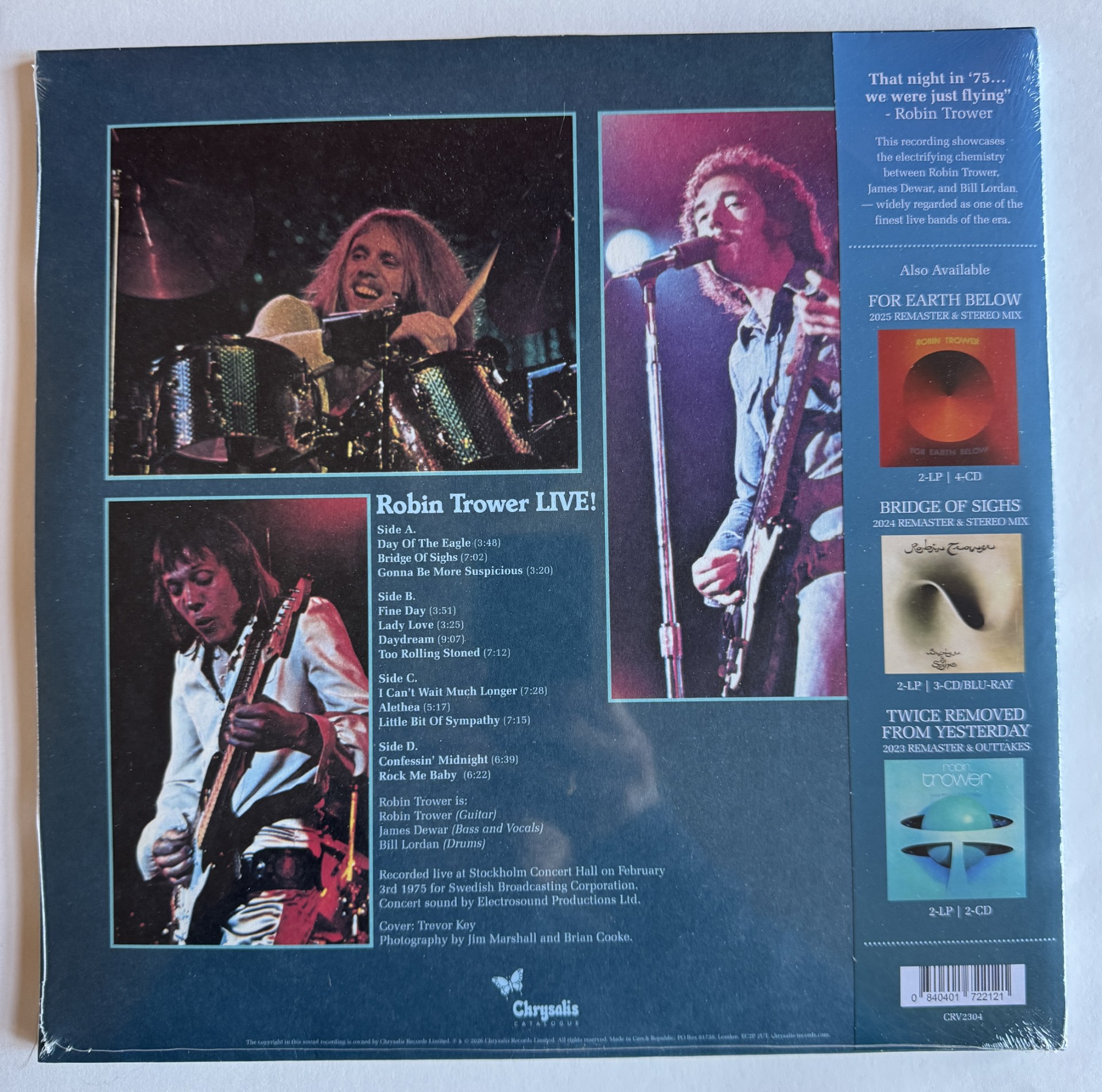
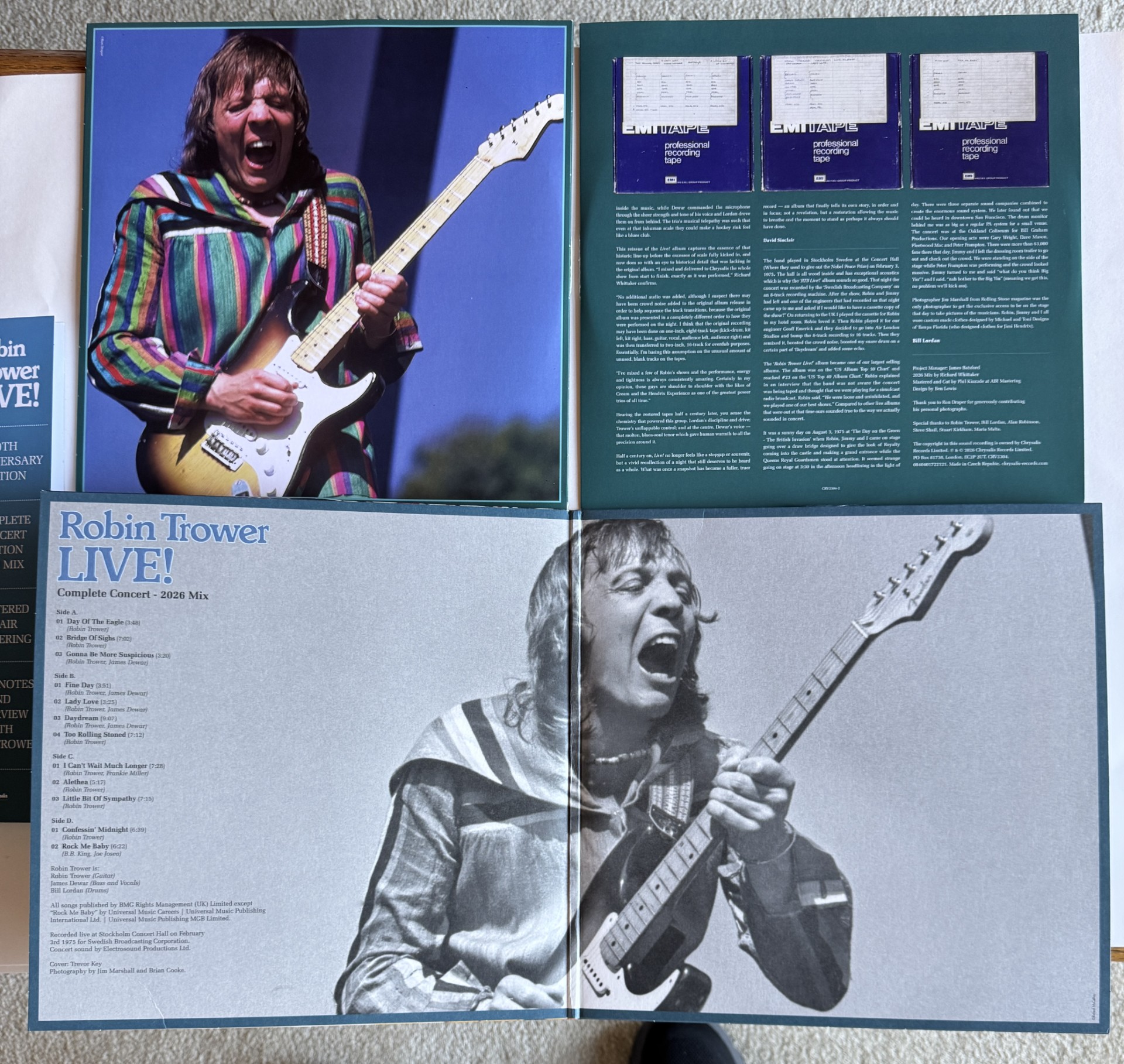
There are five songs in this reissue that have never been released until now. This adds almost 25 minutes of additional concert material. The songs are; "Day of the Eagle," "Bridge of Sighs," "Gonna Be More Suspicious," "Fine Day," and "Confessin' Midnight." These happen to be the first four songs of the concert, and the next to last. However, the 1976 LP order was rearranged to fit LP side lengths, which made it a bit discombobulated.
Sonic Comparison: 1976 LP vs. 2026 Remix
The original 1976 LP has the familiar mid‑70s Chrysalis sound: a slightly compressed, forward midrange presentation with modest top‑end roll‑off and a narrower stereo image shaped by the common limitations of the era's live‑recording equipment and practices. It's energetic but somewhat congested, with tape saturation and console coloration acting as both character and constraint. The 2026 remix, sourced directly from the original multi‑tracks, opens the recording up in ways the 1976 LP version couldn't. Instrument separation is a bit cleaner, transient detail is sharper, and the noise floor is lower without sacrificing the analog texture of the performance. Drums gain a little more definition, Trower's Stratocaster has more air around it, and the overall mix breathes a little more dynamic range. It's still unmistakably a 1975 live rock recording—but the 2026 version reveals the concert's truer character, rather than compressing it into the limitations of a 1976 single LP.
Trower said of the concert "That night in 75… we were just flying. We were loose and uninhibited, and we played one of our best shows." This 2026 remix was fully approved by Robin Trower, ensuring the edition reflects the guitarist's own sense of how the Stockholm performance should sound. Yes, this is certainly the best version of this concert available. Trower is in his element playing live. This remix allows you to get more out of the performances, and that's what it's all about.
The Technicals
- Project Manager: James Batsford
- 2026 Mix by Richard Whitaker
- Design by Ben Lewis
- Mastered and cut by Phil Kinrade at AIR Mastering
- Plated by: Chrysalis has not disclosed
- Pressed by: Chrysalis has not disclosed
- Dynamic range: Limited by the source tapes
- Vinyl surface noise: Very good
- Vinyl centricity: Average
- Vinyl warp: average
- Album Packaging: Very nice!