
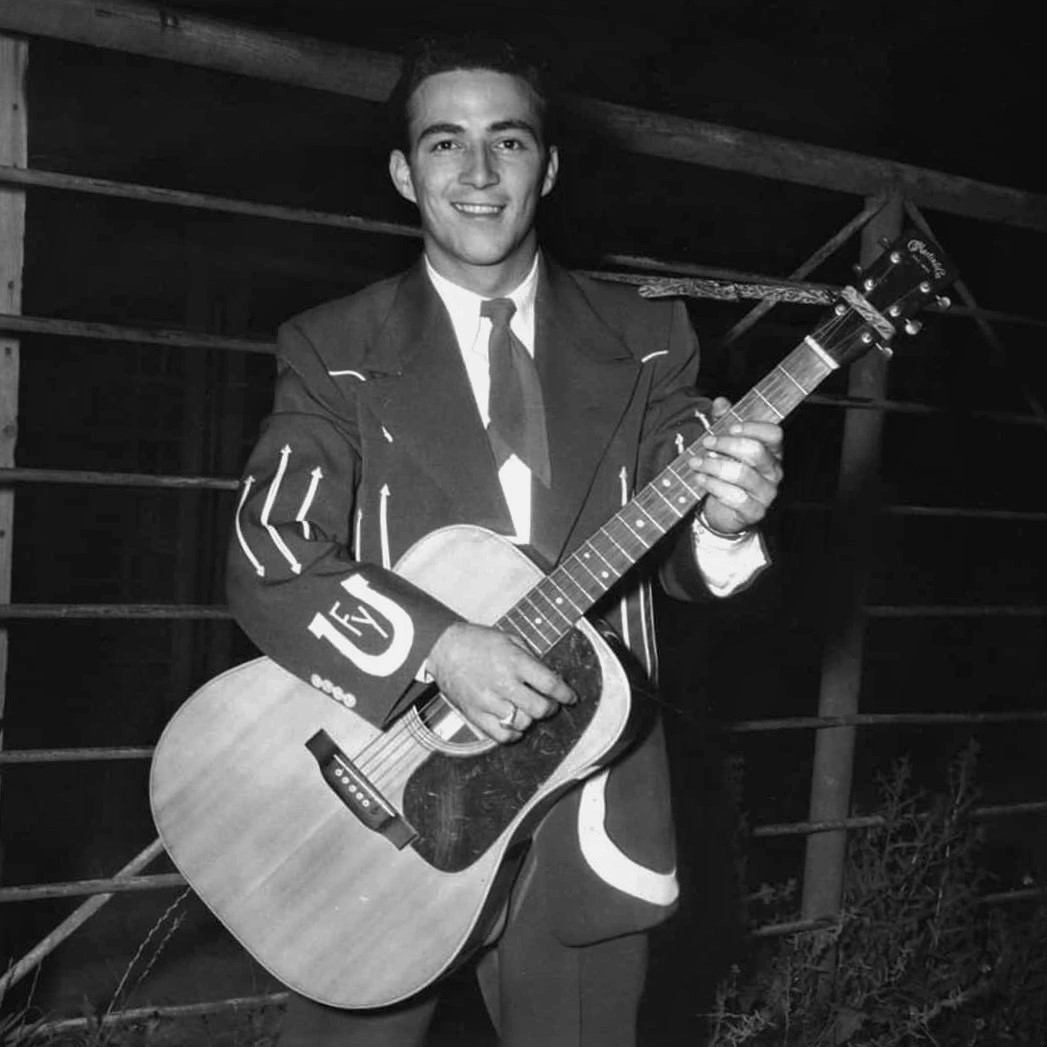
One one the finest voices from the golden age of country music belonged to Faron Young (1932-1996). During the fifties, the handsome singer had a unique tenor voice with an agility similar to that of Elvis Presley. He came from Shreveport, Alabama, and went by the monikers The Hillbilly Heartthrob and The Singing Sheriff. With a voice that could sound as flexible as a steel guitar, his ability to turn simple lyrics into riveting experiences rivaled the likes of Hank Williams, Ray Price, Webb Pierce, Ernest Tubb. And like ol' Hank, he had problems with alcohol, depression, physical ailments, and marital turbulence. Although his popularity was still strong in the seventies, his personal demons affected the quality of his later recordings. His voice began to sound like a parody of its former glory, and his albums became packed with forgettable songs. His biggest hit was the Willie Nelson-penned "Hello Walls" from 1961. His second biggest hit was a surprisingly good comeback from 1969 which he co-wrote. It's called "Wine Me Up." His life was ended by suicide.
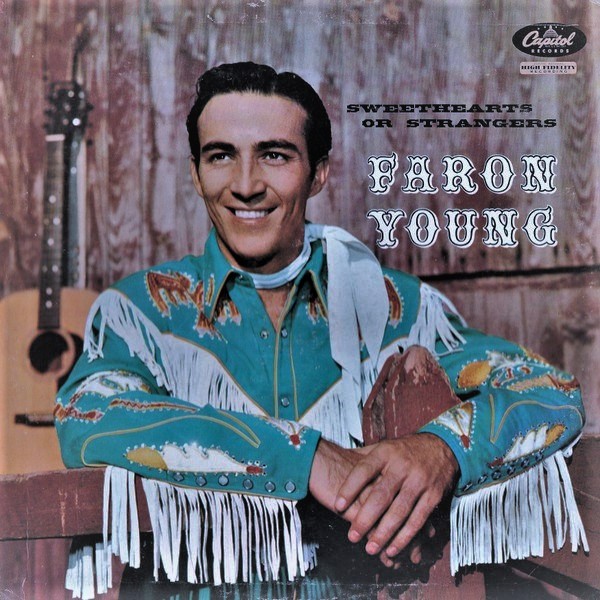
Today's subject is Young's first album, Sweethearts Or Strangers (Capitol TT778). I discovered it in the mid 2000s, courtesy of my local Salvation Army thrift store. When I first spun it, I was flabbergasted by his incredible voice and flawless phrasing. I also wondered why I hadn't seen the LP earlier. A few months later I acquired two of his Mercury titles from the seventies. They sounded nothing like the Capitol title. They were forgettable, so I didn't keep them for very long. Sweethearts Or Strangers is a mono recording from 1957, and the best cuts make it unforgettable. This was his first release in the album format. It was issued in 1957. His seven inch singles date back to 1952. Although this album is straightforward country-pop, many of Young's previously released singles are performed in the ultra twangy Hank Williams style, which I find very appealing. I'm looking to add more of Young's early material to my music collection, and when I do, you'll read more about this giant of country music. Along with the incredible music, this album features one of the best looking cover photos in my entire LP collection.
The album opens with the title cut, "Sweethearts Or Strangers," which was a hit by The Singing Governor (of Louisiana), Jimmie Davis in 1940. While I don't dislike Young's performance, it doesn't grab at me the way Davis' original does. The real action starts on cut two.
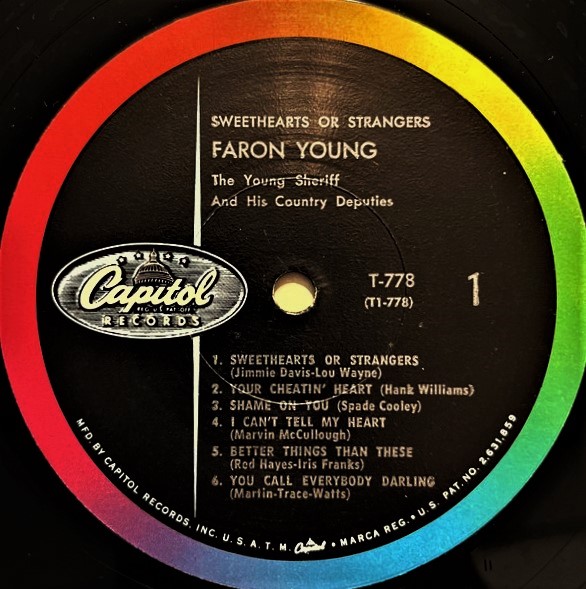
Cut two is where this album really starts. It's a stunning—and I do mean a stunning—performance of Hank Williams' signature song "Your Cheatin' Heart." Does it replace Hank's original? The answer is a resounding no, but it's awesome. The cut opens with one of the loneliest sounding steel guitars ever committed to vinyl. The guitarist is the great Buddy Emmons (1937-2015) and you won't be feeling lonely when Young sings the familiar lyrics. You'll also wonder, just like I did, why you didn't buy this album sooner in your life. The way he sings the classic is so incredibly perfect, it sounds like it was written specifically for him.
Cut three is in my opinion the definitive recording of Spade Cooley's "Shame On You." I've known the melody since I was eight or nine, since my father used to play a swinging instrumental version by steel guitar virtuoso Noel Boggs. Before I heard Young's version, I didn't know the tune had lyrics, and what good ones they are! I always catch myself singing along with Young, and there's always that brief moment when I think that I can sing as good as he did. Of course, it's only a fantasy, or perhaps something I did well in another lifetime. His singing on this cut is perfect. For the sake of this review, I listened to other recordings of the song, including Cooley's own recording, featuring singer Tex Williams from 1945. Not one of them comes within miles of Young. The great Red Foley recorded a fox trot version in 1945 with Lawrence Welk (what a strange pairing), and I kind of like it, as I like both Foley and Welk. But, again, nobody sings it like Young. Like the prior cut, this is my idea of vocal and musical perfection.
Side two cut two is one of the most covered songs of them all. It's Hank Williams' "I Can't Help It." Williams covers, like those from Bob Dylan and Willie Nelson, are often improved by others, and this is a shining example. As much as I love ol' Hank, his twangy voice can sometimes sound annoying. Young's voice is equally twangy, but not so much that it draws your attention away from the song's beauty. Emmons' steel guitar opens the cut with four seconds of sublime Hawaii-meets-Nashville magic, and when Young starts singing your heart will melt. This cut also has the best sound on the record, because it sounds a little more dynamic than the previously mentioned cuts. The string bass provides a rich foundation, and Emmons isn't just playing brief solos, he's staying on for the entire ride. There's also a delicious guitar solo from what sounds like a Fender Telecaster. We're also treated to two fiddles. It's so damn good! Other fine interpretations of this song include Ray Price, from his debut album Ray Price Sings Heart Songs (Columbia CL 1015), and a surprisingly good version from Bobby Vinton, from his underrated album Roses Are Red (Epic BN 26020). Another version I like is by Margaret Whiting from her album Margaret (Dot DLP 25113). If you'd like to experiment with others, check out this huge list HERE.
Cut three is "Worried Mind." This is the only version of the song that I own or know. My notes say "Buddy Holly." because the song would have been perfect for Buddy's voice. However, Buddy never recorded with a steel guitarist, and Emmons is stealing the show! The sound is pretty close to the sound of the previous cut, so turn the volume up just to the point where the steel guitar sounds like it's in the room. You will be impressed!
Cut five is called "That's What It's Like To Be Lonesome." It's disappointing, because Young recorded a different version that's much better, and without the LP's reverb, which for some reason is a bit too much on this cut. I cannot find much in the way of information on the alternative version, but it's featured as a bonus cut on the CD version of this album. It's so incredibly good that I want to share it with you right HERE.
Some albums shouldn't be judged by the quantity of great cuts, but rather by the quality of the great cuts. This album is a perfect example. The five cuts I love on Sweethearts Or Strangers are off-the-charts incredible. To me, this is a must-have album. I haven't heard it in any of the digital formats yet, so all I can say is this: Find a way to make it come out of your speakers!
Of course, no review of an album for an audiophile magazine is complete without some commentary on its sound. Overall, it sounds very good and at times excellent. With my friends, I use a letter grading system. "Shame On You" and "I Can't Help It" are A++. They have the kind of sound that I would proudly use to demo my audio system. The tonality is perfect from top to bottom, and the amount of reverb is just enough to provide the music with ample size. Other cuts have a little more upper-midrange and a little too much reverb, rendering them a solid B to an A-. Having said this, when I consider the dripping-in-digital-reverb music that plagues our once wonderful audio shows and audio stores, the sound of this album will be for many a breath of fresh mountain air.
If you're already dipping your toes into fifties-era country music, with people like Johnny Cash, Hank Williams, and hopefully Ray Price, add Faron Young to your list of must-hear artists. His voice will mesmerize you.