

One of my all-time favorite violinists is Arturo Delmoni, who has recorded far too infrequently. Here we have an opportunity to hear him performing in a superb reissue of his recording Music for Violin and Guitar. Originally released by Athena Records in 1993, this reissue is a significant sonic improvement over the original CD-only version for which Discogs reports a last sales price of $150. Read on and let me tell you more—it's a great story.
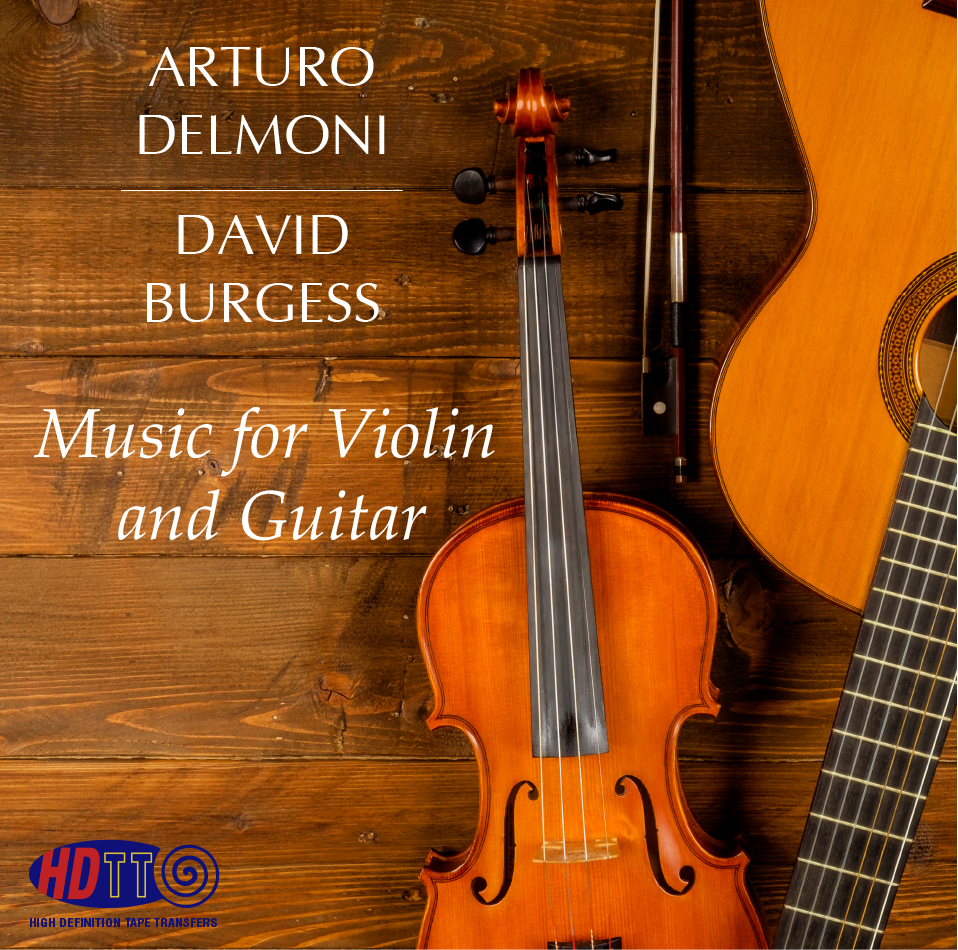
Music for Violin and Guitar, Arturo Delmoni (violin) and David Burgess (classical guitar). HDTT 1993 2026 (DXD remastering from the 44.1 files recorded by renowned recording engineer Bob Katz in an auditorium in Bronxville, NY, in 1991) HERE
The key focus is, of course, the music and the musicians. When originally released in 1993, Robert Hesson wrote a review for Stereophile (Recording of the Month, November 1993, here), in which he says, in part, "These are remarkable performances captured in unusually lifelike sonics, and I strongly recommend them, especially to those who have, or wish to, come under Mr. Delmoni's selfless spell."
They are. And I too strongly recommend them these many decades later.
Playing music of emotional complexity, Delmoni's tonal control and subtlety of phrasing are impressive, as always. And David Burgess is the perfect collaborator, mirroring Delmoni's restraint and intelligent playing in every measure, and providing some excellent arrangements.
The album opens with Handel's Sonata in E major, the 15th violin sonata (of 16), all of which were published as his Opus 1. Or, it's the 14th of 15, depending on how you count the first sonata in the series. Is it one sonata with revisions, or two separate sonatas? Ah, well. Such quibbles are the domain of musicologists, not poor listeners like me.
I'm told that the original accompaniments for the Opus 1 sonatas exist only as figured bass. In this recording, we have guitarist David Burgess' realization of the figured bass arranged for classical guitar. For me, this does no violence to the composer's original musical intent. I think Burgess' contribution is marvelous, and musically very engaging. Delmoni has appropriately ornamented the Largo movement (included in the free sample download file below). This is completely consistent with performance practice of Handel's day and most likely would have been expected by the composer. The ornamentations are both tasteful and beautiful. And sound exceedingly difficult to play.
John Haley was kind enough to share with me some background I found interesting and will share: "Delmoni plays a magnificent G.B. Guadagnini violin of 1780 in this recording, which he is still playing today. The great Italian violin makers (as well as violin makers of today) primarily used as models the violins of Antonio Stradivari, who lived from 1644 to 1737. Handel lived from 1685 (same birth year as Bach) to 1759. As an admirer of Italian music, it seems likely that Handel could have been familiar with what we call great old Italian violins, or at least what they could do."
As a further tidbit of interest, John Marks tells me that the violin strings were cryogenically processed by Museatex Cryogenics, Inc. I've been told this is common for metal and metal wrapped guitar strings, but this is the first I've heard of cryogenic processing of violin strings. Further below, you'll read about cryogenic processing of CDs, so hang in there.
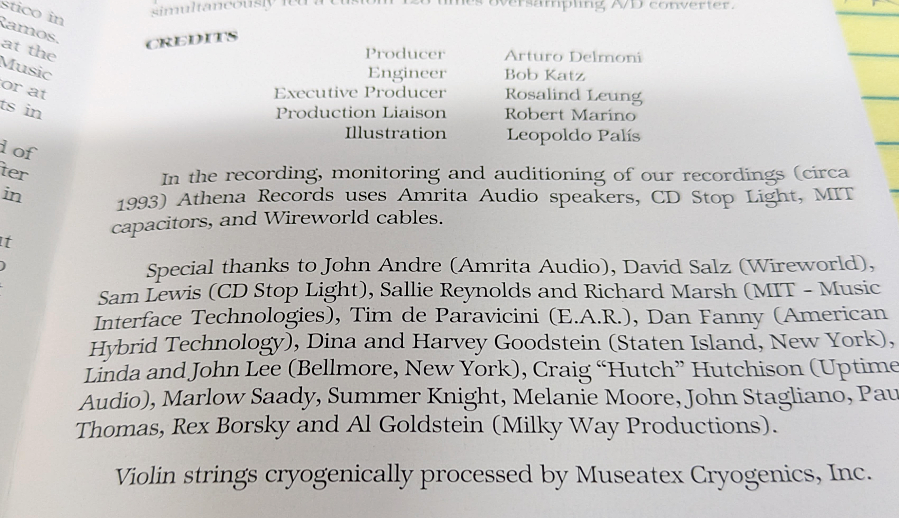
Page from the original CD's enclosed booklet.
And, then, there is the delightful work by the late-Classical guitarist, Mauro Giuliani, his Sonata in A major, op. 85. Most often we hear this work performed with flute and guitar, but Giuliani intended it also for violin and guitar, and that is what we hear on this album in all its singing glory. It is as incisively charming a performance as one might ever be so fortunate to hear.
The work which I find the most intriguing, and challenging, is found in Tracks 9-11: David Leisner's Sonata for Violin and Guitar. There is dynamic energy in the opening and closing movements that is wonderful to hear. These outer movements are balanced by an inner movement that is quiet and reflective, with technically challenging modulations that, as Robert Hesson commented in his review, "are both technically clever and richly ambiguous in the best poetic sense."
The remaining pieces on the album are completely enjoyable encore pieces by Kreisler, Granados, Ravel, Paganini, and Chaminade—bits of fluff perhaps, but exquisitely performed.
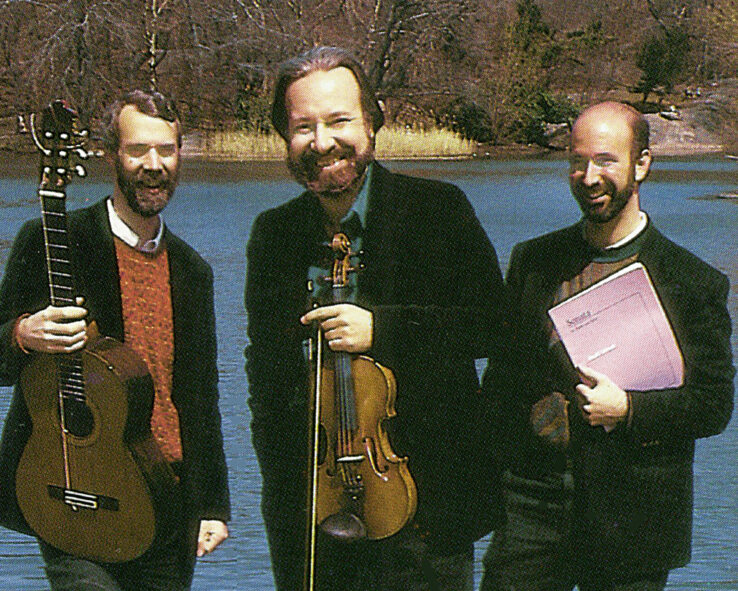
David Burgess, Arturo Delmoni, David Leisner (from around the time of the recording sessions in 1991)
So, what about the restoration?
This is a relatively rare and valuable recording. It is a recording of historical significance. It is a recording by two marvelous musicians providing compelling performances of extraordinary technical and aesthetic merit. And, the original digital master tape has been lost. Gone. Poof. Nada. Nowhere. All that is available is the original released CD. So, what to do?
Start with what you have. It's a challenge.
As John Haley wrote me while discussing this reissue, "Of course this exercise would not be worth doing unless the recording itself is an exceptionally good one to start with, which Music for Violin and Guitar definitely is."
In the free download below, you can follow the process through each step. HDTT, restoration magician John Haley, and co-producer John Marks have graciously agreed that we can share these files with Positive Feedback readers as a free download. By listening, you can hear the same track (Track 3, the Largo movement of Handel's Sonata in E major) as it transforms from step-to-step. Here are those steps:
Step 1: The "raw" CD file at 44.1kHz at 16-bits as released back in 1993.
Step 2: Give the CD a cryogenic treatment. Why not? Give it a shot. Does the CD sound better after being cryo'd? Answer: Yes, it does sound better. Go listen to the sample file for yourself.
Step 3: Play the cryo'd CD on a high quality transport and DAC (Bricasti) and capture the analog output to DXD via a very good A/D Converter. This breaks the chain of jitter (that bane of digital sound) which follows along, cumulatively, with every file conversion and which would otherwise have been baked in from a quarter century ago.
Step 4: Let restoration magician John Haley of Harmony Restorations LLC perform some selective post-transfer tweaking to remove artifacts and apply some gentle EQ where needed. All by ear.
Now listen to the transformation. Yes, go listen for yourself. I hear a tremendous improvement over the original CD. It's an absolutely gorgeous transformation!
Free Download of Restoration Comparisons: Track 3, Music for Violin and Guitar
I am not able to explain what processes are at play when one cryo's a CD. It's been explained to me... It's all about the physical parameters of the polycarbonate substrate of the CD and I won't pretend to understand it to a point I can further explain it. What I can tell you is that I hear a difference. That difference is a positive improvement in the tonal character, ease, and lowered edginess. I find the difference immediately apparent as I play the first track of the download samples where the original "raw" CD track ends (at 3:11) and the cryo'd version of that same track begins after about a 1 second delay (at 3:12).
The "restored" track improves the sound quality yet again. In the download, you will find two versions: the DXD restored file and that file converted to 44.1kHz so you can compare apples-to-apples at the same resolution of the original CD should you wish to do that.
John Haley's restoration legerdemain is remarkably successful, in my opinion. The original CD was always "good." The restoration is tremendously more listenable, more enjoyable, more lifelike, more true to the natural sound of the instruments.
Kudos all around: to the musicians, to original recording engineer Bob Katz, and to the trio who made this restoration for us, HDTT, John Haley, and John Marks. Many thanks to all of you for this gift of great music!