Seriously, what has our audiophile’s world come to?
Back in “normal” times, getting better sound was straightforward: spend some money, and expect a commensurate audible return on investment. Plump for a big ticket latest and greatest, or pay the mortgage and upgrade economically. Tweaks, tubes, footers, that sort of thing, under $100, maybe $200. A new platter mat, perhaps.
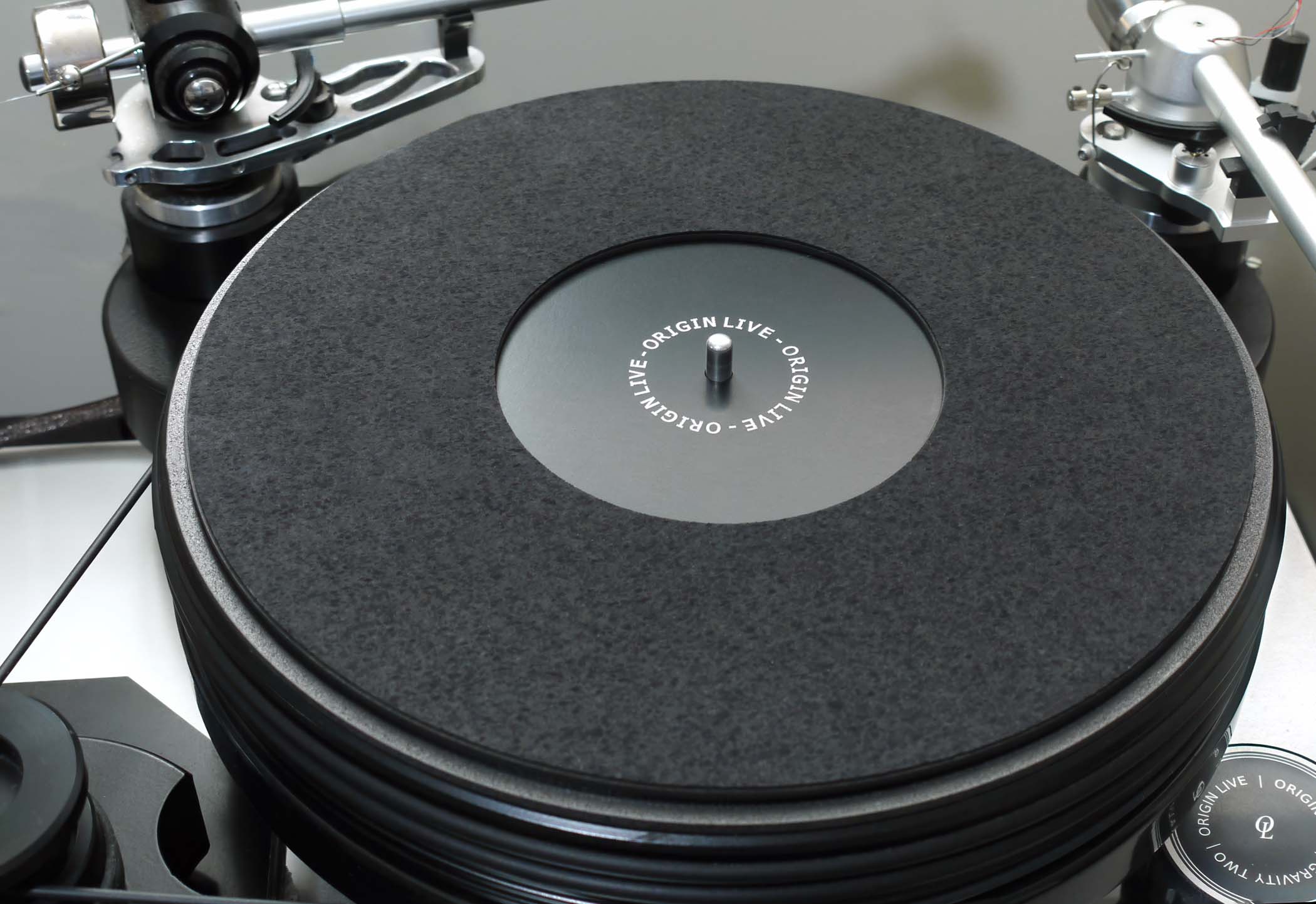
Now comes a review of a £325 platter mat, the Origin Live Strata.
US prices on imported goods currently fluctuate. Spending $523.44 (today’s retail at Analog Matters, a US Origin Live Dealer) to replace the free felt or rubber mat that came with your, say $2K turntable, might seem ludicrous. Unless, of course, it made your rig sound better than the $3-5K+ table, arm, or cartridge you’ve been mulling. Or maybe, if it simply made listening to your vinyl that much more pleasurable.
The Strata is the latest innovation from Origin Live, the noted UK turntable and tonearm manufacturer. It is a major upgrade from their original “Upgrade“ mat I reviewed (Here) in concert with their Cartridge Enabler head shell isolation pad and the Gravity 1, a 67g record “weight”. The latter was recently replaced by the 70g Gravity 2 (Here). All their analog add-ons will work with virtually any brand turntable or tonearm, and can be economically shipped anywhere direct from the UK.
Yes, some turntables are designed to be used without a platter mat – usually because the design adequately isolates the LP from mechanical drive-motor/bearing noise. My venerable Well-Tempered turntable screw-clamps the LP directly to a slightly concave acrylic platter, for example, and sounds quite fine. My Nottingham Analogue SpaceDeck’s metal platter has a label recess for naked disc play, but they strongly recommend a pricey graphite “Heavy Kit” for best performance. I’ve compromised with a thinner Boston Audio graphite mat instead, which does indeed deaden the platter nicely.
After decades refining their tonearms and turntables, Origin Live began thinking about self-generated mechanical vibration in the stylus/groove interface itself. Wait, the stylus tracing a vinyl groove is a problem? Yes. You can easily hear the stylus banging about the grooves by playing a disc without amplification – it’s that faint “needle chatter”. It’s masked by the amplified sound, but it’s always there – tiny vibrations mechanically transferred from stylus up the cantilever to the cartridge, which then “transduces” vibrations into an electrical current, but doesn’t eliminate them. Some portion goes from cartridge body to head shell to tonearm, exciting any resonances along the way, all then getting reflected back from the pivot, faintly re-vibrating the arm, cartridge, and ultimately the stylus, adding low level random noise to the original signal. This is a well-known issue in tonearm and cartridge body design, and which the inexpensive Cartridge Enabler was designed to mitigate.
The Strata goes beyond tiny to address micro-vibrations in the vinyl itself. Technically, because a wiggling stylus has inertial momentum, every time it changes direction in the groove the energy it has stored as mass and velocity gets drained off into the vinyl in the form of mechanical vibration (and heat from friction). Unscientifically, I suspect that these inertial reversals are at least part of “analog sound”, and why “tip mass”, cantilever rigidity, compliance, etc., are key factors in cartridge design and performance. On both the size and hardness scales, 180g vinyl may look to a tiny diamond like a slippery slab of quivering jello, but those grooves do wear out a diamond stylus after a couple thousand hours of play.
These micro-vibrations are directly propagated into the vinyl disc itself, and thus registered by the “vibration measuring” stylus as low level noise overlaying the musical signal. Among other tasks, modern platter mats, record weights, and clamps are intended to reduce this noise. That they all sound different is because different shapes of different materials absorb, resonate, and reflect vibrations of different frequencies differently.
Origin Live’s £50 “Upgrade” platter mat appears to be a 1mm thin flexible disc of the same gasket-like material used in the Cartridge Enabler. In both the Gravity record weights, the material was apparently employed in contact with the record label, but with other materials (including wood) loosely stacked above it, damping vibration through what they call tuned “destructive interference” rather than just simple mass, which they find can deaden articulation, extension, and clarity at the frequency extremes.
The Strata name refers to its construction from three dissimilar layers. The top layer appears to be the same material used for the previous mat, here only loosely attached to a second layer which is itself firmly bonded to the bottom layer, resulting in a rigid mat almost 5mm thick, and weighing about 270g (9 oz). The bottom layer incorporates a pattern of thin (laser cut?) resonance blocking slots similar to those employed in the Gravity record weights. I don’t know if the middle layer is also specially treated. Origin Live says they evaluated hundreds of combinations of materials before settling on the final arrangement, but are disinclined to identify the winners. The extensive R & D and small-batch manual assembly probably contribute more to the price than the materials.
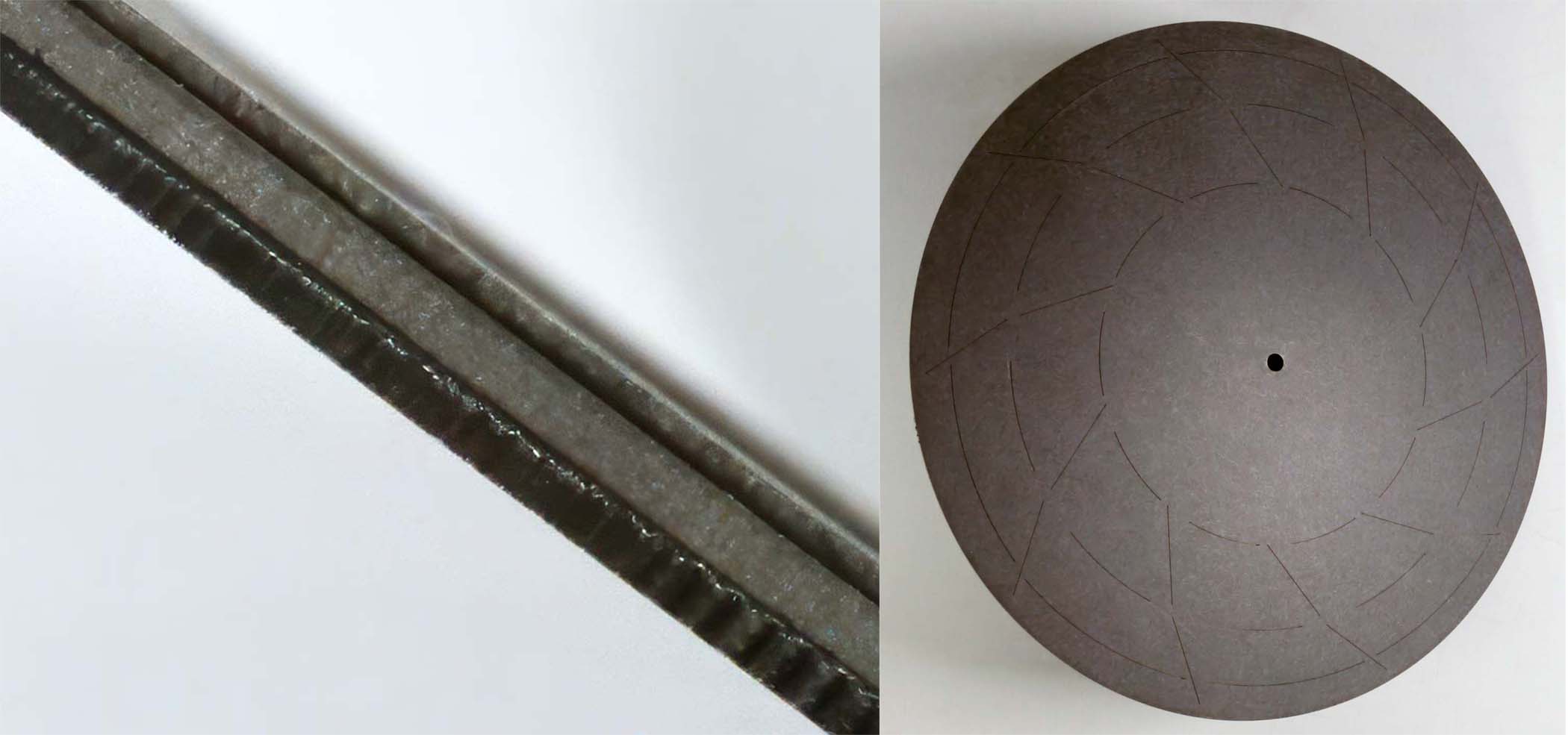
The most obvious visible difference between the two Origin Live mats is the “doughnut hole” on the top of the Strata. It’s worth noting here that the vast majority of British/Scottish turntables since forever were supplied with simple (good enough for Linn and Rega) thin felt (or foam) platter mats, as were many non-UK designs as well. So the thin Origin Live mat was and is an easy drop-on “upgrade”, and especially for all the turntables out there fitted with a Rega no-VTA-adjustment tonearms.
Originally, platter mats were flat, and primarily designed to block motor and bearing noise, known as “rumble”. However, most LPs do not have a flat cross-section. The label area is typically an “island” higher than the grooved area, as is the outer lip, which means the grooves are not uniformly – if at all – in contact with a flat platter mat, no matter how heavy a weight is on the spindle. There have been many slight variations of this disc profile over the years, but it originally provided “anti-scratch” bumpers in the early days of “automatic record changers” that stacked several discs atop a tall spindle, dropping and playing them in sequence.
There are now many platter mats with a shallow recess for the label area to offset this label/groove differential and keep the mat in better contact with both. The Strata takes a radically different approach. The label recess is 125mm diameter, wider than even the original Decca wide band FFSS label. It is actually a cutout through the top two layers, and about 3mm deep, guaranteeing the bottom label “island” does not contact the mat at all. That’s also why the Strata has a smaller diameter (285mm) than the flat Upgrade mat (295mm), allowing the LP rim to overhang the top layer and insure disc/mat contact is only under the grooves. Which of course begs the question of what record weight – if any – should be used with the Strata. In my evaluations I used the Gravity 2. Of course I did. The Cartridge Enabler too.
Countless mats of various materials have been produced over the years, and they all sound different. We all know of elite reviewers who merrily swap out $10K cartridges to change an LP’s sound to taste. In the world I live in, having multiple mats on hand has served much the same purpose, on the cheap. I’ve compared the Strata to several from my own collection, including popular current mats like the rigid Funk Firm Achromat ($100), the flexible Herbie's’s Way Excellent II ($70-90 depending on thickness), an earlier version of Herbie's’ Grungebuster (now $159), the Origin Live Upgrade mat (£50), plus generic felt and foam mats.
Sorry, I don’t have any of the other $200+ high-tech mats the “vinyl revival” has brought to market. But from my collection of 40-50 year old mats I added a Chadwick Modifications dual-layer Corktone mat, the exotic French Planax-PX, and the Canadian EON Research Tri-Pad, a three-layer cork, acrylic, and soft polymer mat.
My criteria for platter mat comparisons were resolution, instrumental and vocal textures, ability to convey clarity in complexity, 3-D soundstaging, extension and definition at both frequency extremes, liveliness and micro-dynamics, and suppression of surface noise.
While I have more than a few audiophile reissues, this is a review of a platter mat. I was an avid record collector long before becoming a card-carrying audiophile, and have thousands of original LPs to choose from, so please indulge me. I’ve selected a few that may never been heard in Hi-Fi Show demo rooms or received audiophile remastering, but easily reveal differences between mats.
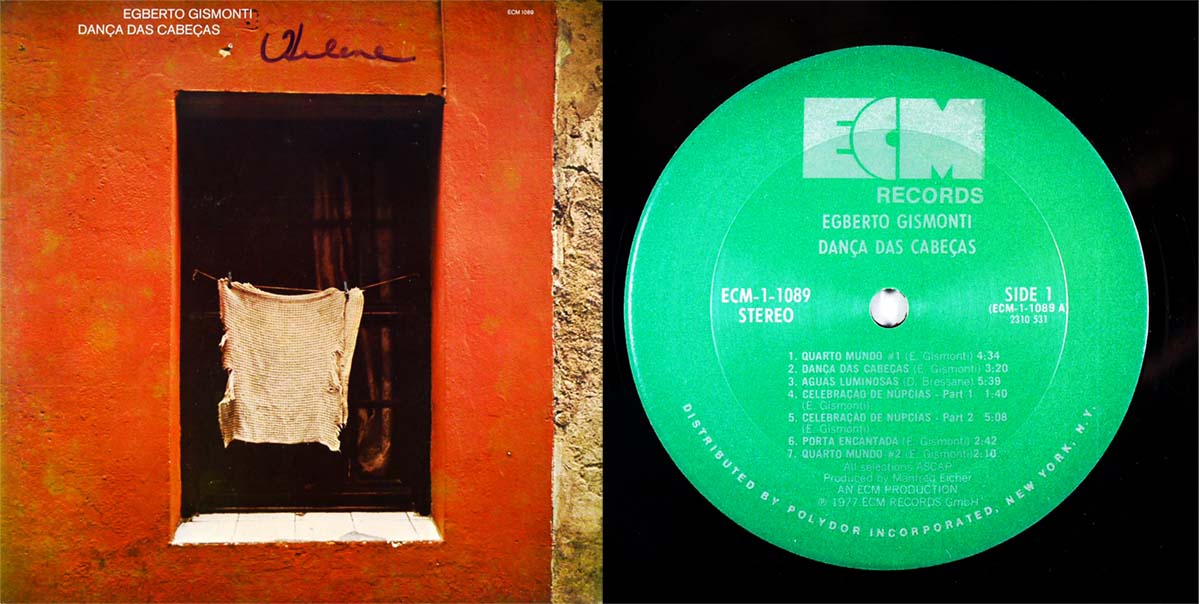
I’ll start with an LP I keep handy to wake-up (sometimes sober-up) non-audiophile visitors to my sound room: Dança das Cabeças, Egberto Gismonti and Nana Vasconcelos, on ECM 1089 (1977 US pressing). It’s what was known back then as a concept album, 6 compositions on side one, four on side two, but played continuously, 25 minutes each side with no breaks. It evokes two boys walking through the Brazilian Rainforest, beginning with startlingly real jungle bird calls. Gismonti plays 8 string guitar and wood flute on side one, switching to piano side two. Vasconcelos handles percussion throughout. The duo apparently first met in Norway only shortly before making the recording over 3 days at an Oslo studio.
Play the birds LOUD enough, and the brain can go into some primal hyper-vigilant mode; these are the last of the dinosaurs, after all. But…there are no 3 minute songs or breaks between cuts, no throbbing beat or verse/bridge/chorus to settle into, and no algorithms to divert attention. Unfamiliar, unpredictable yet compelling, the recording asks the unsuspecting to listen…intently. It’s a matter of engagement; a quality hard to quantify, but familiar to many as the “play the first cut, stay for the side” syndrome common to analog audio. By the way, the Portuguese title does translate as Dances of the Heads.
Using the Strata, the ECM sonics are stunning, instruments close-miked, but with plenty of hall sound, and wide and deep imaging. It’s overall the most “alive” I’ve ever heard this disc, outclassing every other mat I’ve tried on the “engagement” scale. That characteristic would play out on virtually every other disc I used for comparisons. One caution: do not play the intro loudly if you have excitable pets in your house, or on your lap.
Pre-internet, folks proudly possessed their own music, and often signed the jacket. To boldly do so on the front cover with a marker seems a declaration of importance. The German pressing is probably better still, but I must thank “Helene” for keeping our US copy pristine.

There’s also no simple measurement for a system’s ability to untangle musical complexities pressed in the microgrooves. So here I chose a much overlooked, genuine audiophile recording: Charles Ives’ Holidays Symphony, Vox Turnabout TV 34146S, Donald Johanos leading the Dallas Symphony Orchestra. It’s one of a few LPs recorded there by David B. Hancock. How many budget label LPs provide any info on the recording process like this?
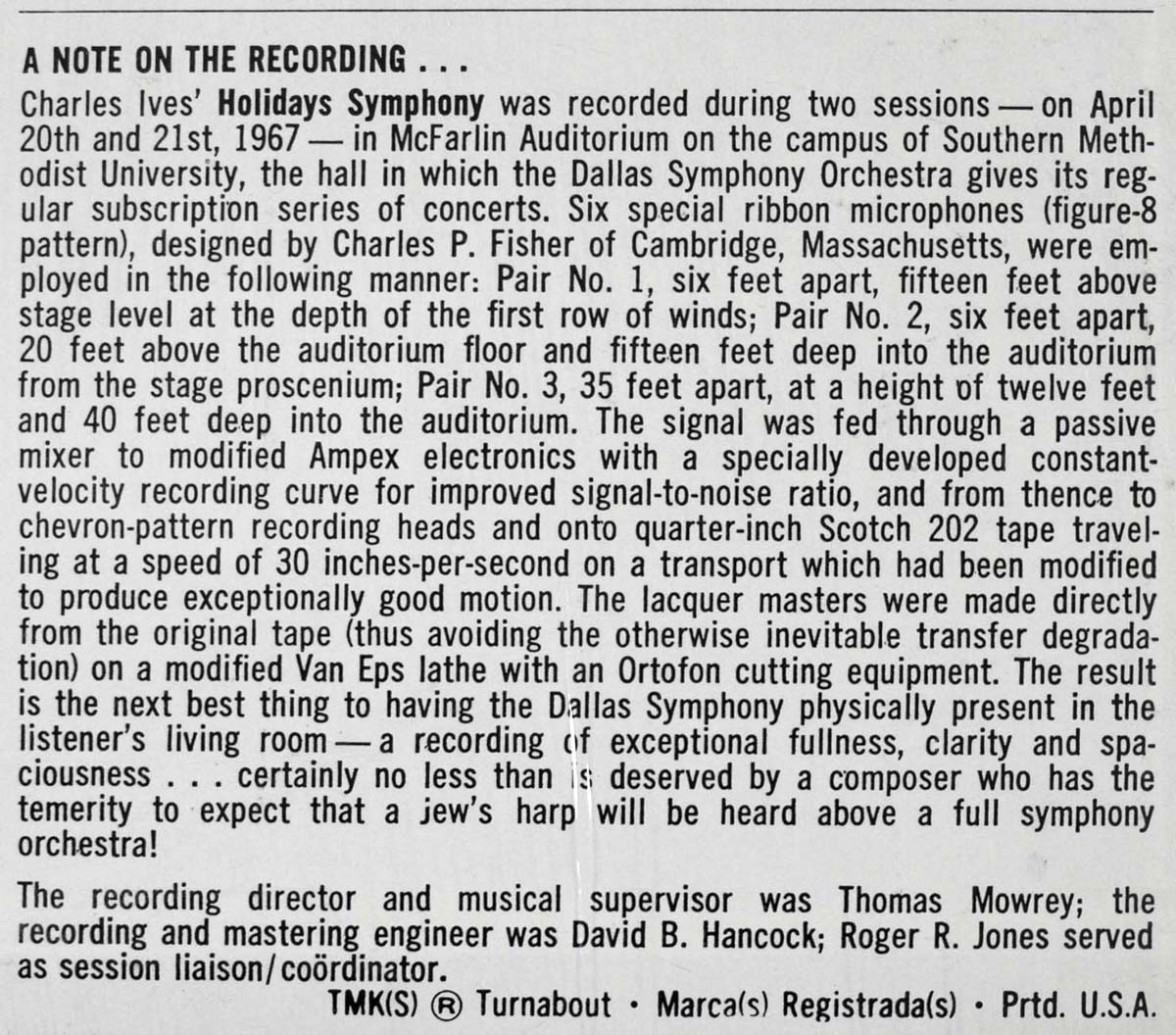
My copy is an early pressing with DBH in a box scratched in the runout grooves. The later black label may lack this, and is considered inferior. Alas, Hancock’s Dallas Rachmaninoff Symphonic Dances/Vocalise (Turnabout TV34145S) got all the raves and reissue attention; Acoustic Sounds will sell you a 15 ips tape of it for $450.
OK, so Rachmaninoff is an easy sell. Ives, not so much, mostly because he had a reputation for being “difficult”. The “Holidays Symphony” might be his most accessible stuff – it’s not even a “proper” symphony, but a pastiche of four compositions (from 1904-1913) he put in a folder labeled N(ew) E(ngland) Symphony, to be played separately, or together as a symphony (and only premiered in 1953, a year before his death). Decoration Day has been renamed Memorial Day, and George’s birthday has been merged with Abe’s to boost mattress sales; they are here played in calendar sequence..
This Ives recording is actually pretty mellow, more meditation on memories than celebration, 1812 style. Ives-ian tropes abound of course, overlapping but still familiar melody fragments, two brass bands playing different tunes simultaneously (a childhood memory – his father was a band leader), and enough almost-the-wrong-note dissonance to charm a Monk fan. While it can get raucous at times, the overall dynamic range won’t faze any platter mat – but then, the devil’s in the details.
Hancock’s unusual microphone setup yields a broad and deep soundstage, all the inner detail needed to unravel the polyphonic scoring, and ample hall sound. Imaging is precise – a church bell way back upper right, a jew’s harp lower left front. The Strata excels at navigating the swirling cross-currents of the score that lesser mats might turn into ripples – it’s a question of resolving both instrumental textures and microdynamics. The Strata sounds like you somehow got a new eyeglass prescription for your ears.
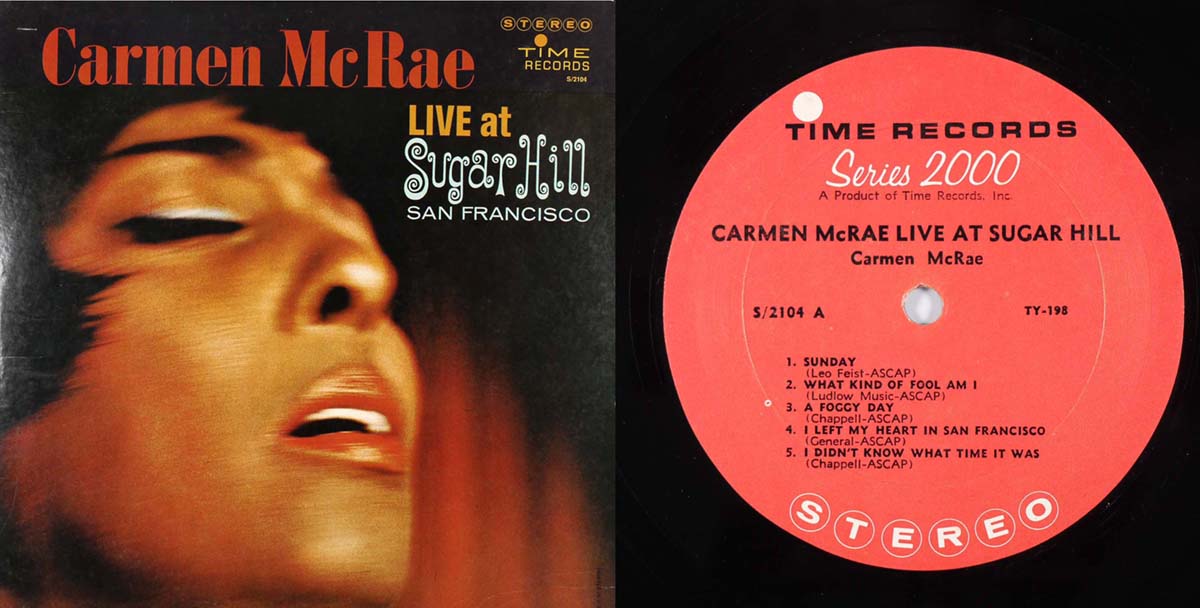
For the essential Female Vocal category, I cued up Time Records S/2104, Carmen McRae Live at Sugar Hill, San Francisco, 1963. It’s among the first stereo LPs I ever bought, and the first convincing “you are there” live recording I heard, so it ticks several boxes. I’ve replaced it a couple times over the decades as I stumbled across copies in better condition. Sugar Hill was a small Blues-Jazz club in San Frisco’s fabled North Beach area, footsteps from the larger and more famous Jazz Workshop.
The engineer was one Wally Heider, who knew a thing or two about location recording. He places McRae up close, front and center, with a piano left, bass and drums to the right. Unusually for the time, she was free to choose her own songs and musicians, which obviously put her at ease on the two nights of recording. The size of the venue meant small but enthusiastic crowds that seem (and likely were) very close to the stage. Heider splits the audience stereo-wide left and right.
The Strata brings a microscope to this closely miked, intimate performance. McRae is in her early 40’s, the prime of her career. Most singers can drape some lyrics over a melody and keep on the beat. McRae had started as a pianist in her teens, and understood performance – you can almost hear the soft/sustain/damper pedals in her precise but flexible phrasing, often behind the beat. She had that unique voice, ranging from a purr to a growl, and a sly sense of humor. Every lyric seems imbued with emotion, intelligence, and wit, much like a Shakespearean actor conveying meaning to words the audience no longer understands.
With the Strata, you hear everything as if you were sitting right in front of the stage, and you hang on every syllable. You are aware of the club’s ambience, even the faint honk of street traffic. Set the level so the audience applause matches your own clapping, and enjoy some turntable time travel.
Bob Shad of Time Records produced this album, and later moved on to Mainstream records, who reissued it as Carmen McRae in Person in 1972, which I’ve never heard. There have been 2 Japanese CDs (under each title), likewise. All 35 minutes, no bonus tracks, sadly.
Audiophiles are aware that the dynamic range of almost every recording is compressed to some degree for the master tape from which the stampers that actually press the final vinyl product are created. Origin Live suggests that the Strata extends the dynamic range and clarity at both ends of the frequency range; the implication being that other platter mats may not.
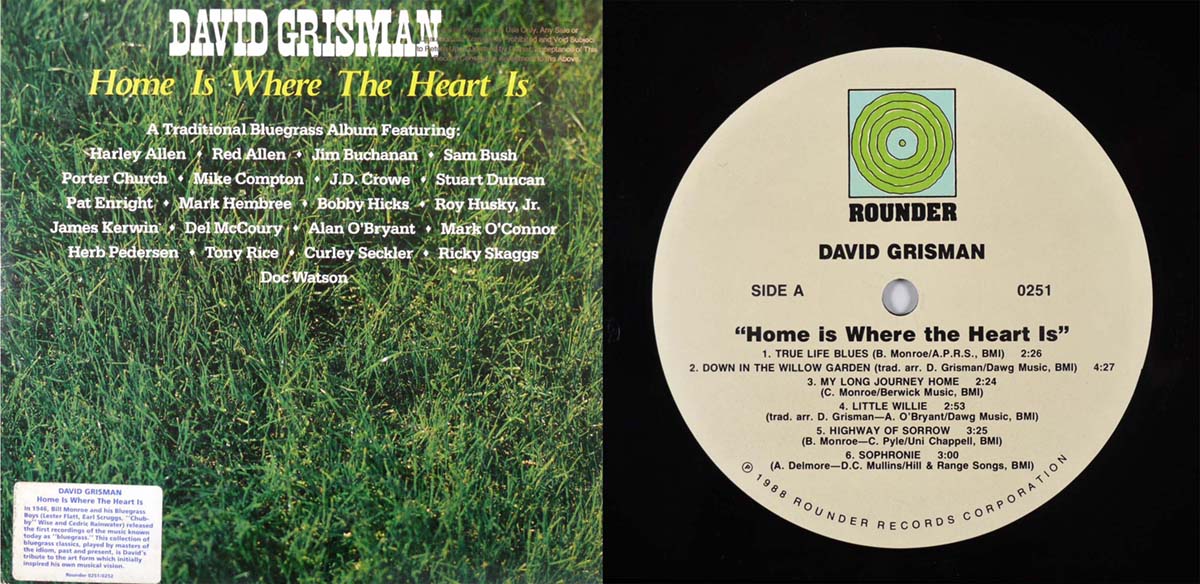
To evaluate high frequency dynamic behavior, a recording needs to have prominent transients at different levels and frequencies. Xylophones? Hell No! Strike up the banjo! Plucked strings are pitched transients, and everything about a Bluegrass banjo (choice of strings, metal finger picks, head material and tension, the tone ring it is stretched over, and the resonator back reflecting sound forward) contributes the attack, brilliance, projection and volume needed to cut through the other instruments. The banjo is the metronome driving the often hectic tempos of the format. Bluegrass LP sonics do vary, so I pulled out my promo copy of Home Is Where the Heart Is, a 1988 2 LP set on Rounder 0251-2. It’s technically a David Grisman album of traditional Bluegrass tunes, featuring old-timers (most have since passed) along with the then-new crop of ace instrumentalists like Tony Rice, Ricky Skaggs, Mark O’Connor and Herb Pederson.
A nice tribute album. But for our purposes, it features four banjo players in four studios, and they sound different. Playing these LPs on different mats, it’s easy to hear the differences between the banjos and how dynamically “vivid” each is. Again, the Strata leads the pack, crystal clear and uncompressed.
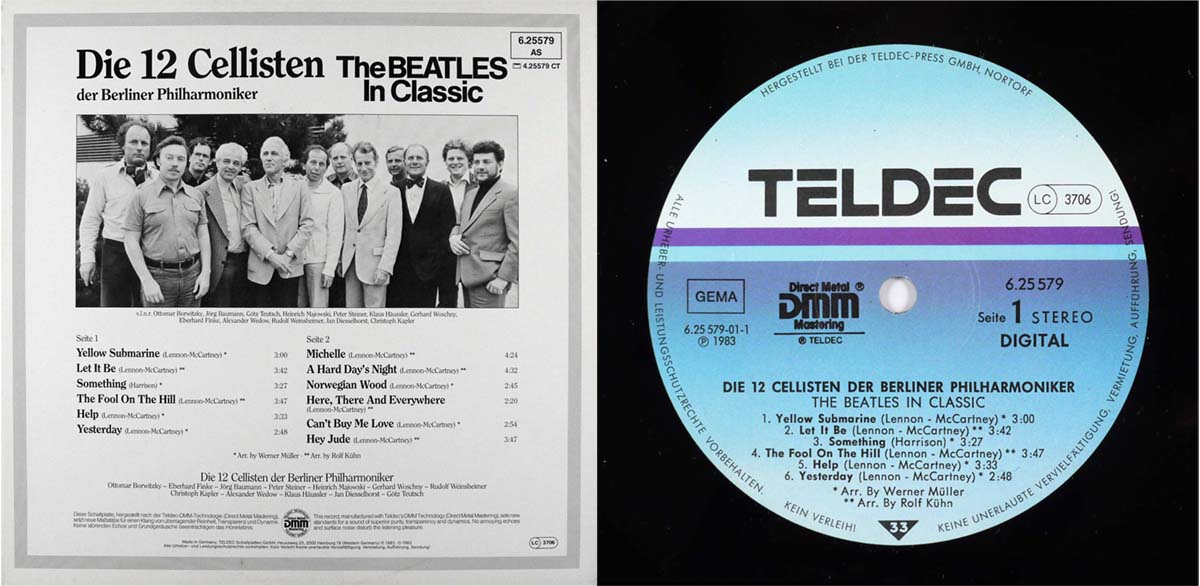
For low end extension, definition, and some fun, I used The BEATLES in Classic, from the 12 Cellists of the Berlin Philharmonic, a 1983 Teldec digital recording of Fab Four tunes. The arrangements vary from quite dense to quite transparent. Sometimes the melody sneaks up on the listener, as with the cello harrumphs leading into “Yellow Submarine”. That’s the fun part.
But it’s a DMM pressing, and so “can” sound bright and/or bass shy on some rigs. It does on mine. Hardly an obvious choice for the discriminating audiophile – unless, as here, our task is discriminating between different platter mats. Musical merits aside, this disc is ideal for that because all the instruments share the sonic signature of a cello, fundamentals full and resonant from 65Hz, expressively lyrical through the mid range, but dryer, even a bit whiney at the top of the range. Most audiophiles are familiar with the sonic character of one cello, but not with a dozen essentially identical instruments arrayed across a broad soundstage in a reverberant acoustic.
The not fun part has been auditioning all these discs with a slew of platter mats while resetting the VTA between trials. I’ve avoided any direct shoot-outs so far, but it’s time to lay my mats on the table. How did they fair in my own system? I don’t expect readers’ systems to be at all similar, so grains of salt all around, but if, when, and how the LPs sounded different on my turntable is down to the platter mat.
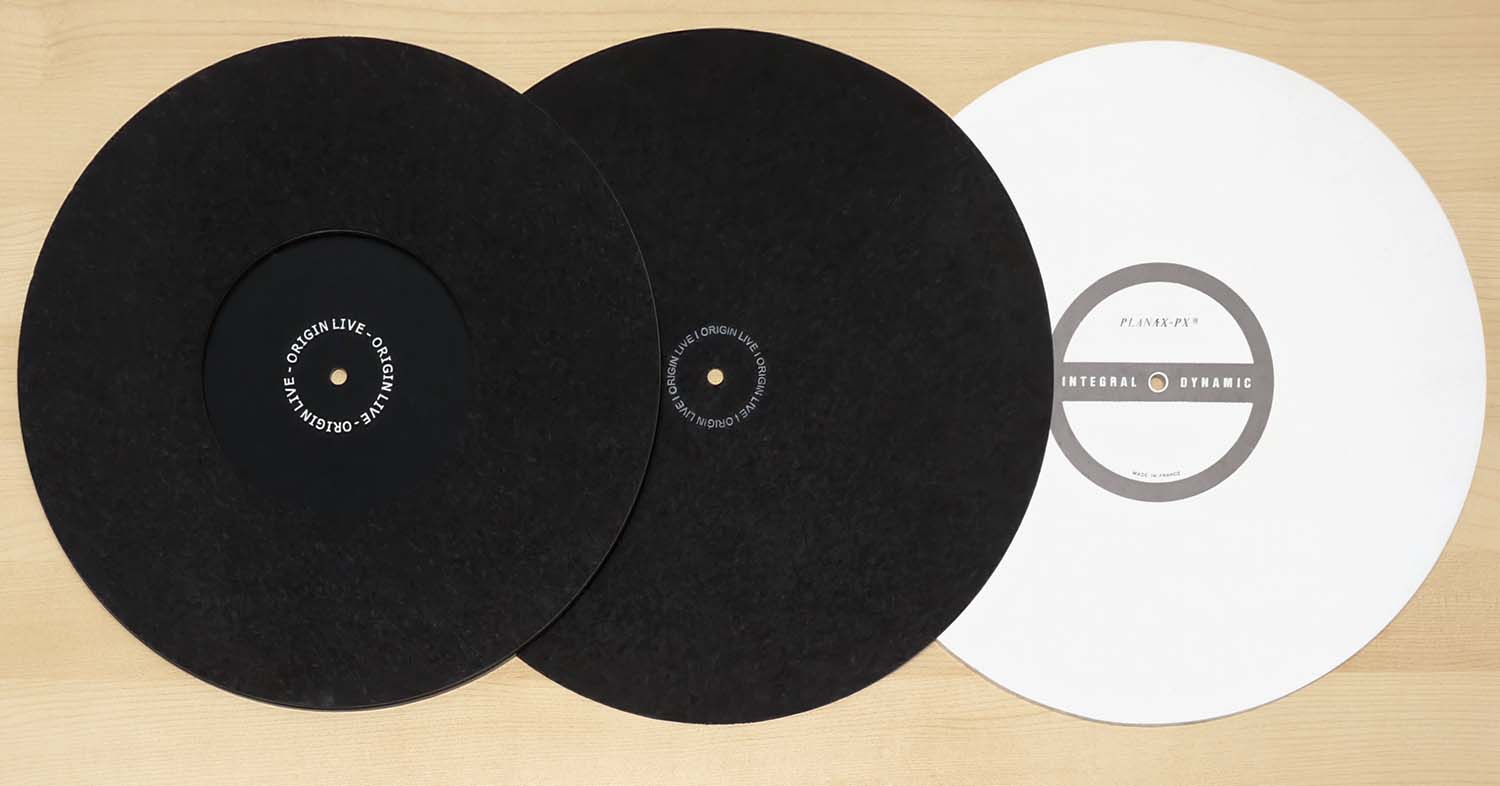
Yes, the Origin Live Strata won Gold, dramatically out-performing the rest of the field on the massed cellos, as it did with the other records discussed here. Definition, detail retrieval, tonalities, dynamics, soundstage, coherence – it was simply unmatched.
The Origin Live “Upgrade” platter mat took the Silver, sharing many of the Strata’s virtues, but to a lesser degree. As noted, it is ideal for decks with Rega tonearms, actually mitigating VTA errors, as the vast majority of cartridges are taller than what Rega supplies. It is also light enough to work on tetchy suspended designs.
The Bronze might come as a surprise: the ancient French Planex-PX Integral Dynamic, a dense, slightly flexible flat white pad with a death grip on the spindle. It was bold, detailed, spacious, and musically coherent. Back when I had room for two turntables, it was dedicated to vintage mono jazz and classical LPs. I still like it with the Origin Live Illustrious tonearm and Miyajima Zero mono cartridge on the SpaceDeck’s second arm.
The middle of the pack fell short of the top three in different ways.
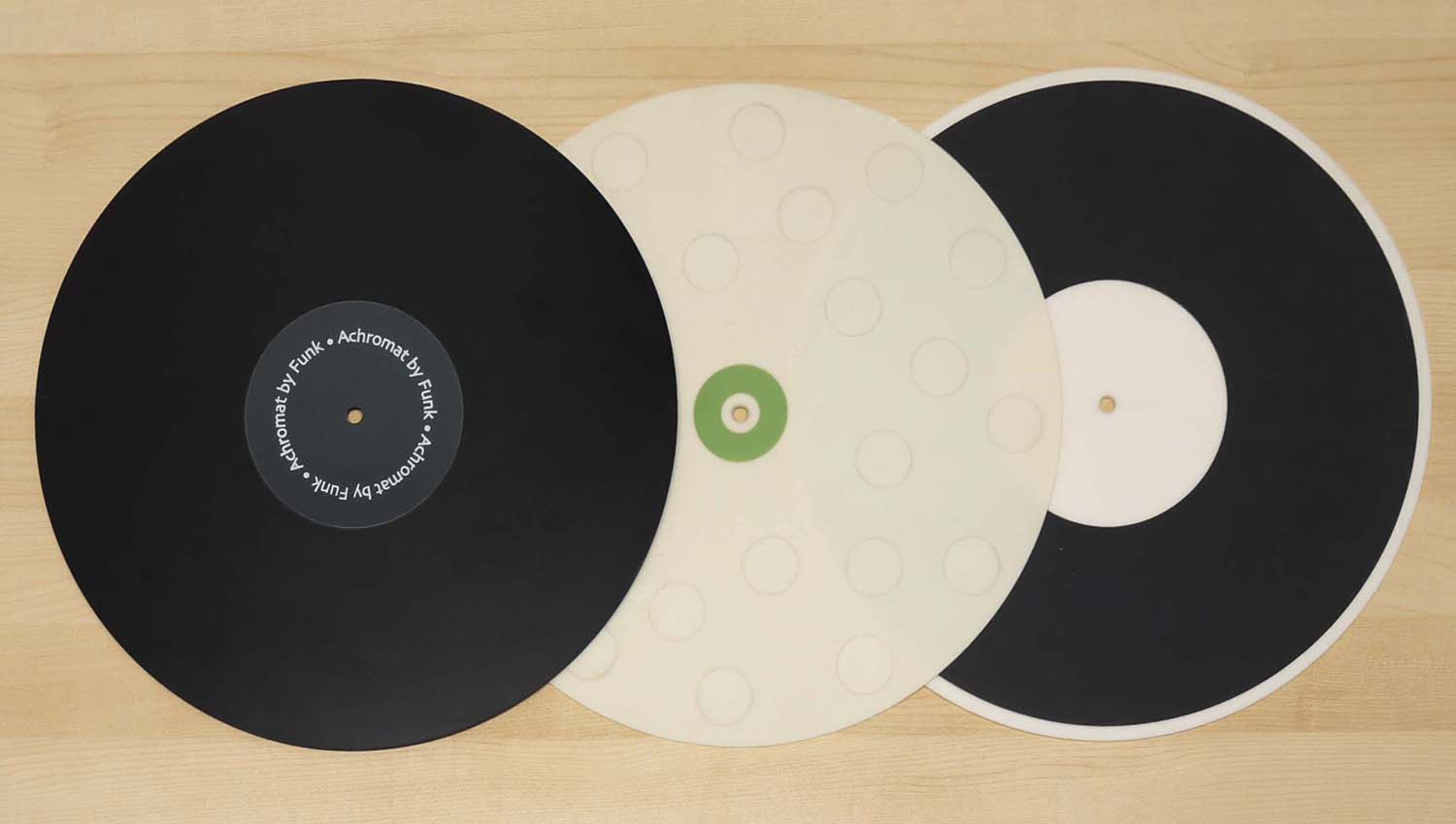
The Funk Achromat has been my daily driver on the SpaceDeck for casual listening, especially with the lively Zu/Denon DL103. It is very clear and expressive through the midrange, but being slightly rolled off at both frequency extremes, it doesn’t draw attention to itself or pressing issues, and is easy to keep dust free.
I’d rank my older version (the 3/4” silicone dots on top create a de-facto label area) of Herbie's’s Grungebuster slightly above his 2-layer Way Excellent II, but both are way better than stock mats. Being the same thickness as the 3mm Funk, I have switched to the HWE II when a bit more zip is needed. The dotted Grungebuster has been on my old Planar 3 for years. The current flat Grungebuster is marketed for acrylic platters with screw-down clamps as well as Regas.
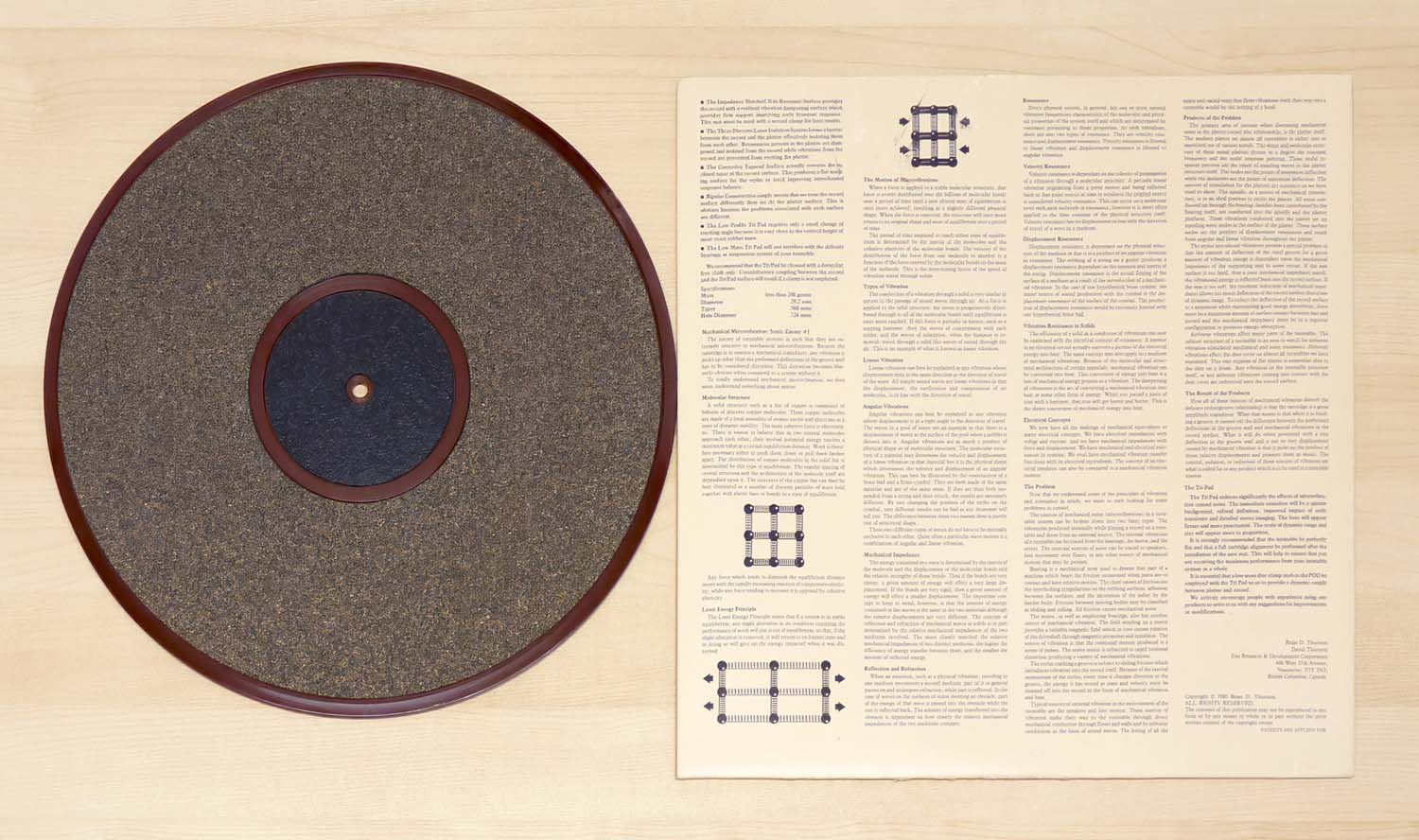
The Eon Research Tri Pad is a special case. It provided the richest bass, deepest soundstage, and sweetest treble from the cellos – but at the expense of treble extension, inner detail and microdynamics. I’ve used the Tri Pad with over-bright LPs like some Mercury and Columbia classical issues. The back of its sleeve is given over to a technical disquisition (in 6 pt type) on vibration and resonance in analog audio replay.

And it was the one mat that rendered the bright/thin DMM pressing tonally close to my non-DMM, non-digital, 12 Cellists Vol I LP (classical pieces with pop culture chasers, including a better sounding "Yesterday."
The remaining mats were not competitive.
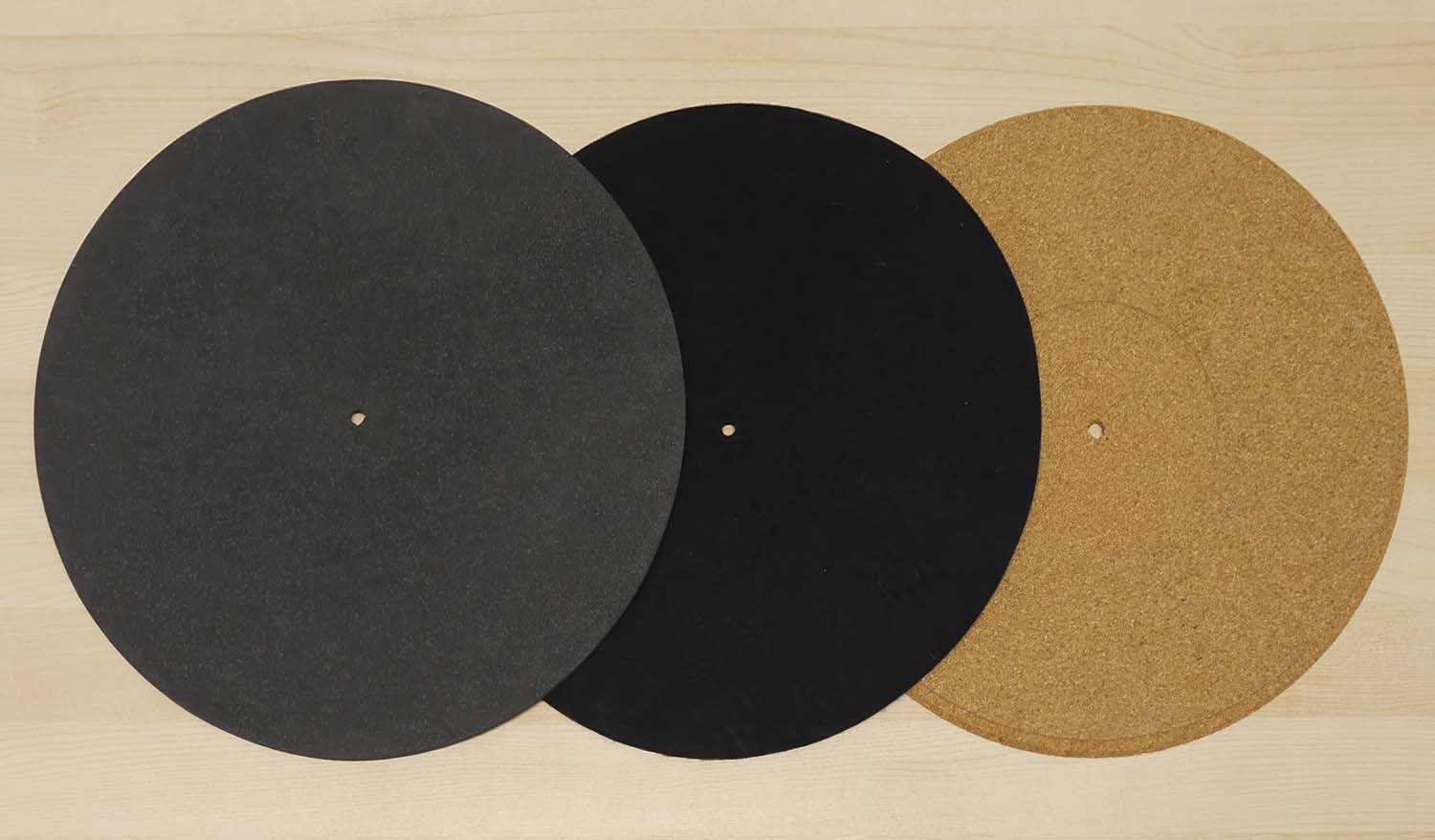
The no-ame open-cell foam pad had better overall balance than the generic felt mat, although the spindle hole is off center on mine. The felt pad seemed confused where the better mats were precise. Most disappointing personally was the Chadwick CorkTone, made in Cambridge, MA back in the days I used the Cambridge-made AR ES-1 turntable, and could afford apartments (and later a house) near Harvard Square. Sadly, the massive SpaceDeck platter did not play nicely with the featherweight CorkTone.
I did also notice a few other things using the Strata that might be of interest. First, surface noise on clean modern discs seems a bit quieter and lower in subjective frequency, but the opposite can be true with older discs, depending on prior use/abuse, vinyl hygiene, or pressing defects. Pops and tics are instantaneous, with minimal overhang. I was also more aware than usual of low level pre-echoes from the following groove. I don’t play much rock, so will offer no opinion on undistorted guitar distortion.
I have played all sorts of LPs atop the Strata with nary an instance where I thought anything musical was left in the grooves. Cliche or not, I was hearing musical information on familiar records I’d not noticed before. Over the years I’ve improved my analog playback with turntables, tonearms, cartridges, and phono stages – each retailing for far more than the Origin Live Strata. Yet it turns out it's this innovative platter mat that actually makes all those other upgrades absolutely worth the expense.
So who (besides your humble correspondent) will be buying a Strata mat? Current or future Origin Live turntable owners might opt instead for a newly available platter which includes Strata tech bonded to an acrylic sub-platter (now standard on their top turntables). That still leaves a lot of audiophiles with decent to extravagant analog rigs, yet still open to real improvement. OK, some might rather spend 500 bucks on 10-12 audiophile reissues. Sigh.
Most highly recommended!
Origin Live Strata Platter Mat £325 (US price varies)
Origin Live
Analog Matters