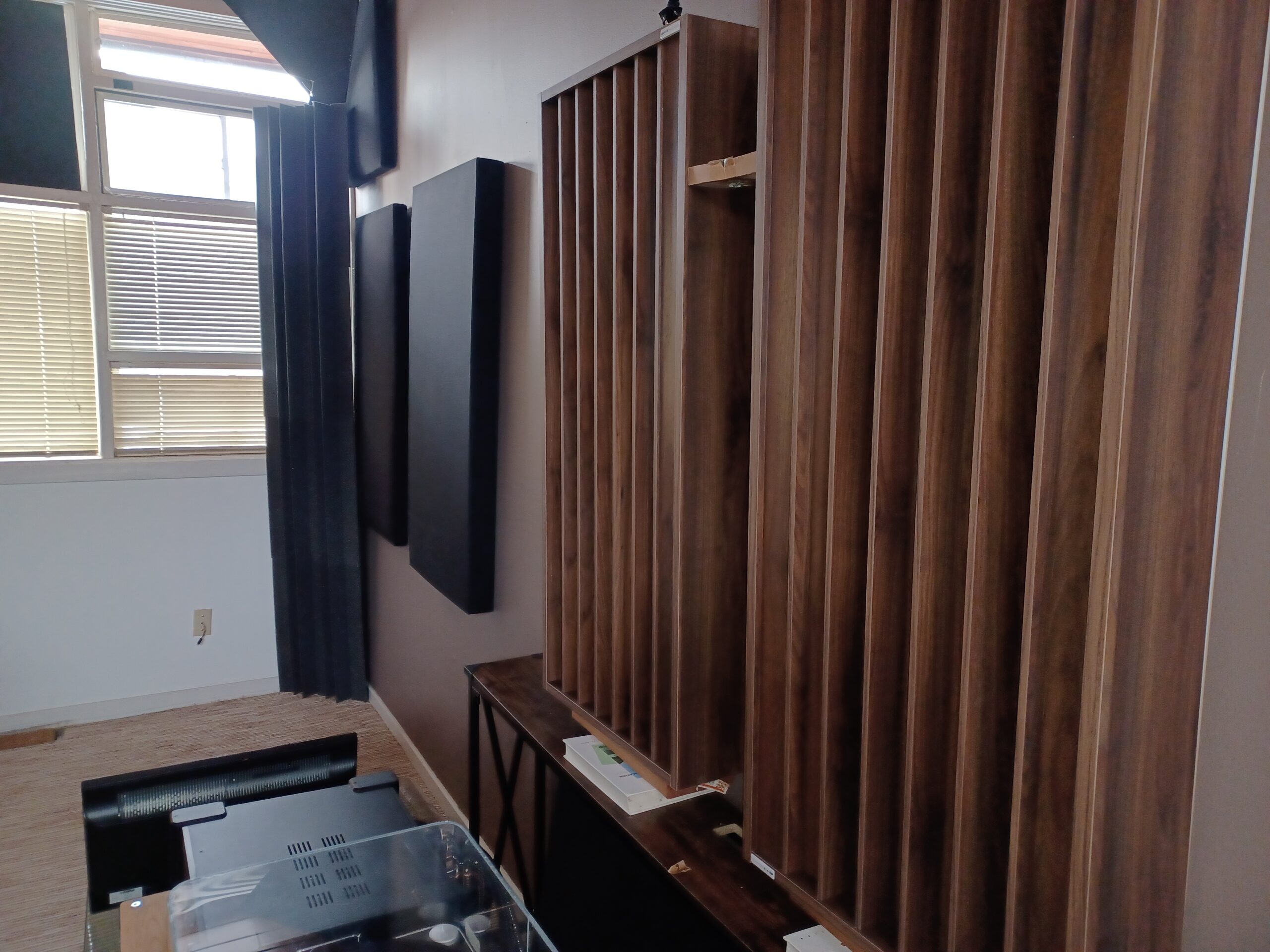

The current phase of my audio journey found me more focused on room and AC power issues. I tackled the room first, and right now I'm very happy with the results, although this is still a work in progress. Now it's time to concentrate on AC power, starting with fuses. I've thought many times about the fuse issue, but I never could come to terms with an expensive single-use device that was designed to blow up. The whole audiophile fuse narrative just never resonated with me. Spending beaucoup bucks on a fuse just didn't make sense. And, from what I read, yeah, they sounded better, but how much better? I've been a believer in upgraded power cables since the first time I heard one, at least on power amps. (They always made the amp sound better, even if I'm still not exactly sure how they accomplish that.) All that current flowing through my thick power cables into the bottleneck of a protection filament the thickness of two hairs? A high end fuse would still be current-limiting, even if it did have the words "audiophile" or "high resolution" printed on it. Finding a solution that made sense to me sonically and economically just didn't seem to be in the cards.
My point of view changed considerably when I read Bruce Kinch's PF review on the Swiss Digital Fuse Box HERE. I was intrigued. First of all it came from Bruce, who has great ears and does his homework. He knows what he's talking about. Second, somebody finally came up with an idea that makes much more sense than a fuse. Remove the fuse and put in a substantial conductor. Incorporate a re-settable device that protects your precious component without restricting current flow like a fuse does.
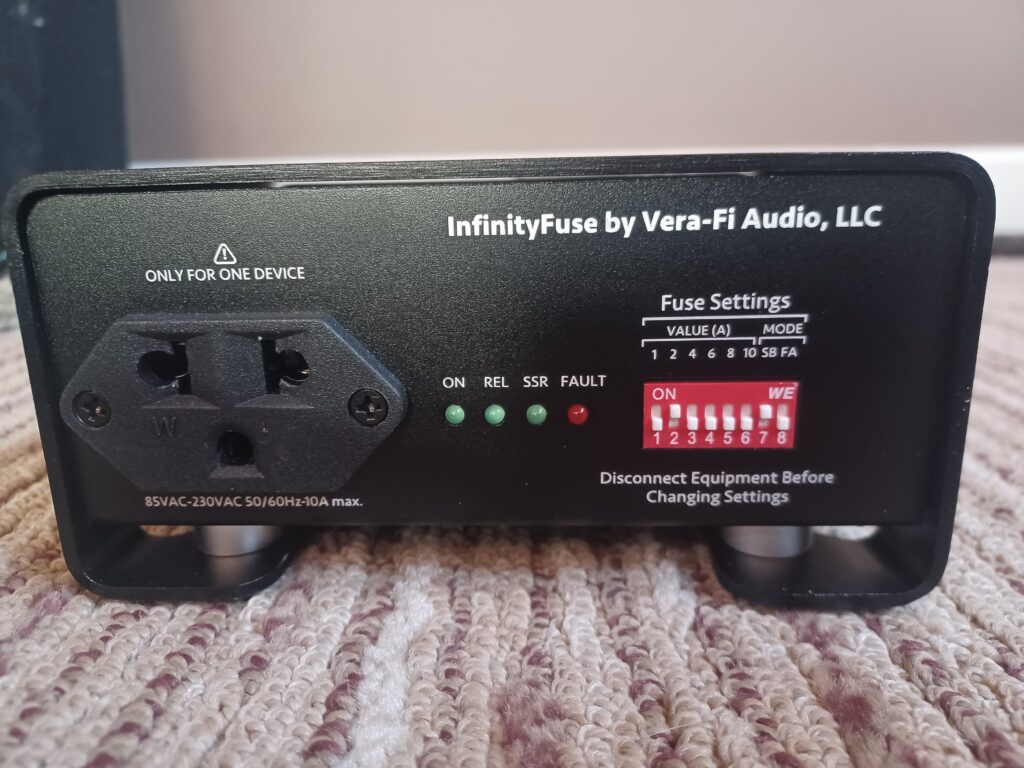
Infinity Fuse Front Panel
Enter Vera-Fi Audio, the brainchild of Mark Schifter, who you may remember from Audio Alchemy a few years back. Vera-Fi is currently producing speakers, subwoofers, cables, AC conditioners, amps and preamps, acoustic tweeks, and other goodies. Although the Infinity Fuse (IF) is the first Vera-Fi product I've heard, there's been a buzz out there around their AC products, bookshelf speakers, and subwoofers that is palpable.
What exactly is the Infinity Fuse? According to Vera-Fi, it's a "resettable fuse alternative designed to safeguard high-end audio systems from over current events—without sacrificing performance."
So, in my mind it:
1. Replaces a fuse, which is a single-use device (which already has me stoked, I'm generally against most single use products.)
2. Lets you reset the device without replacing anything, and
3. Potentially upgrades the sound of your system by eliminating the electrical current bottleneck fuses cause.
After I read Bruce's praises of the SDFB, I got serious about talking to Mark to obtain a review sample. I was surprised that Mark actually remembered me from the old days at the Rocky Mountain Audio Fest, still my favorite audio show of all time. He said I'd probably like Vera-Fi's follow-on to the SDFB, the Infinity Fuse (IF), which uses the same technology, but doesn't limit you to one fuse value.
The IF is rated for 85-230V AC / 10A max, with a fused IEC inlet and standard NEMA outlet. Built for indoor use only, it's fully CE-compliant and meets international safety standards. The Infinity Fuse also limits the dangerous current spikes during startup—common with toroidal transformers. This protects copper windings and helps extend the life of your amplifiers, DACs, and preamps. The DIP switches on the front of the Infinity Fuse allows you to customize for slow blow or fast acting, with a current values from 1 amp to 10 amps. Bought a new power amp? Want to try the IF on a different device? You're covered.
I got two of the IFs to evaluate with my EL-34 based monoblocks. Included in the kit were two of the Graphene Sluggos, the conduction device you insert in place of the original fuse. The graphene (considered the ultimate electrical conductor) is the most expensive of the Sluggo choices at $199, the others being High Purity Brass ($33) High Purity Copper ($33), or High Purity Copper in Gold immersion ($33). The Infinity Fuse is designed in the USA and assembled in China using only premium-quality components. If you check Mark's Facebook posts you can most likely find video of the factory where Vera-Fi components are built.
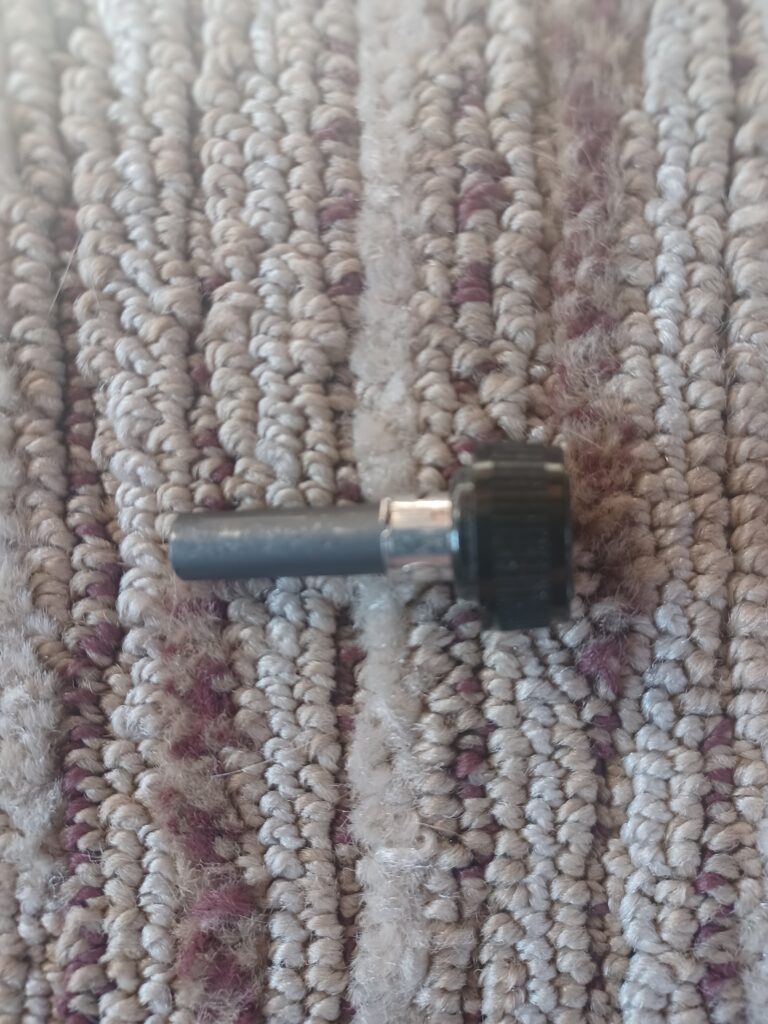
Graphene Sluggo in Fuse Holder
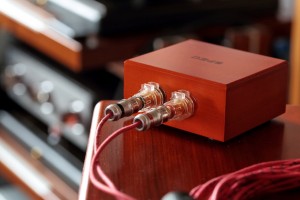
The IF is a small unassuming box, measuring about 4.25 x 5.25x 2.5 in. The back features an IEC socket (along with the power cable that comes with the IF). On the front you'll find an outlet to plug your device into, LED indicators, and 8 DIP switches.
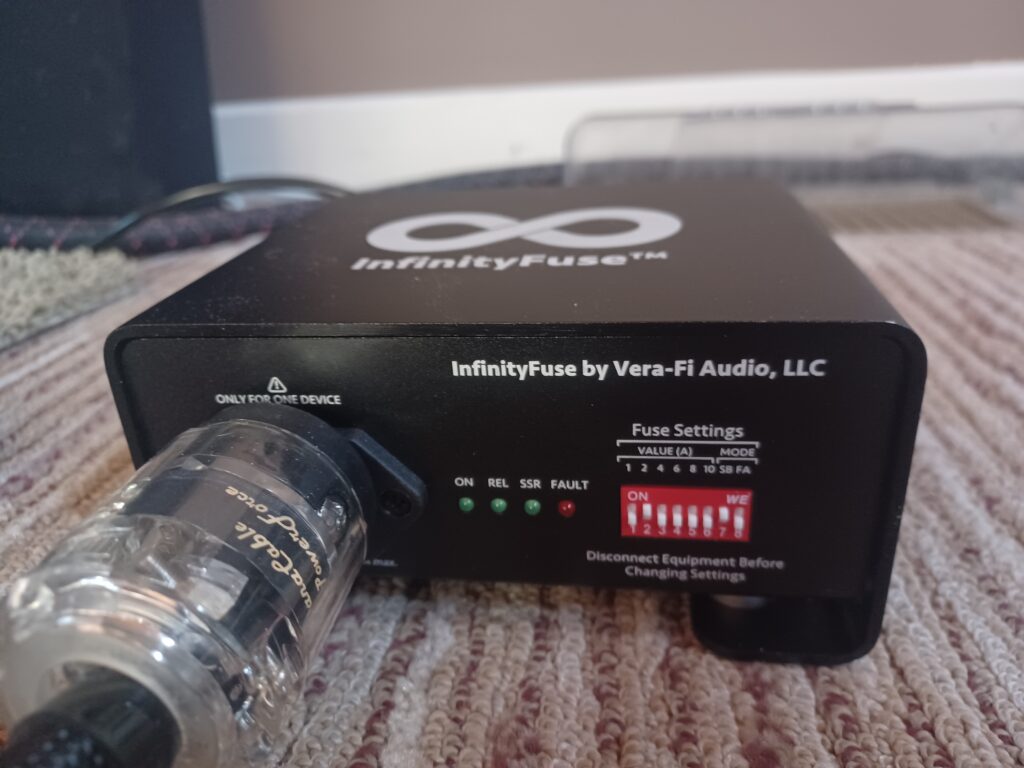
Front Panel With Power Cable
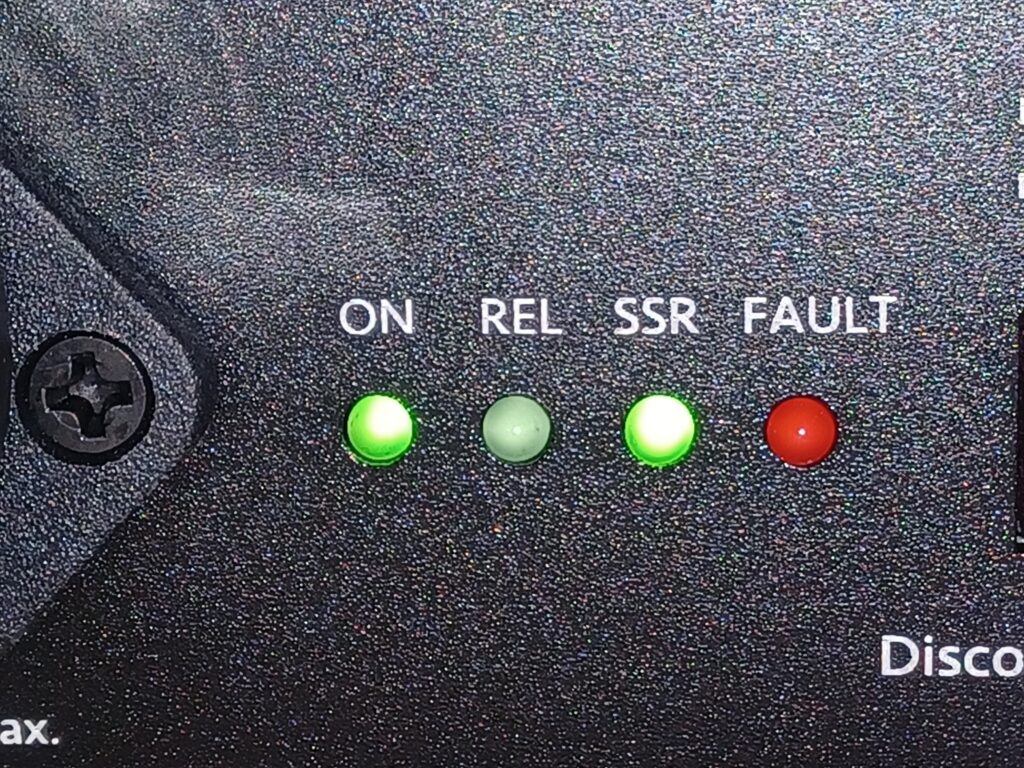
LED Indicators
Install was easy. Pull my old single-use fuses out of the amp's fuse holders and put the Graphene Sluggos in. Put them back in the amps and tighten. Configure the DIP switches for 2-amp slow blow. Plug the IF into the wall, and plug the amp's power cables into the IF. Vera-Fi Audio suggests a minimum 40-hour break-in period for their audio products, including the Infinity Fuse, with improvements potentially continuing up to 400 hours.
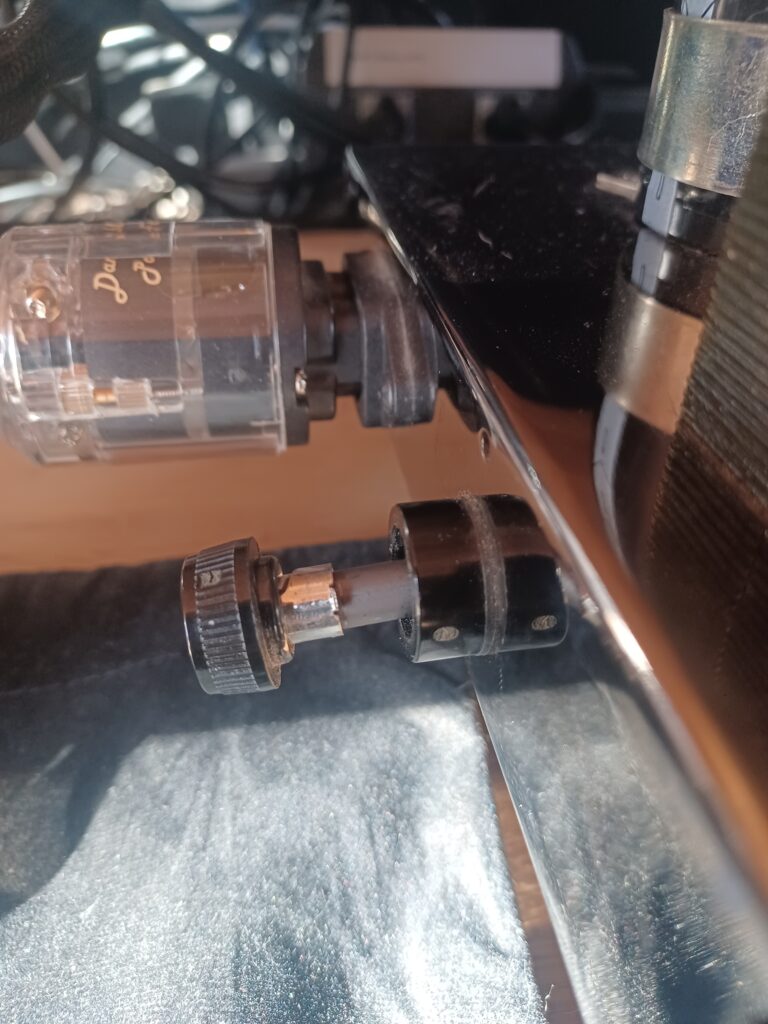
Sluggo Fit in Amp Fuse Holder
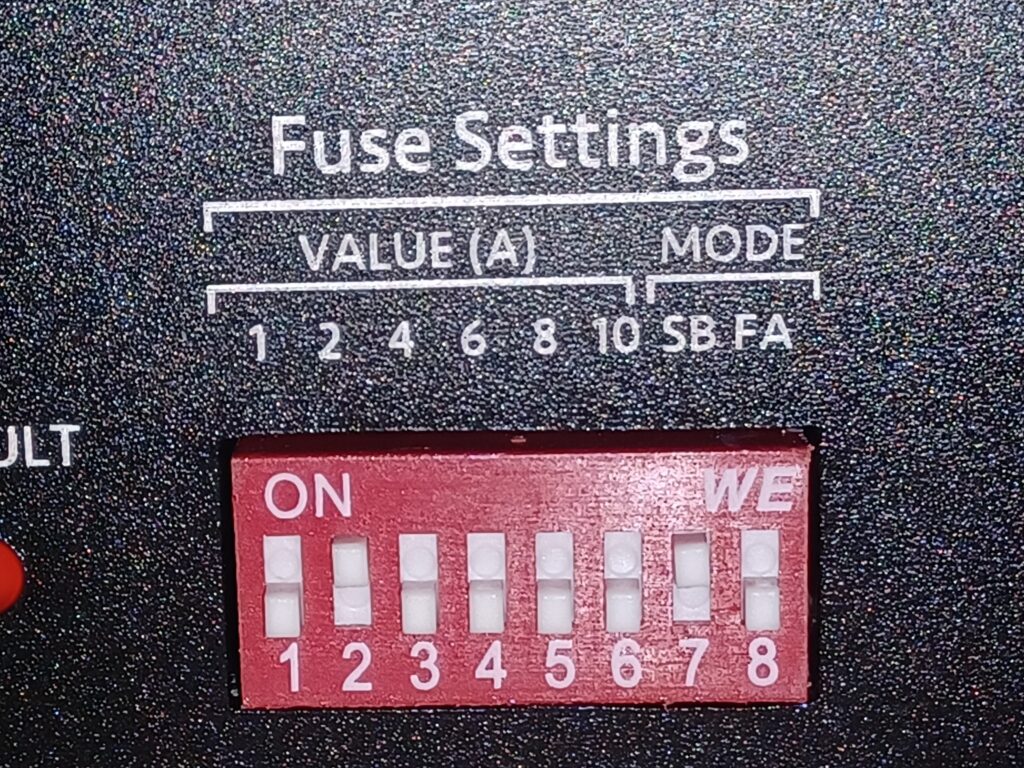
Fuse Settings
Normally a stickler for break-in time, I was uncharacteristically impatient that day. Plus, if the IF sounded really bad (almost all components I've tried sound terrible before break-in) I could rationalize all that break-in time with the system playing all day for a week, although I really did not want to go through another break-in period. So, I decided to have a quick (or so I thought) listen.
I was lucky enough to be using the MG Communique speakers, which at about 91 dB efficiency, are an excellent match with my beloved Quicksilver Mid Mono amps. This superb speaker sounded even better when I recently switched to a combination of the MG Planus copper and silver flat interconnects and the MG Planus flat speaker cables (reviewed by PF's own Pete Davey way back in 2014 HERE.) Using cables that are designed to be used with a particular speaker by the same designer—in this case the very talented Lee Matusczcak—is the way to go. Such a bummer that MG audio closed. I'm familiar with the Communique speakers (a prototype that never went to market), which have been in my system more than a year, and I've had the cables in for about a month. This is a synergistic match that never fails to delight me.
After deciding to (at least temporarily) forego break in time, and take a listening chance, the first thing I wrote in my listening notes was: Yow! What?
What I heard (and felt) was an effortless, polished luster that bathed me in a lovely glow. My all tube amplification chain was loving the Infinity Fuse—in a way I felt like I was listening to a different system.
The entire soundstage became better defined. Voices and instruments that were back in the mix stayed back, but now they were better defined, more present. Dynamics began just bursting out, and sudden peaks were delivered with more ease. It felt like a governor had been removed from the system. Macro and micros both made more sense. I honestly felt my 50-watt EL34-based amps had added more power. A feast of improved headroom.
Voices had a special presence that translated to more spirit, which, in turn, came across as an image that was closer to a live vocalist. The space between the speakers and the front wall (which in my room is just shy of seven feet) all of a sudden filled in with instruments and voices surrounded by an airy radiance. This went a long way towards enhancing the 3-D effect that good stereo can reproduce. The system was already doing an adequate job at this, but this was a palpable step forward. Music wasn't just alive on the wall, it now occupied more of the space between the front wall and the speakers themselves. I've never experienced this to this degree in my room before.
What kept coming back was the smooth feeling of the presentation. I kept thinking ahhhh…like a proper single-malt. I don't think I'm exaggerating when I say it was akin to upgrading (within reason) preamp, amps, or both. I kept listening, and it turned into one of those sessions where you're thinking "just one more track, then I'll stop". I kept turning up the gain past where I normally listen, because everything was just so relaxed and easier to listen to. I was up way late. Glad I decided to skip the break in period.
The goodness continued, and although I didn't experience any more sea changes, the system continued to play with an effortless grace. It was almost begging me to turn the gain up past my former normal levels. I never experienced the system maintain its composure like this before. Again, it was if my amps went from 50 to 100 watts.
During my time with the Infinity Fuse I didn't experience any issues that would cause a fuse to blow. It always displayed the Green ON LED meaning the system is powered, along with the Green REL LED meaning the solid-state relay is engaged post inrush delay, which limits the dangerous current spikes during startup. Luckily, I never saw the Red REL or Red FAULT LEDs that indicate a problem.
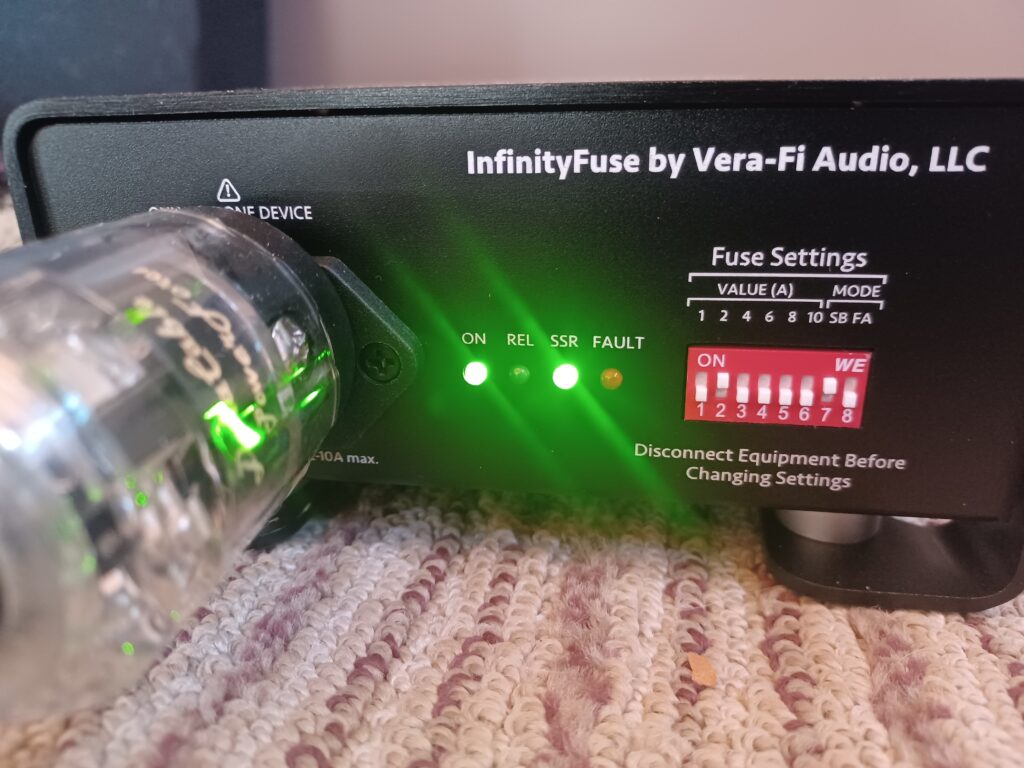
Normal Operation LED Indicators
I'm really liking the Infinity Fuse. After having it in the system it would be hard to live without. For the current price of $594 with the Grapene Sluggo (it would be $428 with any of the other Sluggos) it's like getting an upgrade for your entire system. And, although I haven't yet tried the IF on a preamp or DAC, I've heard it also does wonders with other components. I can recommend this resettable fuse alternative without hesitation, and hope you experience the same delights I did when I removed the 2-amp slow blows from my amplifiers, and replaced with the Graphene Sluggos and the IF.
I'm looking forward to writing soon about the Line Noise Blackhole (LNBH) and the Snub Station Zero (SSZ). These are clean power components from Vera-Fi that should be interesting to say the least. Vera-Fi is a fairly new company and I think they are going to be a contender if not at top of the pile for affordable high-quality audio in the near future. I've heard raves around their subwoofers, bookshelf speakers, AC conditioning, vibration control, and other accessory products. Amplifiers and preamps are on their way.
The Infinity Fuse taught me that if you take the old current-limiting protection device out of your power amplification circuit and replace it with a good, thick conductor and active protection, your system will reward you handsomely. I don't see any cons to adding this device, and the cost (even with the Graphene Sluggo) is easily worth the price of admission. It resolves the fuse issue, both sonically and economically, and lets your current flow unhindered. If you decide after a couple of weeks of break-in (or even if you skip the break-in like I did) that you don't like the Infinity Fuse, (I'd really be surprised) you'll still have time to return it to Vera-Fi with the 30-day return window. The term win-win has become a little trite, a bit cliché, and for sure overused. But, where the Infinity Fuse is concerned I feel it still works.
Infinity Fuse
Retail: $428 with Brass, Copper or Super Sluggo, $594 with Graphene Sluggo
Vera-Fi Audio