
Greetings friends, I hope you are well.
I've always been impressed with Mr. Ken Ishiguro's approach to audio. Ken-san builds insightful audio products with innovative applications of technology that always make a positive contribution to the sound quality and musicality of my audio systems.
I've been writing about Ken-san's audio creations for almost twenty years now, and they never disappoint. You can see the full list of articles I've written about Acoustic Revive products HERE. Scroll down to where you see "The Acoustic Revive Chronicles" for links to all the articles.
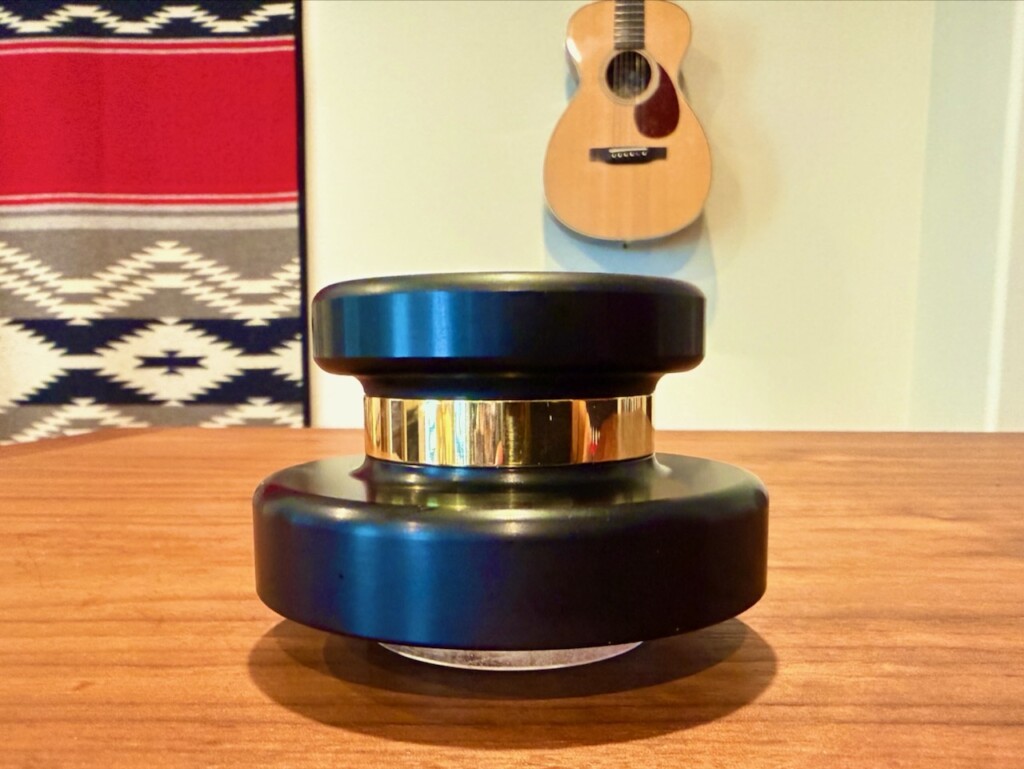
The subject of today's article is the Acoustic Revive Analog Stabilizer PS-DBLP.
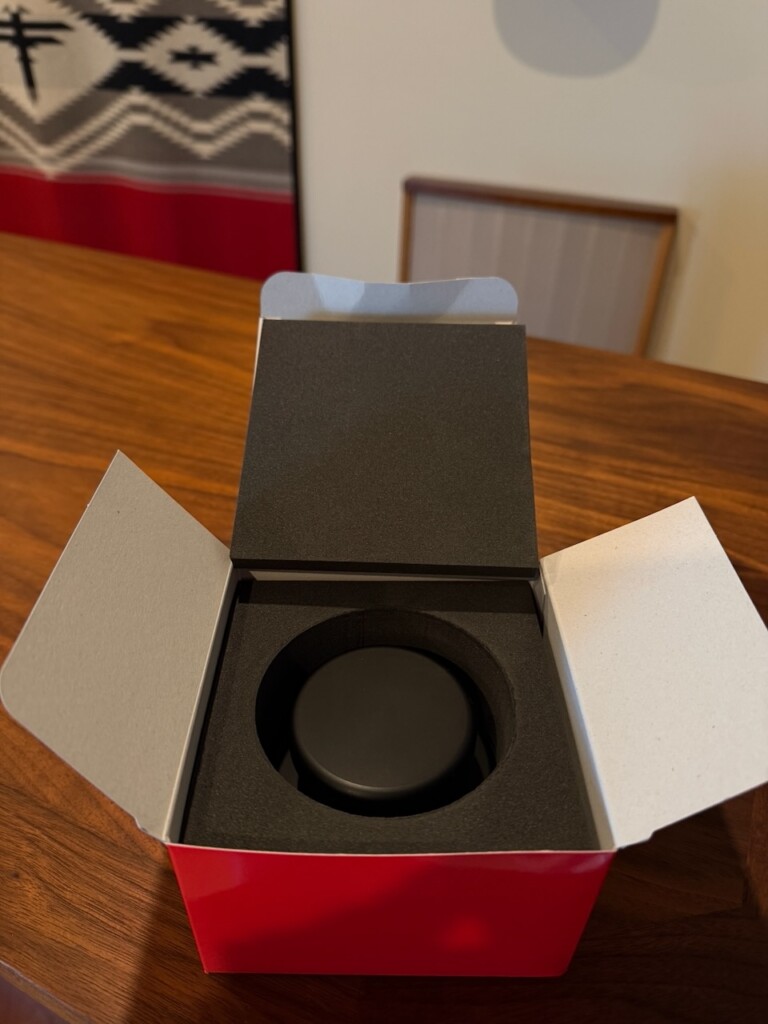
Like all of Ken-san's creations, the fit and finish are extraordinary. As a nice touch, the analog stabilizer PS-DBLP comes safely packed in protective, form-fitting packing material to make sure it gets to you in pristine condition.
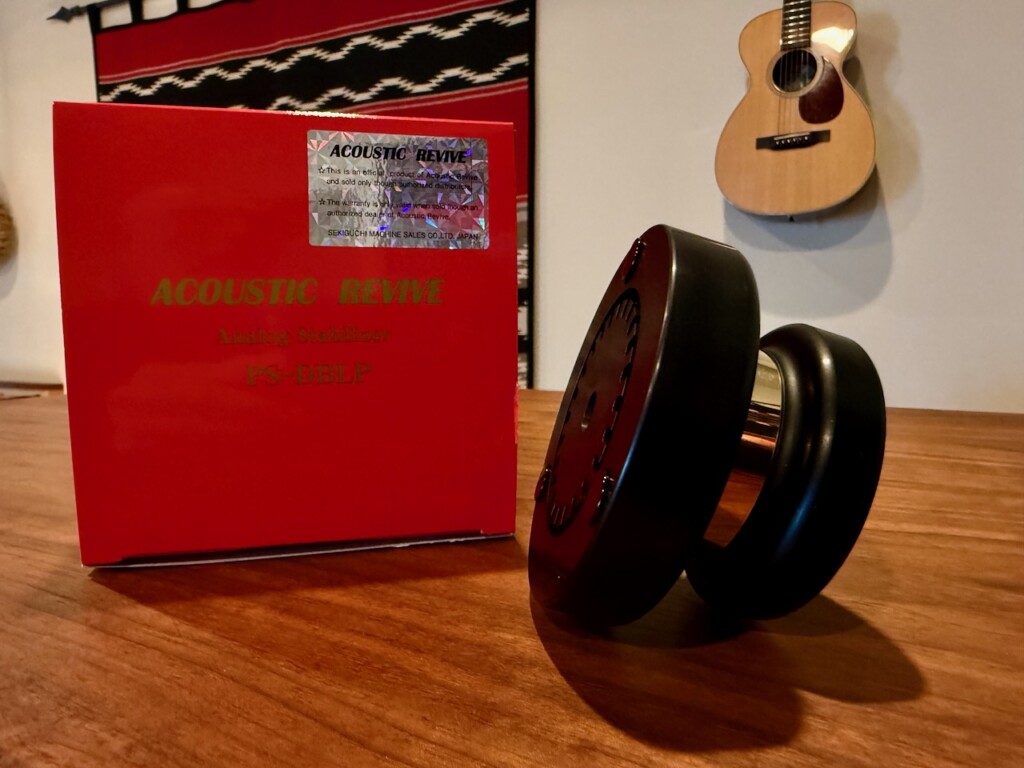
All of Ken-san's creations have more to them than classy looks, though, as they are carefully thought out in terms of design and materials science to provide the intended benefits to the listener.
"Intended benefits? It's just a record weight, right? It just holds my record down on the mat."
It turns out that "record weights" have evolved from being devices that just mass-load a record to hold it securely in place, and into active devices that do much more than that.
So you've probably surmised that the idea of the PS-DBLP is that it does more than just squash your LP down securely onto the record mat.
Ken-san's idea is that a record weight can be designed through materials science principles to actively reduce or eliminate vibrations from the two primary vibrational pathways present in a turntable: acoustic and structural vibrations.
Structural vibration comes from the mechanical operation of the turntable (e.g. the turntable motor, platter rotation, etc.), and acoustic vibration comes from the loudspeakers - the music - impinging on the record and turntable's surface.
Essentially, all you want is the "good vibrations" from the stylus tracing the groove going into the moving-coil in the cartridge to be converted to an electrical signal, and not those "bad vibes" from the turntable motor and loudspeakers added to it which degrade the signal's sound quality.
Here's what Ken-san says about the PS-DBLP:
"PS-DBLP combines super duralumin and brass heterogeneous metals, and has a groove with a geometric pattern that effectively suppresses vibration, and places a natural smoky quartz resonator that supports the point on the contact surface with the record label, and in the interior a large number of natural ore particle blends are enclosed in a groundbreaking structure that instantly converts vibrations generated from motors and speakers from analog players and disappears. You can experience the overwhelming sound quality improvement effect, such as clear sound image positioning that is three-dimensional and dynamic, which overturns the concept of analog stabilizers that only added the tone of the material."
Ken-san doesn't divulge exactly how his PS-DBLP design works, design secrets and all, but based on other products Ken-san has designed and I have written about, I think I may have a pretty good idea - so let me speculate a bit on how the PS-DBLP might work to reduce vibration.
All high-mass record weights will have some vibration damping effect on a turntable due to mass loading. By adding mass to a vibrating system, the mass loading damps vibrational energy by reducing its oscillation amplitude and energy. A good thing.
So it is a given that the PS-DBLP damps vibrational energy present at the record's surface by mass loading. Typically, the optimum mass for a record weight is considered to be in the range of 375 grams to 460 grams. The higher the mass, the more vibration is damped. The PS-DBLP weighs in at about 460 grams.
Now let's take a look at the vibrational characteristics of common materials used for record weights, as well as the uncommon materials used in the PS-DBLP.
While mass damps vibration, the composition of the mass also affects its ability to damp vibration. So if a selection of record weights have the same mass, but are made from different materials, they will have differing abilities to damp vibrations, and will sound different as a result.
Aluminum has conductive vibrational properties that can amplify vibrations, so generally speaking, aluminum is to be avoided where vibration reduction is desired, as in audio applications.
Duralumin (A2017) is an alloy of aluminum, copper, and magnesium. Duralumin is heavier than aluminum due to copper increasing its density, and giving it a higher strength-to-weight ratio, which makes Duralumin a popular choice for aerospace applications. Duralumin's mechanical properties and internal friction mechanisms enable it to absorb and dissipate vibrational energy more effectively than aluminum. This enhanced vibrational damping characteristic makes it suitable for applications that need vibration reduction.
Super Duralumin refers to a type of aluminum alloy (A2024) which is strengthened with higher amounts of copper and magnesium compared to standard Duralumin. Super Duralumin exhibits improved vibrational damping characteristics due to its higher copper content, which enhances its mechanical properties and internal friction mechanisms, resulting in better damping characteristics and lower vibration amplitudes compared to standard duralumin.
Brass has moderate damping properties, which effectively reduces unwanted vibrations in electronic devices. Consequently, it's frequently employed in connectors and housings to minimize noise and interference.
Quartz's vibrational characteristics are high stability, low loss, and effective vibration control, which makes it a popular choice for oscillators and sensors.
Tourmaline possesses unique piezoelectric properties that enable it to enhance vibrational energy harvesting by converting it into heat. This makes it a valuable material for sensors and other electronic applications where reducing vibration is desirable.
So each of those dissimilar materials has a different effect on vibration transmission and control, and given that the PS-DBLP is constructed of layers of quartz, Super Duralumin, brass, and perhaps tourmaline, those layers of dissimilar materials affect how vibration travels through the PS-DBLP to be dissipated.
If you look at the side view of the PS-DBLP (above), you can see the Super Duralumin (black anodized CNC'd pieces on top and bottom), with brass in the middle. There are also three quartz resonator discs on the bottom surface of the PS-DBLP which you can't see in the photo, and—I suspect—tourmaline crystals in the interior structure of the PS-DBLP, which you also can't see in the photo.
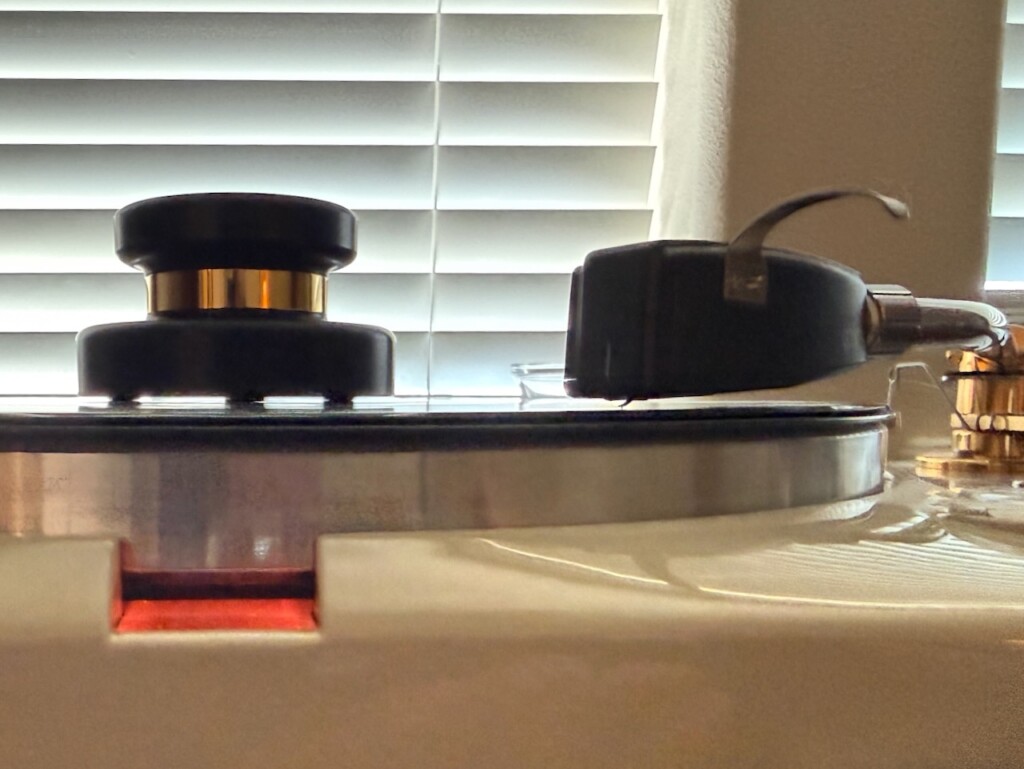
If you look closely at the photo above, you can see how the three quartz resonator discs contact the surface of the record label, and how they elevate the PS-DBLP slightly above the surface of the record.
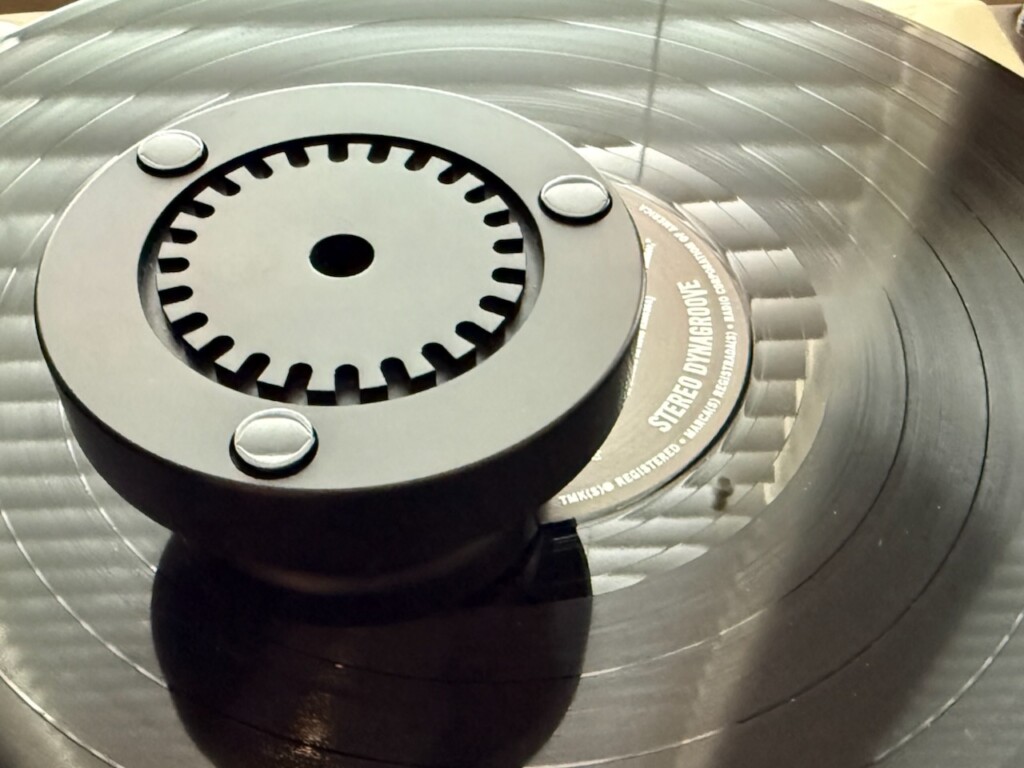
If you look at the bottom view of the PS-DBLP (above), you can see how the three quartz resonator disks are mounted to its outer perimeter. Those round disks are the "natural smoky quartz resonators" Ken-san mentions that are the point-of-contact on the record's surface.
The idea is that the quartz resonators mitigates and transmits surface vibrations into the PS-DBLP's interior. Also, note the geometric pattern that is machined into the bottom of the PS-DBLP that Ken-san says "effectively suppresses vibration."
Inside the PS-DBLP: Ken-san says, "... in the interior a large number of natural ore particle blends are enclosed in a groundbreaking structure that instantly converts vibrations generated from motors and speakers from analog players and disappears."
In other components Ken-san produces, he uses tourmaline crystals for their unique properties of converting vibrational energy into heat, so I suspect that is also the case for the PS-DBLP.
Here's an AI explanation for the way tourmaline works: "Tourmaline is a unique piezoelectric and pyroelectric mineral that converts mechanical stress, vibrations, and temperature fluctuations into electrical energy. This, in turn, generates negative ions and far-infrared (FIR) radiation, which are absorbed by surroundings as heat. This "resonance absorption" allows tourmaline to effectively turn physical vibrations into heat."
Then there are the three quartz crystal resonators located on the bottom of the PS-DBLP that rest upon the record label's surface: quartz crystals are widely used in wristwatches, telecommunications, and medical devices for timing and frequency control due to their ability to vibrate at specific frequencies due to their piezoelectric properties.
Quartz crystals respond to both mechanical stress/mass loading and vibrational energy with a piezoelectric effect. If I understand it correctly, the pattern machined in the base of the PS-DBLP helps dissipate vibrational energy coming from the quartz crystals into the base, and from the internal tourmaline crystals that convert vibrational energy into heat.
The turntable spindle can act as a conduit for vibrational energy from the motor, and when the PS-DBLP is placed over the spindle, the vibrational energy from the motor is absorbed by the tourmaline and converted to heat.
Okay, so that's my understanding of how the Acoustic Revive Analog Stabilizer PS-DBLP works.
Audio System for This Article
My audio system for this article consisted of the following:
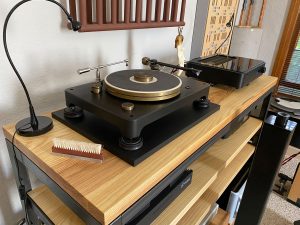
My turntable is Classic Turntable Company Classic 301 motor assembly equipped with an oversize high-mass (12kg) brass platter, mounted in a high-mass Artisan Fidelity plinth fitted with Stillpoints Ultra SS footers.
I use a SPEC AP-UD1 Analog Disc Sheet (turntable mat) on the brass platter, a Thomas Schick 12-inch tonearm—rewired with silver wire—is mounted on the plinth's armboard, and a Thomas Schick graphite headshell equipped with Acoustic Revive hybrid silver-copper PC-TripleC/EX headshell leads rounds out connections to the phonograph cartridge.
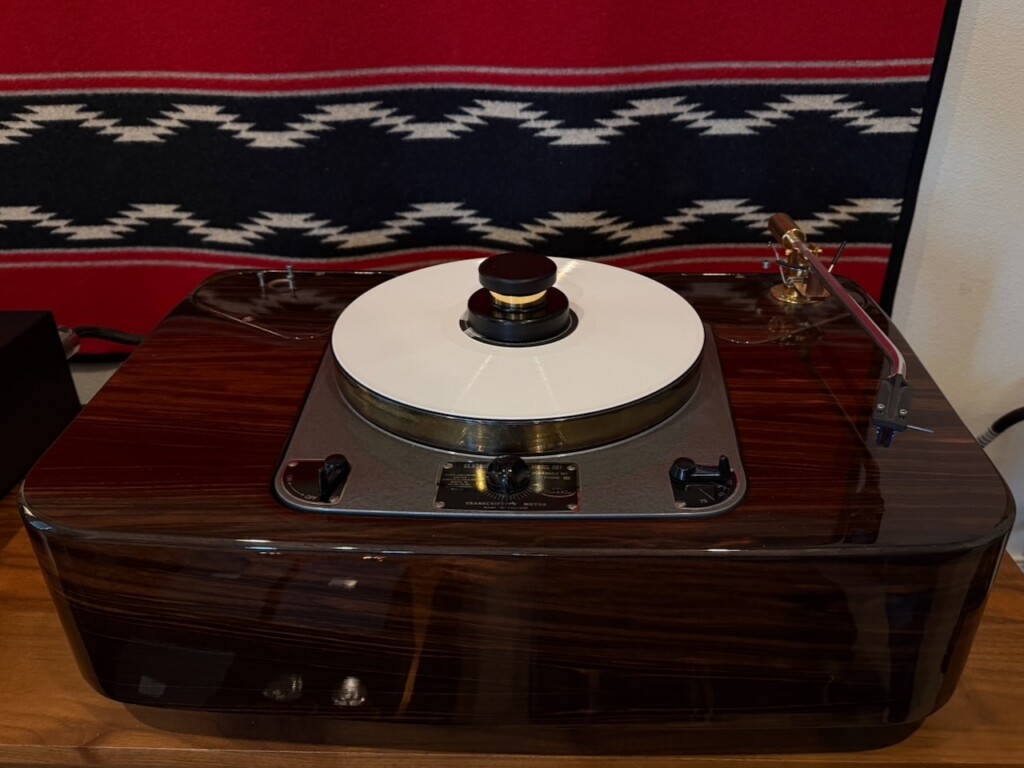
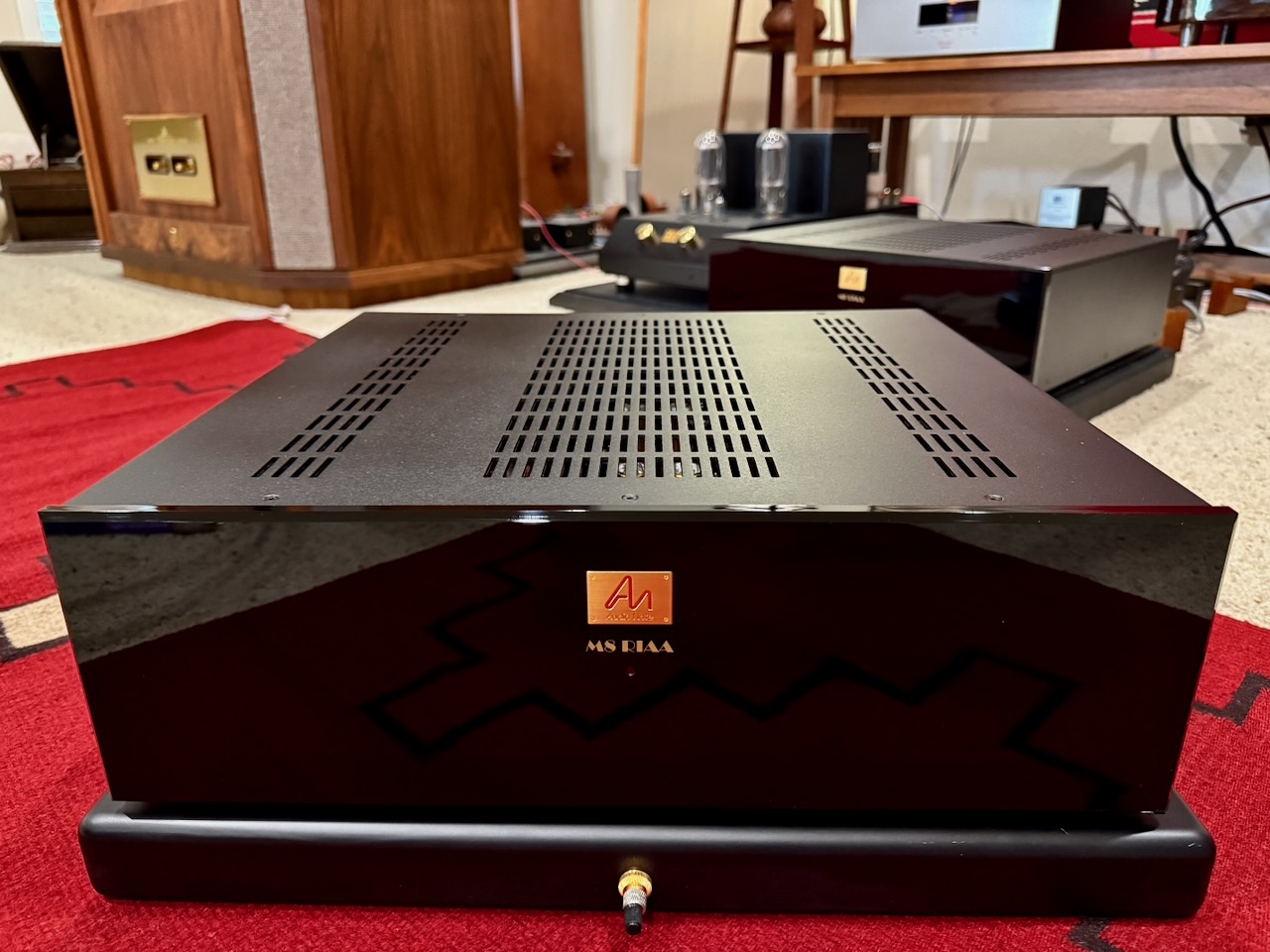
An absolutely dreamy and über-performing combination of Audio Note (UK) components are visiting me at the moment: the Io I moving-coil phonograph cartridge, AN-S8 step-up transformer, and M8 RIAA phono equalizer provide the analog signal to drive a drool-worthy Ongaku 211 SET integrated amplifier.
The Ongaku powers my Tannoy Westminster Royal SE loudspeakers that are hot-rodded with ultra-performing custom Duelund CAST silver & copper crossovers (Part 1, Part 2, Part 3).
The Ongaku and M8 RIAA phono equalizer rest upon Acoustic Revive isolation platforms.
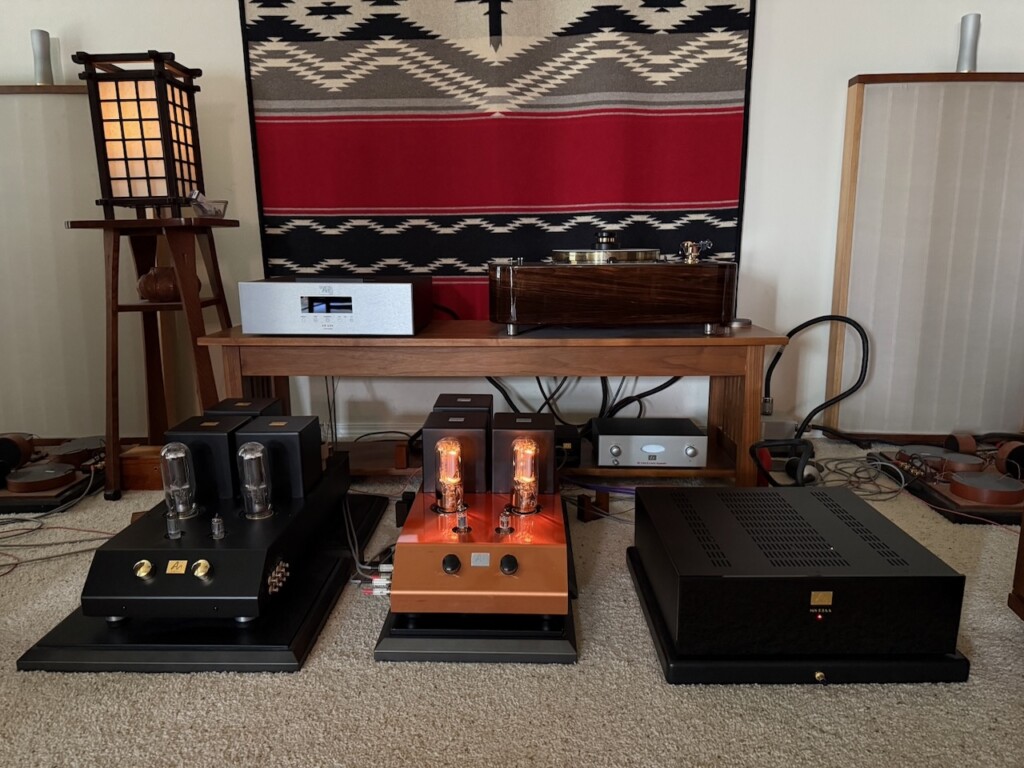
Audio Note (UK) AN-V silver interconnects and AN-SPe silver loudspeaker cables connect all the components together.
Acoustic Revive Absolute power cables connect the components to an Acoustic Revive RPT-6 Absolute NCF power distributor, which is connected to wall AC with an Acoustic Revive Absolute power cable.
The AC outlet consists of an Oyaide R-0 AC outlet, Acoustic Revive CB-1DB receptacle base plate, Acoustic Revive CFRP-1F carbon fiber outlet plate, and an Acoustic Revive CS-3K outlet stabilizer.
For cleaning records I use my homebrew cleaning solution with my VPI HW-19 vacuum record cleaning machine, followed by treatment with an Acoustic Revive RL-30 Mark III Analogue Disc Demagnetizer, both of which I highly recommend to vinyl aficionados.
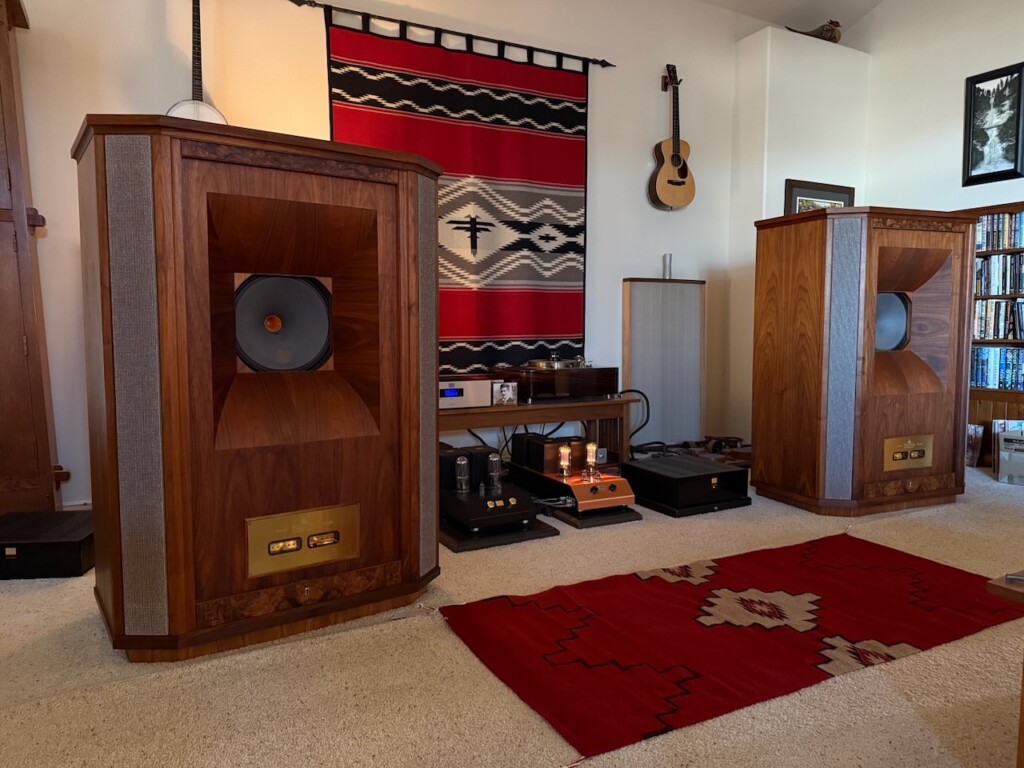
My room is equipped with three Acoustic Revive RWL-3 acoustic conditioners, one behind each loudspeaker, and one on the back wall. Two Acoustic Revive RHR-21 Helmholtz resonators are used for room tuning.
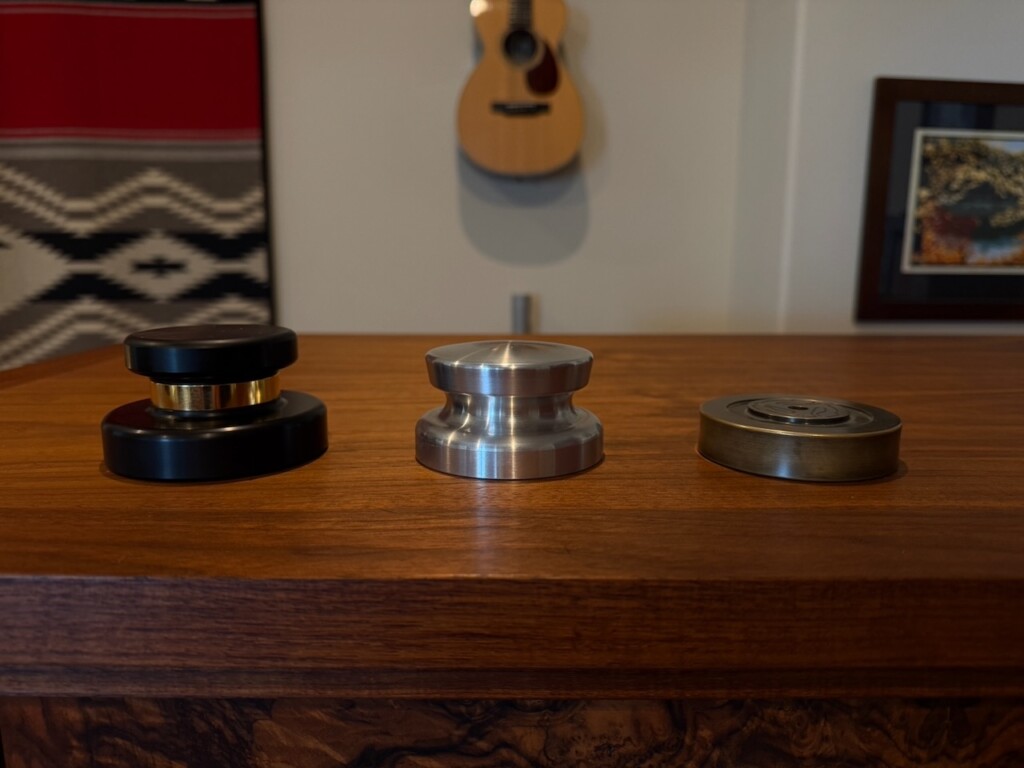
I used two other record weights I own as comparators to gather listening impressions: the 397 gram Artisan Fidelity CNC-milled 6061-T6 aluminum record weight ($249), and the 630 gram Fern & Roby brass record weight ($165).
Listening Impressions
I've listened to a lot of records with the Acoustic Revive Analog Stabilizer PS-DBLP since it arrived.
It's been an illuminating experience for me, and finding out that a record weight can have a large effect on the sound quality and level of musical engagement of albums surprised me.
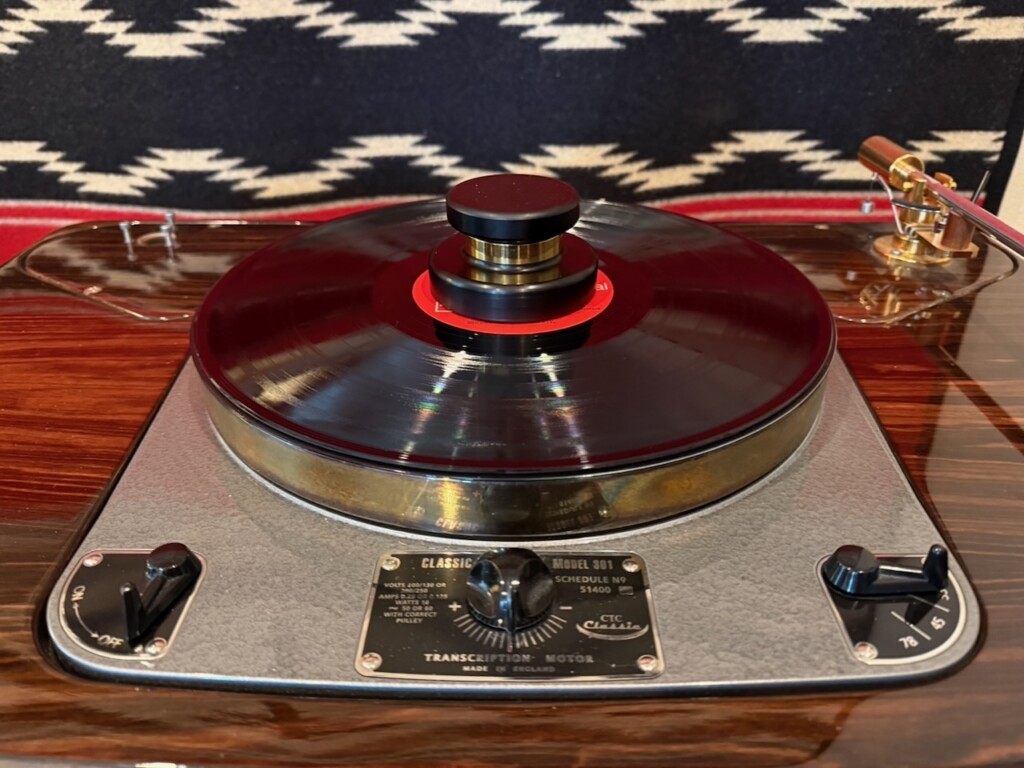
I didn't really have an appreciation for the magnitude of improvement a good record weight can make until listening to music with the Acoustic Revive PS-DBLP. It turned out to be a rather big deal for me.
To give you a better idea of what the PS-DBLP is capable of, I first listened to selections from albums with no record weight to serve as a baseline, and then rotated in the Artisan Fidelity, Fern & Roby, and Acoustic Revive PS-DBLP record weights to characterize the differences in their performance. I found that listening approach to be very illuminating, and I learned a lot about how mass and materials compositions affect sound quality with record weights.
Let me go over a few examples to give you an idea of what I'm hearing from these record weights.
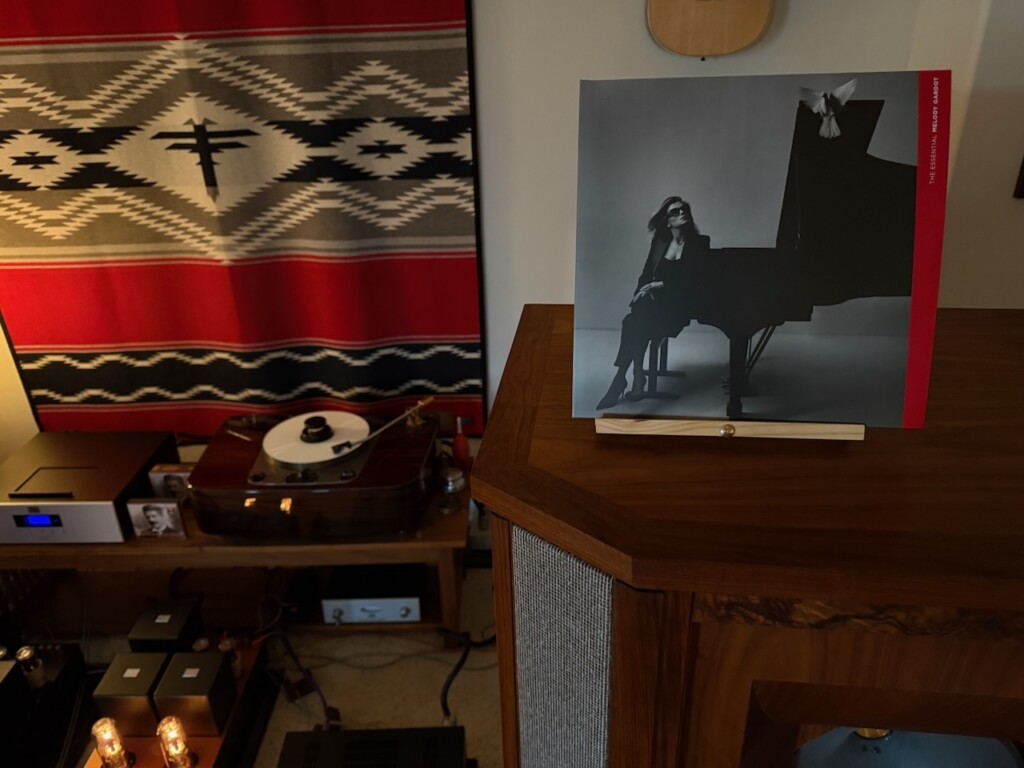
My first example is Melody Gardot's Essential Melody Gardot 2 LP white vinyl compilation album (Decca 6558101, 2024). By the way, if you don't have any Melody Gardot albums in your collection, I recommend this one, and I think this album will blow you away with its musical artistry and excellent sound quality.
"Baby I'm A Fool" was mastered by the famed Bernie Grundman, and as you would expect, Bernie really did a sweet job of it. The level of sound quality and musical engagement was superb, with the impressive talent of Melody and her backing musicians being showcased in spectacular fashion.
With no record weight, the tonal balance across the audio spectrum sounded well balanced and natural, and really sounded and felt gorgeous and engaging, just as I have come to expect from this audio system.
The aluminum record weight added a bit of unpleasant sibilance to Melody's vocals compared to no record weight, and the bass region became noticeably boomy and annoying, altering Ken Pendergast's fine bass playing in an unpleasant way. So the aluminum record weight was a fail, and it made "Baby I'm A Fool" sound quite a lot worse than no record weight at all.
So what caused the sound quality anomalies with the aluminum record weight?
For female vocalists, sibilance typically appears in the 5-8kHz region, spanning the mid to upper part of the presence region (4-6kHz), and the lower frequency part of the brilliance region (6-20kHz). The bass region (60-250Hz) can sound boomy when boosted too much.
So my guess is that the aluminum weight was boosting the presence / brilliance and bass regions just enough to have audibly unpleasant effects, compared to using no record weight at all.
With the brass weight, Melody's vocals sounded slightly richer and darker overall, but also more withdrawn and less articulate, with less vivid imaging presence, compared to no record weight at all. The brass weight added no sibilance to Melody's vocals like the aluminum weight did, but as with the aluminum weight, Ken Pendergast's bass sounded unacceptably boomy.
So what caused the sound quality anomalies with the brass record weight?
Well, my guess is that like the aluminum weight, the brass weight seems to boost the bass region enough to make it sound boomy, but unlike the aluminum weight, it seemed to suppress the presence and brilliance regions a tad for a more laid-back presentation.
When "Baby I'm A Fool" began to play with the Acoustic Revive PS-DBLP weight, it was almost like I was listening to a different album.
The music opened up and bloomed, expanded in space, and seamlessly filled my room. The sound became more transparent; there were lots more musical nuances in evidence. The audio soundstage became a "soundspace" that was shaped and filled out by living and breathing vocals and the instruments in a rather spectacular fashion.
Everything improved: the music bloomed with life and beauty, the imaging improved, there was no sibilance in Melody's vocals, no bass boom in Ken's bass playing, just natural and musically well-balanced sound quality across the frequency spectrum. I melted into the flow of the music and soaked it in. A very good outcome.
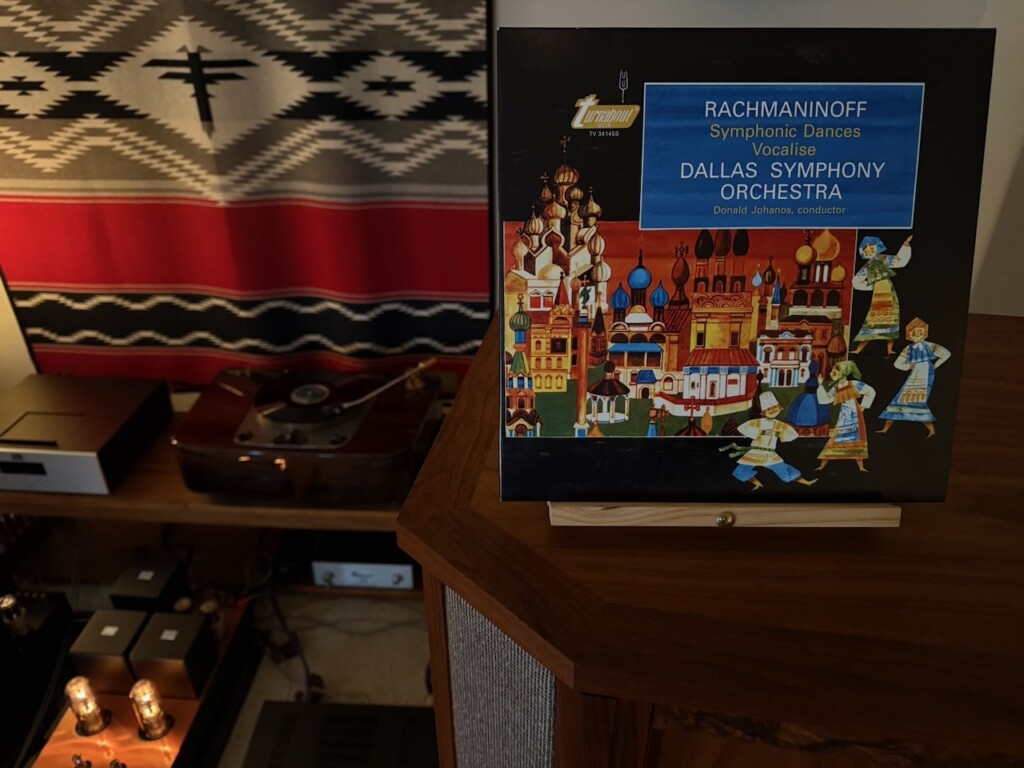
A second example for you: Rachmaninoff, Dallas Symphony Orchestra, Donald Johanos conducting, Symphonic Dances and Vocalise (Turnabout TV 34145S, 1967). The version I have is the Analogue Productions 45rpm version on two LPs (APC 34145S).
This album is an audiophile classic for both its great music and superb sound quality, and you know when Chad Kassem is involved in the reissue of it as a 45 rpm two-record set, it's going to be something special, and it is.
On side 1, Symphonic Dances For Orchestra, Op. 45, is powerful, dynamic, and exciting music, and it will give your pulse and audio system a real work out. The dynamic contrasts can go from blasting at you like a howitzer, to soft and gentle, adding lots of dramatic feel to the music.

Take a look at the photo on the back of the album of the Dallas Symphony Orchestra. There are lots of musicians with their instruments, so there's lots of musical nuance to hear, not to mention the potential for a lot of interesting imaging. Listen closely, can you hear the contributions from all the different instruments?
The aluminum record weight fared better on this album compared to no record weight at all, with the boost in the bass and presence/brilliance regions not being an unpleasant distraction as with my Melody Gardot example.
In fact, the aluminum weight added a little excitement to the presentation that I liked. I also thought that the imaging and soundstage aspects of the recording were improved a bit, with the images having a more distinct and vivid presence across and deep into the soundstage.
The brass record weight also fared better on this album, sounding a little darker and richer than with the aluminum record weight, or no record weight at all. Bass dynamics were forceful and powerful, but perhaps not quite as articulate and resolved as with the aluminum weight.
Overall tonality was more naturally warm sounding with the brass weight, with timbral textures sounding more natural, rich, and "real." String movements were truly beautiful, and in fact, everything was a little more beautiful and romantic sounding with the brass weight. A nice showing overall for the brass weight on this album.
With the Acoustic Revive PS-DBLP weight, the music once again expanded in terms of soundstage, with the music opening up and blooming to infuse my room with a greater sense of the recording's hall reverberation times, which added depth and ambiance to the recorded sound.
Imaging improved considerably over the aluminum and brass weights, and there were a lot more definition of individual instruments that I could hear emerging from the soundstage. Big dynamic swings were more dramatic, powerful, and exciting, and with lower-level passages being more resolved and articulate.
The bass was more resolved, and the bass boost I heard with the aluminum and brass weights was gone, to give a better overall bass balance and definition. Also, there's a certain tonal purity and timbral realism that I found really striking as I listened, and in this regard in particular, the PS-DBLP was at a considerably higher level of performance than the aluminum or brass weights.
All through the seven frequency bands of the audio spectrum—the sub-bass, bass, low midrange, midrange, upper midrange, presence, and brilliance regions—I heard improvements in clarity, articulation, resolution, and naturalness.
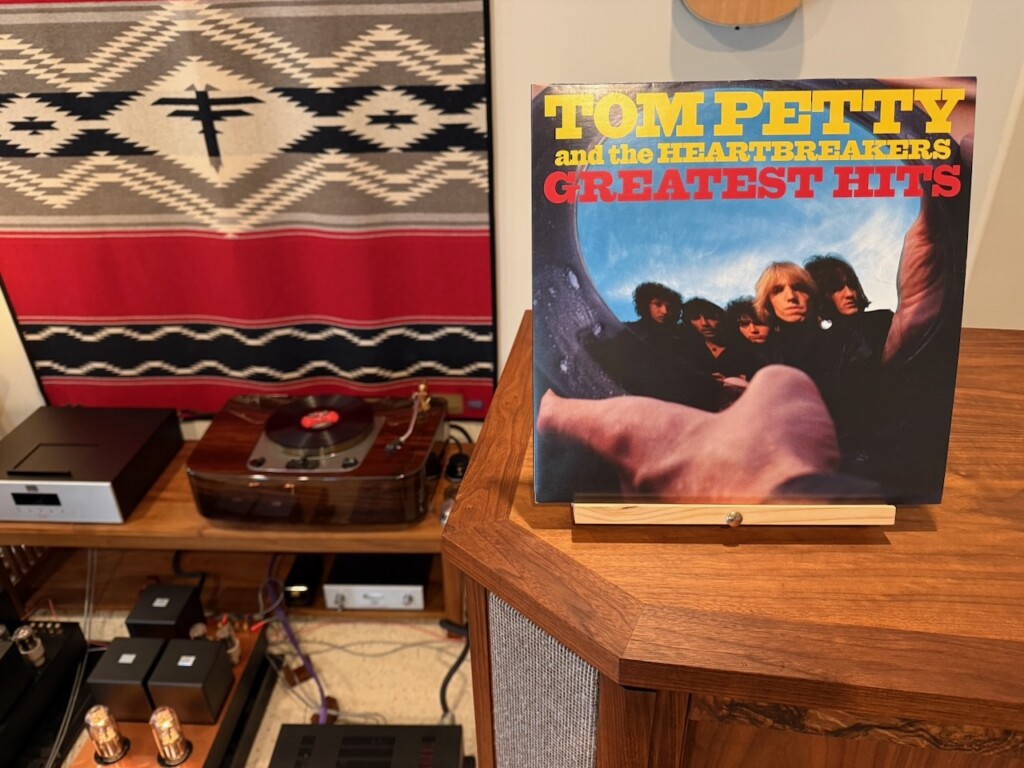
My third example is from my Tom Petty and the Heartbreakers Greatest Hits album (Geffen B0024293-01, 2016).
One of my favorite Tom Petty songs is "I Won't Back Down" from the album Full Moon Fever (1989), which was co-written by Jeff Lynne. Another rock & roll great, George Harrison, also sang and played the guitar on the recording.
"I Won't Back Down" was written by Tom and Jeff after an arson at Tom's home in 1987, and reflects defiant themes of resilience and determination.
You know how life's troubles will kick you in the nether regions a few times in a row before everything settles back down for a while? During those kinds of times, this is my favorite song to put on the turntable and sing along to as loudly as I can. It's therapeutic. It cheers me up. Try it!
Energy, intensity, and a certain defiant forcefulness characterizes "I Won't Back Down." I find it exciting to listen to and sing along with, while reminding myself that life's troubles are a normal part of life, and I can learn from them, improve, and carry on.
Even with no record weight, "I Won't Back Down" is exciting and encouraging to hear; dramatic and dynamic, the emotion comes through in spades. Also, it is immediately obvious that the recording quality was excellent, with vivid imaging, a wide and deep soundstage, and a room-filling sense of recorded ambience.
A strong drum beat gets my foot tapping while I'm flashing the one-fingered salute with both hands at life's troubles. Then I jump up and dance around while doing the same, singing at the top of my lungs. I feel better just telling you about it.
The aluminum record weight fared pretty well on this overall, but I did note it added a slight edginess to the presence/brilliance regions in places, and a noticeable boost to the bass beat, but not in an obnoxious way. It also seemed to cut the feelings of intensity and defiance in the dramatic feel of the music somewhat. Imaging became more vivid and solid, and the layers of instruments and vocals back into the soundstage became more distinct.
The brass record weight also boosted the bass beat a bit compared to no record weight, but not in an obnoxious way. The edginess I was hearing from aluminum weight disappeared with the brass weight. The images became more vivid on the soundstage, and overall the tonality of the recording was a bit warmer and lusher. I liked what the brass weight did on "I Won't Back Down."
The Acoustic Revive PS-DBLP weight improved clarity across the audio spectrum. Tom's vocals sounded more natural tonally and more dramatic from an emotional impact perspective. Imaging improved quite a lot, and I heard a timbral purity with instruments that I found to be compelling. Also, the sense of spaciousness in the recording improved considerably, and individual instruments were rendered in greater clarity and vividness.
As I was sitting there listening, I was just shaking my head thinking, "It's just a record weight, right?"
Well, it turns out that a record weight's materials composition, mass, and passive and/or active properties all factor in to its level of performance. Record weights can reduce the amount of vibration noise going into your cartridge, but can also cause small shifts in the audio spectrum that affect sound quality in surprisingly large ways.
A really good record weight like the Acoustic Revive PS-DBLP can significantly improve the sound quality, the sense of emotional engagement, and overall listening satisfaction.
From a performance standpoint, the Acoustic Revive PS-DBLP was at a considerably higher level of performance than my Artisan Fidelity aluminum record weight and my Fern & Roby brass record weight.
The Acoustic Revive PS-DBLP was consistent in its ability to improve performance across all the albums of varying musical genres I've listened to since its arrival. However, I found that my Artisan Fidelity aluminum record weight and my Fern & Roby brass record weight were more inconsistent, and sometimes they improved performance a bit, and other times they degraded it, depending on the album.
Summary and Conclusions
The use of a record weight can provide considerable benefits. Compared to using no record weight at all, the benefits I heard from the Acoustic Revive PS-DBLP after listening to a broad selection of albums from the classical, opera, jazz, folk, blues, and rock & roll genres, both audiophile standards and decidedly non-audiophile records that I enjoy listening to, were a more open and clear sound quality, an audible increase in the amount of natural musical nuance, improved realism of timbral textures, improved articulation of dynamic gradations across the dynamic spectrum, improved visuospatial performance for more vivid imaging and soundstaging, and a greater sense of recordings' room or hall reverberation times, which added depth and ambiance to the recorded sound.
The Acoustic Revive PS-DBLP significantly outperformed my aluminum and brass reference record weights, and eliminated the anomalous boosts and cuts that they unpredictably added to the audio spectrum, which could at times distort a balanced presentation of the music in unpleasant ways.
My audio pal Ron summed up the Acoustic Revive Analog Stabilizer PS-DBLP nicely: "I bought an Acoustic Revive PS-DBLP. I am enamored with it. I have three other very expensive ones and the Acoustic Revive blows them all out of the water. This one is so good I am thinking of buying a second one."
The Acoustic Revive Analog Stabilizer PS-DBLP is limited to 100 pieces sold worldwide, so if you're interested in getting one, you'll need to act fast.
As always, thanks for stopping by Positive Feedback to read my articles, and may the tone be with you!
Acoustic Revive Analog Stabilizer PS-DBLP
Retail Prices: ¥88,000 in Japan (excluding taxes, tariffs, etc.), and $885 in the USA through The Lotus Group. If you are located outside of Japan, you can contact exporter Mr. Elia Hontani at the MuSon Project for the importer from whom you can buy the PS-DBLP in your country, and then check with the importer in your country for the current price including taxes, tariffs, etc.
Acoustic Revive