


Just about six months after the release of The Doobie Brothers’ Toulouse Street, they began working on the Captain and Me, again with producer Ted Templeman and recording engineer Donn Landee. They could not book Amigo Studio solid, as the band was touring, so they had to piece-meal the project, even recording some overdubs on the road at a studio in Washington, DC.
The album has their signature sound, but also adds once again some piano and B3 work from Little Feat’s Bill Payne (Templeman and Landee had worked with Little Feat), and quite a few ARP synthesizer sounds programmed by TONTO legends Malcolm Cecil and Robert Margouleff, and also some steel guitar work from Steely Dans’ Jeff “Skunk” Baxter. String arrangements were by Nick DeCaro.
The album is mainly comprised of Tommy Johnston rockers along with some blues and country flares, and even a Chinese-influenced piano line Payne came up with for China Grove. Turns out there is a town in Texas called Chine Grove, which Templeman found in a US Atlas.
With that, Johnston wrote the lyrics in one afternoon. Johnston typically wrote the lyrics in the studio at the last minute.
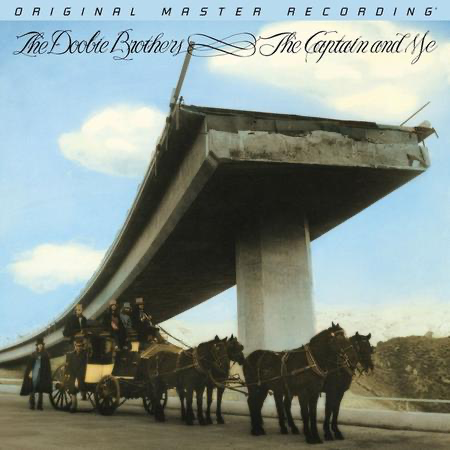
The album cover and inside gatefold photos are deliberate time-warps, with a Wild West stagecoach parked under an earthquake-wrecked 1970s freeway. The location is the Newhall Pass interchange of I-5 and State Route 14, near Sylmar, California. The unfinished bridge in the shot had partially collapsed in the Feb. 9, 1971 San Fernando earthquake, about 1.5 year prior. The same section of freeway collapsed again in the 1994 Northridge earthquake. The front, back, and inside shots show the five band members plus manager Bruce Cohn, all in 19th-century costume. This answers the long-running question of who the sixth man is. Warner supplied the period clothes and the horse-drawn stagecoach from their film studio lot. The inside gatefold carries the gag further with the band in Victorian dress eating dinner at a table in the shadow of the collapsed overpass. The jacket photography is by Michael and Jill Maggid, and designed by John and Barbera Casado.
Note how well the MoFi Stoughton jacket reproduces the photo, since the image depends on the sharp contrast of concrete slab against sky and stagecoach. This jacket has huge variations in color and saturations depending on who printed it.
MoFi does a nice job here.
Album cover, courtesy of Mobile Fidelity; Drawing by Bruce Walker