
By Theodore Walton Denney III
Founder, Lead Designer & CEO — Synergistic Research, Inc.
This article is drawn from an ongoing series of public discussions on electromagnetic field theory and audio cable design, conducted on my personal Facebook page over the past several weeks. The exchanges documented here are real—quoted directly from public comments—and represent a pattern I have observed consistently across hundreds of similar debates over thirty-three years. The original discussions, along with the physics framework they reference and the community that has formed around them, can be found on my Facebook page under Theodore Walton Denney III.
Every week, somewhere on the internet, a man pastes a link to a Headphonesty article and declares the cable debate settled. "A Compilation of 50+ Blind Tests Reveal the Only Gear Upgrade That Actually Matters." It sounds devastating—fifty studies, one conclusion, case closed. Speakers are the only upgrade that matters. Everything else is snake oil.
The article has been shared in my Facebook comment sections dozens of times in recent weeks. It's presented as the definitive word—the compilation that ends the argument. It is none of those things. The source isn't a study. The methodology can't detect the phenomenon being tested. And the same publication concluded that mud is a valid audio conductor.
The article falls apart in five ways.
1. The Source Material
Headphonesty is a website that earns revenue through affiliate commissions on product purchases. Its primary source for the cable section is a Head-Fi.org forum thread—compiled by a single forum member over fourteen years. Not a research institution. Not a laboratory. Not a peer-reviewed publication. A forum thread, compiled by a hobbyist, repackaged with professional formatting, and presented as settled science.
The cable section cites seventeen blind tests. Fourteen "found no audible difference." The most famous—the 2004 Audioholics coat hanger test—involved five trials with no published methodology, no documented listener qualifications, no statistical analysis, and no peer review. It is a forum anecdote that became folklore. Headphonesty treats it as data.
2. The Methodology
Every test cited uses ABX rapid-switching protocol—short listening intervals where the listener hears a few seconds of one condition, a few seconds of another, and then identifies the unknown sample. This protocol was designed for gross tonal discrimination: is this louder or softer, brighter or darker.
It cannot detect the perceptual qualities that cable design affects—soundstage depth, spatial coherence, timbral decay, imaging specificity, micro-detail retrieval. These qualities require extended listening. Minutes, not seconds. The listener needs to settle into a presentation, attend to spatial cues, evaluate the dimensional structure of the soundstage, and assess timbral accuracy over time.
Testing whether cables affect spatial presentation with rapid switching is like testing whether a novel is well-written by reading random sentences. The methodology is categorically wrong for the phenomenon being evaluated. And when a methodology can't detect what it claims to test, the null result doesn't mean the phenomenon doesn't exist. It means the test can't see it.
3. The Systems
The article does not document what amplifiers, speakers, sources, or rooms were used in the majority of the cited tests. This is not a minor omission. A blind test conducted on a system that cannot resolve the difference between two cables will produce a null result—not because the difference doesn't exist, but because the system cannot reveal it.
System resolution is the threshold variable that determines whether a cable difference is audible. A system with low-resolution speakers, a modest amplifier, and an untreated room will mask the differences that a reference system in a treated room reveals effortlessly. Omitting system resolution from the test documentation is like publishing a visual acuity study without documenting whether the subjects wore their glasses.
4. The Era
The article cites the Richard Clark amplifier challenge, which ran from the early 1990s to approximately 2006. Amplifiers were level-matched "to fractions of a decibel" and kept "in their linear range." The challenge predates the electromagnetic environment of a modern home—ubiquitous Wi-Fi, 5G cellular, smart home devices, GHz-clocking CPUs, switch-mode power supplies in every charger and appliance. The broadband RF environment of a 1990s listening room bears no resemblance to the electromagnetic landscape a modern audio system operates in. Test results from that era do not transfer to a 2026 listening room saturated with MHz-GHz interference from every direction. The evolution of the ambient electromagnetic environment across the decades—from the relatively quiet RF landscape of the 1970s through the Wi-Fi and 5G saturation of the present day—and why that history matters profoundly for audio reproduction in 2026, is the subject of an upcoming article in this series.
The article's headline claim—that speakers scored 97% in blind identification while everything else scored at coin flip—is presented as proof that only speakers matter. It proves something different. Speakers produce the largest measurable differences of any component category. ABX rapid-switching can detect large differences. It detected speakers. It failed to detect cables and amplifiers—not necessarily because those differences don't exist, but because the methodology's detection threshold sits above them. The differences cables produce are not smaller—they are finer. Spatial coherence. Phase relationships between channels. Timbral decay. Imaging specificity. These are nuances that require extended listening to evaluate—not gross tonal shifts detectable in a three-second switching interval. The conclusion should be: "the test methodology can detect gross differences and cannot detect finer ones." Instead, the conclusion is: "finer differences don't exist." That is a limitation of the test reported as a conclusion about reality.
5. The Publication
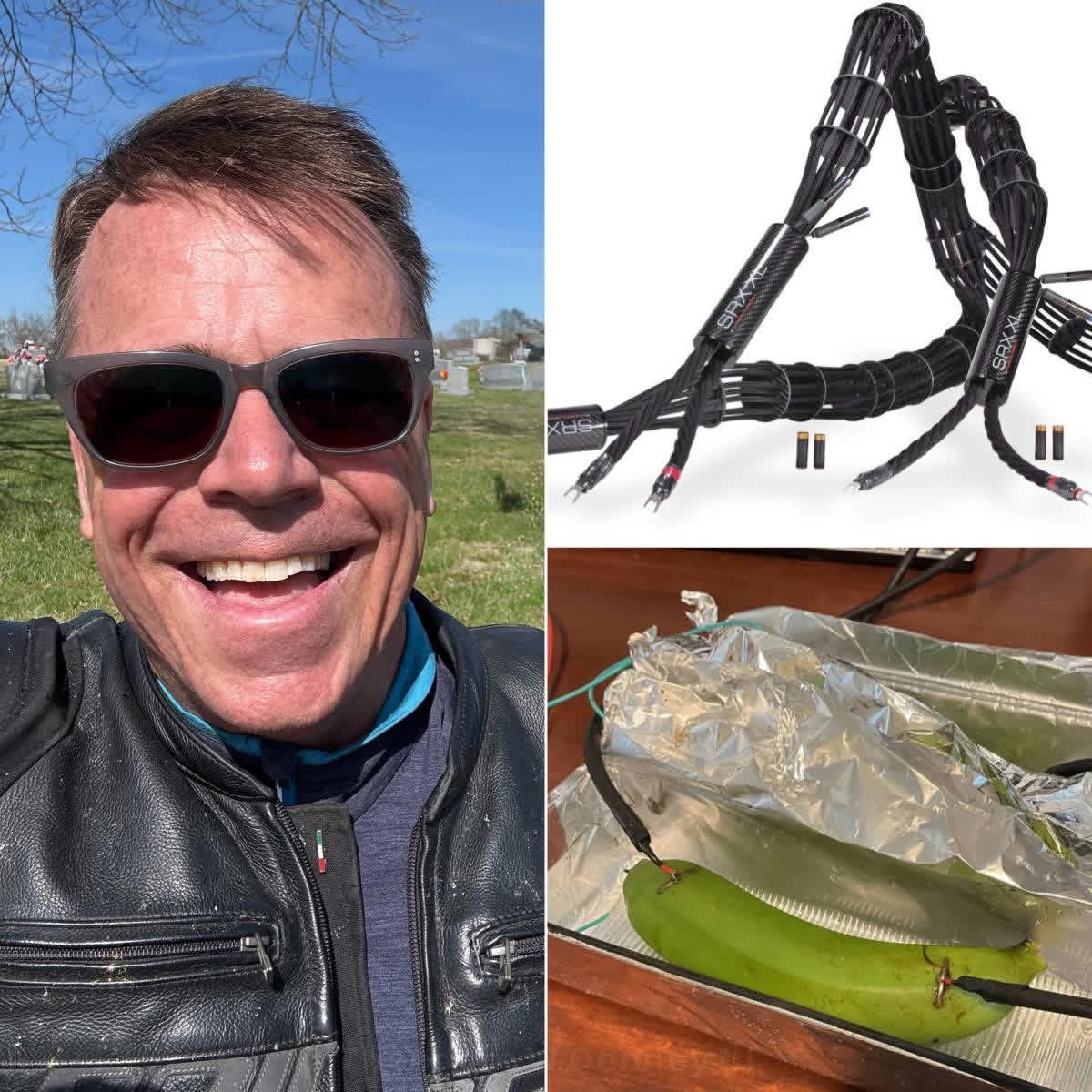
Headphonesty also published an article titled Audiophiles Can't Differentiate Audio Signals Sent Through Copper, Banana, and Mud in Blind Test. The test passed audio signal through mud and through a banana. The conclusion: because listeners could not reliably distinguish mud from copper in a rapid-switching blind test, conductor material does not matter.
This is the publication the objectivist community cites as its scientific authority on cable performance. A website that concluded mud is a valid audio conductor.
What the Evidence Actually Shows
While Headphonesty repackages forum anecdotes, actual measurement work is being conducted. Alpha Audio—an independent Dutch audio publication—tested thirty-two speaker cables with calibrated instruments, documented their methodology on video, included blind listening evaluation, published every measurement, and reached a clear conclusion: speaker cables make a measurable and audible difference.
The study found impedance variations of a factor of one thousand between commercially available cables. A single cable choice reduced a Bryston amplifier's damping factor from 500 to under 13—a 97% loss of amplifier control over the speaker. Their earlier twelve-cable study, which included explicit blind listening protocol, found 70% overlap between the measurement Top 3 and the blind listening Top 3.
My own CanJam NYC 2026 white paper documents 693 data points from sixty-three independent listeners across eleven perceptual parameters, with a thirty-point invariant gap between control and treated electromagnetic environments—consistent across two days and two completely different listener populations. The methodology, limitations, and every unfavorable score are published and available for review.
Both studies include their limitations. Both publish their data. Both disclose their methodology. The objectivist community's preferred source is a forum thread compiled by a hobbyist over fourteen years, repackaged by an affiliate-revenue website that tested audio through mud and bananas.
The question is not whether cables make a difference. The measurements confirm they do. The blind listening confirms it correlates with the measurements. The question is why a community that spent twenty years demanding "show me the measurements" now rejects the measurements—and cites mud as its rebuttal.
Theodore Walton Denney III is the founder, lead designer, and CEO of Synergistic Research, Inc. He founded the worldwide high-end power cord industry in 1992 and holds nearly twenty patents in electromagnetic field management for audio applications. This is the first article in an ongoing series published at Positive Feedback.