
Listening Adventures and Impressions - The Chameleon!
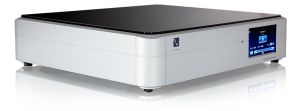
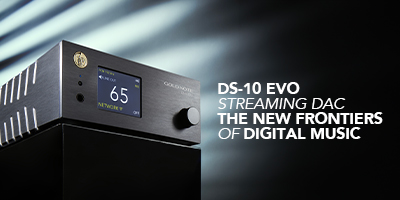
Let me start my listening impressions with a preamble: the Gold Note DS-10 EVO streaming DAC and PSU-10 EVO power supply is the most technologically complex audio component that has come my way for review, one of the most educational components I've written about, and certainly the most difficult component to articulate the performance for of any component I've ever reviewed.
Writing about this Gold Note combo has stretched me as an audio writer into new realms of inquiry and observations, into new realms of considering the interdependent relationship between hardware and software, and what is possible within the performance manipulation realm of digital audio.
Because of the Gold Note's technologically complex nature of being able to stream pulse-code modulation (PCM) and direct stream digital (DSD) audio signals at various resolutions, and to alter the sound quality character of those signals with 48 different internal equalization parameters, it can be an audio experimenter's delight, or conversely an obsessive-compulsive nightmare, because it can be challenging to pin down its overall character and ultimate performance level due to the different software formats and the number of possible equalization parameters.
There's also the interdependent role of software and hardware to consider. Because the Gold Note can stream PCM from the Red Book standard of 16-bit/44.1 kHz all the way up to 32-bit/384 kHz, and DSD from DSD64 (64 times Red Book resolution) up to DSD256 (256 times Red Book resolution), the Gold Note's level of performance spans several performance levels depending on the type and resolution of the digital stream.
Also, albums processed as PCM or DSD sound different from each other to me, as the way the analog is processed is done differently with those two digital formats, which gives them their own unique "processing signature" that in turn affects sound quality.
So essentially, the Gold Note DS-10 EVO streaming DAC functions as three different digital sources: a Red Book PCM source, a high-resolution PCM source, and a high-resolution DSD source. They all sound and perform differently.
Also, to further complicate things, I have found that Red Book PCM albums, high-resolution PCM albums, and high-resolution DSD albums all vary in their quality within each file format, from low-fidelity to high-fidelity, just as albums on LP and CD do, due to the different recording, mixing, and mastering styles used.
The varying processing and album fidelities make it challenging to figure out what performance aspects are due to the fidelity of a particular digital file, and what performance aspects are a trait of the hardware.
As I mentioned previously, I wanted to "bracket" the DS-10 EVO streaming DAC and PSU-10 EVO power supply's "performance level" by comparing its performance to my other source components with known performance levels.
Specifically, I'm interested in the DS-10 EVO streaming DAC and PSU-10 EVO power supply's ability to deliver the authentic identity of the way the recording arts documented the musical performances, the overall performance level of high-fidelity sound quality, and perhaps most importantly, its ability to deliver the drama and emotional impact inherent to a particular piece of music as intended by the musicians and recording team for the performances.
I am going to do three lengthy deep dives with multiple source components in three different audio systems to compare the Gold Note DS-10 EVO streaming DAC and PSU-10 EVO power supply to in order to characterize its performance, so if you don't want to read through all those details you can click on the link below to go to the last page of this article, which is the summary and conclusions section.
Please click on the link below to go to the next page.