
Roger Skoff writes about the impossible dream
Back in the 1950s and early ’60s, when I and our hobby were both very young, the whole subject of hi-fi seemed much simpler. Julian Hirsch – the most highly regarded audio reviewer of his time, with, eventually, more than 4000 tests to his credit – specifically stated that the only really critical elements of a hi-fi system were its electro mechanical components: the phono cartridge and the speaker. (Yeah, just one speaker; for most of Julian’s career, hi-fi was monophonic. The first home stereo phono playback cartridges and LP records not introduced until December 1957 and early 1958)
According to Hirsch, and just about everyone else at the time, none of the other parts of a system made a whole lot of difference: The turntable was just something to spin the record at the right speed, without rumble or wow-and-flutter. The tonearm was just something to hold the cartridge in the proper position relative to the phono groove, and the platter mat was just something to set the record on so that it didn’t get scratched by the metal or plastic surface of the platter.
As to the rest of the system? The speaker was critical, but where you placed it didn’t matter. (Mono, remember? No imaging or soundstaging to worry about). The electronics, with typically less than 1% total distortion, were regarded as close enough to perfection that which ones you used – as long as they played loud enough and had all the functions you needed—didn’t matter. And wire? Wire was just wire, and as long as it was of decent quality, of adequate gauge (if it was an AC cord), and the connectors (if there were any), were of good quality and fit well, it wouldn't matter at all.
I, frankly, have no idea of what brought about the change and opened people’s ears to the truth about their system. Maybe, even as far back as when tubes were all there was, some desperate HI-Fi Crazy, having blown a tube and not having the same-number to replace it with, tried a usable substitute and found that the sound was different. (Oh, incidentally, I can’t verify it personally, but word hath it that Julian Hirsch, in all of his thousands of reviews – of features, build-quality, and product appearance – never once used the word “sound.” That may have waited for J. Gordon Holt and the advent of “subjective reviewing” years later.)
Another possibility for when people started noticing sonic differences was when transistor electronics first became popular, in the early ‘60s: Classic tube and early solid-state gear definitely had different characteristic sound qualities, and that may have been what got people started noticing that other things sounded different, too – that it wasn’t just the phono cartridge and the, by then, two speakers that were affecting the sound, but that the electronics played an important part, as well.
Stereophonic sound brought more than just two speakers: With two different speakers playing two different channels of information, recorded from (at least) two slightly different microphone positions, it became possible for a listener to “triangulate” on a sound source and, for the first time, to hear not just that there was music, but to hear the locations of the different artists playing it, relative to each other and to the room or other venue in which they were performing.
To get the most from stereo recordings required not just the right gear and properly placing the speakers (thus, for the first time, making the listening room a part of the sonic equation), it also became necessary to time align the speakers’ drivers.
For mono, a speaker’s drivers could be placed anywhere that was convenient or looked good to the designer. With stereo, though, and the knowledge that each driver of a two- or three-way speaker system launches its sound from a different position on the enclosure, and thus with a different arrival time at the ears of a listener, driver positioning became critical and stereo imaging suddenly became something far more precise than just “left” and “right.”
The sonic image from time-aligned speakers became a stable, coherent picture, greatly improved in focus, and with that improved focus came not only greater musical enjoyment but a far better tool to make the sonic contribution of every aspect of the system more easily audible.
The Hi-Fi paradox is that every step forward in revealing the music is also a step forward in revealing sonic differences that, before, had either not been recorded, not been reproduced, or had been masked in either the recording or the playback process.
Most importantly, it revealed that everything in the system—even the room it’s played in – is a system component.
In a phono-based system, the mass, materials and resonances of the platter, the platter mat, and the tonearm, as well as just the cartridge, make clearly noticeable differences , even in playing the same record on an otherwise-same system. With all else correctly set-up or aligned. Improved cartridge designs reveal more information, but require pre-amplification or even pre-preamplification, and preamp sonics become a crucial issue.
With digital systems it’s the same thing, exactly, just different bits of gear. And regardless of system type, analog, digital, or mixed, even the wires that connect everything together and provide the signal or power paths for everything have been shown conclusively to make a clearly audible difference.
(That includes even such hard to imagine items as the AC power cord on your turntable. Despite classic-non-believer claims of “voodoo” and “snake oil,” even such acknowledged experts as Dr. David W. Robinson, Founder, Editor, and Publisher of PF, and Michael Fremer, long-time analog guru, agree that changing a turntable’s power cord can make a clear and obvious difference to a Hi-Fi system’s overall performance.)
Understanding that Julian Hirsch and generations of his followers were wrong; that nothing does nothing; and that everything throughout the entire recording and playback process has an effect on the sound we hear can seem to be the end of the Hi-Fi dream – to have a system that will simply step out of the way and let the music come through, unaltered and unimpeded. In fact though, what it really is is the guarantee that, while we may never find audiophile nirvana, we can always keep on getting closer to it. There will always be new components to try, new cables to hook them up or power them with, a new room acoustic treatment to try, or even the possibility that just moving one of the speakers just a leetle bit that way will lock the image into focus and give us something new and different to strive for!
The hobby will never end. How can it? Nothing does nothing.
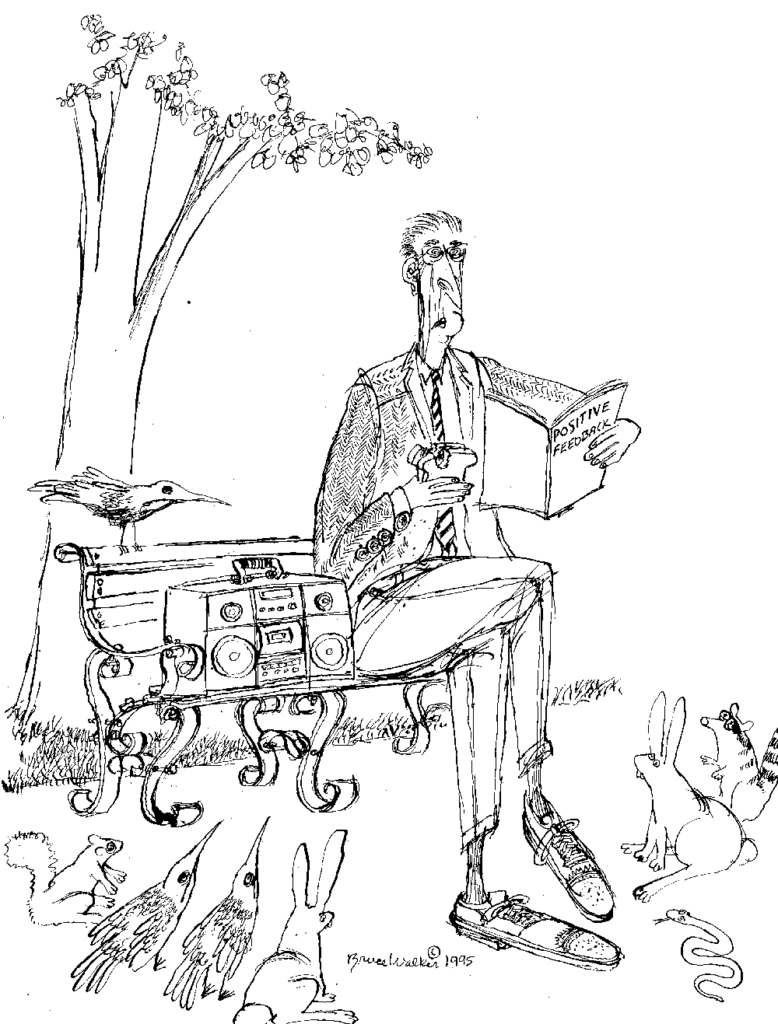
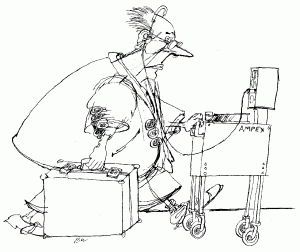
Cartoon by Bruce Walker.