


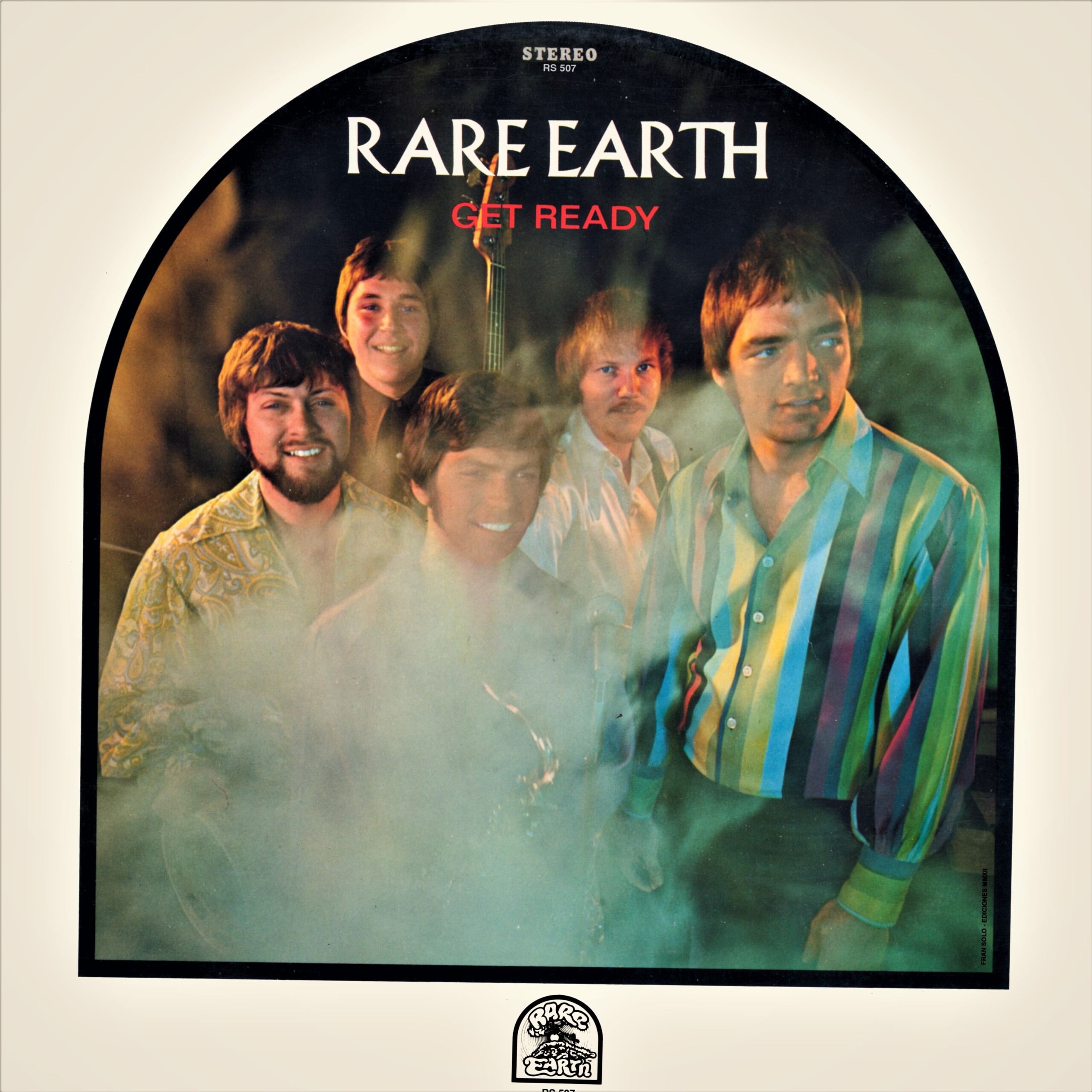
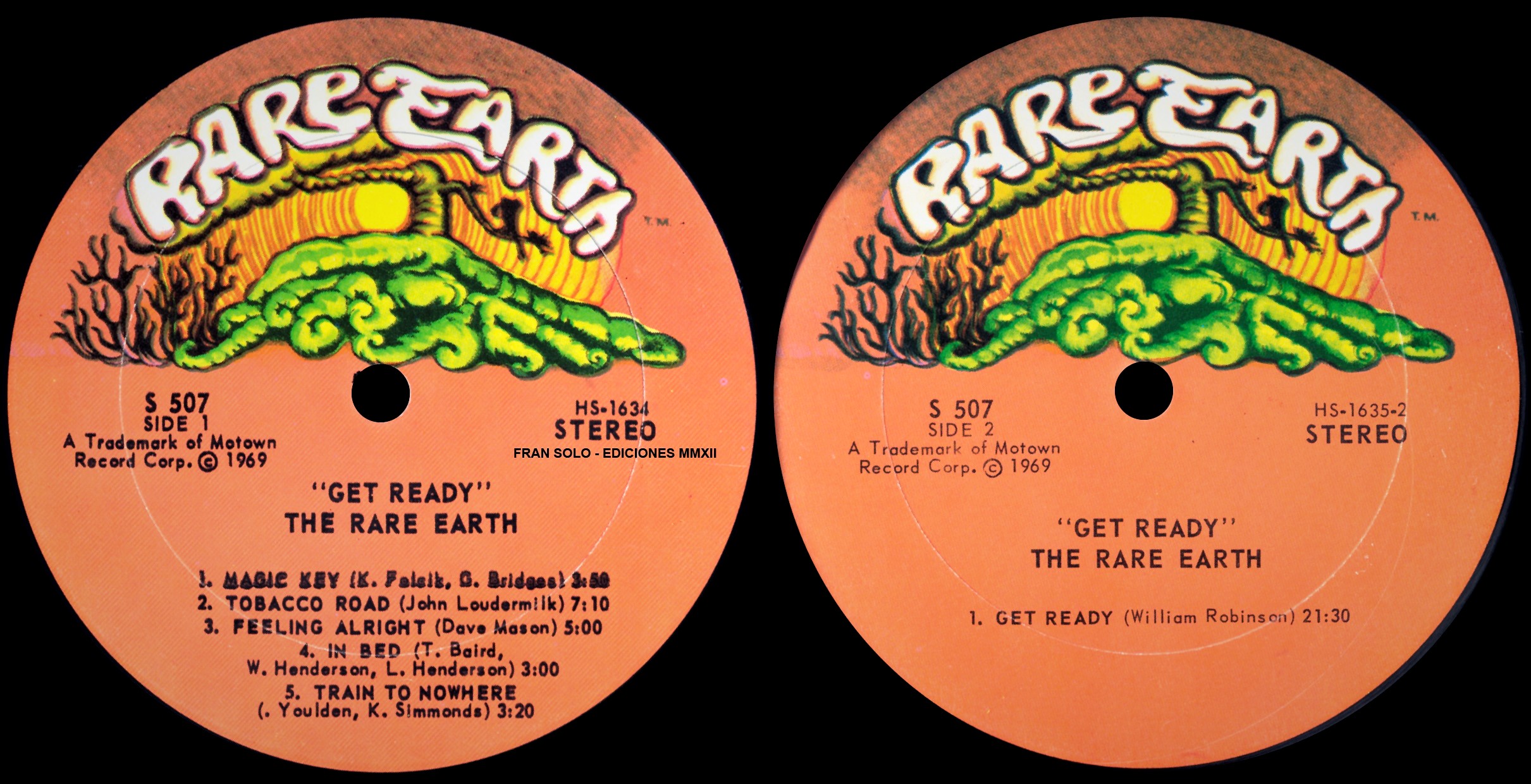
Recently, while driving and tolerating my Las Vegas’ moldy oldies FM station KQLL, I heard an old favorite that I don’t hear too often. It was Rare Earth’s “Get Ready,” a song that I swear was custom-made for me. The deliciously grungy tone of the electric guitar is dangerously addicting, and what follows the guitar is, in my opinion, the best tuned, played, and recorded snare drum in all of recorded music. And I shouldn’t forget the incredible singing from Peter Rivera. Who else could transform “Fee-Fi-Fo-Fo-Fum” into meaningful words? By the time the two minute and fifty-four second single ended, my car was sitting in my driveway. As soon as I entered the house, I grabbed my three garage-sale-sourced copies of the album Get Ready (Rare Earth RS 507) and scrubbed them on my VPI record cleaner. I made a quick comparison to determine which one sounded the best, and then I played the twenty-one minute and twenty-nine seconds album version of the song “Get Ready,” which takes up the entire second side of the album. This is the work of a gifted group of musicians who were having a really great day in the studio. If only I could rid the song of its one glaring problem: The cheesy sound of a dubbed-in cheering audience.
I thought that maybe this time, finally, I could make “Get Ready” sound good. What I was hoping for was what I remember hearing twenty years ago when I swore it sounded great, but this time it sounded like cardboard. Frustrated, I called my friend and fellow vinyl addict Bob Donnelly and asked him if he’s ever heard a good-sounding copy. He said it used to sound awesome on his brother’s Marantz-driven JBL L100s, but that was fifty years ago! Then I called my friend Greg Mahoney, who owns Lifestyle Audio Video Interiors, and asked him if he knows the album. It turns out that he knows it very well, but his experience with it was fifty-five years ago! That was when Greg was known as The Rambler Gambler, and DJ’d at Cova d'en Xoroi in Spain. Back then, he used to play the long version of “Get Ready” right after he finished playing the seventeen minute and three seconds long version of “In-A-Gadda-Da-Vida” by Iron Butterfly. The idea of those two incredible-but-incredibly-long songs played back to back sounds insane. However, as I’ve never been much of a club goer, I did some research. It turns out that DJs loved these two records, because they could use the bathroom! And if they combined the two they could also grab a drink and mingle with the patrons. Greg, who now does his master blasting at home with a PS Audio PMG Signature 512 DAC, a PS Audio PMG Signature Preamp, a pair of McIntosh MC 1.25 amplifiers, and his PS Audio Aspen FR30 speakers, just happened to have a 96K 24 bit file made from a pristine copy of the LP, transferred from another person’s ultra high end analog rig. On his system, “Get Ready” didn’t exactly sound like a demo record, but it sounded clean, completely free of surface noise, and most importantly I heard the sound that I was hoping to hear from one of my copies. We had a ton of fun hearing it, but, sadly, there’s no going back to Bob's brother’s bedroom.
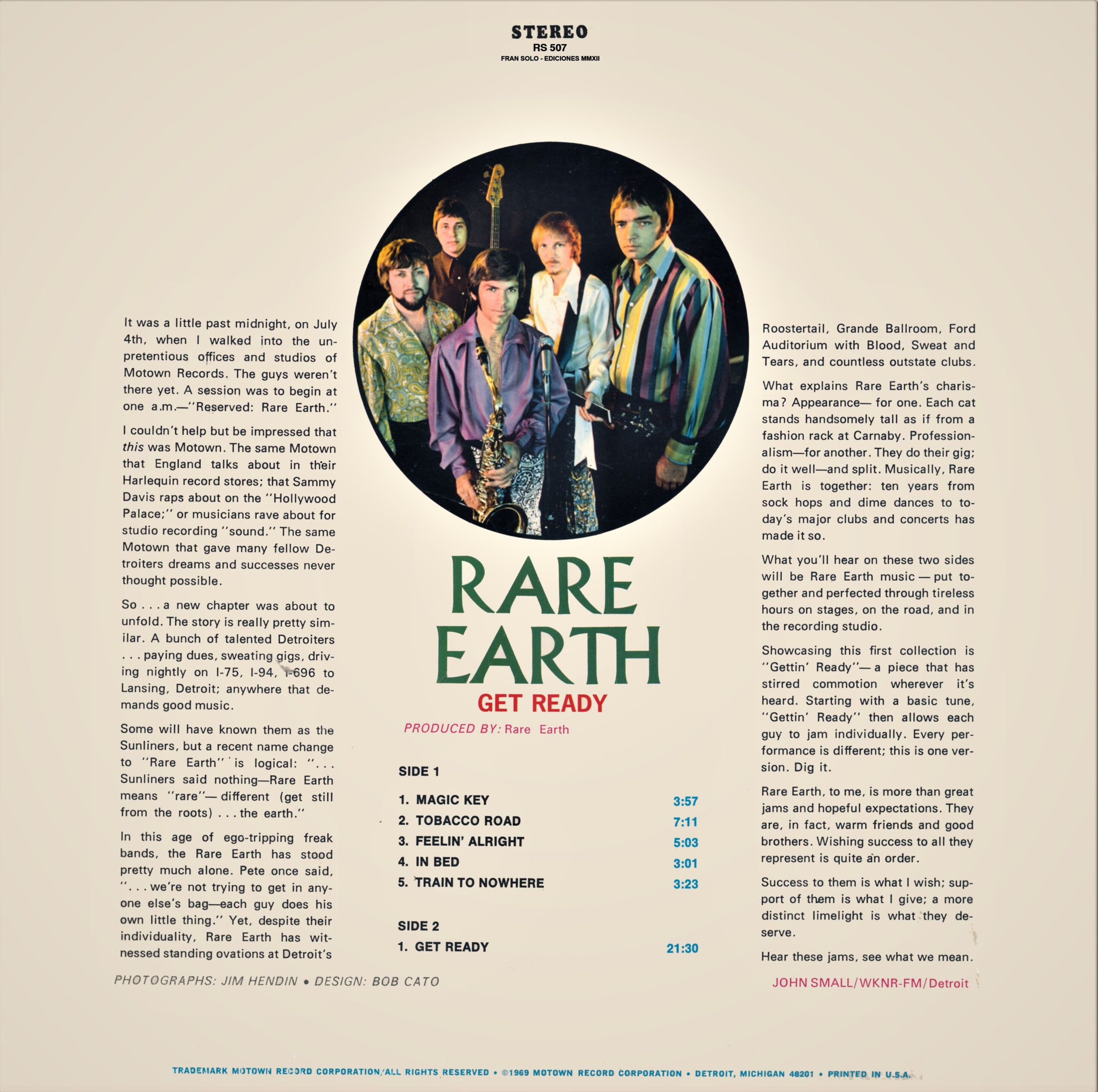
Who was Rare Earth? They were a band from Detroit who were originally called The Sunliners. They took their name from the 1956 Ford Sunliner which founding member Gil Bridges drove. In keeping with the heavier band names of the late sixties, like Iron Butterfly and Led Zeppelin, they changed their name to Rare Earth, a better representation of their blend of soul, blues, and psychedelic rock. Over the last five decades the band has gone through numerous personnel changes and more than thirty musicians have been members of Rare Earth. However, most of them do not pertain to this review. My focus is on the original band: the quintet who created their debut album for Motown. The musicians on this record are Peter Rivera (born Peter Hoorelbeke in 1944) on drums and lead vocals, John Persh on bass and backup vocals, Rod Richards on guitar and backup vocals, Gil Bridges on alto sax and tambourine, and Kenny James on keyboards. Rivera is the only surviving member of this lineup.
Before I tell you about the album, I must explain why I’m approaching it from the second side first. Like Iron Butterfly’s album In-A-Gadda-Da-Vida (which was the template for Get Ready) the ultralong title cut on side two is the only reason why the album was a huge hit. Also, the song “Get Ready” in its extended album form is the only way the band intended it to be heard. When you play side two first, it becomes the main course, and whichever songs you chose on side one becomes dessert.
Extracting the radio-length single from the album version had to have been very easy, since, much to my surprise, the two minute and fifty-four second single sits exactly as it was released, right after a reflective two minute and nineteen second Santana-like prelude. I’m mentioning Santana only because the prelude reminds me of the opening cut on Abraxis, “Singing Winds, Crying Beasts.” The way in which Richards’ electric guitar darts in and out of this section reminds me of only one guitarist: Carlos Santana. And considering that the release of Get Ready preceded the recording sessions for Abraxis by seven months, it’s obvious that Mr. Santana was paying close attention to Rare Earth. While the opening cut on Abraxis uses a piano and an electric guitar, the opening of “Get Ready" uses an electric guitar, an alto sax, and a simple tom-tom beat. But for the music lover who was simply grooving with the music, the feeling is much the same.
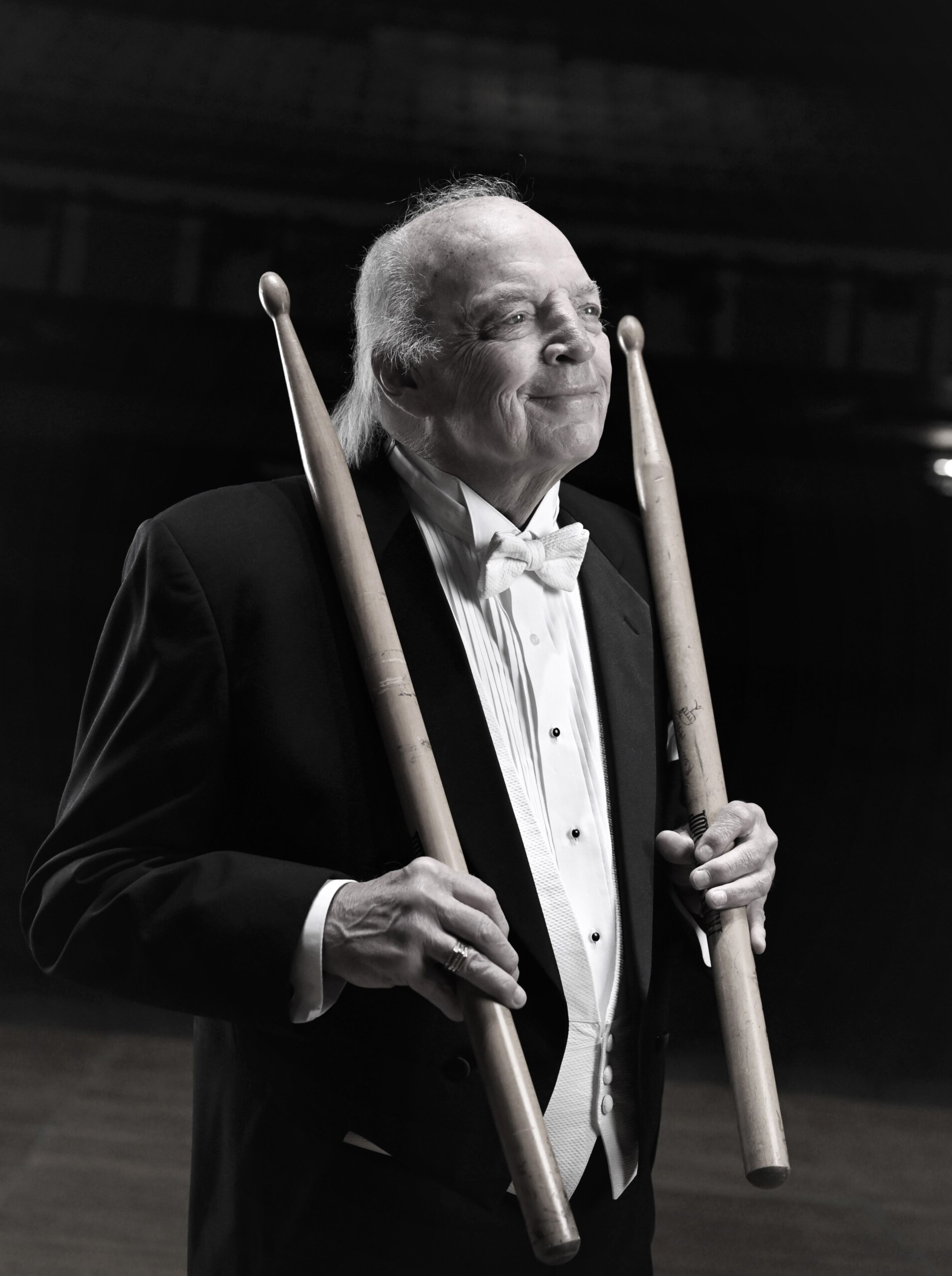
Rivera with his sticks these days...
So what happens after the single-length portion “Get Ready” from the album-length version ends? Well, the band performs one of the finest jams ever recorded. Richard’s guitar sounds incredibly grungy and flavorful. Rivera’s drumming is some of the finest ever committed to analog tape, and the first of his two drum solos begins at the five-minute mark, and lasts for two minutes. Except for a little help from Persh's bass, Rivera commands your attention all by himself. Following solo number one, the dubbed-in audience (more on it later) introduces James’ evocative organ playing. At this point you are in it for the long haul, so just sit back and inhale the power of Rare Earth. During this extended period you’ll be dazzled by Bridges’ sparkling tambourine. And you can practically feel the impact of the above-mentioned finest sounding snare drum ever recorded. Rivera’s cymbal work is remarkable. His bell shots sparkle and his cymbal crashes evoke strobe lights. At 10:55 Richards plays a blistering guitar solo supported by the constant drum beat. At 14:55 James reenters with a strange sounding keyboard. At first I thought it was Bridges’ sax (which is only heard during the prelude and the familiar single portion), but it's actually 1940s era Hammond Solovox! At 16:32 Rivera begins his second drum solo, supported by more blistering guitar, but after a few seconds all you hear are his perfectly tuned and perfectly played drums. His touch and his tone are magnificent! I’ve heard longer drum solos, but none that I like better! From 20:49 to 21:27 we hear a spliced-in coda which features the whole band playing and singing the words “Get Ready ‘Cause Here I Come.” And, by the way, the canned audience is inserted wherever the producer thought it sounded good, like after solos. As mentioned, the only major flaw in the recording is the canned audience. (I could also do without the afterthought coda.) The real performance by the band lies in its raw form under a blanket of reverb and overdubbed cheering.
The extended version of “Get Ready” was for many naive listeners their first experience with recorded-live rock ‘n’ roll, but, as mentioned, it wasn’t really live. As live rock albums were yet to be commonplace in the late sixties, the canned audience worked as intended. Fans fell for the simulated concert. The story behind the canned audience goes something like this: The band had a reputation for performing long jams on stage, ones that included their cover of “Get Ready.” Motown executive Barney Ayles wanted to capture the Rare Earth concert experience in the studio, and the Smokey Robinson-penned song was the perfect vehicle to achieve his vision. After an unsatisfactory recording was made, the band, frustrated, allegedly were left alone to record it themselves. If this is true, who set the mics up? And who ran the tape recorder? Clearly, the mic placement on the drums was much better than the cuts on side one. Adding reverb was nothing new at Motown, or anywhere else, but adding a canned audience was and still sounds weird. It seems to me, after all of these years, with the canned audience now sounding truly fake on our modern audio gear, we deserve to hear what the band actually performed in the studio. Does the two-inch sixteen-track master tape still exist? If so, why hasn’t anybody remixed and released the whole shebang in its raw form? I want to hear the undoctored Rare Earth! Under a shroud of postproduction BS lies an amazing-sounding recording. It could even be the ultimate demo track if the raw version were ever to be released to the public!
How did “Get Ready” become a single? To answer this question, we need to understand how the long album version became known first. It and the long album version of “In-A-Gadda-Da-Vida“ were staples of night time FM radio in the early seventies. (Radio jocks also use bathrooms!) The first city that the complete “Get Ready” was aired in was Washington, DC. Listeners loved it and they thought Rare Earth, Motown’s first white band, was a black band. When word got back to the execs at Motown that the entirety of side two was gaining airplay, their next step was to edit the song’s length to suit AM radio. The single version of “Get Ready” peaked at number four on the Billboard charts before any other Rare Earth singles were released.
I can’t rightly discuss “Get Ready” without mentioning The Temptations. Smokey Robinson wrote it specifically for them, and their 1966 recording is a perfect example of the classic Motown sound. And it has a lot going for it. Rare Earth used an electric guitar to open their version of the song, while The Temptations used a small brass section. As expected, The Temptations’ harmonies are flawless and Eddie Kendricks' lead vocal is superb. Motown’s studio musicians, The Funk Brothers, played, as usual, flawlessly. The recording even has a killer tenor sax solo, played by Hank Cosby. Having said all of this, Peter Rivera sang it with even more impactful soul than Kendricks. As mentioned earlier, he even gave the silly lyric “Fee-Fi-Fo-Fum” a powerful punch, and added an extra “Fo” in the process. Rare Earth also broke Motown’s mold by playing their own instruments, and their extended jam made it historic. By comparison, The Temptations version is just another churned-out, factory-made, Motown dance record. Lastly, the Temptations record features Mr. Record’s kiss of death: Strings.
What about side one? The first cut is “Magic Key,” a Rare Earth original, composed by Bridges and James. I kind of like it, although it sounds like they were trying to emulate Iron Butterfly. Although that in itself is not a bad thing, the song ultimately lacks depth, despite some great slide guitar playing from Richards and excellent singing from Rivera.
Cut two is a brooding blues cover of John Loudermilk’s “Tobacco Road.” The best known version is the protopunk recording by the Nashville Teens from the UK, released in1964. The Blues Magoos essentially copied the Nashville Teens for their 1966 recording. Rare Earth, like The Jefferson Airplane, used an arrangement that’s closer to Loudermilk’s own recording from 1960. Rivera’s stunning vocal is clearly inspired by Lou Rawls’ recording from 1963. Having said all of this, seven minutes and thirteen seconds is an awful lot of time to devote to this song, especially if it’s not performed in front of an audience. Again, I can’t stress strongly enough that Rivera’s singing is off-the-charts incredible, and everything that made Rare Earth great is on full display. This includes James’ great organ work, Bridges’ superb alto sax playing, and some delicious blues guitar playing from Richards. What’s missing is the inspiration that comes from musicians who are in front of an audience. Rather than getting lost in a great performance of blues, I feel burdened when I play it. Sorry, guys. I love you, but this doesn’t cut it.
I love cut three! It’s become my favorite recording of Dave Mason’s “Feelin’ Alright.” There are a few fine versions to choose from, and the best known of them is Joe Cocker’s. If you’re into music history, then you should listen to Mason’s original recording that’s found on Traffic’s second album, Traffic. Three Dog Night also recorded it in 1969, and Chuck Negron’s singing on it is superb. However, with all these choices, which I most certainly have, Rare Earth is the best and here’s why: It opens with explosive blasts from Rivera’s drums and Richard’s guitar, and they are perfectly backed by James’ organ, but the real star is Rivera. What a singer! Like “Get Ready” this cut begs you to crank the volume. And unlike my three bad-sounding side twos, my best copy sounds great on side one. I wish the vinyl was a little quieter, but the sound I’m hearing from my Grado Reference cartridge and my Sennheiser HD650 headphones is thrilling. If Rare Earth performed “Feelin’ Alright” this well in the studio, they must have blown the roof off when they played it live.
Cut four is the superb song called “In Bed.” From what I can tell, it was written specifically for Rare Earth. I don’t recognize the writers, but it’s an awesome blues-rock song with a funky edge. The keyboard, which sounds like it's either a Fender or a Wurlitzer, gives it a cool sound, rather than a blazing hot sound. Imagine combining War, Steely Dan, and The Frijid Pink’s fuzz guitar. Ooh! And I’ll express my opinion of Rivera’s singing again: He’s simply great. The lyrics are a little depressing, but the cool sounding keyboard, the guitars (I assume Richards played both of them) and some very good singing, makes it hard to resist. Once the Rare Earth groove enters your bloodstream, you won’t be able to resist this cut.
Cut five is a decent cover of Savoy Brown’s “Train To Nowhere.” As expected, Savoy Brown’s version is more of a basic blues, but Rare Earth’s vocal harmonies are much more enjoyable than Chris Youlden’s solo voice. I also like the fact that Rare Earth sped up the tempo. Unfortunately, it’s another cut that probably worked better on stage. Also, it’s the worst sounding cut on the album. Heck, the whole album needs to be remixed, but this cut, like the title cut, needs it badly.
The folks at Motown knew that Rare Earth could provide them with a new image. At the time of the band’s signing, Motown was in the process of creating a new subsidiary label that would feature more sophistication than their usual brand of family-friendly dance music, much the same way that A&M, around the same time, was releasing cutting-edge British rock to forge their new image. Rare Earth was not only Motown's first white band, they were the first to back their voices with their own instruments. They were also Motown’s first act that performed long instrumental jams. Motown honored the band by naming their new subsidiary label Rare Earth Records. Rare Earth Records also released the psychedelic sounds of the British band The Pretty Things.
Although Rare Earth never quite reached the status of the so-called super groups, they certainly shared bills with some of them. Examples include Led Zeppelin, Deep Purple, Emerson Lake & Palmer, and Jethro Tull. As far as I know, there still is a touring band that carries the band’s name. Rather than viewing the later iterations of Rare Earth as imposters, I’d rather view them as tribute bands. Perhaps one day I will have the chance to hear one of them.
Mass production caused significant variations in sound quality of this title. None of my three copies sounds as good as I think it should sound on side two. Although Greg’s source came from a better turntable than mine (a Transroter, he thinks), I’m sure that with the right copy I could achieve excellent sound. I’ve yet to hear a CD or a streamed version, but all three of my copies are reissues featuring the two-tone reissue labels. One thing I do know for sure is this: It takes effort and patience to obtain good sound from Motown pressings, as proven by the numerous copies of Stevie Wonder’s Talking Book, Innervisions, and Marvin Gaye’s What’s Going On that I’ve bought and traded over the years. Talking Book can sound drop-dead stunning on the right copy, but the average NM used copy sounds barely better than an FM tuner.
One could argue that Get Ready isn’t really an album, but in actuality it’s a twelve-inch single combined with an EP. Perfect it’s not, but worth a place in my LP collection it most certainly is! If it’s not in your collection, you should make space for it. Maybe some day, hopefully soon, we will all have access to a remixed Get Ready with a lot less reverb, and none of that silly canned audience.