Some of Positive Feedback's intrepid readers may have thought about writing audio reviews. Much like purified drinking water and soft fluffy toilet paper, there's always a pressing need for gifted Consumer Electronics (CE) industry writers.
Many audiophiles believe they could work as professional audio reviewers. Some semi-geniuses imagine that they might even become brain surgeons or astronauts. There's also the usual motley crew of intoxicated buffoons who think that they could climb into the ring with Donovan 'Razor' Ruddock and survive. As the former heavy-weight boxing champion and noted Rabelaisian scholar Mike Tyson once profoundly commented: "Everyone has a plan… until they get punched in the face."
In reality, very few audiophiles possess the skill-sets needed work as professional (i.e. paid) audio critics or music reviewers. In this article, I'll discuss what it takes to be an audio writer.
The Ability to Write
To describe how audiophile gear and cabling sounds requires an aptitude for writing. Mastering the hard and fast rules of grammar and syntax is a long and painful process. This means intensively studying the English language at the graduate school level. No matter how 'gifted' you think you are as a writer, if you don't know what split infinitives, dangling participles, and modifier errors are, then you'll never be of any use as an audio journalist.
Many writers think that they're gifted wordsmiths. In truth, many are mediocre hacks… at best. Reading their writing is about as exciting as watching paint dry. Their words have all of the intellectual depth and descriptive dexterity of a comatose snail whacked out of its head on a synthetic morphine bender.
It's important for writers to understand the potential strength and value of language. It may seem that writing about audio equipment is like dancing about architecture. After all, how exactly does one describe how sound… er… sounds? And yet, when drawn with precision, the aesthetic beauty of words can inculcate a profound depth of meaning. Never underestimate how influential language can be.
American writers like Hunter S. Thompson and Norman Mailer crafted their words as if they were painters or sculptors. Their use of language was akin to artwork and their canvases were blank pieces of paper. Both were wordsmiths who could "paint" with language in a way that echoed their own etymology so deftly, that their writing now stands as some of the best produced by any American during the second half of the 20th century.
As a descriptive force, the written word can—and should—cause a perceptual concussive impact. The rare ability to find specific and exact words that will smack readers on a profound level is uncommon. These days in 2026, most journalism is completed under tight deadlines by hack writers. Craftsmanship in audio writing is damn near dead.
The ability to marshal ideas, descriptions, metaphors, and similes into translatable and repeatable patterns of order is… somewhat… "God-given." Much like being a gifted thoracic surgeon, fighter pilot, or professional boxer, there's only so much that can be taught. If the natural talent isn't innately there, then no amount of education, dedication, or perspiration will allow said talent to ooze forth and percolate into a liquid Hell-broth of perspicacious insight and analysis.
Can you describe stereo sound with written words in a way that will register profoundly with readers? Can you bring a new literary flavor to the salivating outdoor pub patio of audio consumers who thirst to imbibe it? Most audio journalists use horribly dull and worn-out metaphors in their articles. Which is why their articles suck worse than a 1930's era Hoovermatic™.
Ask yourself one simple question: do you love—and I mean capital L.U.V.—audio gear, cabling, and loudspeakers so much that you're driven to write about these goodies? If you don't immediately answer "yes!" with a 100% positive "Hell Yeah!" conviction, then rapidly abandon the idea of becoming an audio journalist.
The Dirty Dozen: Common Errors in Syntax and Grammar
To put an exclamation point on the hard and fast rules in syntax and grammar, here's a short list of some of the most common grammatical mistakes that far too many audio journalists commit:
- Don't use no double negatives.
- Make each pronoun agree with their antecedent.
- Join clauses good, like a conjunction should.
- About them sentence fragments.
- Corect speeling iz essentielle.
- When dangling, watch your participles.
- Verbs has to agree with their subject.
- Don't write run-on sentences they are hard to read.
- Try not to ever split infinitives.
- Don't use commas, when they are not necessary.
- Its important to use your apostrophe's correctly.
- Proofread your writing carefully to see if you any words out.
- Czech your spelling carefully. If you mix up two measly letters in one word, the entire meaning of the sentence will be urined.
- However, do not start sentences with modifiers. However, they are hard to read.
- How to cook crack and clean a crab. Step one: learn how to use commas correctly.
I've had quote-unquote "editors" add dozens of errors (see the above list) into 2000 word length articles which, frankly, a high-school level educated wordsmith should've known not to write. There are already far too many of these drooling idiots posing as audio journalists and editors within the audio industry. Please… pull-lease… don't become another hapless amateur audio reviewer whom has zero understanding of the formal rules of syntax and grammar.
Passion for Music
Most audio critics own enormous music collections. The last time I moved house, it damn near cost the lives of five strong Nepalese Sherpas to shift all of my gear, CDs, vinyl records, SA-CDs, cabling, and equipment stands from one house to the next. I kid of course. No one died. There were a few minor injuries, but no one perished in the cause.
Passion and curiosity are organically intertwined. The great thing about passion is that it can (sometimes) trump "God-given" talent. There is no formal accreditation to become an audio writer. This is a "school of life" career field. It is primarily a passion for listening to recorded music and going to live concerts that… somehow… magnetically attracts music lovers and audiophiles to want to write about what we hear.
In one sense, this lack of accreditation is good because anyone can jump right into the grandiose Mr. Turtle® pool of over-caffeinated audiophile journalists. From another, it's bad because a lack of formal education and accreditation inherently results in lower standards—and a far lower quality—of writing and reviewing.
If you want to be an audio writer you will, at times, have to lose sleep, ingest near-lethal amounts of caffeine, and push through bouts of creative constipation when the words just won't "plop" out the way that you wish they would.
This requires a level of passion which can, sometimes, devolve into not-so-sane thinking and action. Talk to any serious audiophile and s(he) has probably maxed-out his or her credit cards a few times in pursuit of better sound. Creating a mountain of financial debt by purr-chasing (sic.) audio goodies truly is bat-Shi'ite insane. And yet, that's the irrational level of commitment a professional audio writer must innately have for this hobby.
One of the greatest aspects of being alive is being passionate about… something; anything. Finding yourself in a euphoric state of being hopelessly, haphazardly, and unapologetically in love with something is critical to understanding and appreciating your own humanity. What converts most music lovers into full-blown audiophiles is a severe, unconditional, and boundless love for music.
Compensation
By and large, Scottish people don't know the meaning of the word fear. We are, however, intimately familiar with the word 'com-pen-sation.'
Stated succinctly, being an audio journalist pays next to nothing. People toiling away in sweat shops earning a few dollars per day stay motivated by whispering to each other: "At least we're not writing audio reviews." Yep… that's how bad the pay is for freelance writers in the audio world.
And yet, if you truly love music, I cannot think of a more enjoyable way to journey through life than listening to—and writing about—recorded albums on a daily basis. I mean, how can you not be passionate about music? How can you not love something that can so dramatically improve your life? If your passion for music and audio gear makes your heart palpitate more than a quintuple espresso, then audio reviewing may be for you.
Experience with Audiophile Gear, Cabling, and Loudspeakers
At some point in every audiophile's life, the audio bug bites. Even if s(he) has a strong immune system, the molecular virus said bug injects into a music lover's bloodstream stays with him or her for life. There is no known cure for an irrationally strong love of music. Pfizer ain't workin' on a vaccine for falling hopelessly in love with sound. This is both a blessing and a curse.
I became "infected" with the audiophile virus when an uncle let me hear his 2-channel stereo way back in the early 1980s. Living in a lower middle-class suburb of Glasgow Scotland, my uncle couldn't afford a Lotus or a Lamborghini. He loved exotic cars. He truly did. He just didn't have the cashish (sic.) for such expensive toys.
What he could afford though was high-end audio gear. Hearing recorded music through my uncle's Quad ESL-57 loudspeakers, Naim separates, and a Linn Sondek LP-12 changed my life. Even though his gear was wired up with strangulation-level cheap lamp cord, the sound of that stereo system really put the hook in me.
Forty-five plus years later, I'm still fascinated by the sound of recorded music. Decades of listening to stereo systems has brought me a lifetime of spine-shivering musical pleasure. This lifetime's worth of experience is invaluable towards doing audiophile reviews. As with many things in life, experience is often the greatest teacher.
Budding audio journalists must know a lot about audiophile products. Every audio nut starts somewhere. The key question to ask yourself is: do you have enough experience with different components, cables, speakers, and tweaks to articulately describe how a specific high-end audio product differs in sound from another one?
How can you present yourself as an "expert" if you have little or no experience? Stated succinctly, you can't. On top of owning a decent sounding stereo rig, you will also need to have decades of listening to different 2-channel systems to write audio reviews.
Owning a Serious 2-Channel Stereo System
There's a joke amongst audio journalists:
Question: What do you call an audio reviewer without a girlfriend?
Answer: Homeless.
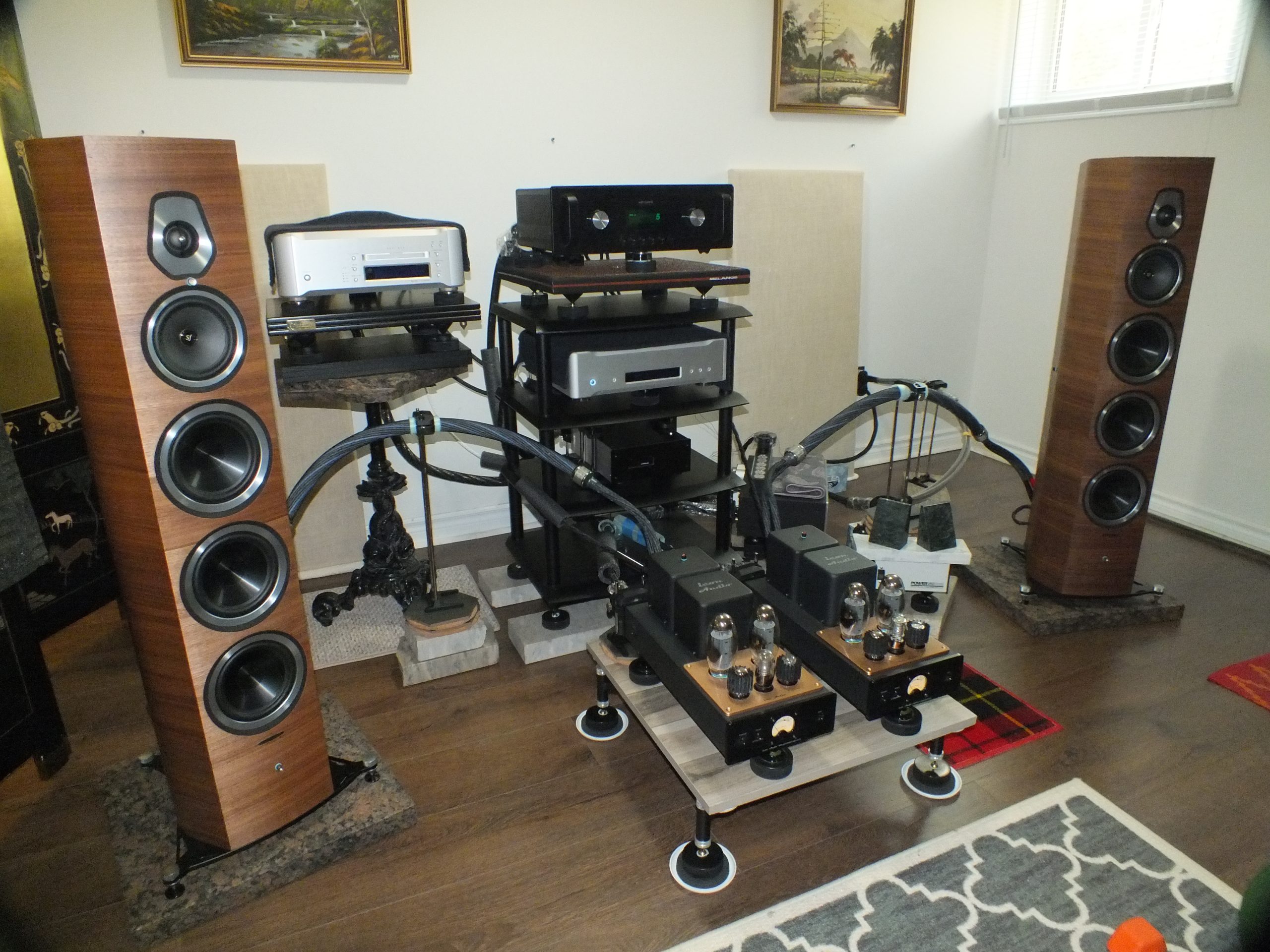
Much like owning exotic sports cars, high-end stereo equipment is not a hobby for frugal folks on a tight budget. Most listening tests in audio reviews are done on a comparative basis. This inherently means that to do reviews, a writer must own a luxury stereo system. While your components and cables don't necessarily need to be state-of-the-art, they should be high-end enough that a reviewer has a sonic base from which to do comparative listening tests.
The word for this is… commitment. Some people are afraid of commitment. It's a hard word to spell; let alone religiously adhere to. If an audio reviewer is going to be taken seriously, s(he) must commit to buying a serious 2-channel rig. The reason why most reviewers are older is because they have the financial capacity to invest in luxury audiophile goods.
If the highest 'quality' stereo you've ever heard is a Bose sound bar, sorry… but that just won't cut it. To be an audio writer you'll need to invest in higher-end stereo gear, boutique cabling, and tweaks. Again, every audio reviewer starts somewhere. And yet, it is critically important to attain a lot of listening experience and to own a serious 2-channel rig before you start writing.
Technical Knowledge
Audio reviewers must have a strong command of the vocabulary that audio scribes use to describe how sound… er… sounds. If audiophile terms like PRaT, imaging, resolution, soundstaging, and dynamics mean little or nothing to you, then you'll need to study articles published in printed audio magazines and online webzines—like Positive Feedback.
Perhaps you've taken a few University courses on circuit design or possess a college diploma in electrical engineering and/or home theater integration? If "Yes"… this will give you some precious knowledge about the technical aspects of audio equipment. While you don't need to have worked as a bench tech in a vacuum-tube audio company, understanding how the electrical and mechanical elements of specific types of audio gear function is invaluable when writing about high-end equipment.
Hands-on experience with Custom Integration (CI) work and/or the business side of running any Consumer Electronics (CE) audio business is also valuable. Stated succinctly, any real-world experience within the CE industry will inherently give your reviews more industry insider knowledge, clout, and authority.
Punctuality / Working with Editors
Punctuality is the soul of good audio journalism. If you can't hit deadlines on time, then don't start writing. Most seasoned journalists will tell you that a writer doesn't so much finish an article, as s(he) abandons it. At some stage, a reviewer cannot improve an article any further and said article must move on from the self-editing process. At this point, it's time for the piece to be submitted to an editor.
Be fully prepared to have your carefully crafted words butchered by some hapless editor whom wouldn't know gifted writing if it shot out of a cannon, tore his or her leg off, and left him or her in a wheelchair. Just kidding… I love my editors.
The best editors are the ones who have the self-discipline to leave the original words intact and keep their editing to an absolute minimum. The worst editors are those who, out of some twisted narcissistic obsession, feel that they must re-write half of your article. In the process, they'll often insert errors in syntax and grammar into the writing and just kill the flow of the words. To put it mildly, this is beyond infuriating.
Worse still, there are a few on-line audio webzines that use groups to do collective editing. You think dealing with one editor is bad? Try negotiating written language with five or six editors at the same time. From personal experience, the end result is always a literary train derailment.
From a metaphoric standpoint, writing audio reviews is somewhat like driving a car: only one person in the vehicle can actively drive the car. While you can fit four or five people into a spacious SUV, only one person can—and should—have their hands on the steering wheel. Four or five sets of hands on the wheel will only result in a chaotic and likely tragic accident that's caused by pure stupidity. Similarly, too many editors will completely and utterly destroy an audio article. Five editors all p*ssing into a literary soup at the same time isn't going to improve the flavor, texture, or taste of said soup.
In my humble opinion, webzines that use groups of editors to edit audio articles are doomed to publish miserably poor writing. Group editing always causes a fifty car literary pile-up during a grammatical snowstorm. While this shouldn't happen, it all-too-frequently does. The end result is always poorly edited articles.
The hard reality is though, at some point you might have to compromise your values to get your work published. Finding a trustworthy editor is like finding an oasis in the desert; a rare and glorious thing.
Conclusion
In British SF (special forces) military circles, when the Directing Staff are overlooking new recruits who're going through Selection, the first question usually asked is: does s(he) have the bottle? By 'bottle', the DS means that special X-factor of highly-specialized and unique skill sets that so few possess.
The experience of seeing Slayer play live is an epic and life-changing one. Writing about audio should be an epic undertaking too. I say "should" because, most of the time, it isn't. Language should contaminate a reader's thinking… in a good way; in a rich and passionate way. Audiophile reviews should bring more meaning and purpose to life.
If you're hopelessly infatuated with music, enjoy the creative writing process, and have an aptitude for describing how sound… er… sounds, being a professional audio journalist just may be the job for you! Please keep in mind, though, only about 1/10th of one percent of audio writers are worth reading. Are you in that 1/10th of one percent?
Please re-read what I've written here carefully. After doing so, if you think you've got the bottle to write professional audio reviews, get your résumé together and email it to our Chief Editor at Positive Feedback. You never know. Maybe one day your name will register with audiophiles as vibrantly as J. Gordon Holt, Gérard Rejskind, or Harvey 'Gizmo' Rosenburg.