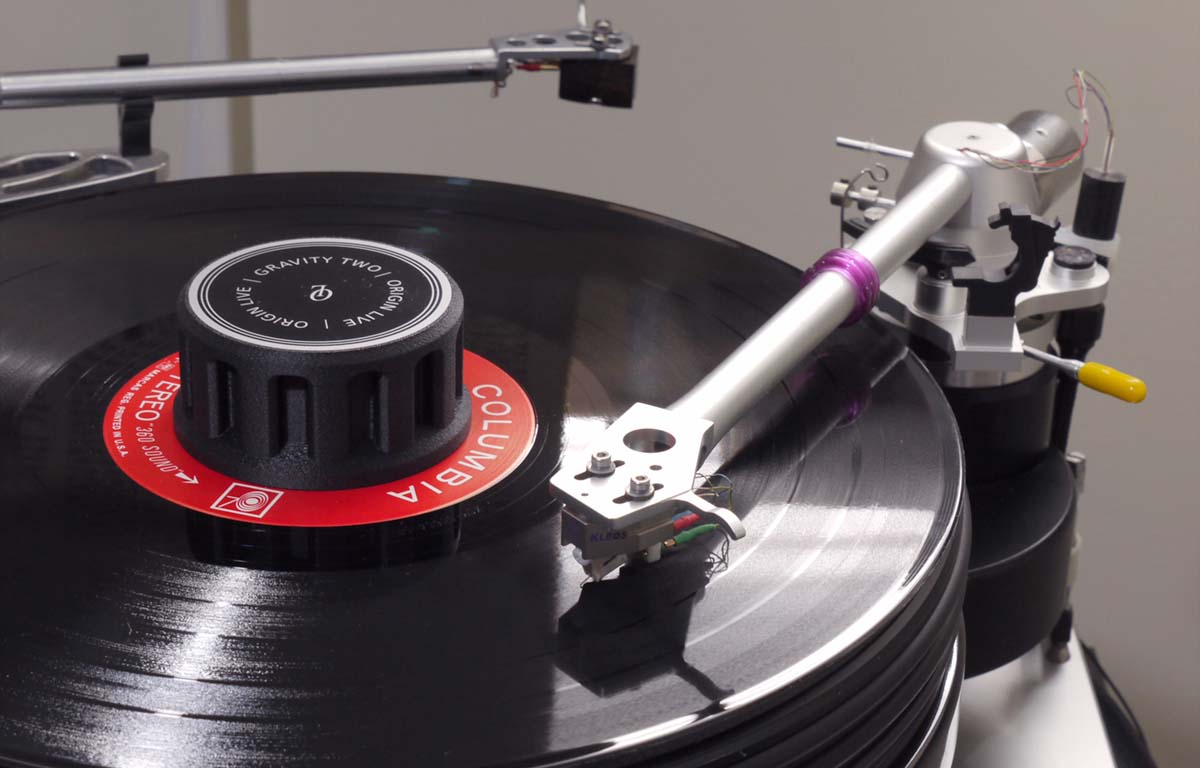
Back in 2023 I reviewed (HERE) the innovative Gravity One record weight from turntable/tonearm manufacturer Origin Live (along with their "Upgrade" platter mat and Cartridge Enabler head-shell isolator). All available to any vinyl fiend for use with any brand turntable, arm, or cartridge. Sure, they were prototyped and developed on Origin Live's own gear, but would that other manufacturers (of anything) were as unselfish with their technology. So, naturally, I wanted to compare the new Gravity Two with its predecessor.
I do use an (older) Origin Live Illustrious tonearm, but on a modified Nottingham Spacedeck turntable, very unlike Origin Live's designs. Since that review I've happily used the Gravity One, platter mat, and Cartridge Enabler with the Rega Planar 3 turntable in my office system as well as the Spacedeck.
Two very different turntables, or as Rega would describe them, "Vibration Measuring Machines."
Alas, there are good vibrations and bad vibes. Audiophile analog comes down to a tiny stylus following even tinier groove modulations as precisely as possible. But of course, the stylus in any decent cartridge is equally adept at "measuring" bad vibes, and not only those from external traffic, footfalls, subwoofers, HVAC systems, etc., but also the turntable's own mechanics such as bearing and drive motor noise.
Hence we get to choose among countless bad-vibe fighting record weights and clamps, platter mats, footers, and isolation platforms. Okay, so we do have to mix and match, as there are audible differences between them all. You just have to find some combination that works in your system and mitigates as much of the obvious bad vibes as possible. As in, are you feeling lucky today?
Actually, one of the peskiest challenges in turntable/tonearm design is minimizing any unwanted vibrations from the stylus/groove interface itself–the one place in the entire playback system that actually touches the disc. About the time I did the Gravity One review, I had bookmarked a discussion that calculated a .6mm conical stylus at a VTF of 2g ends up as 93,268 pounds per sq inch (about 47 tons) over the infinitesimal stylus/groove contact area, and almost twice that for a MicroRidge.
That, my friends, is a lot of "gravity" in a small space, if you were curious about the name. When Origin Live says the stylus "pumps" vibration back into the record, they are serious.
Play an LP with the volume off and you will usually hear audible "needle chatter"—mechanical noise generated by the stylus "tracking" the groove, just like the "needle" did in an old antique acoustic gramophone. Good back then, but bad now—in the age of electricity, such low-level tracking vibrations still get mechanically transferred from stylus to cartridge to tonearm, then even reflected back again to the stylus from the arm's pivot. Everything gets amplified.
Sure, Sir Isaac figured out gravity, but let's not ignore Newton's Third Law: for every action there is an equal and opposite reaction. Stylus tracking "noise" is propagated back into the disc itself, making it microscopically vibrate. And from there, down into the mat, platter, and up to the record weight, and whatever they cannot be suppress, right back to the stylus. The cartridge thus converts all bad vibes (including motor and bearing noise, etc.) into electrical hash overlaying and subtly smearing the music in the grooves. Yes, most energy absorbing record weights and platter mats can ameliorate the problems, but often at the expense of suppressing lively micro-dynamics, definition, and sometimes even shifting the tonal balance towards the bass.
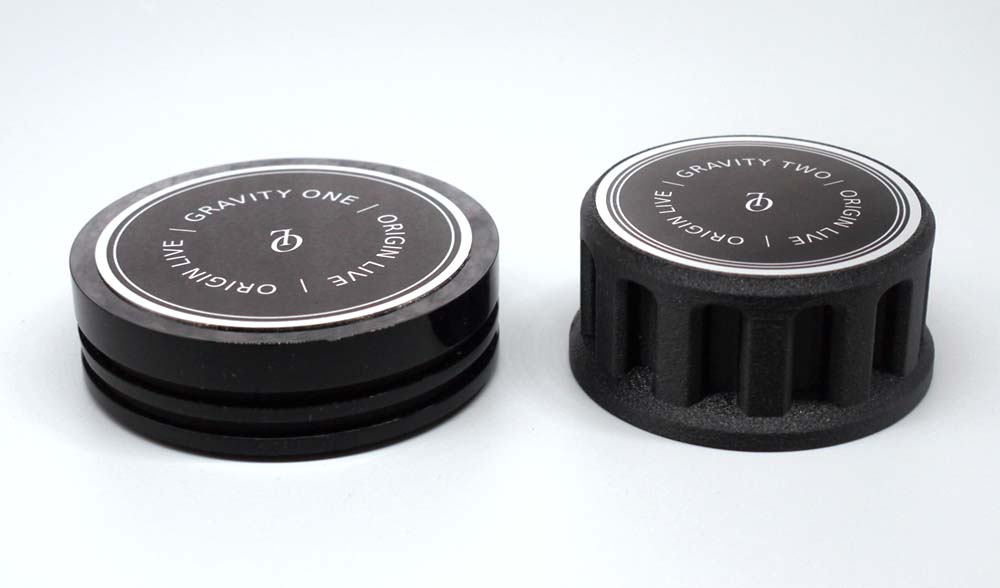
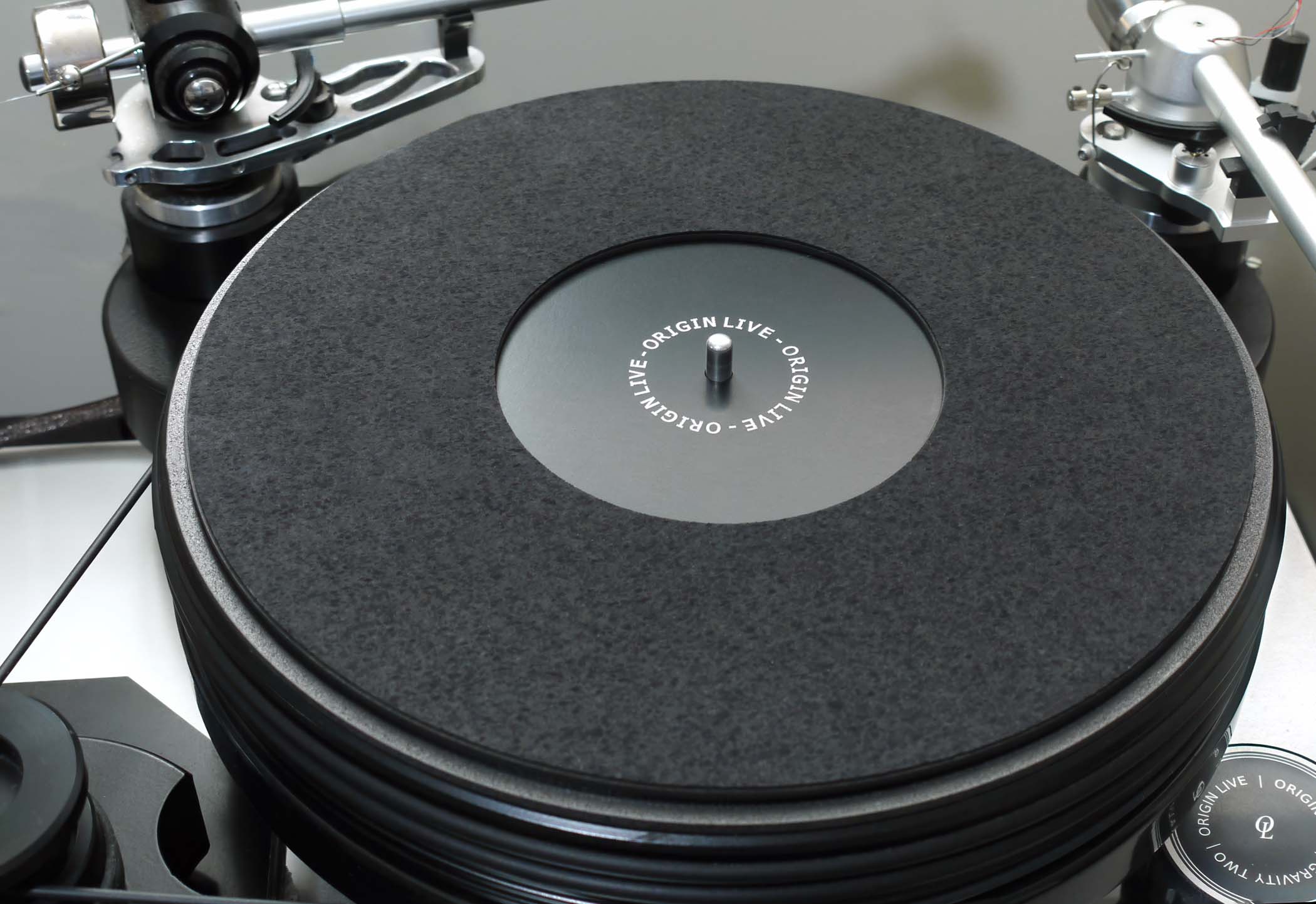
A record weight is usually some substantial passive mass sitting atop the label. As I related in the Gravity One review, and now with the Gravity Two, Origin Live addresses the record weight concept quite differently. It's actually misleading to even call them weights. The One checks in at 67g, the Two at 70g (2.5 oz for those of us in the colonies). The Two is taller and narrower (40mm high x 70mm diameter ) than the One (25mm x 80mm ). This change eliminates my chief complaint about the Gravity One: on some LPs with tight inner runout grooves, the broad head shell on my Audio Origami arm could contact the weight. Other arms, no problem.
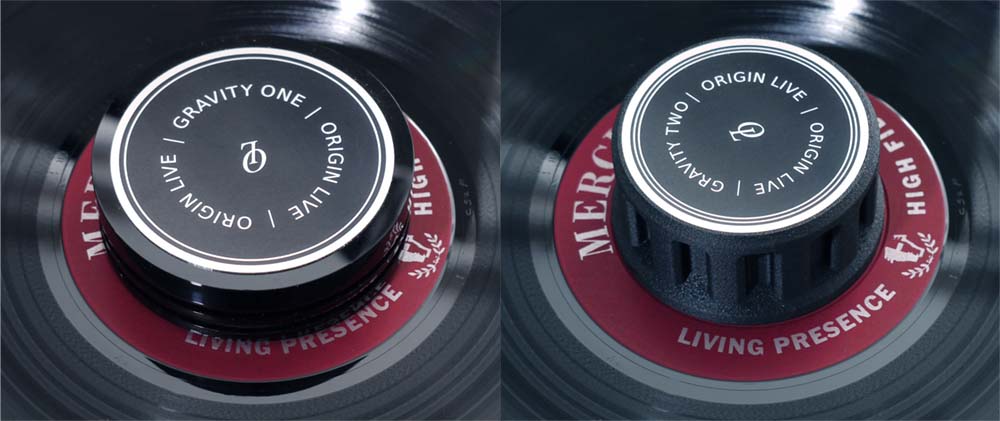
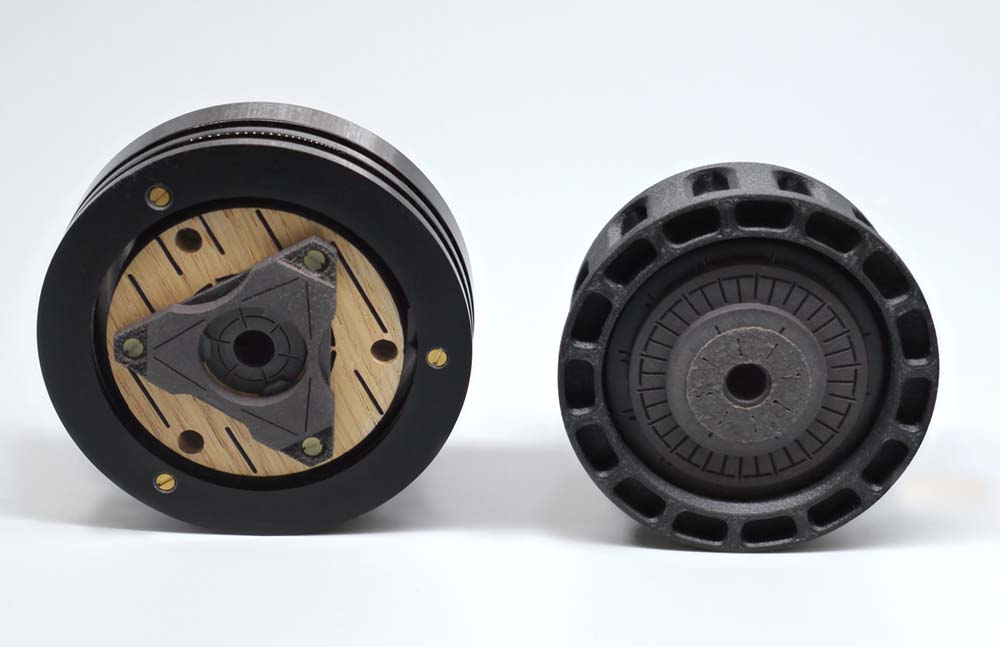
Look under the hoods, and you can make out stacks of various vibration damping stuff, with precisely cut slots. Shake either, and you realize that the innards are free to move about a bit. In both, the spindle hole is oversized for minimal contact. In the One only the inner triangle "works" sat on the disc's label; in the Two the outer rim also rests on it. The One enclosure was hand assembled with multiple bolts, but the Two looks ready for prime time. I'd add that the size, ridges, and texture of the polymer shell make it much less droppable on one's prized LPs.
The Gravity Two had arrived just as I was finishing up my annual turntable clean, lube, and adjust ceremony: change oil, clean belt, check level, alignment, azimuth, anti-skate, VTF/VTA, etc. I had just switched over from my Zu/Denon DL103 mounted arm wand to the more setup-critical Lyra Kleos one, leaving the Origin Live platter mat and Cartridge Enabler in place.
One LP I've often used in this process is UK Decca SXL 2037, a 1958 "wide band FFSS" pressing of Ansermet's OSR doing Bizet's Carmen and L' Arlesienne Suites. The Carmen side begins and ends with a series of prominent cymbal crashes—ideal fodder for assessing tracking and treble definition in the two areas where distortion always increases with any pivoted tonearm geometry.
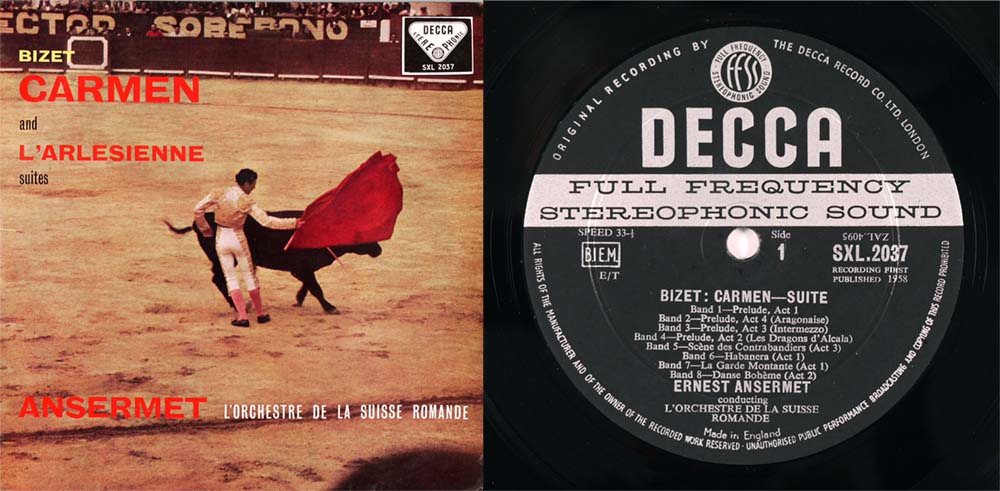
There's long been some controversy about early Decca stereos. They can sound a "bit bright and thin" when played back with the now standard RIAA replay EQ curve as used on my Sutherland Little Loco current-mode phono stage. I also have an extremely flexible phono stage with alternative EQ options (HERE), but it really does seem that every label in the early stereo era had a distinct "house sound."
For example, with the Decca LP just sitting on the platter mat, the repeated cymbals at the beginning of the Carmen side had some toneless "pebbles in a tin can" texture, and the orchestra does sound a bit scrawny. Adding the Gravity One cleaned up the cymbals and instrumental textures quite a bit. Swapping in the Gravity Two, everything simply got better still, especially in the bass region.
But I was still in setup mode. Lyra cartridges are finicky about setup, so I checked. Lyra's website and my Kleos' own spec sheet suggest a very tight VTF range of 1.65g-1.75g (1.72g "recommended"), although several vendors now list it as 1.7g -1.8g, 1.75g as "optimum." Now, 1.72g has always sounded fine, but emboldened by the increased resolution apparent when the Gravity Two was in place, I decided to trust my ears and make some further adjustments.
I have used three methods to set up the Kleos. The Twentieth Century's version—set VTF for tracking, then VTA for tonality, listen and fiddle a bit—still works. Contemporary audiophile thinking is to match the Stylus Rake Angle (SRA) to the angle of the cutting stylus (~92˚) at a chosen VTF, using a USB microscope and computer. Lyra's advice is different—set the cantilever angle at 20˚ to center the coils within the magnetic field (I just use a macro lens on a digital camera and Photoshop).
I had just set up the Kleos at 1.72g and cantilever at 20˚ as per Lyra. I now moved the VTF to 1.735g, raised the VTA back to 20˚, reset the VTF, and reduced the anti-skate a skosh, all based on listening with the Gravity Two off/on the platter. And all to the better. I should mention sliding the odd plastic coil seen on the tonearm back and forth makes otherwise frustrating minor changes in VTF a doddle–without ever moving the counterweight.
I realize setup can seem arduous—why else do you think the CD was invented? The take-home here is that the Gravity Two eliminated whatever stylus "noise" that masked key setup issues, making fine adjustments much easier to assess.
With the Gravity Two straddling the spindle, and setup optimized, the Bizet sounded much less "wrong EQ", and just much more vital, focused, colorful, transparent and balanced. The three-microphone Decca "Tree" presents an orchestra very differently (and closer) than the widely spaced omni's long favored in the USA, from RCA to Telarc; more the conductor's perspective than 10th row center. So now the cymbals sounded like cymbals, with tonal color and sizzle, the brass had better bite and blat, the winds had breath, and the string sections were defined rather than congealed. And all this in a panoramic soundstage.
To further evaluate playback with the Gravity Two, I turned to some familiar LPs I felt would be interesting challenges. Sorry, I haven't bought a new LP in years, having acquired thousands used since the CDs arrived. So first up was George Antheil's notorious Ballet Mécanique, on a 1976 Telefunken disc I've used over the years to evaluate cartridges, cables, speakers, etc.
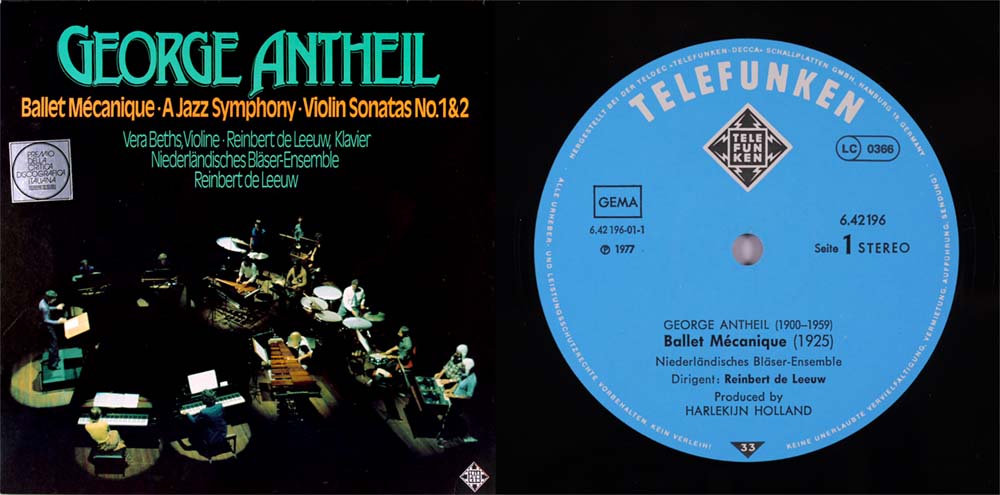
There is not even a standard performance tradition for this piece. Reinbert de Leeuw's 15 minute live version is scored for four pianos, two xylophones, tympani, bells, drums, and percussion. Oh, and an airplane propeller (the only wind instrument needed). According to the jacket notes, the original version was a half-hour long, while the 1927 US premiere at Carnegie Hall had sixteen pianos, anvils, saws, and "car hooters" as well as the propeller, so this is kind of a chamber orchestra version. But as the notes conclude: "In order to do full justice to the dynamics…it is necessary…to play the record much more loudly than usual." What more could you want?
Well, with the gain turned up to 11 and the Gravity Two in place, the results were spectacular. Most of the time there's a lot going on, but the Kleos had no problem parsing it out. In particular, the bells and xylophones were crystal clear, the drums and tympani solid and defined, the pianos left/right, front/back, all imaging just as seen on the jacket. If you ever get a chance to play Mécanique for some teenagers, it can be oddly gratifying when they complain "That's not music, it's just noise!"
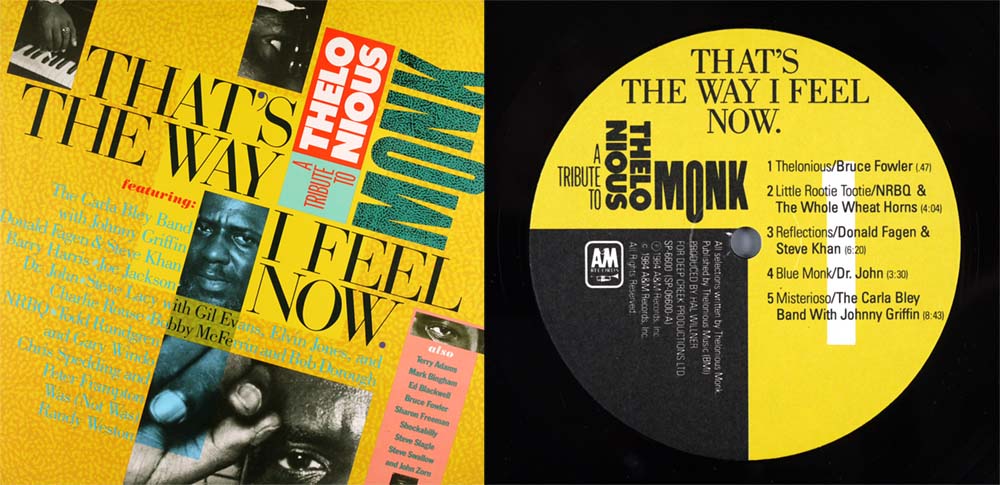
One of my favorite jazz tribute albums is That's the Way I Feel Now, a two LP set of Monk tunes played by the likes of Todd Rundren, John Zorn, Dr. John, Was (Not Was), and NRBQ as well as contemporary jazz musicians. The arrangements are just as diverse, the recording excellent, and it has never sounded better than with the Gravity Two. All tracks were just that bit clearer, micro-dynamics especially benefiting. It's really eerie to stand off to the side, by the turntable, add/remove the record weight and be able to hear the difference, then to go sit down and listen to the soundstage open up.
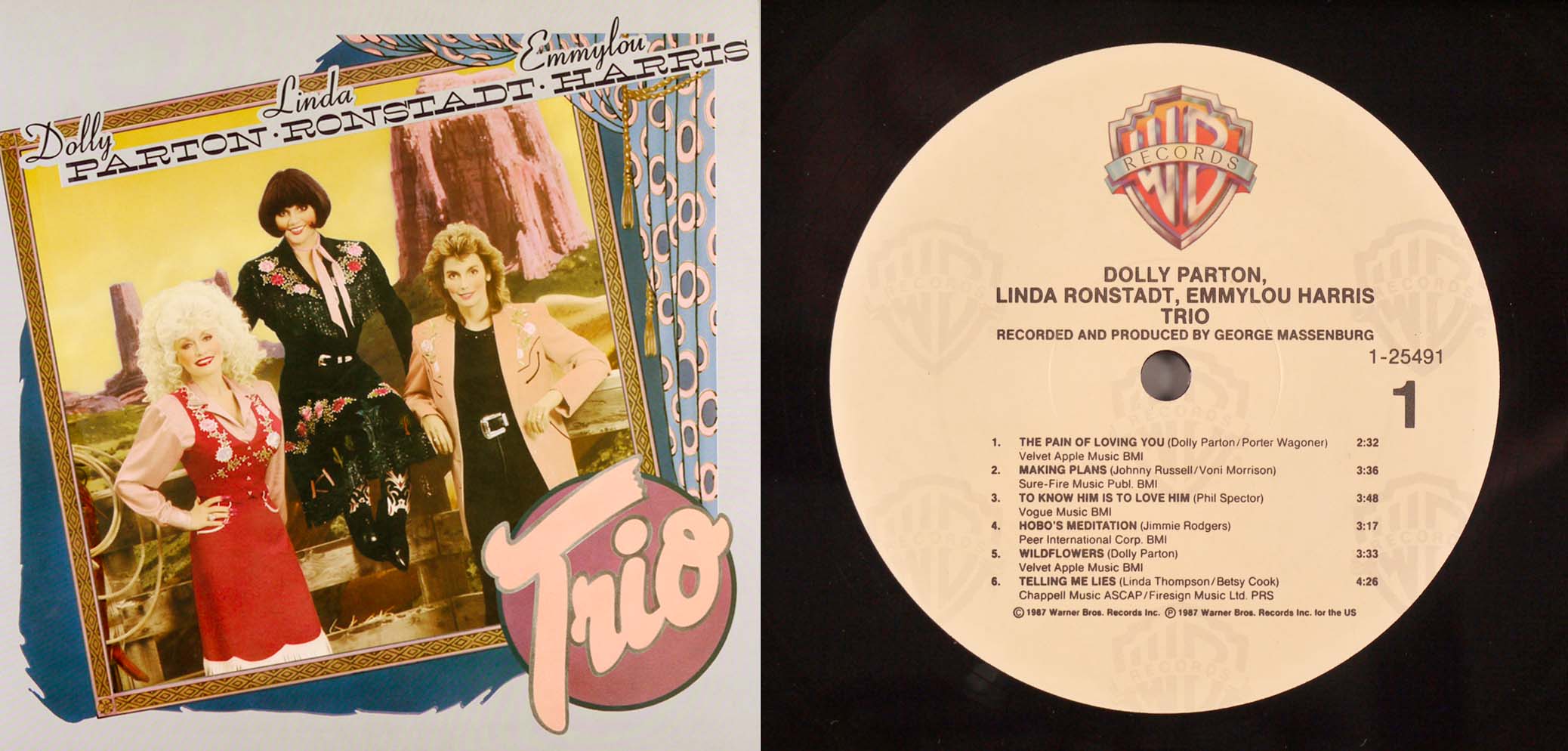
As to the review-requisite Female Vocal recording, one of the claimed attributes of the Gravity Two is an increased ability to separate and resolve individual voices, so I pulled out Trio. Recorded in 1986 by George Massenburg, and with both analog and digital mastering by Doug Sax, it's a great system check up mass-market LP. Dolly, Linda, and Emmylou have quite different voices solo, yet their harmonies can be exquisite. However, Dolly's upper register in particular can be tough to reproduce without sounding a bit "rough." Passive mass record weights can over-damp her, but the other ladies' vocal textures suffer instead—it's a delicate balance. With the Gravity Two in play, no problem. The individual voices remain clean and distinct throughout, and the backup band is top-flight (Albert Lee, Mark O'Connor, David Lindley, Ry Cooder, etc.)
Of course, as with any "tweak," the degree of audible benefit from the Gravity Two will vary with any given system's components, setup, other vibration management, and overall resolution. It is worth noting that the Gravity Two, like the One, appears to incorporate the gasket-like material used in the Origin Live Upgrade platter mat and Cartridge Enabler, both of which were also used in this review. I would encourage anyone auditioning a Gravity Two to also consider investing in the inexpensive Cartridge Enabler head-shell isolator at minimum, as there is synergy at work here.
So, really, howzitdodat? Origin Live just tells us:
The tuned assembly absorbs vibrational energy pumped into the record by the stylus—dissipating it through the vibrational interference of lightweight metallic parts with precision-cut profiles, combined with layers of wood, composites, and polymers.
Huh? Were I to speculate, I'd suspect "tuned" incorporates the EQ'ed tonality of the groove's version of the recording: bass levels much reduced, treble exaggerated. "Absorbing" 20Hz information with lightweight metal parts? Probably not. In audio, "dissipating" usually means transferring energy from one thing to another with various spikes, springs, squishy stuff, mass, carbon fiber, etc. None of that seemed to apply here, so I emailed Origin Live for some details:
"On the technology and how it's dissipating vibration—a lot of our products in recent years have begun to incorporate a Multi-Layer philosophy. The idea behind this being based on vibrational interference, with vibrations being minimized by destructive interference between layers…As is always the case with micro-vibration, there's no great measurables at such a scale. Everything has to be developed by ear, testing hundreds of different material combinations, profiles and properties. The Gravity One achieved what we set out to do in terms of a do-no-harm 'weight' that would allow the mids and top end to breathe, add texture, separation, and allow the bass to extend naturally. But we also felt that the Gravity One had room for improvement. It took a number of years and a lot of R&D, but we're glad to have pushed the design further, and in doing so provide more performance from it"
Okay, that explanation may still not satisfy the Internet's "measurements or it's snake-oil" trolls. Personally, I'm comfortable with technology sufficiently advanced as to be indistinguishable from magic, and I'm buying the review sample. It may at first seem pricey for a record weight, but It's way cheaper than buying a "better" cartridge in hopes of getting a comparable level of improvement.
One final note. Origin Live is happy to ship anywhere from the UK, and also has dealers around the world, including in the USA. Given the continuing chaos around tariffs and currency exchange rates, pricing may vary. I've listed current UK price as well as the price in USD from the website of their primary US dealer, Analog Matters (in Florida).
Gravity Two Record Weight
Retail: UK £230.00/US $338.14
Origin Live