


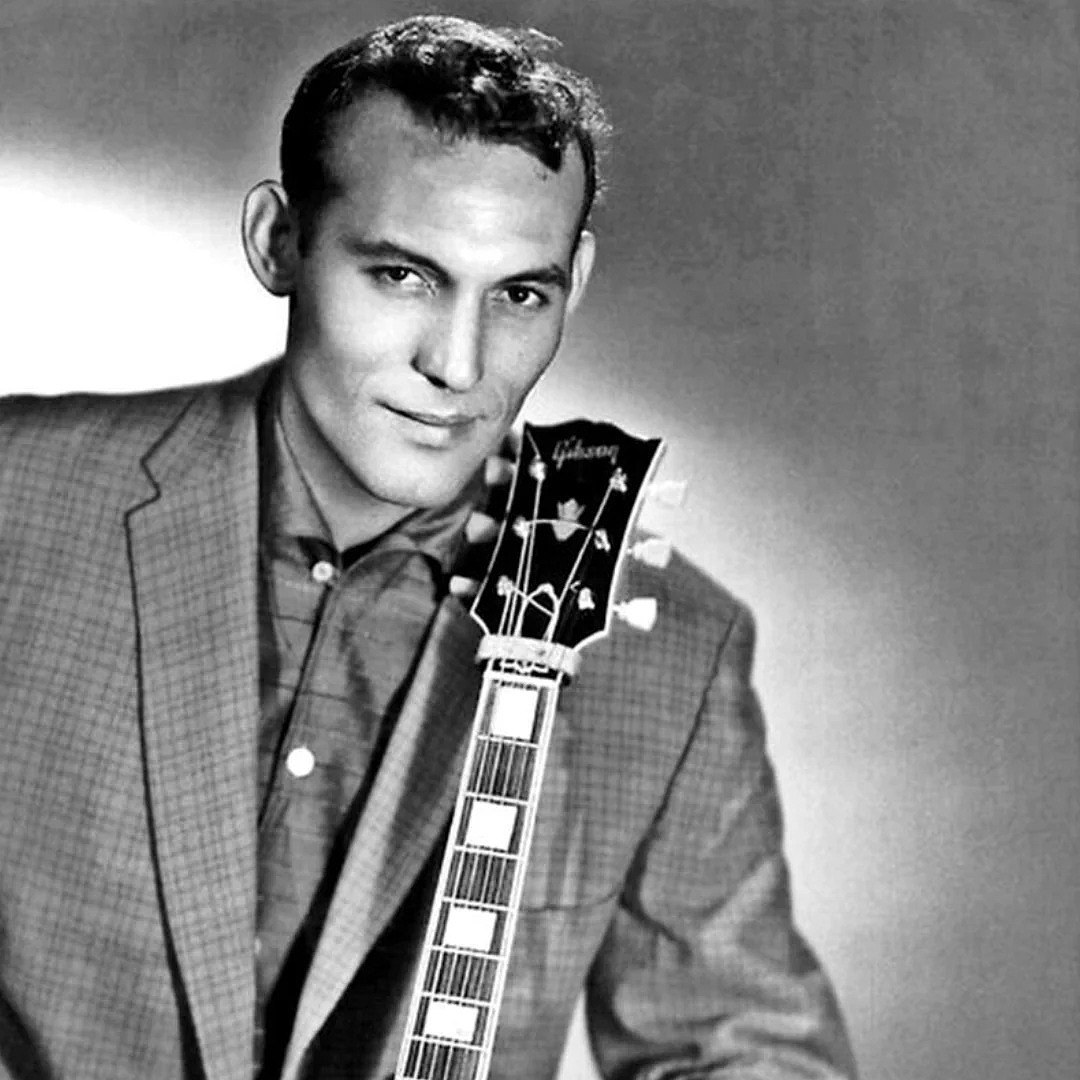
Intervention Records has just announced their Intervention Sun Records Hi-Fi Series, which will offer deluxe 180 gram, 45 rpm mono LP editions of classic Sun Records albums. The series has kicked off with Dance Album of Carl Perkins, the iconic guitarist's 1957 compilation album that not only commemorates the 70th anniversary of his classic hit "Blue Suede Shoes," but also features a plethora of his most popular songs. Including Perkins' originals like "Honey Don't," "Everybody's Trying To Be My Baby," "Matchbox," and of course, "Blue Suede Shoes"—but also classic covers such as "Only You" and "Wrong Yo Yo." Perkins' music influenced a host of major recording artists, including the likes of Elvis Presley, Johnny Cash, and of course, The Beatles, who covered Perkins' songs not only as a band, but individually on solo albums. Their covers very likely gave Carl Perkins a much-needed nudge in popularity stateside.
Memphis' Sun Records Studio is widely regarded as the "Birthplace of Rock n' Roll," and the label was launched in 1952 by music legend Sam Phillips. Along with their recordings of Carl Perkins, Sun Records also jumpstarted the careers of Elvis, Johnny Cash, Roy Orbison, and Jerry Lee Lewis, to name but a few. Phillips also recorded blues artists like Howlin' Wolf, B.B. King, and James Cotton, along with R&B and soul artists like Rufus Thomas and Ike Turner. While the original focus of the label was the issue of 7" 45 rpm singles, the growing prevalence of LPs encouraged Sam Phillips to eventually issue long-playing compilations, but in the aftermath of the sale of Sun Records in the late Sixties, master tapes for LPs like Dance Album of Carl Perkins no longer existed. Many of the original tapes for the 7" singles used in the production of the LP had been misidentified over the years, and it was necessary for Shane Buettner of Intervention Records and the staff of Sun Records to spend countless hours listening to archival tapes to find the best-sounding version of each of the album's tracks. It's very likely that Dance Album of Carl Perkins hasn't been cut to LP from the original analog tapes since the 1960's, and Buettner is convinced that the tapes chosen for Intervention's reissue are indeed the original master tapes.
Dance Album of Carl Perkins was mastered directly from those tapes using a AAA, all analog process at Cohearent Audio by Kevin Gray, who also cut the 45 rpm lacquers. RTI plated the LP using a 3-step process for ultimate quality, and the 180 gram LP was pressed on ultra-quiet, high-definition vinyl at Gotta Groove Records in Cleveland, Ohio. Gotta Groove is a boutique pressing plant that specializes in short-run, high quality LPs, and if this album is any indication, they were the perfect choice for this project. The heavy album jacket used artwork sourced from the Sun Records archives, and was created by Stoughton Printing using their "Old Style" tip-on process. New liner notes for the reissue were written by Sun Records historian Colin Escott, and are printed on a graphically stylish full-color insert. The beautifully shiny 180 gram LP arrived inserted in a perfectionist rice-paper style inner sleeve—everything about Intervention's new reissue exudes quality, and sets the bar high for the upcoming titles in this new series! You can order a copy of Dance Album of Carl Perkins from Intervention Records' web store HERE; it's also available at Sun Records' official site HERE.
My personal take on the music of Carl Perkins and his connection with The Beatles
I grew up in Gainesville, a small town in the foothills of the North Georgia mountains; it had a pair of AM radio stations that mostly offered news and farm reports throughout the day, with a smattering of music. And when they did play music, it was typically from country music artists like Johnny Cash, Merle Haggard, Loretta Lynn—you get the picture. As a kid, I'd just begun to start really listening to music on the radio, and I also mowed lawns to earn some cash for 45 rpm singles and LP purchases. My very first LP was intended to be Johnny Cash's Live At Folsom Prison, but I ended up walking out of the record store with Meet The Beatles, which going forward significantly changed my musical arc. I never fully embraced country music, but hearing so much of it early on definitely informed my musical choices throughout my lifetime.
Fast forward many years to late 2001; George Harrison of The Beatles had just died, and that profoundly affected me—he was undeniably my favorite Beatle, with Ringo Starr a close second. Not long afterward, the star-studded Concert For George tribute took place in London, and a couple of years later when the DVD of that event was released, I was suddenly thunderstruck. When Ringo made his appearance onstage, he immediately noted George's deep appreciation for the music of Carl Perkins, then launched into a rollicking version of "Honey Don't." Grabbing my LP copy of Beatles ‘65, I realized that I'd forgotten that Perkins' "Honey Don't" and "Everybody's Trying To Be My Baby" (sung by George) appeared on the album, and that his "Matchbox" (sung by Ringo) had appeared on the band's preceding album, Something New. Both LPs—and especially the songs written by Carl Perkins—entered my heavy rotation then, and again recently with the 2024 reissue of The Beatles' 1964 US mono LPs (Grab them, they're superb!).
For whatever reason, and decades later, the music of Carl Perkins as portrayed by The Beatles really resonated with me. I suddenly obsessed over those early Beatles albums—especially their covers of Carl Perkins' songs—and like never before, it all made perfect sense to me. And I realized that George Harrison had been the impetus for their inclusion on Beatles' albums in the first place. By doing so, George (and The Beatles) helped introduce future generations of listeners to the music of Carl Perkins, who otherwise might not have gotten any exposure to his superbly crafted songs.
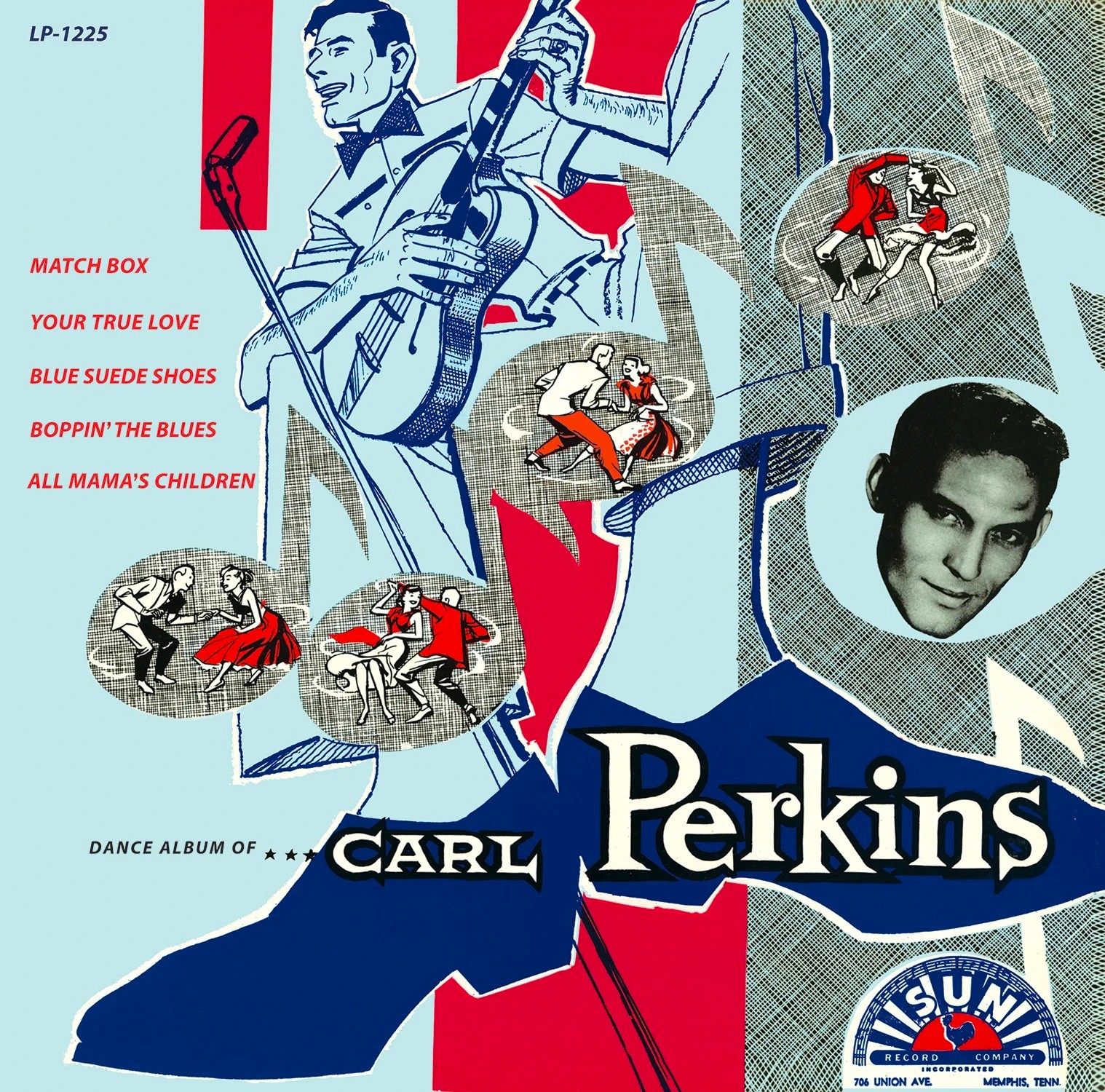
Carl Perkins: Dance Album of Carl Perkins, Intervention Records. 180 gram 45 rpm Mono LP, $40.
Following Carl Perkins' chart-topping success with "Blue Suede Shoes," Sam Phillips of Sun Records sought to capitalize on that momentum by releasing a continual stream of singles, which were often inexplicably met with lukewarm sales. Perkins was highly regarded by peers like Johnny Cash and Gene Vincent, and was a dynamic live performer, but for whatever reason, none of that translated into sustained record sales. Which probably fueled his decision to leave Sun Records for Columbia in 1957; Sam Phillips quickly pulled together a collection of Perkins' best songs and released it as Dance Album of Carl Perkins. The LP served as Carl Perkin's first official studio release, but didn't make much of an impact on the charts.
Perkins' follow-up and debut for Columbia Records, 1958's Whole Lotta Shakin' was also a commercial disappointment, and his career seemed to almost completely stall over the next few years. In 1964, Perkins was offered an opportunity to tour Great Britain with Chuck Berry, and he at first declined, convinced he was all but forgotten by American record buyers. The last thing he needed was for English audiences' apathy to punctuate his obscurity. Berry convinced him to come along on the tour, assuring him that American artists were much more popular abroad than at home. Perkins grudgingly agreed, and his tenor changed upon landing in London, where he was greeted by signs proclaiming "Welcome King of Rock n' Roll." Unbeknownst to him, four lads from Liverpool who'd been making quite the splash on the American pop charts were paying very close attention to Dance Album of Carl Perkins.
According to Colin Escott's superb new liner notes, Perkins played weeks of sold-out shows to enthusiastic English crowds, who raucously voiced their appreciation for his music. Whereas in the years beyond his breakout hit "Blue Suede Shoes," audiences had been relatively polite at his stateside shows. By tour's end, Perkins' confidence was significantly buoyed, and at an after-tour wrap party, none other than The Beatles were in attendance. The Liverpudlians had been the newly crowned rulers of the U.S. pop charts for several months at the time, but Perkins was obviously less impressed with The Beatles than they were smitten with him. The Fab Four arrived at Perkins' wrap intent to rectify that situation, and were keen to get Perkins' approval to record some of his songs.
They invited him to the studio the following day, where they recorded his "Matchbox" for what would become The Beatles' fiftth American studio album, Something New. Later that year they'd record "Honey Don't" and "Everybody's Trying To Be My Baby" for Beatles ‘65. And if you happened to see Peter Jackson's documentary Get Back—which covered the events surrounding the making of Let It Be—you no doubt heard the Fab Four jamming to "Gone, Gone, Gone," "Tennessee," "Blue Suede Shoes," "Your True Love," and "Wrong Yo-Yo." The Beatles Live At The BBC recordings features a performance of "Sure To Fall"; Paul McCartney has recorded "Boppin' the Blues" and "Movie Magg," Ringo recorded "Only You," and John Lennon and his Plastic Ono Band also recorded "Blue Suede Shoes" on the Live Peace In Toronto album. Over the course of their career, The Beatles as a group and individually recorded every song on Dance Album of Carl Perkins—how's that for his having made a lasting impression on them?
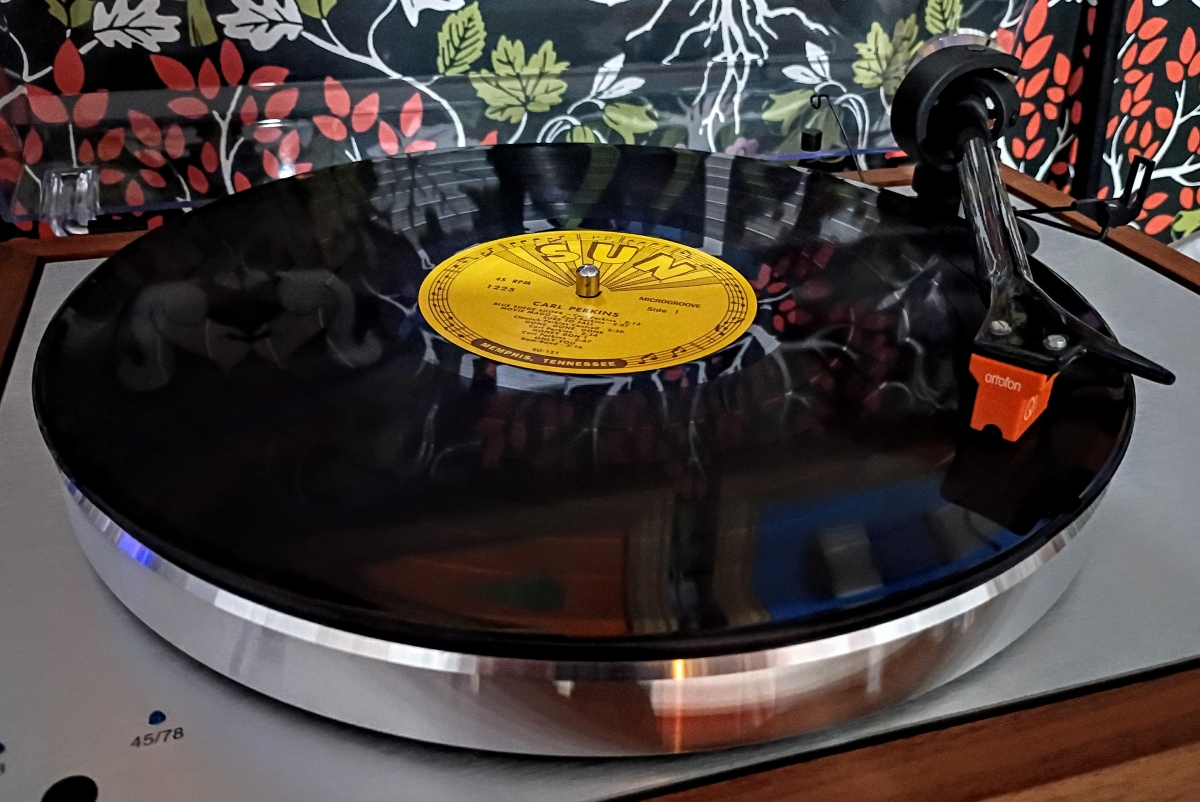
Dance Album of Carl Perkins bodes well for Intervention's Sun Records Hi-Fi Series
Dance Album of Carl Perkins shocked me with its goodness, and the LP pressed by Gotta Groove Records was perfection incarnate, with perfectly quiet sides that exhibited no appreciable groove or surface noise. Sun Records' mono sound offered that kind of wide mono many Fifties' albums are revered for, and in this recording, Carl Perkins and his group of players occupy a very real space in the soundstage in front of you. I listen to a ton of mono recordings of this same vintage, and Dance Album of Carl Perkins is definitely among the best; it's clear that the tapes used for this release are the originals, or darn close. The sound quality and performances exceeded my expectations, and have increased my excitement for this series exponentially.
At the point of its original release Dance Album of Carl Perkins was little more than a cash grab by Sam Phillips and Sun Records, but in retrospect, it's gone on to become one of the finest collections of rough-and-ready rockabilly that ever existed. With many of the album tracks now achieving status as bona fide rock n' roll standards—try and name another rockabilly album that can possibly compete with the perfect performances and exceptional sound quality found within these grooves. The record was Carl Perkins unintended first studio album, but is also probably his best, and has essentially become his "greatest hits" record, and deservedly so.
Many thanks to Maria Malta for bringing this superb new reissue series from Intervention Records to my attention! Shane Buettner and everyone involved in this project deserve highest praise for resurrecting Dance Album of Carl Perkins from obscurity, while bringing it to an astonishing level of perfection. For fans of Carl Perkins, rockabilly, and thanks to the Fab Four connection—even early records of The Beatles—this LP comes very highly recommended!
Intervention Records
All images courtesy of Intervention Records and the author