Greetings friends, I hope you are well.
When Positive Feedback Editor-in-Chief Dr. David Robinson asked me if I'd like to review the Gold Note DS-10 EVO streaming DAC along with its optional PSU-10 EVO power supply, I wasn't really sure what I would be getting into, as I've had minimal experience with streaming DACs, and zero experience with high-end streaming DACs that could accommodate both high-resolution pulse-code modulation (PCM) and direct stream digital (DSD) files. But I'm always up for a new audio adventure, so of course I said, "Yes!"
I had lots of questions rattling around in my head about where a high-end streaming DAC would fit into my audio life. What could it do, and what couldn't it do? Could it play Red Book digital as well as my reference CD player, the formidable Audio Note (UK) CD 5.1x? Does high-resolution PCM sound better than Red Book PCM? Does high-resolution DSD sound better than high-resolution PCM? Could high-resolution PCM or DSD compete with vinyl playback? Does high-resolution DSD sound identical to the master tapes they were transferred from? Also, could I adapt to the idea of not having physical media in my music library?
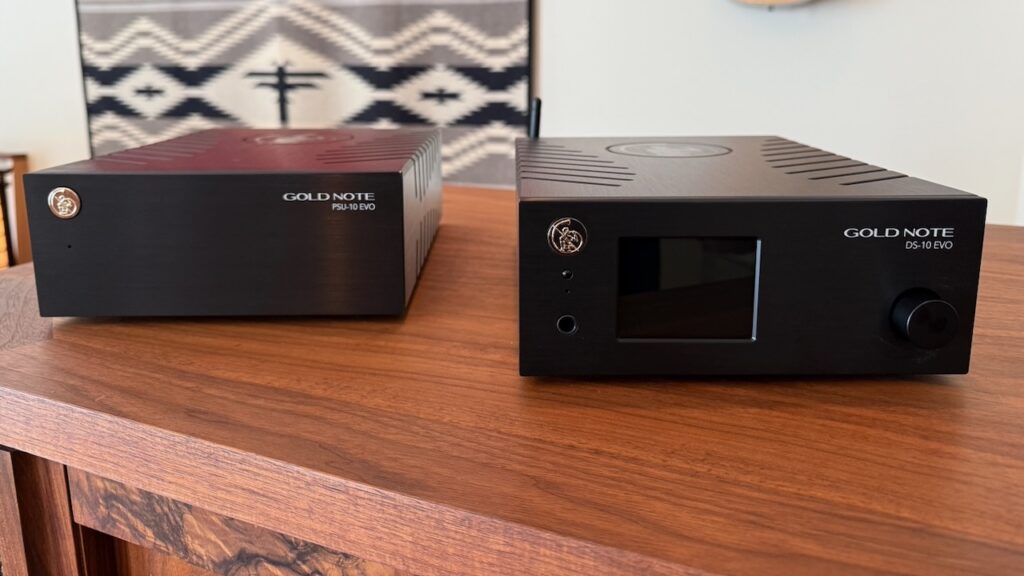
To get a handle on answering those questions, I rotated the Gold Note DS-10 EVO DAC and PSU-10 EVO power supply through three of my four audio systems with source components at various levels of performance, so I could get some meaningful performance comparisons.
My goals for this article are twofold. First, I want to bracket the Gold Note DS-10 EVO DAC and PSU-10 EVO power supply's level of performance, according to the performance of vinyl and digital source components I'm familiar with in my various home audio systems.
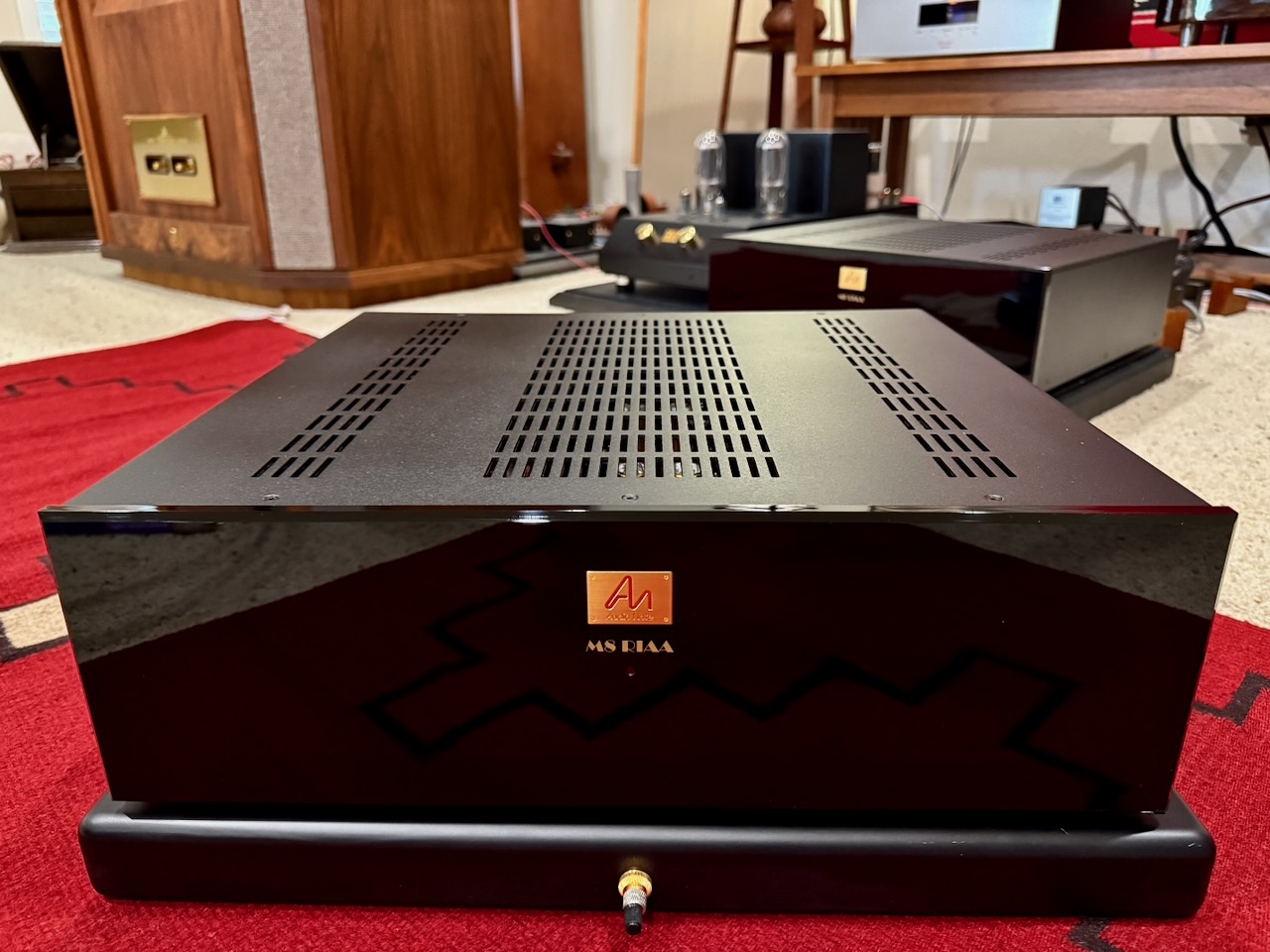
Towards that end, I bracketed the Gold Note's performance by placing it in the range of "level zero to level five" in a corollary to that of the idea of the Audio Note (UK)'s performance level system, as I have a "level three digital source" here in the Audio Note (UK) CD 5.1x CD player, and a "level five" Audio Note (UK) pairing of the M8 RIAA phono preamplifier with the AN-S8/L step-up transformer, that I can compare to as benchmarks, as well as my other source components that I have already assigned "performance levels" to in this way.
While the Audio Note (UK) "performance level system" references its own use of circuits and specific circuit components, I am using the level system more generally in reference to components' ability to deliver the authentic identity of the way the recording arts documented the musical performances, the overall level of high-fidelity sound quality, and perhaps most importantly, the ability to deliver the drama and emotional impact inherent to a particular piece of music as intended by the musicians and recording team for the performances.
For example, in the way I am applying my take on a performance level system, a component at "performance level zero" describes the performance of excellent entry-level high-fidelity source components. Components at performance level zero can thrill and astound you with their musical abilities, and many music lovers and audio enthusiasts will never feel a need to go beyond that level of performance, although performance level zero components do have performance limitations compared to components at higher performance levels. In my experience, this is the level of performance one would find in source components at price points up to about $5000 USD.
When one gets to "performance level three," that is at the upper limit of performance that 99% of us audio enthusiasts have experienced, and I would characterize that as "real-world" state-of-the-art performance. Source components at performance level three significantly exceed the performance of source components at performance level zero, and they would typically fall into the price range of $25,000 to $35,000 USD.
When one gets to "performance levels five and six," one is getting into a rarefied performance realm that 1% or less of us audio enthusiasts have ever experienced, and source components at those levels of performance significantly exceed the performance of sources at performance level three in essentially every way imaginable. Getting into this rarefied level of performance tends to be very expensive, with source components falling into the $100,000 USD and above range.
So you get the idea, the performance of source components varies over a spectrum of performance levels that can usually, but not always, be broken out into cost categories.
My second goal for this article is to describe my experiences with the Gold Note DS-10 EVO DAC and PSU-10 EVO power supply as a standalone source component, according to its own merits: where does it fit in with my listening preferences, what's it like to use, and what do I think its strengths and weaknesses are?
Now, before I tell you what I found out, I want to tell you about the technological nuts and bolts of this Gold Note combo.
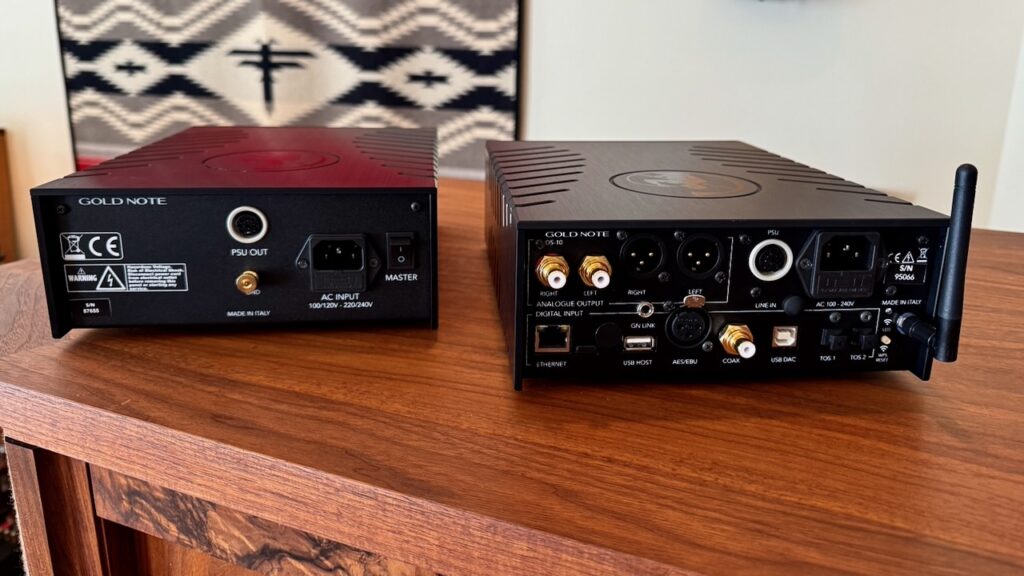
I always get excited about the arrival of new HiFi components to listen to. So, like a kid at Christmas, I eagerly awaited the arrival of the Gold Note DS-10 EVO DAC and PSU-10 EVO power supply that Tom Dolfi at Gold Note in Italy had shipped to me.
Upon the shipments' arrival I noted that the shipping containers were well designed and protected their precious cargo very well. A good sign.
As I unpacked the Gold Note DS-10 EVO DAC and PSU-10 EVO power supply, I was impressed with their excellent built quality and heft - these are substantial audio components.
Generally, I don't ask about retail prices until after I have completed my listening impressions and I am ready to start writing the feature review for Positive Feedback, so that I am relatively unbiased price-wise when forming my impressions.
I was surprised to find out that the retail prices were $3495 USD for the DS-10 EVO DAC and $1395 USD for the PSU-10 EVO power supply, which I thought was very reasonable considering their high level of build quality and their overall high level of performance. I was expecting them to be priced at least double what their retail prices turned out to be. I find them to be a very good value at their price point. Well done, Gold Note!
Please click on the link below to go to the next page.