

After a year of hiatus from reviewing, I'm thrilled to return with a series of three reviews that will highlight significant changes to my system.
My system is now anchored by the finest Cary Audio amps and preamp, including the SLP-5 preamp and the 211 Founder's Edition Power amps. (I replaced my 805C amps and SLP98 Preamp.) To this foundation, I've added the Odeon Carnegie horn speakers and the newly introduced Benny Audio Odyssey Turntable, which has just entered the US market.
Let's delve into the first of these three additions: the Benny Audio Turntable. This is my personal turntable. Crafted in Poland by the talented designer Thomasz Franielczyk, Benny Audio manufactures two turntables: the entry-level Immersion II and the subject of this review, the extraordinary Odyssey. I've been using this turntable for nearly a year, and it will remain an integral part of my system until my passing!
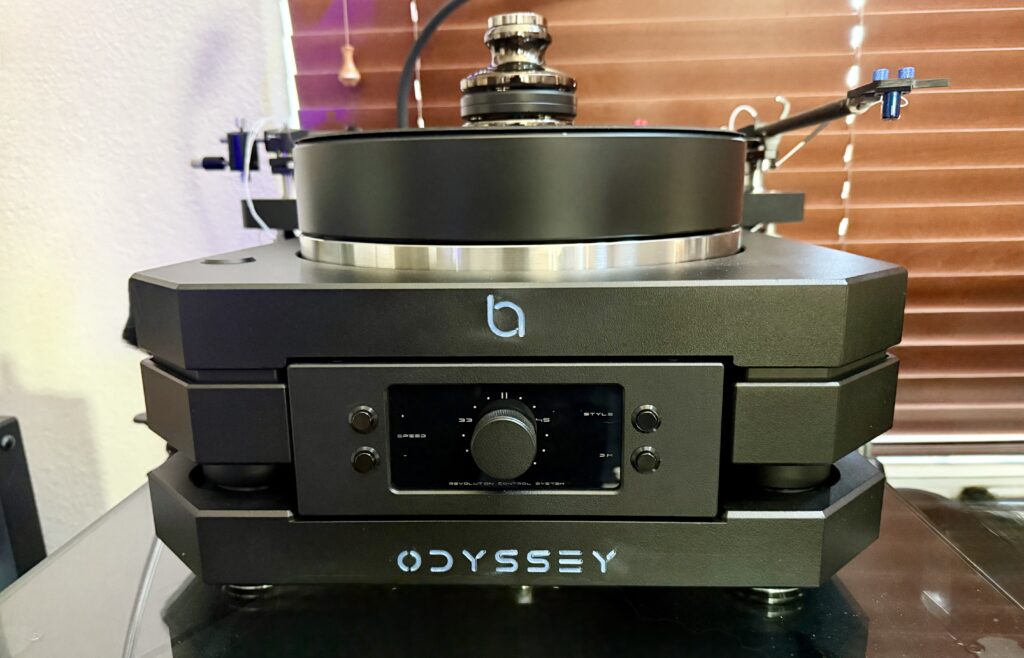
I firmly believe that unless Thomasz can create something even more exceptional, I'll never use another turntable in my life. While I'm certain that there will be minor improvements (two have already arrived), I firmly believe that this turntable is already an incredible piece of engineering.
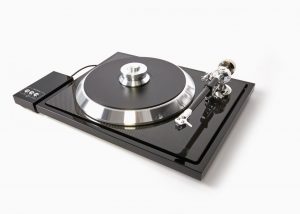
This belt drive turntable features two plinths, a three-piece platter consisting of a two-piece main platter and a drive platter, and is relatively easy to assemble. Thomasz meticulously packs all the parts into two flight cases, and the foam surrounds are clearly labeled. The assembly process is straightforward. However, it's important to note that ease of assembly does not imply ease of lifting. This turntable is quite sturdy. It weighs a hefty 130 lbs, but thankfully, it's broken down into manageable parts. Nevertheless, it can still be a workout for the arms and legs (if lifted properly).
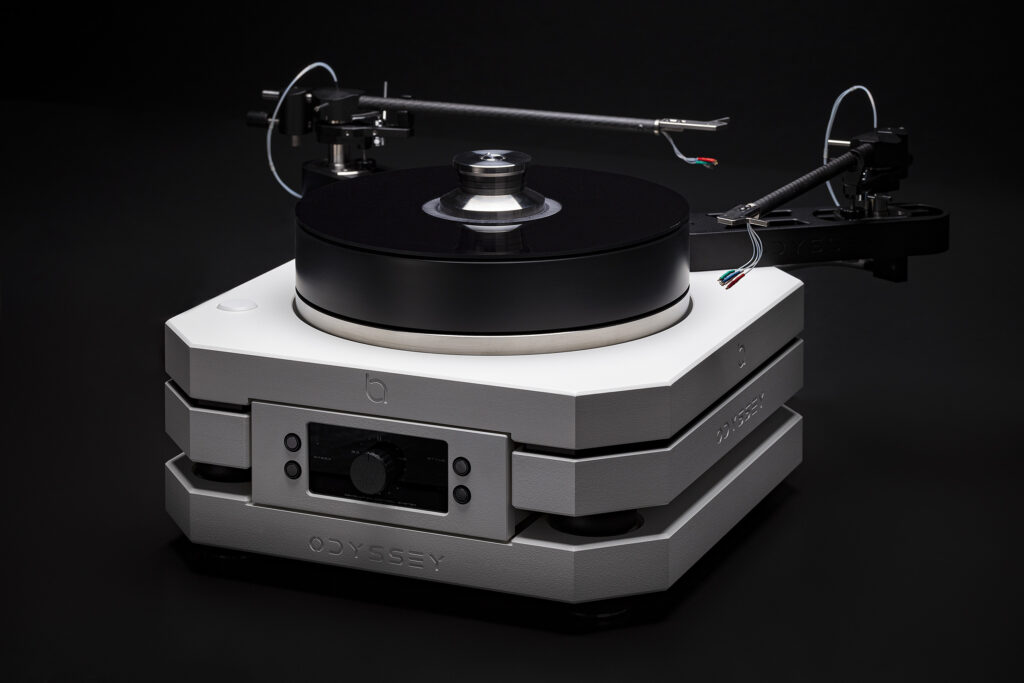
Start by leveling the bottom plinth with the included bubble level. Then, place the bearing assembly and the drive platter on top. Next, install the independent drive motor and thread the belt. Finally, place and level the top plinth. (That's at least how I do it.)
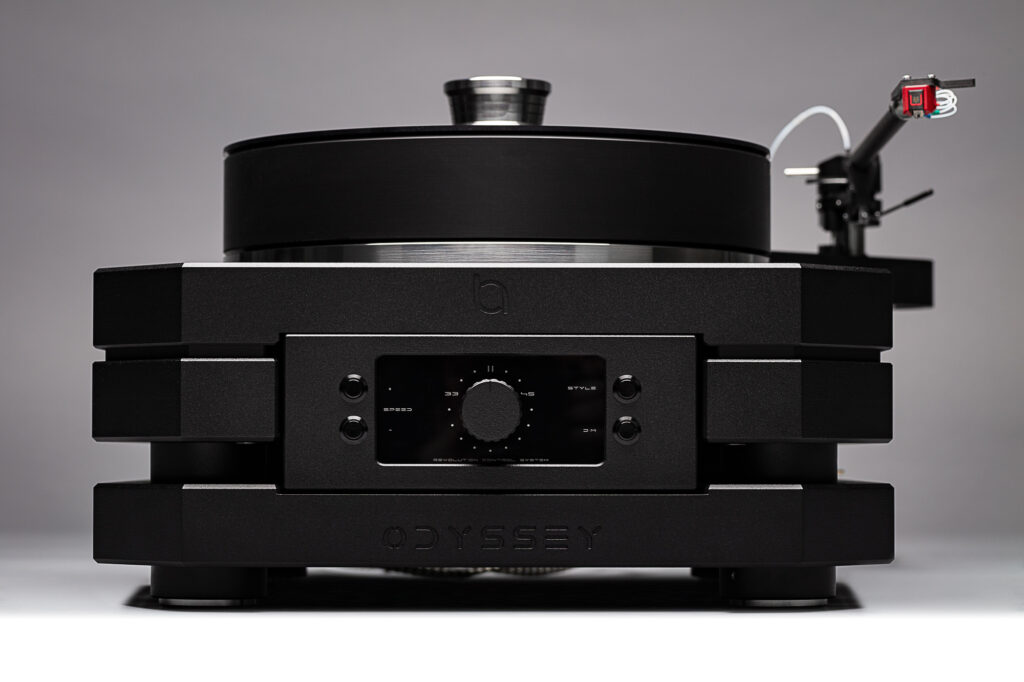
Let me explain the drive unit. It's a box that neatly slides in between the top and bottom plinths. It features a single rotating knob to select the speed and a series of buttons that operate other functions, including an array of about 14 colors for the LED readouts. Mine is always set to blue, of course, to match my room lighting scheme.
Next, place the two platters. The bottom platter is made of solid stainless steel, about an inch and a half thick. The top platter is a proprietary composite, also about the same thickness and exceptionally dense, as heavy as the bottom platter. You'll need the included lifting screw handles because the platters are half the weight of this behemoth.
Once the turntable is set up, it's time to add a tonearm or three. Yes, it can handle three tonearms. Overkill? Not even close. I prefer two, but I might eventually add a third arm for easier cartridge reviewing. So far, two has been plenty.
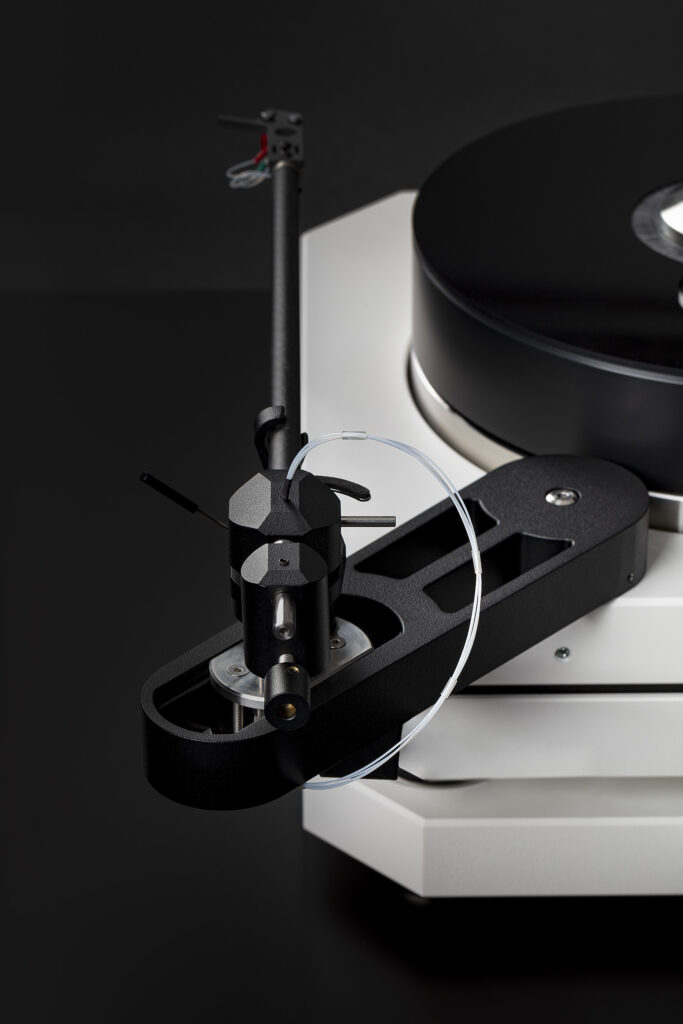
The standard tonearm for the Odyssey is a 14-inch carbon fiber arm specially designed by Thomasz for this table. I say "standard" only because it's the only tonearm for this table. That being said, it is anything but standard. The tonearm is a classic unipivot with lateral stabilization, which is the key to its uniqueness. Every unipivot user knows the pain of constantly correcting azimuth. In the BennyAudio design, this problem has been effectively eliminated, resulting in easier setup, stress-free day-to-day use, and more stable sound.
The 14-inch effective length is no mere coincidence. It's a long, ultra-rigid armwand that ensures precise transfer of mechanical energy into musical information. This design eliminates any room for shortcuts: a poorly executed 14-inch arm will sound terrible, while a properly engineered 14-inch arm with high stiffness delivers exceptional speed, clarity, and tonal balance.
The arm is crafted from stainless steel and carbon fiber. The junctions between these materials are meticulously engineered to be extremely rigid, facilitating efficient dissipation of vibrational energy from the cartridge into the arm structure. Internal damping is implemented at precisely calculated points, tailored specifically for this model.
The headshell is a proprietary Benny Audio design that decouples vertical tracking angle optimization from overhang adjustment, making fine-tuning both parameters significantly more intuitive. Signal wiring is high-purity mono-crystalline silver from Polish manufacturer Albedo. Connection is via DIN socket; a direct-wired option is also available for users who prefer this approach, though it comes with its own set of setup sensitivities. VTA adjustment is straightforward and can be performed on the fly.
Overhang and armboard positioning are straightforward, with clear geometry and user-friendly adjustment ranges. Oil damping is included as standard. The oil trough remains concealed during normal use but becomes easily accessible once the arm is lifted.
The tonearm underwent a proprietary measurement methodology analyzing vibrational behavior from 20Hz to 20kHz. This process enabled Thomasz to identify resonant modes and apply targeted, highly effective damping, directly contributing to the arm's composure, resolution, and musical coherence.
It's a beautiful piece attached to the table with a slightly teardrop-shaped mounting plate, allowing for precise adjustment of angle and proximity. You could use any high-end tonearm and dial it in perfectly in this system. But why would you? The tonearm is one of the best I've had (now I have two), and it's incredibly well-balanced and easy to dial in. Each arm comes with both a carbon fiber headshell or a titanium unit. I discovered that the carbon worked best with analytical cartridges like the Lyra. I use that headshell with it, and it slightly warms the cartridge. The titanium headshell works best with my Etsuro and Hana Urushi cartridges, giving them a slight sparkle. I imagine any Koetsu-type cartridge would benefit from the titanium. The most important thing is that you have the option as part of the standard package. I calibrated both tonearms with the complete Wally Tools setup. You also get a fantastic record clamp and a wonderful antistatic cleaning brush for your LPs! It's the complete package. The only thing I changed was to replace the standard power cord for a more upscale XLO Signature 3.
The final step is to plug in the outboard power supply and crank it up!
Here are the technical specifications:
- Model: Odyssey
- In production: 2023 (prototype), since 2024 Official
- Dimensions: 242 (H), 400 (W), 400 (D) 9.5" x 16" x 16"
- Dimensions with one tonearm: max 230mm + regular W and D
- Weight: 59 kg (without tonearm) 130 lbs
- Number of tonearms: Up to 3 tonearms (4 mounting points)
- Power supply: ULPS 12 VDC
- Rotational speed: 33.3 rpm and 45 rpm
- Wow&Flutter: IOS RPM App: 0,07% (best run)
- SHAKNSPIN MK2: DIN 0,002, WRMS 0,000 (SHAKNSPIN Database)
- Service interval: 3 years (oil refill)
So there you have the technical details, but let's get to the important part: how it all sounds!
Well, the simple answer is that it doesn't. At all. It's dead quiet with the stethoscope. Zero, zip, ziltch, niet, nada!
This table is as solid as you need. While there are undoubtedly larger and heavier turntables available (I've owned a few myself), many of them are equally quiet, visually appealing with great aesthetics, and packed with interesting features. Tables made from Unobtainium and Can'taffordium, featuring exotic fluid-filled platters, magnetic drives, laser-guided tonearms, and total automation. All these features are undoubtedly impressive and keep things fresh and innovative. However, do they truly make a significant difference in the listening experience? I've had the pleasure of listening to several of these super-exotic tables at shows like AXPONA and the MUNICH show, and I was definitely impressed. But I've yet to find anything that offers such a comprehensive package at such an affordable price as the Benny Audio Odyssey.
Moreover, introducing new, exciting, and flashy features adds a layer of complexity that increases the risk of failure. I've been drawn into that trap before and prefer a simpler approach. Besides, I absolutely adore the aesthetics of the Odyssey. When you see it in person, you're instantly aware that you're in the presence of something truly special. Everyone who's spent time listening to my system always takes the time to examine the turntable and arms thoroughly. The consensus is universal: "I want that turntable!" There's nothing wrong with making a turntable that also happens to qualify as audio art. You end up looking at it a lot. It's wonderful that it's physically so alluring.
Now, let's talk about the features. It's dead quiet, stable speed, and instantly changeable between 33 and 45. While this may not be the best choice for those with a large collection of 78 albums, I firmly believe that the vast majority of vinyl enthusiasts will be perfectly served by this table. The good news is that if you have a large collection of 78s, he can configure a 78 speed for a slight up-charge.
Using the Odyssey is a breeze. Just like any turntable, simply place the album on the table, clamp the spindle, and rotate the dial to the desired speed. Swing the arm over and drop the cueing lever, and it smoothly descends onto the record. Now, relax and enjoy the music.
The sound emanates with incredible detail and focus. Even large-scale pieces are handled with ease, while quieter passages sparkle with life and vibrancy. Low-level detail is meticulously detailed, free from smears and producing no sound staging or depth loss.
Now, let me mention some of the updates Thomasz has made since I first set up my table:
The first change is a new "anchor piece" for the tonearm mounting. These are roughly twice the mass of the originals and now come with two rubber grommets to isolate the metal-to-metal contact points. This made a noticeable improvement in detail. If I hadn't spent a year with the old setup, I'm not sure I would have ever noticed, as the original configuration was already stellar in this regard. I was certainly surprised at the difference it made. The focus improved, and the space between players is now even clearer and more defined. The background is as dark as the center of a 3000-foot deep mine. If you've never experienced absolute darkness, let me tell you, you haven't experienced it until you visit an old mine and turn off all the lights.
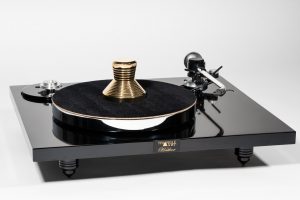
The second change is a new record clamp. This is a serious record clamp. The original was a nice, heavy clamp that anyone should be satisfied with and did the job admirably. But Thomasz isn't the "it's adequate and that's okay" kind of guy. He's always looking for improvements, and this clamp completely and thoroughly demonstrates that ethos. Made by Omicon Group, it's a little 3-pound marvel unto itself. The clamp features the cutting-edge Omicron Magic Dream energy dissipation system, which enhances the precision of your turntable's cartridge, delivering sound with exceptional accuracy and dynamic clarity compared to the baseline. It helps to produce an enriched soundstage, precise low-frequency performance, and refined micro-details that bring your vinyl collection to life.
Add to that, it's quite the looker. Crafted from premium brass and bakelite with sumptuous finishes, this clamp combines timeless aesthetics with innovative sound technology.
Buying it on the open market will set you back about $800 alone, and you get it with the table as a standard piece.
Sound? Well, in a nutshell, it doesn't have a sound, and that's a wonderful thing. It simply spins at precisely 33.3 RPM and adds nothing and takes nothing away from whatever record you place on it. In my opinion, simplicity rules. The tonearm(s) provide exactly what you want from a tonearm—rigidity, damping capabilities, and adjust-ability for VTA, as well as the ability to accept a broad array of cartridges and get the absolute most out of whatever cartridge is attached to it. The physicists and engineers can way in with way more in-depth explanations.
Listening
Chris Botti is a favorite of mine because he doesn't hog the spotlight in most of his songs. He collaborates with various guest artists and maintains a consistently high-quality core group. The jazz variety on any of his albums is extensive and dynamic. His live performances are truly exceptional.
The latest addition to my Botti collection is the Blue Note recording Chris Botti Vol.1, B00375120. One of my favorite Botti tracks is "Bewitched, Bothered and Bewildered." It features a delightful blend of sweet jazz guitar from Gilad Hekselman and Chris's superb trumpet.
From the moment I started playing this turntable, I noticed a slight improvement in the guitar's presentation. The notes were crisper, and the tone was more fleshy and smooth. While my previous setup had a similar quality, this improvement was more pronounced and defined.
It's the same cartridge, but the table and arms are different. I had previously alternated between the JNT table and the Musical Soundings tables, but neither of them produced the level of clarity and detail that came through with the Odyssey. I suppose that's to be expected considering the cost difference, but as we all know, more expensive doesn't always equate to better performance.
Joe Satriani's Flying in a Blue Dream, released in 1989 by Relativity Records (88561-1015-1), stands as one of my all-time favorite Satriani records. The title track effortlessly tops my Satriani playlist selections. This enchanting tune begins with a delicate girl's voice, accompanied by a nylon string guitar and synth. The drums and bass gradually join the ensemble, and the voice becomes remarkably clear, allowing me to comprehend its lyrics with unprecedented clarity. The snail drum hits are tighter and more pronounced, infusing the track with a subtle pop. Satriani's guitar sizzles throughout the song, while the nylon string guitar maintains a focused yet warm tone that permeates the entire track.
Mannheim Steamroller's Fresh Aire III, released on American Gramophone (365), is a captivating album. During this session, I particularly focused on "The Woods Are Alive - Morning." This soft and soothing track features wildlife sounds played against a gentle piano melody. I have always cherished this album for its softer edge and some of its more spirited tracks. On this particular track, I noticed that the animal sounds were sharper and more prominent than before. The crickets are more prominent and alive. The second side of the album seems to have a tighter and better-balanced sound. While it may not be a life-changing event, it suddenly becomes more detailed and enjoyable, as if every tiny speck of information is brought to life.
Finally, I decided to highlight Anne Bisson, one of my all-time favorite singers. I've had the pleasure of meeting her more than once, including running into her and her husband in Munich last year. I've made it a habit of looking for her at shows, buying albums, and getting them signed.
One day, I was walking through a show and, to my surprise, there they were—Anne and her husband. We instantly spotted each other and stopped to chat for a bit. I immediately mentioned that I had a $100 to spare and wanted to buy a replacement album. She said she was just singing and didn't have any money.
"Oh, too bad," I said. "Well, next time, for sure!"
Her husband, in his infinitely charming way, immediately said, "Not so fast, Gary. I have all your information. Give me that $100, and I'll ship it to you as soon as we get back home."
He took the $100 bill and handed it to me. What a salesman! About a week after the show, the album arrived. I don't know many artists who treat their fans so well.
Anne is not only a phenomenal singer, but also a truly lovely human being who always has time for her fans.
I'm not sure if it's the tonality of her voice or the ease with which she delivers the song, but there's no doubt that she has the talent. I just never get tired of listening to her. All of her albums are available on 45rpm, which sonically is preferable.
I'm also a fan of Diana Krall, but in comparison, I find Anne's vocal delivery much more enthralling. Maybe because I've listened to her speak about singing and recording, I feel it's more approachable. Whatever the case, I'll always go with Anne as my first choice for a female jazz singer.
That very album, titled Anne Bisson Keys to My Heart, released by Camilio Records (CAM5034), was the one I chose for this review. One of my favorite tracks on the album is "Where Am I Now?" It's a lively and upbeat tune that features Anne Bisson on vocals and piano, accompanied by Darek Oleskiewicz on acoustic bass and Joe LaBarbera on drums. Listening to the entire album on the Odyssey was like having Anne in the listening room with me. Her voice was incredibly smooth and romantic, almost ethereal. Her piano playing was on par with anyone else currently recording, with notes that popped with a lightness and clear attack. The bass was so alive that you could feel the flesh plucking the strings, and the sliding of notes was definitely present, but not overly pronounced. It felt more like a live performance than a recording. I'll attribute that to the Odyssey's ability to deliver every aspect of the album's groove without adding any of its own characteristics. It was simply stellar!
Suffice it to say that if I've dedicated half a year of my life working to afford and finally owning the BennyAudio Odyssey, it speaks volumes about its incredible capabilities. Mine is all black, with the engraving painted in a light blue metallic and pearl finish. Other colors are available, including silver and white, and Thomasz is reportedly working on more options.
If you're seeking the ultimate turntable to elevate your system and ensure decades of satisfaction, the Odyssey should be at the top of your list. Its performance is unparalleled, and I can't imagine anyone not being fully content for a long time.
However, if you're looking for a competitive advantage in a spitting contest with your audio buddies, spending a lot more money won't necessarily translate into a significant improvement in sound quality. As I mentioned earlier, there are turntables that cost much more and have more intricate features, but they often come with unobtainium and can'taffordium bits and pieces that don't always equal a relative improvement to the sound and add more complexity.
In my opinion, it's better to save the extra money and invest in more reference vinyl or upgrade the cartridge. That, in my view, would be a more prudent choice. You simply can't get a better bang for the buck.
Odyssey Turntable (single tonearm)
Retail: 32,900 EUR (VAT included), approximately $45,000 USD
Additional tonearm
Retail: 7,900 EUR (VAT included), approximately $10,900 USD
Please note that these prices are subject to current conversion rates and tariffs.
BennyAudio
For the most up-to-date pricing in the US, contact:
Supreme Acoustic Systems
Hiram Toro at 702.210.5382.