|
You are reading the older HTML site
Positive Feedback ISSUE 56
Ask Dr. Digital…
From time to time, Positive Feedback's Dr. Digital will attempt to answer your questions regarding life, the universe, and all that, as well as matters relating to the arcane of digital audio. He may also wax prolix on whatever interests him at the moment. Be warned that you may not like the answers, but at least they'll be authoritative and based upon solid, scientific evidence, at least some of the time. Shane, Las Vegas: Why would anyone want to spend more than $300 on a USB DAC? My HRT MusicStreamer+ really does it for me. Dr. Digital: I'm sorry to hear that, actually. But at least you're asking a question, and being sincere in communicating your experiences, rather than trumpeting your... well, never mind. Why spend more? Well, think for a moment about how much the MusicStreamer+ costs: just $299. In order to stay in business, the manufacturer has to pay the designer, buy all the parts, assemble them, test it, put it in a box, create a reserve for warranty returns and customer service, etc., all on a budget of maybe $70. Building entry-level gear in modest volumes is no way to get rich. So what do you get with USB DACs that cost $1000 or more? Well, in short, a lot more of what you want, and a lot less of what you don't. With a budget of $250, designers can afford higher quality parts and construction techniques (thicker circuit boards, heftier power supply capacitors, for example) that are simply out of the question at the lower price points. In most cases, for four times the price, the more expensive DAC generally do sound way better than the less-expensive products. Sure, the really inexpensive inline USB DACS are simple, compact, easy-to-use and reliable—all good points—but sound-wise, they leave a lot to be desired: Even on my modest office system with its KRK Rokit 8 powered monitors, the MusicStreamer+ has a muffled, rolled off, wooly, sound, and seems plagued by a variety of colorations and distortions. There's a flatness to the presentation front-to-back, and little sense of dimensionality in the images. The mid-range DACs instead often have decent soundstaging, more natural timbres, and don't sound congested. Shane: But from the reviews I've read, most of these more expensive DACs all measure pretty much the same, and not that differently than the MusicStreamer. What's the deal? Dr. Digital: You bring up a very interesting and valid point: some basic parameters, such as frequency response, these days most DACs do tend to measure pretty much the same. Just look carefully at the Y axis on some of the performance charts: It's quantized in just tenths of a dB. And the graph itself is flatter than a pancake, to use a technical term. Even the MusicStreamer is quite flat in this regard, until heading slightly south at 10kHz, although it's apparently only down 1dB at 20kHz. If you've got the ears of a Frank Zappa or a Keith Johnson, you'll hear that kind of difference in the mix; most other mortals probably won't. So if relatively routine measurements, developed during the analog-only days, aren't all that differentiating, what should one look at instead? To simplify things a bit, USB DACs have a more-or-less digital input section, and an analog output section that drives the amps. On the digital side of things, jitter in all its forms is the name of the game. In addition to hard-to-remove random jitter, there's deterministic jitter that can usually be tracked down to issues in the design or external influences, and most exotic of all, data-pattern jitter which, incredibly enough, is generated by particular arrangements of bits in the digital music stream. Deterministic and data-pattern jitter in the digital section tend to create discrete modulation artifacts, or spurs, that are usually symmetric around a given frequency. Random jitter, if broadband, simply raises the noise floor evenly, and in this sense, is relatively benign.
To investigate the sensitivity of a design to data-pattern jitter, all one has to do is create, in software, bit sequences that may drive the electronics into a state of distraction: Changing bits in certain sequences and patterns may do nasty things to the power supplies, induce crosstalk and generate a host of other artifacts. The late Julian Dunn developed what he called a J-test AES3 test signal that stimulates jitter in a device. This "probe" doesn't contain or inject jitter itself, rather it creates a stressful influence which might in turn generate jitter. Basically the J-test gives everything a good shaking, and one waits at the analog outputs with a spectrum analyzer to see whether the gear gets flustered, or shrugs off the insult and moves on. For our purposes, the new Audio Precision APx 515 audio analyzer is particularly well-suited: In a moment, one can visualize an entire suite of parameters derived from both analogue waveforms (voltage versus time) as well as computed spectra (amplitude relative to full scale, against frequency). Because the APx 515 uses a personal computer for its user interface, one can arrange the resulting graphs and charts on dual 1920 x 1080 monitors and immediately get a comprehensive picture of what's going on. And it's always reassuring to see results that agree to 3 decimal places to their expected values. To put it mildly, making such measurements wasn't always this easy.
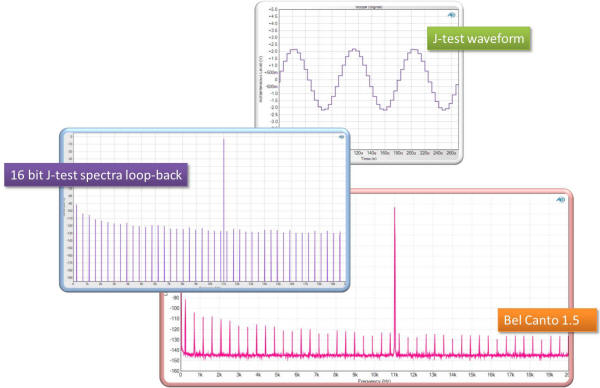
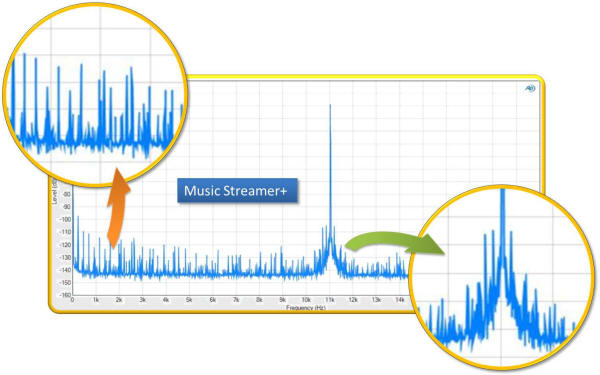
The J-test signal comprises two main components: This first is a primary frequency that's ¼ the sampling rate, which works out to 11,025Hz for 44.1kHz, or 12,000Hz for 48kHz. This tone is a square wave, whose hexadecimal values are C00000 and 400000 (- 0.5 full scale, + 0.5 full scale respectively). The second tone is created by periodically flipping the least significant bit or LSB, which in turn generates a large number of markers spaced roughly every 460 or 500Hz across the spectrum. Because the MusicStreamer is a 16-bit device, we'll use the 11,025Hz J-test at 44.1kHz. Notice when the J-test is "looped back" inside the Audio Precision, the spikes are perfectly clean, and between them, the spectral values are precisely zero. Running this same signal through John Stronczer's $1395 Bel Canto 1.5 USB DAC—one of my favorites with respect to its refined user experience—notice that there's very little noise between the spikes. According to John, the results are pretty much "textbook" and what's between the spikes is simply the -148dB "real world" analogue noise floor replacing the "perfect" noise floor of the pure digital "loopback" J-test visualization. At least for the kinds of data patterns generated by our J-test signals, the Bel Canto simply goes its merry way without generating much of anything that shouldn't be there. In the case of the $299 MusicStreamer, under the same circumstances, it's apparent that it really doesn't like the J-test jitter stimulator probe. There's a lot of "grass" growing between the markers. While the amplitude is well below the practical noise floor for 16 bits of roughly -96dB, if one were to integrate the jitter associated with all these extraneous spikes, the total noise created could be substantial. Looking around the 11,025Hz carrier, notice how its base is considerably spread out compared to the same signal on the Bel Canto. This widening is probably the result of low-frequency phase noise and is definitely not supposed to be there.
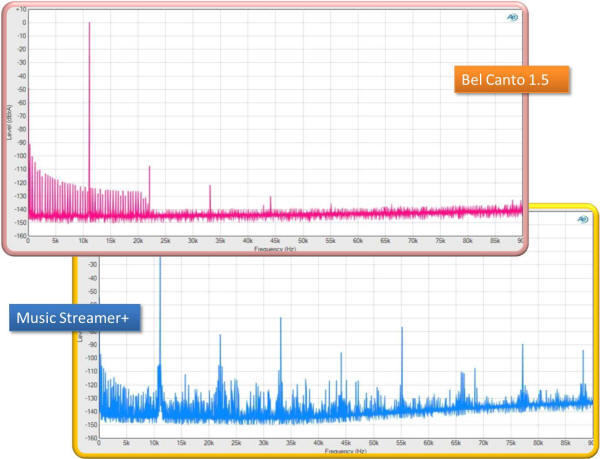
Looking at a broader spectral window, the "wake" of the 11,025 Hz stimulus is limited in the case of the DAC 1.5, but the MusicStreamer has all kinds of noise going out to the bandwidth limit of the spectrum analyzer. These days, with the DC-to-light frequency response of many preamplifiers and amplifiers, introducing all this noise, even at low amplitudes, is highly undesirable. Next question… Mark Messer, Brooklyn, NY: Is it true that elephants have very sensitive hearing, and are aware of sounds way below 20Hz? Dr. Digital. Oh, brother. What a dumb question. Has it ever occurred to you to examine an elephant's external ears, or pinnae as learned folk would say? Did you notice anything? No? Just as I thought. Well, they're actually about 16 square feet in area. What brilliant conclusion can you draw from this observation? Yes, I know all about "what beautiful ears you have, my dear" and that female elephants can wiggle and ripple their ears in ways that bulls find absolutely irresistible, but that's not the point. Let me put it in a way that even you might understand. If you made gigantic sonic reflectors and placed them behind your ears, what do you think would happen? Yes, if a cockroach burped in the house next door, you'd hear it. Back in the 60's, a possibly latently suicidal National Geographic team set up an ultra-low-frequency sound system in the middle of some God-forsaken scrub in Africa, and within minutes, well, lots of minutes, the place was jam-packed with curious and slightly confused pachyderms. One several-ton bull steamed in from the North, and given the non-directional nature of low-frequency sound, marched right by the tower and headed off towards the opposite horizon. Fortunately the researchers folded up shop for the night, before the bull figured out he'd been had and returned to flatten the camp. The rich harmonic structure of elephant vocalizations apparently may even allow estimation of distance. These beasts can really belt out the blues, with their loudest bellowing topping the scales at a skull-crushing 112dB. Under ideal circumstances, for example an atmospheric temperature inversion, elephants can apparently hear sounds from five or six miles away. Frequencies, down around 10 or 15Hz, are apparently audible, and may also be detected through vibration sensors in the elephant's trunk and feet. Males rumble and grumble starting from around 12Hz, females around 13Hz, and relatively squeaky-voiced calves vocalize at 22Hz and above; however, some of the frequency components go as low as 5Hz! Now you know. Be sure to tune in next time for another tour Dr. Digital through the wild world of audio phenomena. You'll probably learn something, although whether it's useful or not is another matter entirely.
|