|
You are reading the older HTML site
Positive Feedback
ISSUE
57
Building a Digital Music Server, The Final
Epilog: Everything Comes Together (with Thoughts About the Future)
"Maybe get a blister on your little finger –Dire Straits, "Money for Nothing" I have to admit, I was getting dismayed with my $11,000 dCS Debussy; it was sounding awfully bright and dCS was taking forever to support 24/192 resolution recordings through the USB and S/PDIF inputs, although you could get it with the right sound card, dual-wire AES-EBU, and a master clock… in other words, a lot more money. When I heard the combination of the original Sonicweld Diverter and the Rega DAC, I realized that despite its own limitations and the enormous difference in cost, the Diverter/Rega combination sounded more musical. I still use it in my home office system although I've switched to an Audiophilleo 1 in that system because it's the best USB to S/PDIF converter I know of for under $1000, and it supports all resolutions up to 24/192. Besides, I gave my friend Nick the original Diverter. That, with the power cable adapter so I can use my Stealth Swift loom power cable system with the Rega DAC and the original Locus Design Axis USB cable, Core S/PDIF cable, and Vision analog interconnects, provide a gently open but beefy sound that nicely matches the rest of the equipment in the system… including a Rega P3-24 with an outboard power supply and a Tri TRV-CD4SE 24bit, 192kHz upsampling CD player. So in summary, for about the same total cost of the Ayre QB-9, you get better bass, a more tube-like sound and the advantage of an S/PDIF input on the Rega DAC. But I digress.
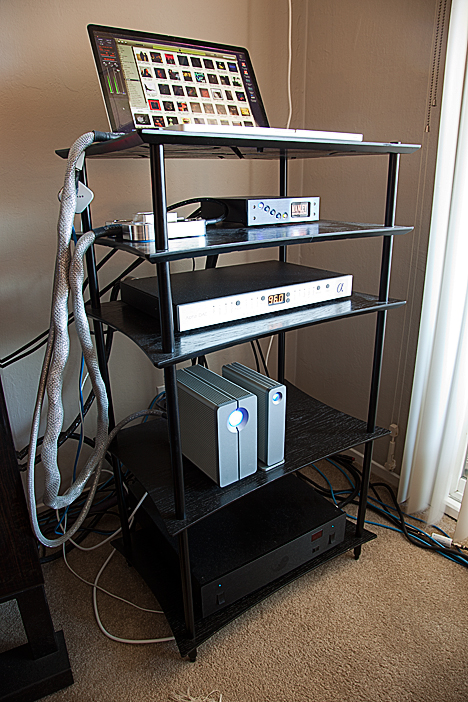
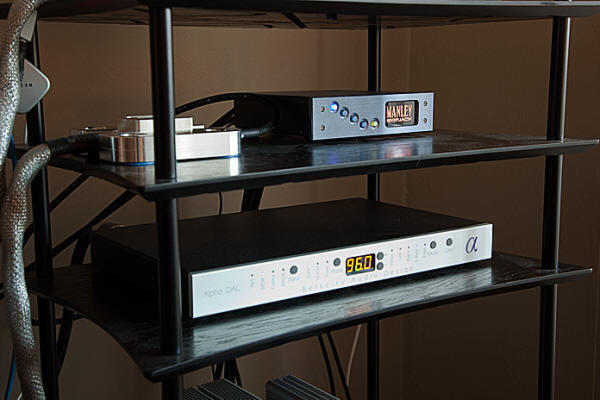
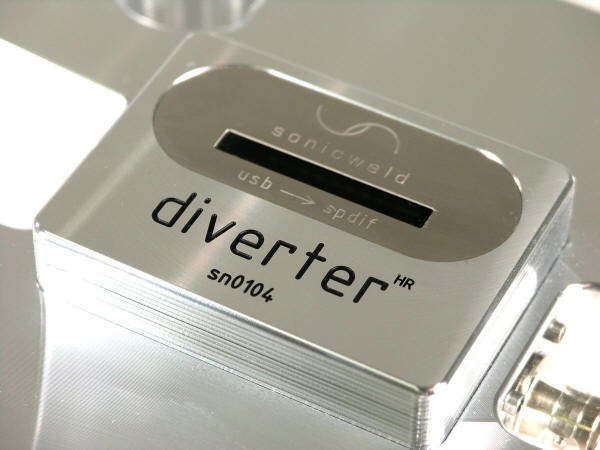
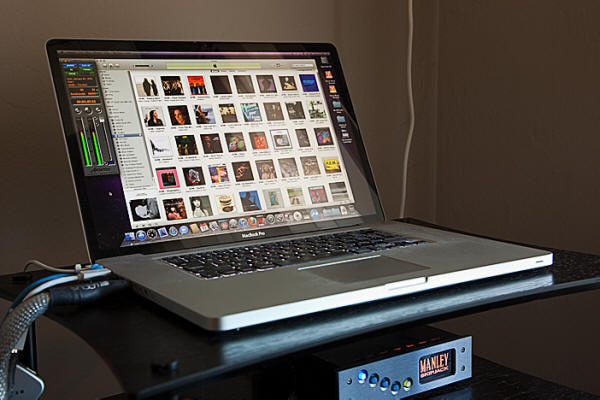
Having gotten fed up with the overly resolute sound of the Debussy, I will admit that I sold it and called Music Lover's Audio in Berkeley explaining that I wanted something with a warmer and more tube-like sound, but with a decent amount of resolution. They instantly suggested the Berkeley Audio Design Alpha DAC, sometimes affectionately referred to as the BADA, so I ordered one sound unheard. This was after chatting with my favorite audio salesperson, Toan Pham, who assured me that I would be very happy with the Alpha, and that despite its much more reasonable price tag ($5000), it fell into the category of a reference DAC. Well, after several weeks—because they build these things by hand—my BADA arrived. I hooked it up to the digital music server with my 17" MacBook Pro, the Locus Design Cynosure v2 USB cable (the "v2" being important), the original Sonicweld Diverter, a Locus Design Core S/PDIF cable with BNC's soldered to both ends, the BADA, and my favorite interconnects of all time for digital applications, the $5450 Locus Design Parables, not to mention the Locus Design Keynote power cables I use throughout the digital music server. In truth, I got nothing less than magic. The BADA should clearly be priced closer to $15,000, and I can't think of a single DAC I've heard that's better, except maybe (well probably) my Audio Note DAC 4.1 Balanced, which is wonderful with all its NOS tubes… but unfortunately it only supports CD resolution files. The digital music server sounded so good, I started to adopt the old software developer's adage, "If it's not broken, don't fix it;" but I'd had the Sonicweld Diverter 192—now dubbed the Sonicweld Diverter HR for "High Resolution"—on order since last November (I waited largely because I wanted to play 88.2, 176.4 and 192kHz files). Imagine my surprise when the HR arrived, and not only does it increase my functionality, it makes everything sound better; although it was a little bright right out of the box. Within a few hours of use, it had started burning in nicely and I started to wonder where they had hidden the miniature tubes. I became so obsessed with the excellence of sound that I fell to sleep at 4:00AM listening to "Jamm" by Cheikh lo through my Audez'e LCD-2's with the ALO Audio Reference 8 balanced cable plugged into my Woo 2 with all the premium tubes and its lovely warm sound, the combination nicely favoring percussion. Now "Jamm" was just imported from the CD and stored in Apple Lossless compression. But the Diverter HR/Alpha combination with all the Locus Design cables sounded so good at all resolutions I could actually call it the equal of my CD player (a CEC TL-0 transport with an Audio Note Pallas S/PDIF cable and my Audio Note DAC 4.1 Balanced) with the advantage of (a) being able to create custom playlists and (b) the ability to be "Remote Controlled" from my iPad 2, which is particularly handy late at night with the headphones on, more commonly a pair of Sennheiser HD800's with the Woo 22. Listening to Allison Krauss and Union Station's "Paper Airplane" on a 24/96 download from HDtracks, CD and vinyl, it's as if I get progressively farther away from the instruments and the performers as I move from one medium to the other. They all sound wonderful, equal in every sense of the word; but with the digital music server I am sitting center stage, front row, whereas with the CD I am sitting a few rows back and—initially—the vinyl sounded like I was up in the balcony near the rafters. Of course there's the issue of getting things to play at the same level, and when I cranked the volume up on the Meishu, I felt much closer to the performers with the vinyl. So at some point I'll take an SPL meter and try to find a way to make a small, erasable mark in neatly sharpened No. 2 pencil on the front of the Meishu for the ideal volume for each medium; but of course each recording is different and the 24/96 download, CD and LP don't come with test tones and aren't guaranteed to be mastered in exactly the same fashion; in fact, I have found a preference for certain sites (Linn and the B&W Society of Sound) because of the consistency of mastering, and consistently high quality of the recordings I get, generally at 24/88.2, 96 or 192 for the Linn "Studio Master FLAC" format or at 24/44.1 or more commonly 24/48 for the B&W Society of Sound. HDtracks is kind of all over the place and doesn't appear to do any mastering of their own, but is more a portal for various labels each of which has its own techniques and standards. So I'm glad that they exist, because they provide a valuable and previously missing service; however, when I write to their technical support about gaps in odd places in recordings, and they respond by wanting the exact minute and second into the track where each gap occurs, I have to say, "Come on guys, just listen to your recordings and do something to earn your seventeen dollars besides put a high resolution file in the metaphorical record bin."
Now let's talk about very high-resolution recordings, and how much 24/192 makes a difference over Apple Lossless Compression. First, there's no doubt that at all resolutions, the Diverter HR sounds better than the original Diverter, and in that sense is well worth the $2888 it costs, even with a less expensive S/PDIF DAC. Having said that, there's no doubt that—all other things being equal—higher resolution recordings tend to sound more open, natural, and LP-like than their lower resolution counterparts. I can't emphasize this enough; the quality of the original recording, and the care in mastering, and transfer to whatever resolution is chosen for delivery, has the greatest effect on sound. So take Linn as an example; I have three recordings from them, "All My Sins" by Maeve O'Boyle at 24/88.2, "Highwire" by Dawn Langstroth at 24/96, and "John Ward: consort music for five and six viols", by Phantasm at 24/192, all of which sound wonderful and the Maeve O'Boyle at 24/88.2 sounds better than "So Beautiful or So What" by Paul Simon at 24/96—not to disparage Paul Simon's fine recording—but "Paper Airplane" by Allison Krauss and Union Station at 24/96 sounds quite wonderful. So all I'm saying—and I don't mean to hammer hard on HDtracks because they provide a valuable, cutting-edge service—is to consider the source. Some of the best sounding and most interesting recordings I have came from the B&W Society of Sound at 24/48. So, to put it short, trust your ears and don't get caught up in numbers. In my own experience making recordings with a pair of Schoeps microphones, an Apogee Duet, and a 17" MacBook Pro with an SSD (Solid State Drive), I can say with confidence that getting from 16 to 24 bits makes the biggest difference in sound, and I generally find the 24/48 is more than adequate for my own recordings. I will say, however, that one fantastic sounding, musically engaging recording from Linn, is the 24/192 download of "Other Love Songs" by the Prince Consort. Again, trust your ears. Both the Sonicweld Diverter HR and the Berkeley Audio Design Alpha DAC exude quality; the Diverter has a small alphanumeric display that indicates the current sampling rate in the form, "192kHz"; however, the letters are very pretty, as if someone has actually taken time to think about the out of box experience. The Alpha DAC has a similarly understated elegance; and in both cases, they do what they're supposed to and they do it well, no exceptions. I have not had a single problem since I plugged the original Diverter, nor the Diverter HR into the Alpha (knock on wood), and the only change that I have noticed is that while each sounds great right out of that box, each moment makes them mature like a fine wine getting ever more palpable, warm, and tube-like. In fact, sitting here listening to "Other Love Songs" by the Prince Consort through the Sonicweld Diverter HR, I feel quite certain that musically—in form if not in fact—this is the closest to vinyl I have heard any digital playback system get.
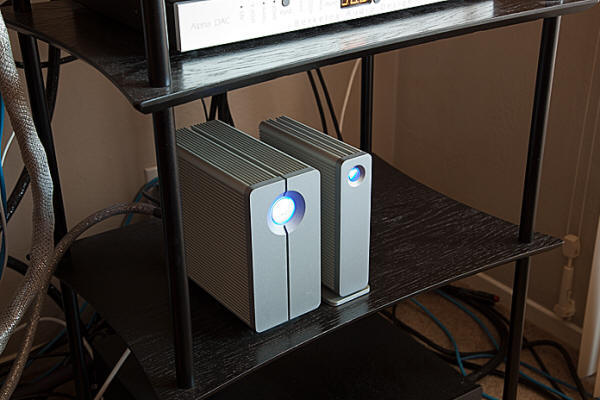
My main concern is preserving my music. As nice as it is to have a complete collection on an effective 1TB of RAID 1 mirrored storage, it's also quite frightening to think that an electromagnetic burst or a savvy thief could wipe out my entire collection by jamming my LaCie RAID 1 drive under his or her left arm; and I can only hope that he or she has the good graces to leave my LaCie backup drive in place so I can restore the music that gets backed up nightly via SilverKeeper. Cloud storage—though an optimal long-term solution—is not really a good option now; so what do I need? I need another backup drive and a safe deposit box. Yep, it's that important to preserve my music. I think, apart from the Core v2 S/PDIF cable and the possibility of transitioning from a MacBook Pro (the machine of choice two years ago) to a Mac Mini or a Mac Pro, my advanced digital music server is pretty much done. I will continue to write about tweaks and progress as they occur in a new series tentatively entitled, "Musings on Building a Digital Music Server"; but for now, I just want to listen to the music. I have noticed, on the office system, that when I have a lot of applications running—even though I have an SSD boot drive and 2TB magnetic data drive internal to the machine—that I start getting skipping on some 24/192 recordings. Perhaps I need to increase some buffer size (note: updating the firmware in my Audiophilleo 1 did much to resolve this issue); the real solution is probably to put the music on its own external drive and back it up nightly with SilverKeeper, or to always play from RAM (see the next paragraph). For now, it's a minor annoyance and potential proof of concept that it really does make sense to keep one's music separate.
I should say that while processor power does not seem particularly important, the type of storage media from which the musical data streams makes a tremendous difference in the softness and suppleness of the sound, so much so that I have come to assume that unless I'm playing internet radio or a very, very long playlist as background music, I use the "CACHE" feature of Amarra to play all of my music from RAM. This also solves the skipping problem. You can do the same thing with Pure Music. Right now, I'm listening to the HDtracks 24/176.4 download of Rebecca Pidgeon's "The Raven" and their 24/192 download of Linda Ronstadt's "What's New", from RAM, and it's really extraordinary how close it sounds to an analog master tape running at 15 inches per second. I think a lot of people don't realize that; and as we move more towards flash memory and solid-state drives for music playback, it will become less of an issue. For now, take those extra few steps necessary to load your album into a playlist, up the number of tracks in Amarra's preferences to as many as you can, and dedicate as much RAM as you can (I set mine to 4 out of a total of 8GB). It really makes a huge difference. Not doing so can lead to a brilliance that may sound like more resolution because it's bright, but in fact is nothing neither more nor less than high-frequency distortion caused by streaming directly from a physical drive. Sitting with my MacBook Air in the sweet spot between my Audio Note AN-E's, listening to Pidgeon's beautiful voice just soar, I wonder why anyone would want to flip 45RPM vinyl every ten minutes. I really do; maybe they want a blister on their thumbs. So Nick, whom I mentioned earlier, and his cohort Lee (not the late Lee Weiland at Locus Design) came by to hear the system. First, they agreed that the Berkeley Audio Design Alpha is much better sounding than the dCS Debussy but that there was still a certain ringing to the high-frequencies that bothered them, so we connected the Diverter HR directly to my Audio Note DAC 4.1X and all of a sudden the problems went away. Nick's exact words were, "The Sonicweld Diverter HR is great." It really made my 17" MacBook Pro sound just like a CEC TL-0. Now the question is, would the Kondo Sound Labs KSL-LP or the Parables better serve the Alpha? I did a comparison awhile back, which Nick offered to repeat, and came to the conclusion that the Parables damped the very "ringing" that they were complaining about better. Of course the solution is for Audio Note to come out with a 24/192 DAC.I got curious enough after they left that I decided to hook the KSL-LP's in place of the Parables one last time and after going back and forth came to the conclusion that much of the high frequency "rattle" that they heard was actually being caused some interaction with the Parables. The last time I listened, the KSL-LP's sounded muddy by comparison, and the Parables had more layers; however, there's no doubt that—using the CEC TL-0 and Audio Note DAC 4.1 Balanced as a point of comparison—the Berkeley Audio Design Alpha DAC sounds that much better and that much closer to the Audio Note DAC 4.1 Balanced when I used the KSL-LP's over the Parables. The Alpha is a very fine DAC, much closer to the AN DAC 4.1 Balanced than I had imagined. This is not meant to disparage the very fine sounding Parables; it's all a matter of synergy and in this particular case, with the Sonicweld Diverter HR, the Kondo's nosed just past the Parables; however, both are very fine cables and I can see how, in a couple of weeks, I might return to the Parables. We're talking about fine-tuning and I consider myself lucky that I can go back and forth on a whim. Kindest regards, Andy
|